Choose your running week first, then the watch
Choosing a watch can easily become twenty open product pages and numbers that are hard to compare. Yet an urban jogger, a marathon trainee and a long mountain racer want to solve different problems. The first may value comfortable recording and a manageable training week; the second, handling workout sections and predictable race-day use; the third, prepared navigation, long endurance and buttons usable with gloves. Start there before treating every promise of a more expensive model as your own need.
This selector is an editorial comparison based on manufacturer product pages and manuals checked on 21 November 2026. It is not our own laboratory or wear test, nor a ranking of every existing watch. It leads to detailed articles on 25 specific models. No scores are invented: phone requirements, display, navigation, measurement functions, named battery modes and service layers appear in the same order. Where a source contradicts itself or lacks a comparable duration, we indicate that too.
Write down three real tasks from the coming month: Tuesday intervals, a two-hour Saturday route and a weekend race, for example. Beside each, note what you want to see and press. Do you need a preloaded workout, an audible interval-end alert or a readable map? Is a phone log afterwards enough? This short requirements list helps distinguish useful features from merely interesting catalogue data.
Phone and account: the first real filter
The current Apple Watch Series 12, Ultra 4 and SE 3 requirements are iPhone 11 or later, or iPhone SE second generation or later, with iOS 27 or later. Bluetooth alone does not make a watch pair with Android. Samsung Watch9 and Ultra2 instead require supported Android phones; current model specifications give Android 13 and Google Mobile Services requirements, and iPhone is not an alternative setup path. Health Monitor functions tied to Galaxy phones, age and country add conditions beyond installing general Samsung Health.
Garmin, COROS, Polar, Suunto and Amazfit may support both Android and iPhone, but the particular app’s current system requirements still apply. Some Amazfit pages list iOS 14 while the current Hungarian Zepp store listing requires iOS 15. With an older phone, check both store installation availability and the model page. Pairing, notifications and replying are different compatibility questions.
Specify separately whether you want standalone run recording or calls without a phone. Independent GPS recording generally needs no mobile subscription, whereas wrist-based calls may require an LTE version, supported network and suitable plan. Do not infer Hungarian availability from a satellite or cellular feature’s name. Before changing phones, check your ecosystem’s backup and transfer process before removing the old pairing.
Reading the model matrix
Every row links to a detailed model article. Display identifies technology or the specific product-page description, rather than subjective attractiveness. Navigation is separate because following a route line differs from navigating a downloaded background map. The measurement column is a brief guide: check complete conditions for every extra in the detailed article. A named battery mode is inseparable from its duration.
Manufacturer maxima are not our own field measurements, and brands use different test procedures. We have not filled missing comparable figures with hours calculated from battery capacity. The detailed fēnix 9 Pro article covers several case and display versions; narrow your choice to the one you would buy. On smaller screens, read the table horizontally too, so service conditions are not missed.
| Model and detailed article | Phone | Display | Navigation | Heart rate and extra measurements | Battery: named manufacturer mode | Service conditions |
|---|---|---|---|---|---|---|
| Garmin Forerunner 970 | Connect: supported Android/iPhone | AMOLED | Built-in maps | PPG; running economy and step speed loss require HRM 600 | 26 h GPS Only; 21 h All + Multi-Band | Basic log plus optional Connect+ |
| Garmin Forerunner 570 | Connect: supported Android/iPhone | AMOLED, two case sizes | Route following; not the 970’s mapping system | PPG; not the 970’s full extra-metric set | 18 h GPS Only, 42 and 47 mm | Basic log plus optional Connect+ |
| Garmin Forerunner 165 / Music | Connect: supported Android/iPhone | AMOLED | Courses routes; not a full background map | Wrist heart rate, running power and dynamics | 19 h GPS mode; music has separate consumption | Music version and music service are separate |
| Garmin fēnix 9 Pro | Connect: supported Android/iPhone | Depends on Pro version; AMOLED and solar versions are separate | Map-based navigation | PPG; extra sensors and functions depend on model | Check case size, display and GNSS mode together | inReach version only: communication with an active plan and regional conditions |
| Garmin Instinct 3 AMOLED | Connect: supported Android/iPhone | AMOLED; different from the Solar range | Routes; do not automatically expect fēnix maps | Wrist PPG and outdoor sensors | GPS only: 45 mm 32 h, 50 mm 40 h | Basic log; Connect+ is a separate layer |
| Apple Watch Series 12 | iPhone 11 or later, also SE second generation onwards; iOS 27+ | Always-On Retina OLED | Apple Maps and region-dependent offline options | Heart rate; ECG app with eligibility conditions | 10 h workout tracking; not 24 h mixed use | Workout included; Fitness+ and cellular separate |
| Apple Watch Ultra 4 | iPhone 11 or later, also SE second generation onwards; iOS 27+ | Always-On Retina OLED | Maps, compass, Backtrack; regional conditions | Heart rate; ECG with conditions; separate Action button | 18 h workout tracking; Extended mode has another measurement profile | Cellular and some services have separate conditions |
| Apple Watch SE 3 | iPhone 11 or later, also SE second generation onwards; iOS 27+ | Always-On Retina OLED | Maps and Backtrack; not every regional map layer | Heart rate; not the Series 12 ECG feature set | 7 h workout tracking; 18 h normal use is different | Workout included; optional apps and cellular |
| Samsung Galaxy Watch9 | Android 13+, GMS; RAM requirement; no iPhone | Super AMOLED, depending on case size | Depends on chosen navigation app and supported feature | BioActive; Health Monitor has Galaxy/region/age conditions | 40/44 mm, AOD, GNSS and power mode are separate | Basic Samsung Health; LTE/apps separate |
| Samsung Galaxy Watch Ultra2 | Android 13+, GMS; no iPhone | Super AMOLED | Trail functions; check the route task separately | BioActive; algorithmic sweat-loss estimate | 800 mAh capacity does not mean 800 hours | Check Health Monitor and cellular conditions separately |
| COROS PACE 4 | Supported Android/iPhone and COROS app | 1.2-inch AMOLED | Global landscape and topographic maps | Optical heart rate; compatible accessory separate | 41 h All Systems / High; 31 h Dual Frequency / Max | Basic COROS system; external service separate |
| COROS PACE 4 Pro | Supported Android/iPhone and COROS app | 1.47-inch AMOLED | Global maps; hardware differs from PACE 4 | Optical heart rate; Pro is not a diagnosis | 60 h All Systems / High; 40 h Dual Frequency / Max | Basic COROS system; external service separate |
| COROS APEX 4 | Supported Android/iPhone and COROS app | Third-generation MIP | Landscape/topography, street and trail names | Heart rate and elevation; geared towards mountain tasks | 42 mm 41 h / 46 mm 65 h: Endurance Satellite Mode 1 | Basic COROS system; two sizes do not share one battery figure |
| COROS VERTIX 2S | Supported Android/iPhone and COROS app | 1.4-inch always-visible display | Offline maps and route guidance | Optical heart rate; try the watch’s weight too | 118 h Standard GPS; 43 h Dual Frequency / Max | Basic COROS system; accessories separate |
| Polar Vantage V3 | Supported Android/iPhone; Flow web too | AMOLED | Offline maps | Elixir PPG; wrist ECG for sport, not diagnosis | 42 h Performance training in the current technical table | Basic Flow features; external route service separate |
| Polar Vantage M3 | Supported Android/iPhone; Flow web too | AMOLED | Offline maps, more compact design | Elixir PPG and sport-focused wrist ECG | Technical table: 27 h Performance; a different 30 h appears below | Basic Flow features; clarify source contradiction before buying |
| Polar Grit X2 Pro | Supported Android/iPhone; Flow web too | AMOLED, sapphire | Offline maps | Elixir PPG and sport-focused wrist ECG | 40 h Performance training in the technical table | Basic Flow features; Titan does not automatically mean a new feature system |
| Polar Street X | Supported Android/iPhone; Flow web too | 1.28-inch AMOLED | Route guidance and breadcrumb; not an offline map library | PPG; ECG and SpO2 absent from specification | 42 h Performance training; Eco is another profile | Basic Flow features; LED does not replace a headlamp |
| Suunto Run 2 | Supported Android/iPhone and Suunto app | AMOLED | Offline maps; check 4/64 GB versions separately | Heart rate and running data; not the old Run specification | 24 h High Performance in the Run 2 comparison | Basic app and maps; partner package separate |
| Suunto Race 3S | Supported Android/iPhone and Suunto app | 1.32-inch AMOLED | Free global offline maps; 64 GB | Heart rate; AI Coach has separate service conditions | 38 h dual-band GPS; 45 h Endurance is another profile | AI Coach may require payment after introductory access |
| Suunto Race 2 | Supported Android/iPhone and Suunto app | AMOLED | Offline maps and route following | Heart rate and training analysis; check external strap compatibility | 55 h high-performance GPS in manufacturer comparison | Basic Suunto system; partner and AI services separate |
| Suunto Vertical 2 | Supported Android/iPhone and Suunto app | AMOLED | Offline maps and long trail tasks | Heart rate; LED light and physical buttons | 65 h high-performance GPS in manufacturer comparison | Basic Suunto system; service offerings can change |
| Amazfit Cheetah 2 Pro | Zepp: Android/iPhone; check current app minimum | 1.32-inch AMOLED | Downloadable offline contour maps and rerouting | BioTracker PPG; running metrics are not medical tests | 31 h Accurate GPS; 26 h GPS + AOD; 15 h GPS + music | Zepp Coach and Aura are different services |
| Amazfit Balance 3 | Zepp: Android/iPhone; specific regional version | AMOLED; do not mix Stainless Steel/Titanium specifications | Mapping and route tasks depend on the specific version | BioTracker; HybridCharge combined load model | US specification examined: 41 h Accuracy GPS, AOD off | Basic Zepp log; Aura and other services separate |
| Amazfit Active 3 Premium | Zepp: Android/iPhone; iOS app minimum is separate | 1.32-inch AMOLED | Offline maps, POI, routes and rerouting | BioTracker PPG; load and running data | 24 h Continuous GPS; 76 h power-saving mode has another profile | Basic Zepp Coach and optional services separate |
 Enlarge image
AMOLED, OLED, MIP and actual readability
AMOLED and Apple’s OLED-based Retina display can offer striking contrast and colourful maps. Always-on display is a separate battery condition from a screen briefly waking with a wrist raise. COROS PACE 4 and PACE 4 Pro use AMOLED, while the current APEX 4 page specifies third-generation MIP. Do not overwrite that because many newer models from the brand use AMOLED. Instinct 3 AMOLED and Solar are different display ranges too.
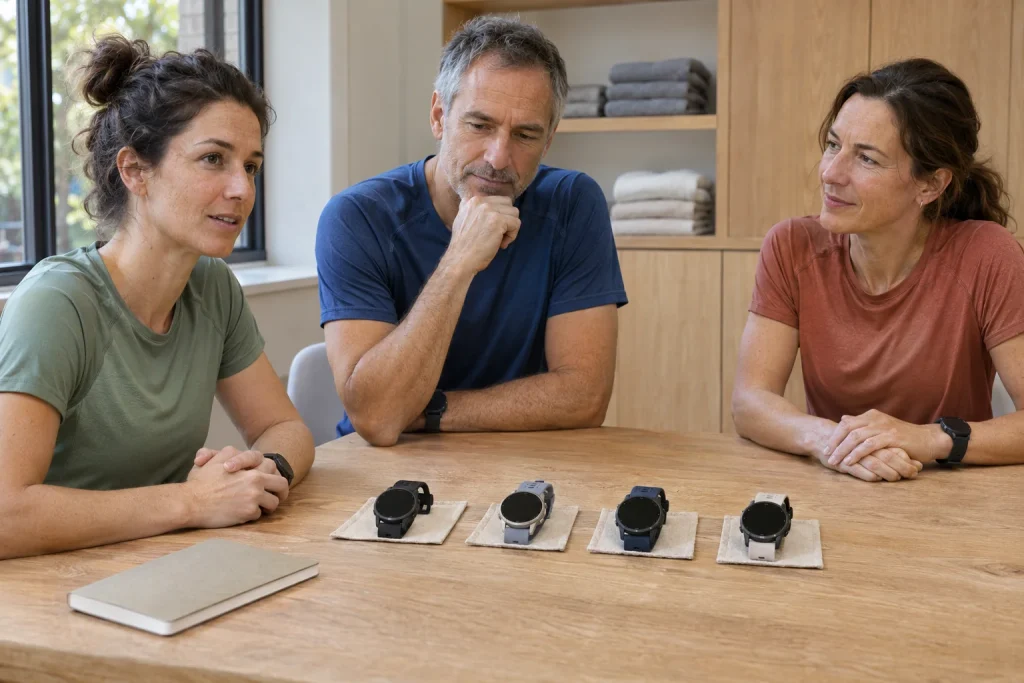
In a practical trial, check whether a brief running glance distinguishes pace, elapsed time and heart rate. If six tiny fields need a stop to read, larger text and fewer fields may help more than higher peak brightness. Button use matters in rain, with wet fingers and gloves. At a shop table, feel case weight and strap tightness too: a tight watch is not comfortable simply because it fits a catalogue wrist-size range.
A lit watch face, built-in LED and headlamp suitable for illuminating a route are three different things. A Street X or Vertical 2 light may be a useful brief supplement, but organisers specify necessary lighting and mandatory kit for a dark forest race. Display peak brightness does not establish safe visibility along uneven trails.
Route, map, turn alerts and rerouting
A route is a predefined line; a map supplies background showing surroundings. Turn alerts warn of the next change of direction; rerouting instead calculates another route. One ‘has navigation’ checkbox cannot describe all four precisely. We therefore distinguish Forerunner 165 and 570 route use from the 970 mapping system. Street X breadcrumb and route guidance likewise differ from Vantage models’ offline map library.
The current COROS PACE 4 already offers global landscape and topographic maps; an earlier generation’s limit must not be copied automatically. Likewise, distinguish Suunto Run 2 from the earlier Run: the Run 2 page lists offline maps and different storage versions. Even with documented offline maps, POI and rerouting on Active 3 Premium, check downloading the chosen region and current firmware.
Before heading onto trails, separately check route sync and the map file, then inspect the starting point without a phone data connection. Successfully transferring a GPX does not prove the background map is on the watch. Unfamiliar or hazardous terrain may require backup navigation and communication alongside electronics. A mapping watch is useful, but does not override local closures, changed paths or visible risks.
Heart rate, ECG and a separately purchased sensor
Optical heart-rate measurement estimates beats from light changes related to blood flow beneath skin. Movement, cold, fit and individual circumstances can affect data. Wrist heart rate, heart-rate variability and an electrical heart signal are not interchangeable. Drawing a pulse trace does not mean a watch continuously produces diagnostic ECGs. A separate chest strap does not automatically transmit every field a receiving watch might use either.
For Forerunner 970 running economy and step speed loss, the manufacturer specifically requires HRM 600. Connecting a general heart-rate strap does not replace this requirement. Sport-focused wrist ECG on Vantage V3, M3 and Grit X2 Pro is not a medical diagnostic service; Street X specifications list neither ECG nor SpO2. Apple and Samsung ECG apps have country, age, hardware and phone conditions: the sensor alone is not complete eligibility.
Do not call sweat-loss estimates direct water or salt measurements on every watch. An algorithm using workout data, body weight and other inputs differs from a local sweat sensor. We do not transfer Samsung Ultra2’s estimate automatically to all 25 models. Feeling unwell, chest symptoms or unusual breathlessness are not reasons to continue because a watch looks reassuring; buying a device does not resolve healthcare actions.
Battery life: duration and mode together
GPS Only, all-satellite-system modes and multiple-frequency reception need different energy. The 970 manual therefore separately lists up to 26 hours GPS Only and 21 hours All + Multi-Band, with different figures again for music. COROS’s 41 hours for PACE 4 and 60 for PACE 4 Pro mean All Systems / High; Dual Frequency / Max gives 31 and 40 hours respectively. These are not equivalent tests running every function simultaneously.
APEX 4’s size-dependent 41 and 65 hours mean Endurance Satellite Mode 1; VERTIX 2S’s 118 hours mean Standard GPS. Comparing the biggest figure with another watch’s most precise GNSS mode is unfair. Apple’s 10, 18 and 7 hours of workout tracking use different profiles from 24, 50 and 18 hours of normal daily use. Ultra 4 Extended and Max Extended introduce further power-saving conditions. Interpret them only with the specific battery footnote.
The current global Vantage M3 page deserves attention: the technical table gives 27 hours Performance, 90 Eco and eight smartwatch days, while lower marketing text states 30, 70 and seven. We have not assembled an artificially favourable specification from them. Clarify the valid data for the precise model and software when buying. For Balance 3, region and material matter: we do not combine the examined US page’s 41-hour Accuracy GPS mode with favourable figures from another version.
Add real reserves to your longest run and try use progressively beforehand with the same display, music, map and sensor settings. Cold, battery ageing and frequent map viewing can alter consumption. Know charging points and race rules before selecting an unfamiliar saving mode the night before. A long event is not the place to discover which data a reduced profile omits.
Training plans and service costs
Watch recording, a basic phone log, paid analysis and an adaptive plan may be separate service levels. Garmin Connect basics must not all be called a Connect+ subscription. Distinguish Polar Flow’s basic training system from outside services too. Apple’s Workout app is not a Fitness+ subscription. Zepp Coach and Aura are different products, so one being available does not make the other free.
Treat Race 3S’s new conversational AI Coach separately from earlier Suunto Coach analysis and planning features. Check introductory access duration, activation deadline and later fees in the specific offer. Within fēnix 9 Pro, built-in LTE and satellite communication require an inReach version, an active plan and suitable coverage; not every Pro version has it. Mapping runs and messaging are not one cost line. Access to a downloaded partner app does not prove all associated plans are free forever.
Add the device, necessary strap or pod, possible subscription and app needed for your goal. You need not buy every extra: with an existing coach’s plan, a clear structured workout and exportable log may be what matters. Of twenty marketed metrics, pay extra only for those with the necessary inputs, understandable meaning and genuine use for better decisions about organising your training.
 Enlarge image
Five typical running tasks, five different decision paths
For an urban running week, consider comfort, a quick start and a clear screen first. Without unfamiliar routes, a usable log and simple task handling may matter more than the largest map library. For marathon preparation, transferring workout sections, managing warm-ups and recovery and verified race-day recording duration come forward. A brand name or the word marathon alone does not guarantee the coaching system you need.
For trails, check map detail readable at a glance, off-route alerts and controls usable with gloves. Over several hours, the right GNSS mode and real reserves matter more than the biggest advertised number belonging to another setting. For everyday smart features, phone system, calls, notifications and app choice may be the first filters. These tasks overlap, but set your own priorities.
Weight and size are not one good-or-bad judgement. A large mapping screen can help at a mountain junction while pressing against a smaller wrist or moving around. Strap fit needed for a heavier case affects heart-rate measurement and comfort. If wearing it overnight regularly, do not subordinate sleep comfort entirely to race-day features. Consistent daily data may be more valuable than extensive features in a rarely worn device.
Trial tasks before buying and the first long run
On a demonstration device, start an imaginary interval session: where is the next task, which button advances it and how do you stop without accidentally saving? Check larger text and reading three important fields together. For routes, ask about necessary downloads and offline status. Observe not merely a displayed map but how your own planned route reaches the device.
After the first easy run on your watch, open the phone log and check intervals, GPS trace, heart rate and export. With an external strap, confirm the watch used the intended sensor. For missing data, inspect connection, permissions and measurement conditions before calling your movement faulty. An activity imported from another platform may not contain every daily wellness datum or original algorithmic assessment.
Keeping two or three candidates is enough by the end. For each, write one advantage, one meaningful limitation and full access conditions. The 25 detailed articles help carry forward the same questions: suitable phone, usable display, necessary navigation, interpretable measurements, named battery profile and manageable service costs. Choose equipment for a specific running task and retain why that model reached your wrist.
Primary sources and comparison date
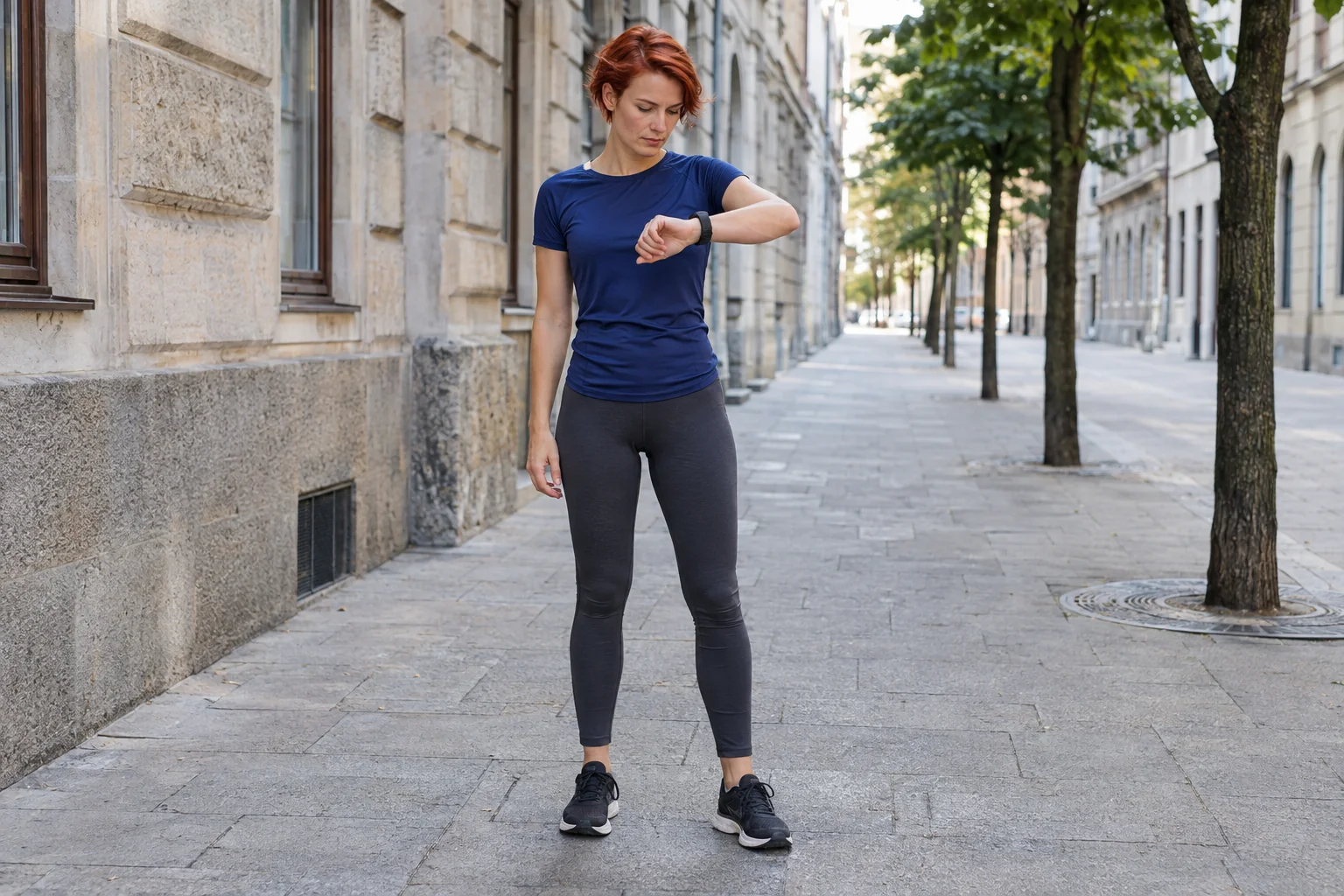
The table’s model links lead to our detailed articles. The manufacturer pages and manuals below underpin the editorial check of 21 November 2026; recheck exact regional version, firmware and current app conditions before buying. Photographs are generic original illustrations, not images from a documented comparative test of all 25 devices.
- www.garmin.com – 1462801
- www.garmin.com – 1463821
- www.garmin.com – light-up-your-run-with-the-garmin-forerunner-165-series-easy-to-use-gps-running-smartwatches-with-vibrant-amoled-displays
- www.garmin.com – garmin-expands-its-flagship-performance-smartwatch-lineup-with-fenix9-and-fenix9-pro
- www.garmin.com – introducing-the-instinct-3-series-from-garmin-rugged-smartwatches-now-with-amoled-displays
- www.apple.com – specs
- www.apple.com – specs
- www.apple.com – compare
- www.samsung.com – galaxy-watch9
- news.samsung.com – galaxy-unpacked-july-2026-a-first-look-at-galaxy-watch-ultra2-and-galaxy-watch9
- coros.com – pace4
- coros.com – pace4pro
- coros.com – apex4
- www.coros.com – vertix2s
- www.polar.com – v3
- www.polar.com – m3
- www.polar.com – grit-x2-pro
- www.polar.com – street-x
- www.suunto.com – suunto-run-2-all-black-4gb
- www.suunto.com – suunto-race-3s-titanium-black
- www.suunto.com – suunto-vertical-2-vs-race-2
- www.suunto.com – suunto-vertical-2-vs-race-2
- us.amazfit.com – cheetah-2-pro
- us.amazfit.com – balance-3
- us.amazfit.com – active-3-premium
- support.coros.com – 23476623096980-Battery-Specifications
- www8.garmin.com – GUID-1933DAC3-8171-4995-A1F0-CD298E1F5A33.html
- www8.garmin.com – GUID-6E1935AD-17DC-48E6-8C54-B2FC79917B0B.html
- www8.garmin.com – GUID-7BB65BBD-E34E-4C59-A573-F91F599FD835.html
- news.samsung.com – samsung-galaxy-watch-ultra2-and-watch9-your-health-companion-on-the-wrist
- account.eu.amazfit.com – active-3-premium
- apps.apple.com – id1127269366
- www.suunto.com – suunto-ai-coach
- Garmin: manufacturer comparison of fēnix 9 Pro inReach and non-inReach versions
- Apple: specific technical requirements for apple-watch-se-3
How Futószív articles are prepared: our editorial guidelines.