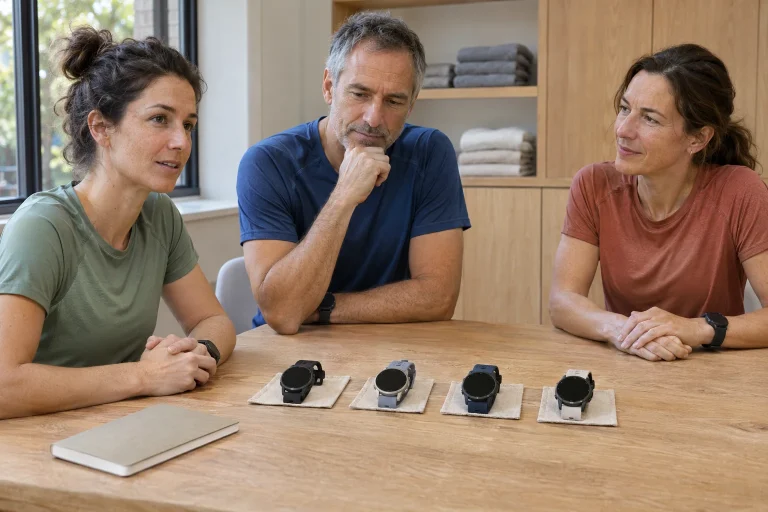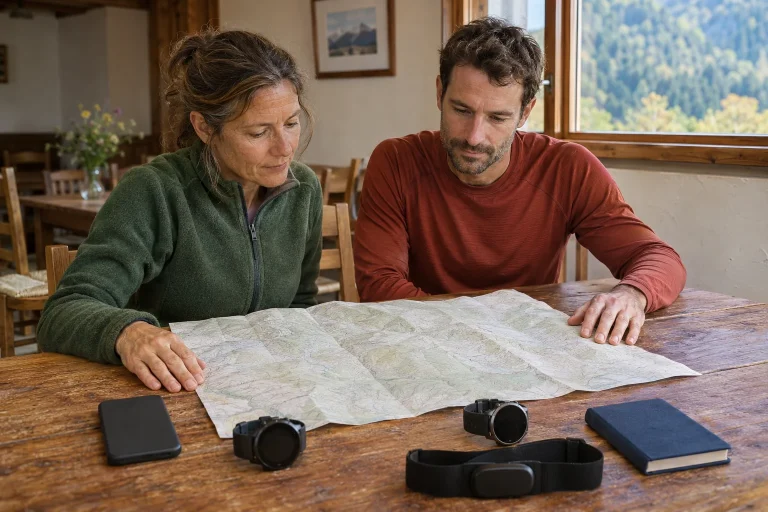
The Suunto Race 3S is a mapping sports watch with a titanium bezel that also introduced the conversational AI Coach service. For a trail runner, however, three separate questions matter: what the watch itself can do now, what requires an app and access, and what remains a promise for a later development. Using manufacturer material checked on 21 November 2026, we distinguish these with practical course-planning examples.
A titanium bezel and a complete weight of 56 grams
The current Race 3S technical specification gives dimensions of 46 × 46 × 11.4 millimetres and 56 grams with a silicone strap. The bezel is titanium, the glass is sapphire and the case is glass-fibre-reinforced polyamide. The precise materials list means the shorthand ‘titanium watch’ does not imply an entirely titanium case. Its 64 GB storage and L1+L5 dual-frequency GNSS are separate technical properties: the former describes content capacity, the latter its positioning method.
Judge ‘compact’ against your own wrist. Inspect the bezel edges, strap curvature and where the crown sits when your hand bends. On a slim wrist, case diameter and how the strap actually rests both matter. A longer running trial may matter more than a bright first impression of the display: you will keep adjusting an overly loose watch, while an overtightened strap does not become comfortable because premium materials surround it.
Include poles, a jacket and gloves when thinking about trail kit. Can you reach the controls without moving everything into the other hand? Does the cuff bunch behind the case or pull smoothly over it? No single weight figure answers these questions. The value of the Race 3S’s physical design emerges in the complete situation of use, rather than just a specification cell compared with another watch.
What changes compared with the Race S?
The manufacturer’s Race 3S–Race S comparison lists a 2,000-nit display, a maximum of 38 hours with dual-frequency GPS, sapphire and 64 GB for the 3S; for the Race S it gives 600 nits, 30 hours, Gorilla Glass and 32 GB. The titanium Race S is listed at 53 grams with its strap, so the newer model is not smaller in every numerical comparison. Both list offline maps and dual-frequency positioning. Maps alone therefore do not automatically justify changing models.
Display brightness is useful, but is not the same as readability for you in every condition. Font size, the number of fields, reflections and wrist rotation together shape how long it takes to recognise a value. In your own trial, find a simple view and then a crowded one. If the latter takes a long time to decipher, more light will not necessarily solve the layout problem.
If you already own a Race S, write down what has been missing over the last three months. ‘The new model does more’ is insufficient: identify a specific situation in which the change helps. Longer charging reserves, different glass, more storage or access to the new service may be such needs. But if your current maps and training log work well, keeping the old watch and familiar controls is also a valid decision.
 Enlarge image
AI Coach: a conversation about your own data
Suunto AI Coach works from training, recovery, sleep and route history in the Suunto app. It can answer with summaries or create a workout or route that you can save and sync to the watch. The service FAQ distinguishes conversational AI Coach from Suunto Coach, which creates structured plans. Not every feature called ‘coach’ means the same interaction, and a conversation on the phone is not a human coach operating independently inside the watch.
A useful question of your own might be: ‘Summarise three differences in my running duration over the last two weeks, and tell me which days lack sleep data.’ This has a time boundary, comparison and verifiable information. An unlimited ‘Tell me what to do’ is less useful when the app does not know about your next work trip, an unexpected family commitment or a new symptom. A question close to the data makes it easier to judge whether the answer really concerns your own log.
The developer introduction itself notes that AI answers may be incomplete or incorrect and that routes must be reviewed before following them. The service provides general training and outdoor information, not healthcare. A useful sequence is to read the answer, check the days it refers to and then consider the action it would produce. A new workout built from a misinterpreted run does not improve simply because it syncs quickly.
Three months of access is not a lifetime subscription
Under the current terms, activating the Race 3S in the Suunto app by 31 December 2026 provides three months of AI Coach access. No bank card is needed, and the period ends automatically; continuing requires a paid subscription. The manufacturer indicates expansion to further compatible watches in early 2027, rather than immediate eligibility for every current model. Interpret the access terms together with the activation date, rather than simply buying the box.
A buying comparison should therefore give hardware and the service separate rows. The watch’s map, case and display are a different kind of value from temporary conversational access. If the AI feature is the main reason you would choose the model, consider whether you would use it if a separate fee were required after the trial. We make no promise about later fees here: check the current terms shown in your own region.
You can use the trial deliberately. During the first week, have it check your basic log; later, request a specific task linked to a familiar route; finally, consider what offered real help. Useful criteria include understanding your data better and organising your running more easily. Many opened conversations or impressive answers are not necessarily the same as decision support you can use in preparation.
Climb Guidance: seeing the course in sections
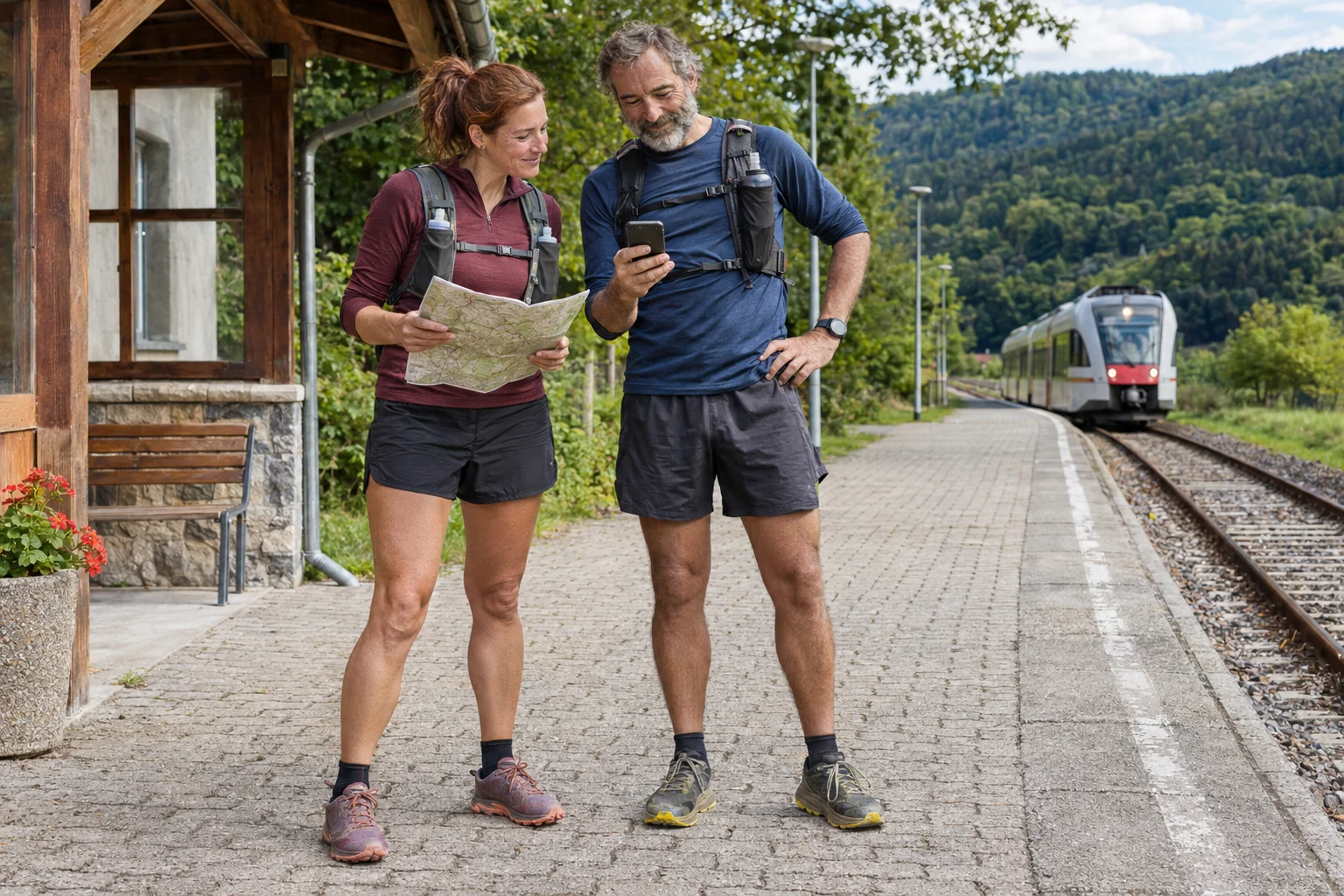
When following a route, the Climb Guidance section provides elevation information. The planned route appears in sections; both the overview and enlarged current section show remaining distance and completed and remaining ascent or descent. You can select gradient in degrees or percent and request notifications of upcoming climbs and descents. To interpret the view, first recognise whether you are reading data for the entire route or one section.
A worked example: 50 metres of ascent over a horizontal distance of 500 metres means a 10-percent average gradient. That is not 10 degrees, nor does it mean every metre of the climb is equally steep. The calculation helps explain the two notations; it does not reproduce Suunto’s section-detection algorithm. On an undulating path, the average can hide short, steeper stretches, so keep looking at the actual terrain as well as the chart.
In a race plan, the climb view helps when you have considered each section’s role beforehand. You approach the start of a long climb differently if you know substantial descent and another climb follow it. You do not need to turn every value into a new pace command. The purpose can simply be orientation: how far to the next ridge, which section am I on, and does the harder part come before or after the agreed meeting point?
Race Planner is currently listed as a promise
For Race Planner, advertised under Smart Race Strategy, the currently checked product-page footnote specifies a later Suunto app and firmware update. The described aim is a personalised pacing plan based on route elevation, weather and race goals, but we do not report it as a capability already usable on every Race 3S. The timing of a future feature can change. Climb Guidance’s actual presence in the manual does not automatically establish that a different planning service is complete.
This creates a simple distinction when buying. If existing maps and the climb view are why you would buy the watch, test them on the current device. If only Race Planner would solve your task, check its actual release, firmware and in-app availability before deciding. Between an advertising headline and a footnote specifying timing, the latter cannot be ignored when judging usability.
Meanwhile, you can create a simple course outline: start, first major climb, refreshment station, long descent, final climb and finish. Add distances and exit options from the event’s official information. This is not advertising a substitute for the missing feature, but clear personal planning. Its advantage is knowing exactly which information comes from the organiser, which from the map and which is your estimate.
 Enlarge image
Offline maps, routes and 64 GB of content
The mapping guide requires setting up a wireless network in the Suunto app and then downloading the region to the watch. With the map menu set to Off, only the route trace appears. The routes section separately offers Navigate only and Start exercise; the former is standalone navigation and does not save a workout to the app. For someone who also wants a running log, this is an important starting decision rather than just a display setting.
Maps and music share the 64 GB storage. The media player distinguishes phone control from offline playback of MP3, FLAC, WAV and AAC files on the watch; the latter requires Bluetooth earphones paired with the watch. Files can be copied from a computer or suitable phone with the supplied USB-C cable. This is not equivalent to supporting downloads from any streaming subscription on the watch.
Do not copy every possible item for a trail weekend without checking it. Be clear which region and route belong to each day and why you are taking music. Open the map, select the route, check the recording start and inspect the saved result after a short trial. Large storage is a convenient reserve, but does not replace orderly file names and planned days. More gigabytes cannot prevent confusing an old course file with a current one.
Even 38 hours requires specific settings
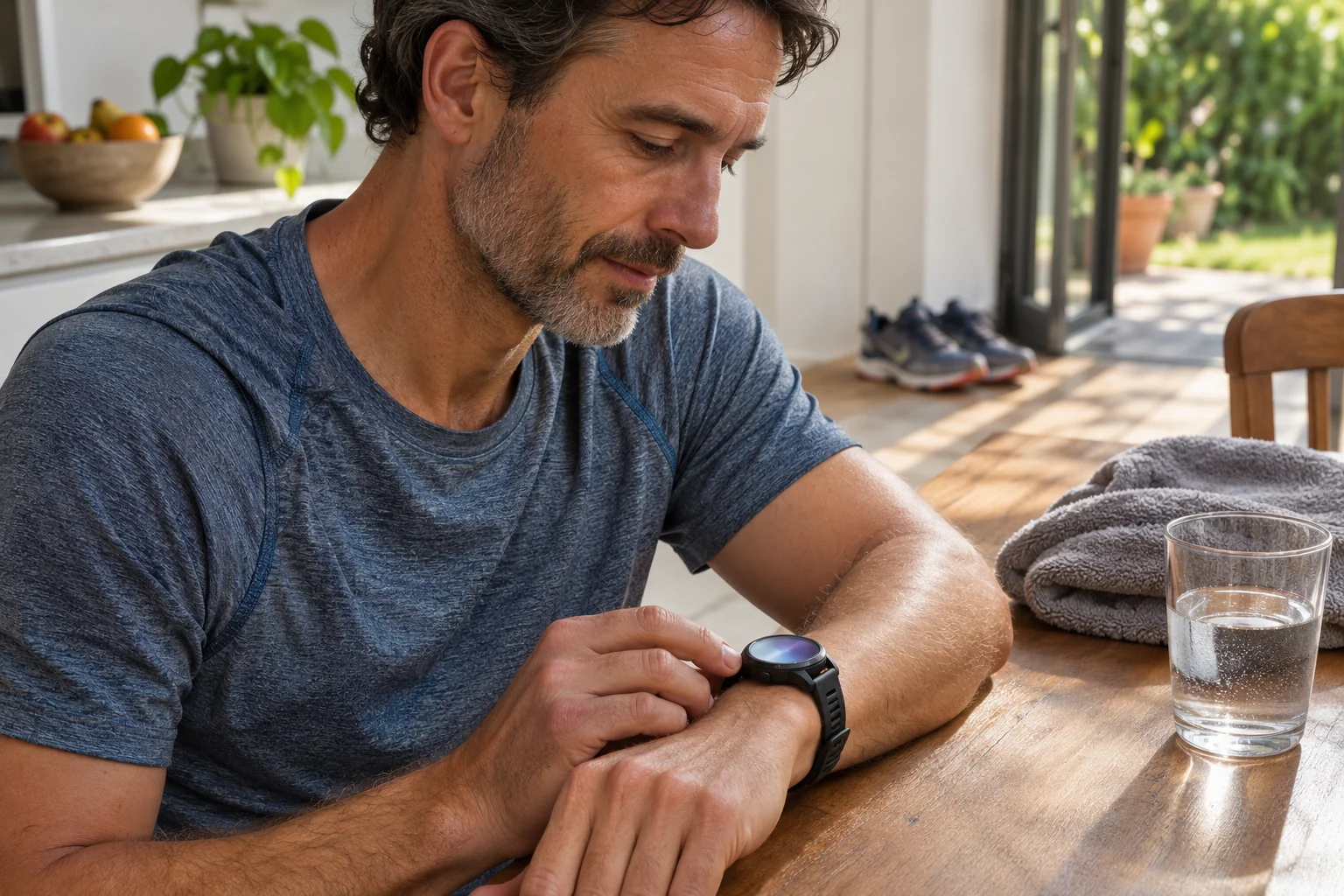
The technical table gives up to 38 hours of dual-frequency GNSS training, or 32 with Always On; single-band mode lists 45 hours, or 40 with Always On. The 120-hour maximum for power-saving modes and twelve-day everyday maximum use different conditions. The manual’s mode selection lists Performance, Endurance, Ultra and Tour; by default, Tour has neither wrist nor chest-strap heart rate. A longer figure can therefore come with different data collection.
For your own race, first name the necessary functions: frequent positioning, map reading, any sensor, music and display. Test that configuration for a known duration. Having reserves after four hours does not imply identical consumption throughout a whole night, in cold weather and with far more map reading. When changing battery mode, consider not only estimated remaining hours but also which service has changed.
The Race 3S provides a considered package when you evaluate its hardware, working navigation and time-limited services separately. A compact case, a map file and an AI answer are three different tools for organising running. Each needs its own purpose and checks. This guide is based on manufacturer documentation, not our own product test: a usable trail race plan combines an understood route, practised controls and decisions suited to real conditions.
Sources
- Race 3S product page and future Race Planner
- Detailed hardware and battery modes
- AI Coach access and terms
- Developer introduction to AI Coach
- Climb Guidance
- Offline maps
- Routes
- Mode selection
- Media playback
- Manufacturer comparison of Race 3S and Race S
How Futószív articles are prepared: our editorial guidelines.