An outdoor appearance does not establish map-based navigation
At first glance, the Instinct 3 AMOLED is a firmly button-operated sports watch designed for long outdoor days. For a runner, the key question remains which navigation and controls you expect. A colour display, multiband GNSS and track following do not automatically mean detailed built-in maps of surrounding forest paths. This distinction can give the model a clear place: do you want to follow a known course with extensive sports data, or need actual map-based orientation on your wrist?
This article concerns the standard 45 and 50 mm Instinct 3 AMOLED versions, using manufacturer documentation available on 21 November 2026. It does not assign every separate Solar or Tactical Edition feature to them. There is no hands-on durability or GNSS test; figures are manufacturer data. Trial situations show how to organise a choice around your needs, rather than promise a field result.
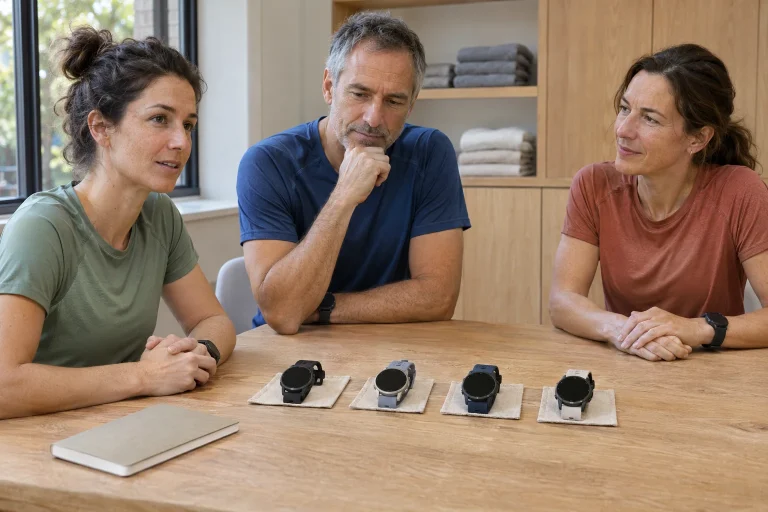
Start with a particular trail day. Are you following only a track on a familiar loop, seeking alternatives among unknown junctions or sorting a running vest in darkness? These are different tasks. A feature list supports decisions when each need is matched with a capability and preparation. Rugged form alone answers none of them.
Buttons and case: try your own movements
The 45 mm AMOLED specification lists a 45 × 45 × 14.9 mm case, 53 g weight, a 1.2-inch 390 × 390-pixel display and 22 mm QuickFit strap compatibility. A reinforced bezel complements the polymer case. These physical properties help place it on your wrist, but strap, movement and clothing together determine comfort.
The model’s button chapter separates GPS START/STOP, BACK SET, UP MENU, DOWN ABC and LIGHT CTRL actions. GPS handles starting and stopping; BACK can handle a lap or workout step during activity, while long presses add functions. The display is not touch-operated: you need to navigate menus and go back with buttons. Learn short versus long presses calmly.
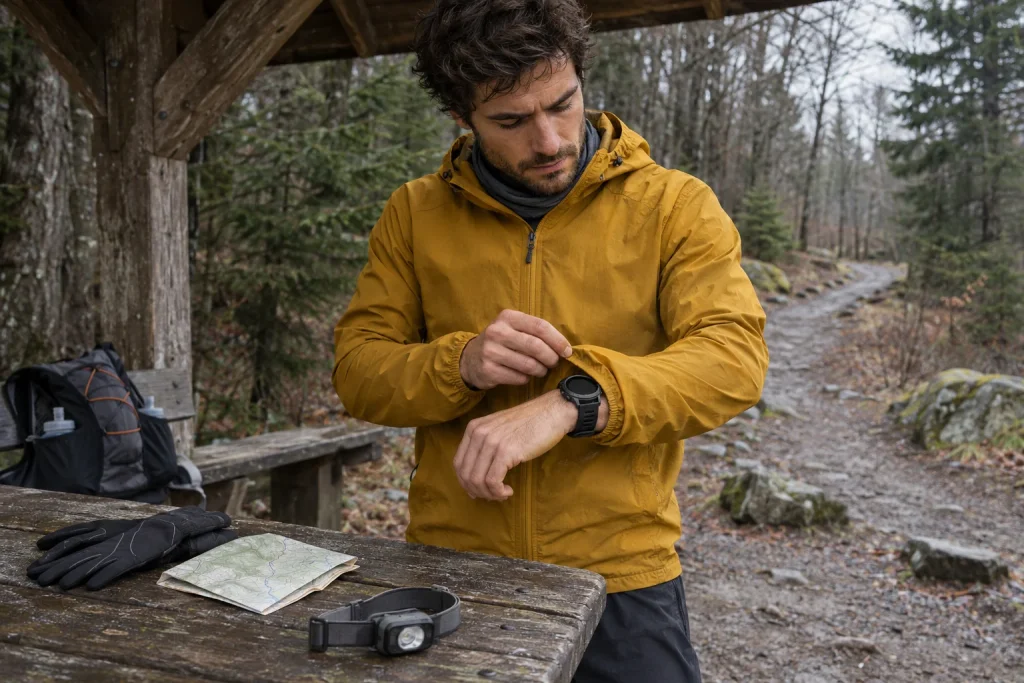
Try it with your running gloves, jacket sleeve and usual vest. Do not deliberately subject a shop watch to water or impacts; controls and wrist bending already reveal much about fit. Comfortable button access with the wrist turned matters too. A strong case may be less useful if thickness or strap fit requires constant adjustment.
 Enlarge image
AMOLED battery life: display mode has its own row
The manual’s battery table gives the 45 mm version up to 18 smartwatch days with wrist gestures and 7 with always-on display. The 50 mm figures are 24 and 9. GPS Only lists 32/40 hours, All Systems 25/32 and All Systems + Multi-Band 23/30. The latter row also specifies typical SatIQ use. These are maxima; functions and conditions affect real consumption.
The smartwatch-mode difference shows why AMOLED needs reading together with display settings. If you want fields continuously visible, do not start from the gesture row. Someone checking often or recording several long workouts may care more about their charging routine than the maximum day figure alone. Display benefits and energy logistics belong together.
Instinct 3 Solar is a separate model with another display, so sunlight-dependent or “unlimited” Solar promises cannot be assigned to AMOLED. Max Battery and Expedition also use different recording modes from a detailed running session. Instead of choosing the largest number, first identify the mode retaining the data you need. Then plan the long day with reserve.
A track on the wrist, detailed maps elsewhere
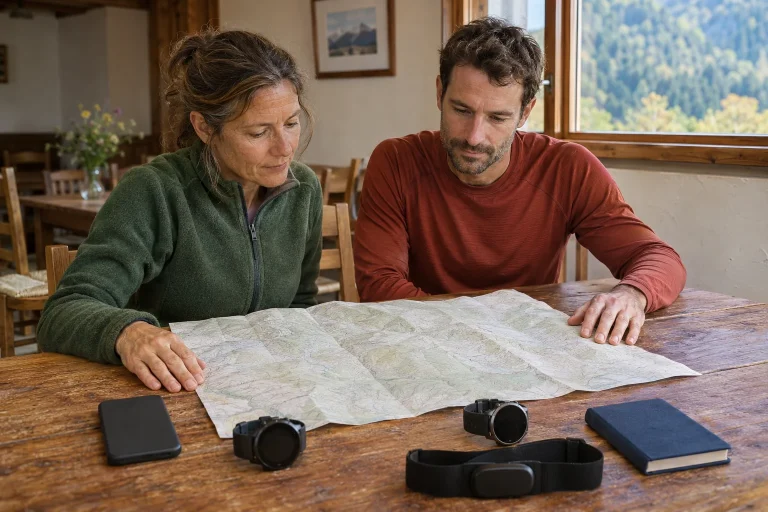
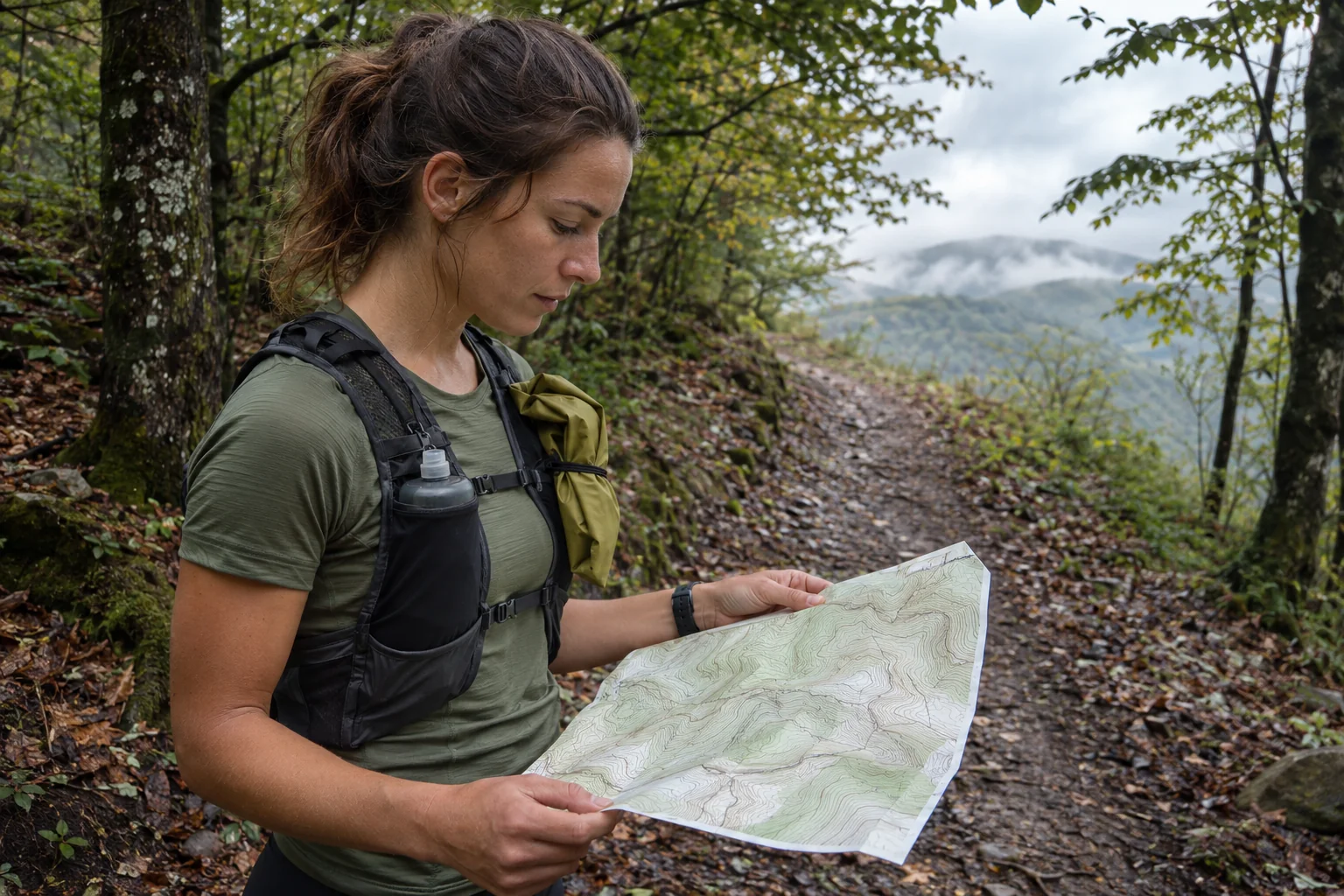
The Garmin manufacturer comparison does not mark built-in mapping for Instinct 3 AMOLED, while multiband GPS is supported. The course-sending chapter nevertheless explains sending a route created in Garmin Connect to a compatible watch. Read these together: course following can work without a detailed preloaded base map.
On a familiar forest loop, a track line can help identify whether you are taking the planned branch. Finding an unfamiliar alternative around a closure would require different information from detailed surrounding paths. Changing GNSS mode does not create that missing information. More precise positioning and the map network’s content are separate properties easily confused in brief specifications.
The manufacturer introduction describes Explore for viewing more detailed maps and creating courses, and TracBack for helping the return. Detailed phone maps do not automatically become built-in watch maps. Know before departure which device will explain alternative routes and what happens without connectivity or sufficient charge on it.
SatIQ and multiband GNSS: choose for the route
The AMOLED series’ November satellite settings list GPS Only, All Systems, All + Multi-Band and Auto Select. Auto Select uses SatIQ to adapt selection to surroundings while considering battery life. UltraTrac reduces point and sensor recording frequency. These are different operations: multiple satellite systems, multiple frequency bands and less frequent storage are not the same change.
For a personal trail trial, choose an open area and a section where trees or buildings constrain reception. Do not retrospectively select only the device’s most favourable few hundred metres; examine sections typical of your use. Alongside total distance, inspect the line through a particular junction. Identical totals can hide different local errors.
Do not tie mode selection to fitness. Faster runners are not uniquely entitled to multiband; environment, data needs and battery life provide its purpose together. A manufacturer option does not guarantee error-free positioning everywhere. Examine a poor recording through start conditions, mode, location and gaps before constructing a brand ranking from one poorly drawn corner.
Running sessions between trail days
The chapter on starting structured workouts distinguishes quick tasks, saved workout libraries and calendar sessions. Compatible tasks for the selected sport mode appear, with stages and goals shown separately. This may be more tangible for daily training than an occasional adventure feature: warm-up, work and recovery are clearly distinguished.
An example is a simple time-based task: warm-up, several agreed work sections separated by recovery and a cool-down. The key is not the length of the programme list, but whether the next stage and current target are clear. Start practising under easy conditions so button use does not become uncertain during an important session.
The model’s glances list Training Readiness and Training Status too. These are feedback from device data rather than a complete assessment of every circumstance. They may help recognise patterns, but a favourable label does not require making a planned day harder. Sleep, recording completeness and a description of your training situation remain useful context.
 Enlarge image
LED flashlight, phone music and connection expectations
The built-in LED light can be a practical addition for packing or a short nearby task. The button chapter specifies a quick double press of LIGHT to switch it on or off. Learn its direction and suitable setting while stationary. Wrist light turns differently in motion from a head-mounted light, so do not automatically treat it as a full replacement for planned night lighting.
The music glance describes controlling the phone’s player, while the manufacturer comparison does not mark watch music storage. Together these are clear: the colour display does not bring a Music version’s independent offline playback. This may be irrelevant if you run without music, but a specific requirement if leaving the phone home is the main goal.
The manufacturer introduction describes linked messages and tracking as services dependent on a compatible phone. The Instinct name does not establish built-in inReach or independent LTE. The current US Connect requirement is iOS 18.2 or Android 9 and later, with native Google Play support on Android and no Go edition. Check the actual phone and app-store availability when installing.
A good choice becomes clear across a whole running day
Buttons, a colour display, model-specific long activity maxima and course following may favour Instinct 3 AMOLED together. Translate the list into one real day: which route will you send, which GNSS mode will you use, what will you read and where will detailed maps be available? Clear answers make the device’s role more understandable.
Size-related battery differences can matter, but do not choose the larger case for that alone without trying it. Fit and comfort under clothing matter on long runs and all-day wear. Check required fields, starting and the lap button on your wrist. These are more specific guides than calling the model ideal for every trail runner.
Check current price, warranty, stock and exact product code when buying. Do not combine AMOLED, Solar and Tactical into an imaginary Instinct with every advantage. The model can serve your running when its own capabilities match your tasks: button-operated workouts, a prepared course and energy planned for the selected mode. Treat detailed mapping and independent music as separate decision requirements.
Sources
- Instinct 3 AMOLED 45 mm: manufacturer specifications
- Instinct 3: buttons
- Instinct 3 AMOLED: battery life
- Garmin: comparison of maps, music and touch
- Instinct 3: sending a course
- Instinct 3: GNSS modes
- Instinct 3: starting a workout
- Garmin: series introduction
- Instinct 3: glances
- Garmin Connect: phone requirements
How Futószív articles are prepared: our editorial guidelines.