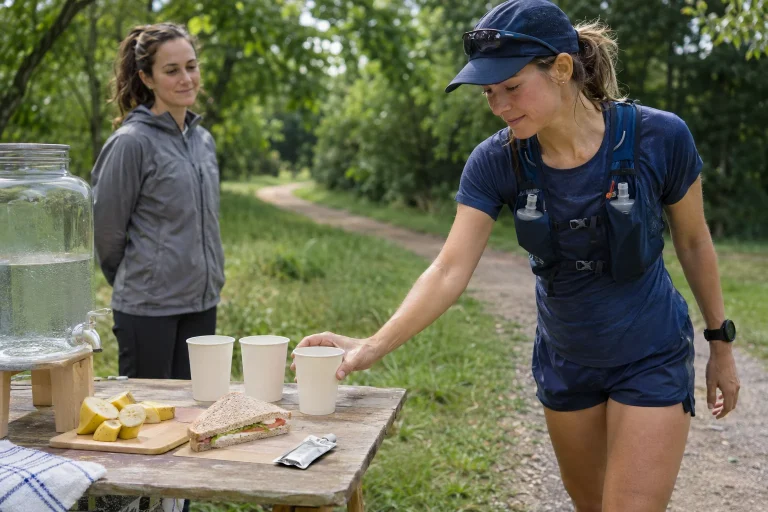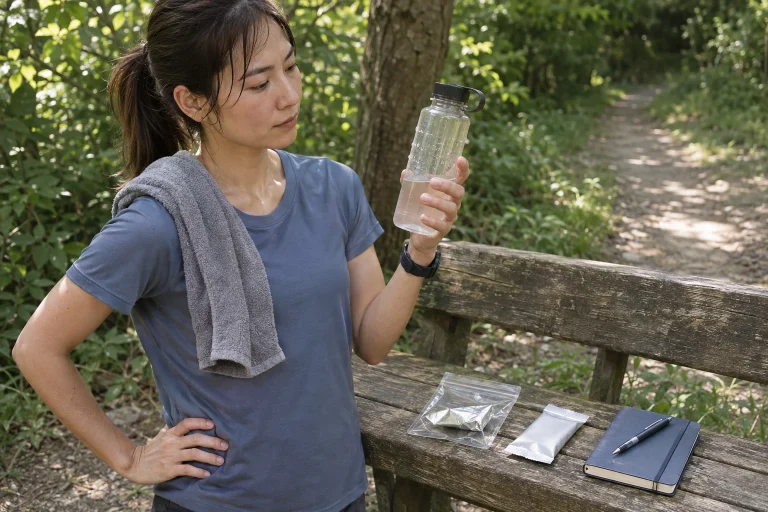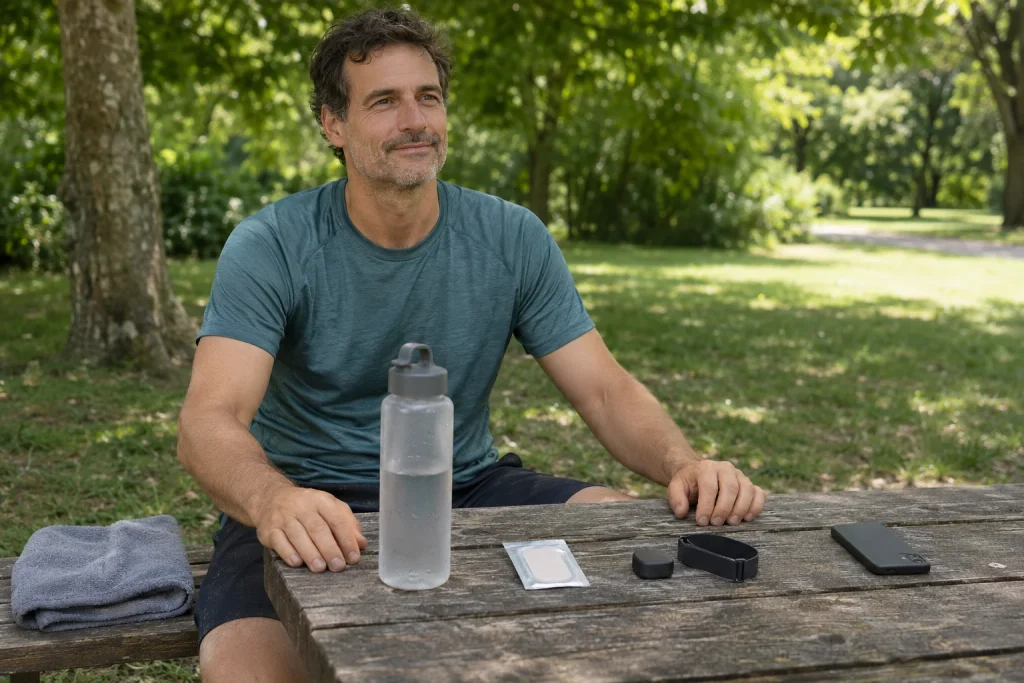
The label “fluid lost” after a run can conceal very different processes. A watch calculates from recorded exertion; an upper-arm device contacts sweat locally; you photograph coloured channels in a disposable patch. The same millilitre display therefore does not mean measurement by the same route. When choosing equipment or interpreting existing data, first understand how the data arise.
This comparison, checked on 21 November 2026, places Garmin’s watch estimate alongside Nix, hDrop Gen 2 and Gatorade Gx Sweat Patch. CORE 2 appears separately as a temperature device, since heat-training equipment often includes it although it answers another question. This is neither personal product testing nor a medically reviewed fluid plan; we read manufacturer documentation alongside research and practical data checks.
Do not merge four variables into one hydration number
Fluid consumed, volume lost in sweat, sweat sodium content and blood sodium concentration are separate variables. A log of drinking from a bottle does not measure sweat. Local skin analysis is not a blood test. A displayed “deficit” usually results from a particular model and entered data, rather than directly inventorying every fluid compartment in the body.
Begin with a simple data sheet: signal name, origin, unit and period covered. Total millilitres lost and millilitres per hour are different. Total sodium loss in milligrams is not concentration either. Before judging accuracy between apps, check time window and units.
Our fictional example: two logs each show 900 millilitres total loss, but one covers sixty minutes and the other ninety. Their average rates are 900 and 600 millilitres per hour respectively. This is division, not a drinking target or research measurement. Equal totals do not mean equal circumstances or exertion; missing context invites overinterpretation.
A watch estimate needs no sweat-collection patch
Garmin support describes estimated sweat loss as a formula. Available inputs can include exertion, body mass, distance, speed, elevation gain, temperature and heart rate. Forerunner 970 is among supported models. This path does not require chemical analysis of skin sweat: recorded activity supplies an estimate.
The convenience is clear: an extra log field without another patch or upper-arm device. The limit follows from the same design. Entered body mass or activity weather is not a direct sweat sample. Do not therefore claim the watch measured sodium or continuously checked blood electrolytes. Those would be different tasks.
Our detailed Forerunner 970 guide also discusses differences between heart rate, running data and sweat estimates. A Connect estimate and entered-fluid log remain separate sources. An automatic daily fluid target changing after activity is software behaviour, rather than a personalised clinical examination.
Nix: a whole-body profile extended from local sweat
Nix’s reusable electronic unit works with a disposable upper-arm patch. The manufacturer says proprietary algorithms extend local signals to whole-body data. This is closer to an actual sweat-sampling site than a watch exertion formula, but the whole-body number remains processed. Placement and orientation are part of the measurement procedure.
Separate the disposable patch’s life from the rechargeable unit’s. Charged electronics cannot make a single-use patch reusable. Starting the appropriate app activity belongs in the initial checks; a pre-filled patch may receive a specific warning. Delayed initial data are not zero loss: enough local sweat must first reach the system.
The detailed Nix article addresses the patch, start sequence and separate connection paths together. The Apple Watch integration redesigned in 2026, for example, requires carrying the phone and starting and stopping from it. A watch notification alone does not prove phone-free use. Match needs to the entire recording chain rather than merely the watch brand.
 Enlarge image
hDrop: reusable electrodes and separate processing
hDrop Gen 2 offers sweat-related data through reusable direct skin contact. Manufacturer descriptions connect sensor signals with algorithmic loss calculations. Removing disposable patches changes upkeep without removing placement, cleaning and proper starting requirements. A dry, poorly contacting or improperly prepared site does not become a reliable reference because the device is reusable.
For Garmin, current manufacturer guidance describes starting on the phone before handing the sensor connection to Garmin. Watch closure is followed by phone synchronisation and full analysis. Live field, recorded activity and later app processing are therefore three checkpoints. Inspect that path before interpreting differences between an interim screen value and final summary.
Our hDrop Gen 2 guide covers research limitations alongside connections. Reusability is an operational property; personal accuracy is another evidential question. A device score is not blood sodium. An app forming its own baseline from repeated recordings still uses its own model, rather than providing a health assessment valid everywhere.
Gx Sweat Patch: a single local test read by photograph
Gatorade Gx Sweat Patch is microfluidic, rather than a separately rechargeable Bluetooth transmitter. Manufacturer instructions specify placement inside the left forearm and app photography while it remains on the arm. Coloured channels produce a profile for that activity. This differs from upper-arm electronic sensing continuously sending data to a watch.
Do not turn operating conditions into training instructions. Specified temperature and duration ranges do not oblige anyone to run longer or in greater heat for data. No usable result can mean an unsuccessful or limited recording; it is no reason to keep loading the body for a patch.
The detailed Gx patch guide separately covers app scanning, the consumable and regional availability. An app recommendation based on a previous profile for similar activity and conditions is not equivalent to analysing a fresh sample during a new run. Clearly separate old-result and current-measurement dates in the log.
CORE 2 belongs in another column: temperature estimation
CORE 2 merits mention because runners in heat often review temperature beside fluid data. It estimates core temperature from heat-flux and skin-temperature-related signals with supported heart-rate input. That is not direct measurement of millilitres lost or sweat sodium. A heat-strain index cannot automatically be translated into fluid deficit.
Our CORE 2 article covers fit, heart-rate source and data-quality requirements. Temperature and fluid data may make an interesting joint log, but do not automatically validate each other. A reassuring value cannot make illness insignificant. Sporting estimates are not substitutes for a medical thermometer or emergency assessment.
Use separate temperature and sweat columns, also recording placement and source. You then need not guess later which of two upper-arm devices produced a value. An organised equipment log is not another mandatory gadget list; it separates data from equipment already used.
Local sampling and whole-body values: where the model enters
Baker and colleagues’ 2019 study involved eleven recreational athletes cycling at two intensities, comparing several local sampling sites with whole-body data. Relationships depended on site and, at some locations, intensity. This was not a Nix, hDrop or Gx product test. It provides physiological background for why one skin site’s result is not automatically the unchanged whole-body figure.
Placement instructions are therefore more than attachment ideas. Where an algorithm is designed for a particular site and orientation, a seemingly more comfortable location raises another question. Advertising images, another athlete’s practice or another brand’s placement do not validate moving your device. Consult the current procedure and limits for the exact model.
Label extended whole-body results so the model’s role remains visible. “Loss calculated from a local upper-arm signal” is more precise than “water definitely lost”. This does not make the data useless; it preserves what supports reliance and what needs comparison with another appropriately conducted assessment.
Missing measurements are part of accuracy results too
Snyder and colleagues’ 2026 hDrop pilot analysed training observations in male university football players. Eighteen of thirty-eight sessions yielded a sweat-loss estimate, with substantial individual error among available data. The app’s hydration score had no demonstrated relationship with urine specific gravity in this sample. The authors did not consider it interchangeable with established individual assessment.
We do not extend this small study in a particular sport to every person, sport or later software version. Equally, looking only at finished graphs while hiding absent data is wrong. Give “no usable data arrived” a row in your trial log too. Successful-connection proportion differs from discrepancies among completed measurements.
Alongside manufacturer accuracy percentages, find the reference, participant and session counts, sport and whether a full study or only conference abstract is available. Small average discrepancy does not imply small error for every individual. We therefore do not rank advertising percentages obtained through different methods in one league table.
Phone, watch and export are three purchasing questions
Unpack “works with Garmin” or “Apple Watch compatible”. Can it start without a phone, which device receives data during running, and what reaches the final activity file? A watch field does not necessarily mean every detail enters the usual export. Final phone analysis may have another role, and a later report need not retrospectively modify the original running file.
For a trial, review settings and documentation first, then trace an already planned activity under suitable conditions. Where is the start visible, did closure arrive, what appears on the watch and in the manufacturer’s app? Do not create dangerous heat exposure or fluid restriction to test equipment. Technical operation need not be demonstrated through health risk.
Retain dates, time zones, initial timestamps and units in exports. For later professional interpretation, original conditions and marked gaps may matter more than a cropped colourful screenshot. Review permissions and transfers for health-related data; reaching a training platform does not make them intended for public sharing.
 Enlarge image
Upkeep and availability: price is more than the sensor
Nix requires repeat patches, Gx individual tests, reusable hDrop cleaning and accessories, while electronic solutions also need charging and support. List the full process: device, consumables, shipping, local assistance, app and optional paid services. Manufacturer base functions do not all follow the same subscription model.
Check regional app availability on your own phone before opening a disposable patch. A US app-store page does not automatically establish Hungarian-account use or local shipping. Gx’s US-oriented terms and phone requirements are separate checks. This comparison claims no Hungarian stock or customer-support presence without specific confirmation.
Calculate upkeep for genuinely planned sessions rather than imaginary perfect daily use. Infrequent use may make preparation and processing time important to value. A system whose procedure you can follow consistently may fit better than the one displaying the most separate numbers.
An app recommendation does not override health circumstances
The Wilderness Medical Society guideline addresses prevention and recognition of exercise-associated hyponatraemia related to excessive fluid intake. Here the lesson is that a loss estimate is not a compulsory immediate drinking dose. Sports drinks or sodium do not eliminate overdrinking risk. The guideline covers different situations; we do not convert it into one millilitre-per-hour prescription for every runner.
When unwell, do not decide cause or intake from one display. Heat illness and fluid-balance disturbances can share symptoms. Confusion, collapse or severe illness require urgent help; call 112 in Hungary and stop running. Give no oral fluids to an unconscious person or anyone unable to swallow safely. A reassuring score does not exclude an emergency.
To choose, identify the question your present log leaves unanswered: a rough activity estimate, local sweat sampling or professional interpretation of repeated circumstances? Linked model articles detail each workflow. A useful outcome is more precisely labelled data understood with limitations, rather than a number you must consume.
Sources and further checks
- Garmin: Estimated Sweat Loss in Garmin Connect
- Nix: local measurement, algorithm and disposable patch
- Nix: pre-filled patches and recording start
- Nix: 2026 Apple Watch workflow
- hDrop: manufacturer methodological and research claims
- hDrop: phone start and Garmin data path
- Gatorade: Gx Sweat Patch use and scanning procedure
- Gatorade: Gx app terms of use
- CORE: device and basic data-quality conditions
- CORE: limits of medical use
- Baker and colleagues, 2019: regional and whole-body sweat composition
- Snyder and colleagues, 2026: hDrop pilot in university athletes
- Wilderness Medical Society: clinical guideline on exercise-associated hyponatraemia
- CDC/NIOSH: heat illness and urgent warning signs
How Futószív articles are prepared: our editorial guidelines.