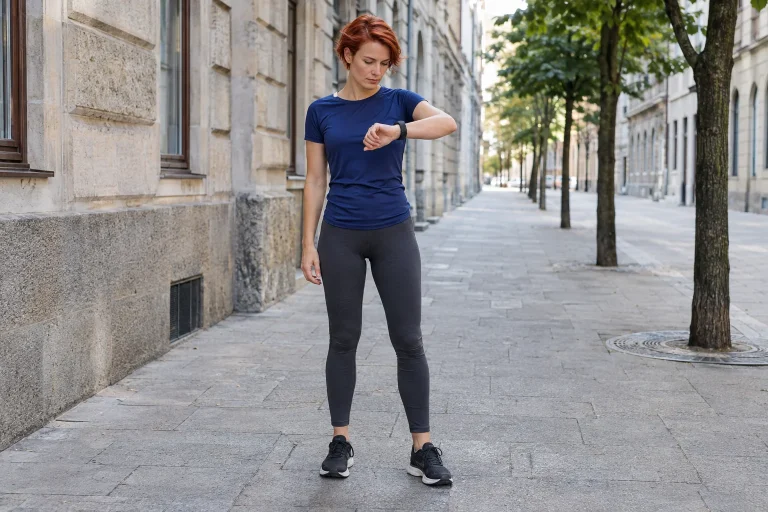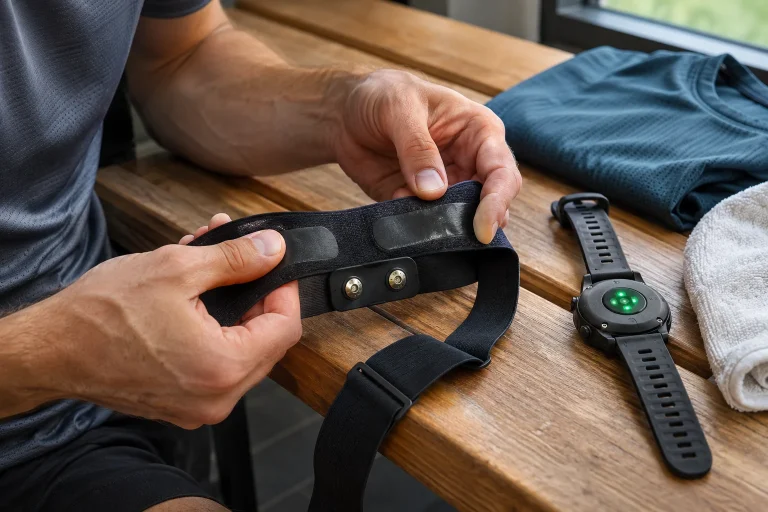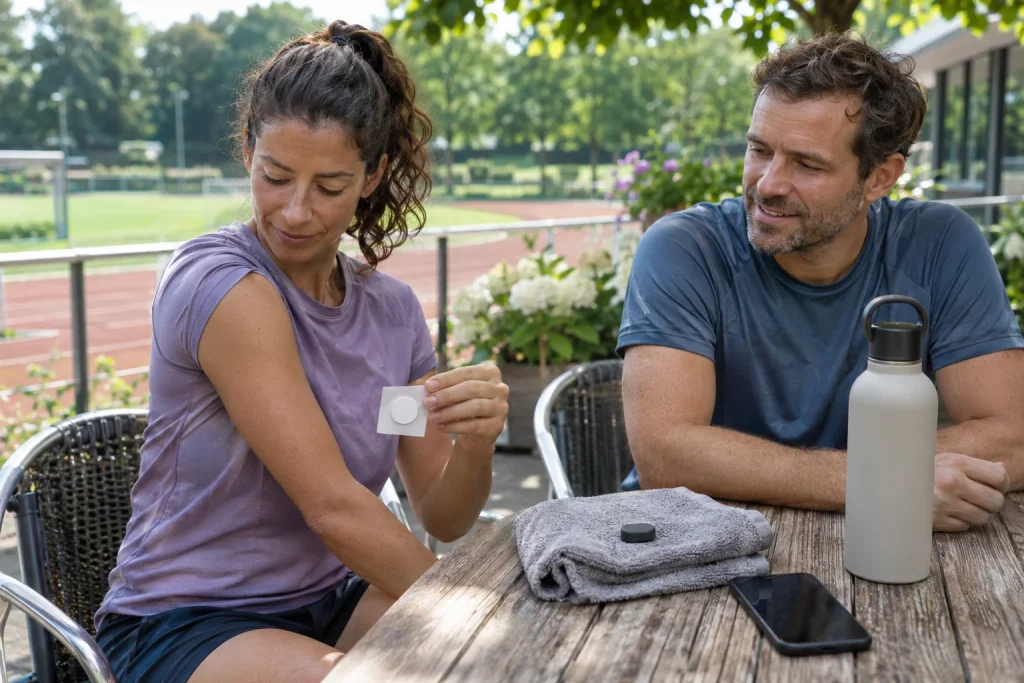
The Nix Hydration Biosensor processes a signal from sweat collected on the upper arm, then uses a proprietary algorithm to estimate whole-body fluid and electrolyte losses. This is more than a watch’s general figure calculated from weather and activity, but differs from laboratory analysis of sweat collected directly from the whole body. Local measurement, whole-body estimation and the app’s drinking recommendation are three separate stages.
This guide draws on manufacturer product and support pages checked on 21 November 2026, together with primary research examining the limits of regional sweat measurement. It is not our own Nix test or a personalised fuelling and hydration plan. The main question is which data reach the log from the patch, and under what conditions they remain interpretable. We do not treat app drinking notifications as mandatory fluid doses for everyone.
What is the rechargeable pod, and what is the consumable patch?
The system’s electronic unit is the pod, which can be charged and reused between sessions. It connects to a single-use sweat patch that adheres to the skin and channels locally produced sweat along the sensing path. The two components have different lifespans. Rechargeable electronics do not make a patch that has already collected sweat reusable.
The product page states a nominal pod battery life of up to 36 hours. This is a manufacturer figure, rather than our measurement, and is not a recommended wear duration for one patch. The patch quantity in a starter pack does not mean unlimited use either. Before buying, check how you will obtain replacements, in what pack size, with which shipping region and final cost. A US webshop price does not automatically establish Hungarian warranty or stock arrangements.
In your budget, treat the pod as a one-off item and patches as per-use costs. For example, planning four selected data-collection sessions in a month means allowing for at least four new patches; this is arithmetic, not a training-frequency recommendation. A session lost to a faulty or pre-filled patch may also use consumables. Choose sessions for a specific data goal before buying a patch subscription or larger pack.
How does a local sweat signal become a whole-body estimate?
Nix’s own research-and-development summary describes electrical impedance sensed at two points and the time taken for sweat to pass between them. These provide information about fluid flowing through the channel and composition-related characteristics. A further model calculates whole-body values from the local upper-arm signal. Displayed whole-body loss therefore does not mean separate sensing at every point on the body.
The manufacturer material also presents bench testing with solutions and proprietary algorithm development. Accurately detecting electrical resistance is a different research question from correctly estimating a moving person’s total sweat loss. Raw-signal measurement error and error in converting local values to whole-body values may be separate layers. We therefore do not automatically extend one high percentage accuracy claim to the full user workflow.
Read four labels separately: loss rate, total loss, concentration and replacement. Our units example: multiplying a concentration of 600 mg/l by one litre of estimated loss gives 600 mg, while half a litre gives 300 mg. These are invented illustrative figures, not recommended sodium doses. Concentration alone does not establish the total amount lost, and neither figure demonstrates current blood sodium.
What does research show about local and whole-body sweat?
The Baker research also cited by the manufacturer was published in 2019: regional and whole-body sweat data were compared in eleven recreational athletes during ninety-minute cycling investigations at two intensities. Participants comprised seven men and four women. Relationships depended on sampling location, and for some locations intensity also needed to enter the prediction equation. Regional measurement is therefore not simply a copy of whole-body data everywhere.
This study is not a standalone test of every function of the Nix system available for purchase today. It provides methodological context for why location and circumstances matter. Laboratory cycling findings should not be transferred as proof for every running pace, winter outfit or age group. Equally, regional differences do not mean that every such sensor is useless for every observation.
A practical reading rule: when comparing two recordings, distinguish sensor site, sport, weather and app version. If these change together, one graph cannot identify the cause of the difference with certainty. Your sweat profile may be an observation built from several circumstances, rather than a lifelong, unchanging “personal saltiness number”. A simpler but accurate description protects against overstatement.
 Enlarge image
A new patch, correct orientation and timely recording start
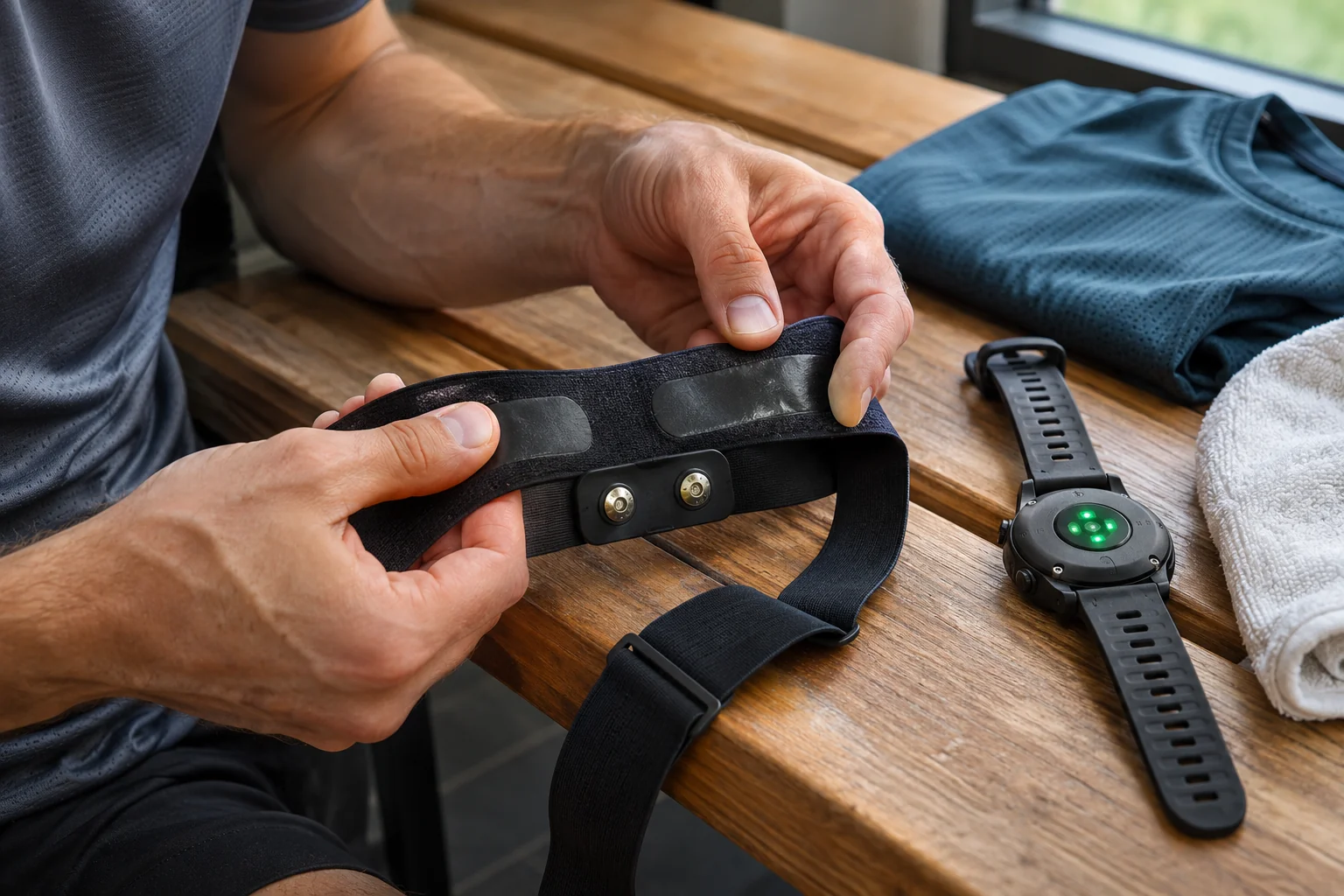
The manufacturer’s getting-started guide requires a new, unused patch, a correctly attached pod and the specified upper-arm placement. Location and orientation matter because of the sweat-flow path, rather than merely appearance. Moving it to another body part does not automatically preserve the same conversion. The editorial photographic illustration described in the caption cannot replace the product’s own placement diagram.
Nix maintains a separate support page for a pre-filled patch. If the patch collects sweat before recording begins, the starting conditions may be wrong; the app may flag this as pre-filled patch. The manufacturer therefore describes starting the app workout immediately after applying the new patch. Drying a previously used patch does not restore a new consumable’s condition.
If this warning appears, do not save only the summary number. Note the circumstances and handle the faulty recording according to the manufacturer’s instructions so it does not distort your average profile. Unusually high or low loss is not necessarily a real physiological change. Check patch condition and recording start before immediately changing the next session’s whole fuelling and hydration plan.
The first minutes and missing data are not drinking instructions
Operation requires active sweating. The manufacturer recommends the product for longer endurance sessions of at least approximately 45 minutes, but this is not an instruction to extend exercise for data. Upper-arm sweating may start later than sweating you already feel elsewhere. An initially blank display does not prove zero fluid loss across your whole body.
The export guide specifically notes that lower loss values associated with other components may appear initially, before upper-arm sweat data arrive. Read the first displayed figure alongside the data-collection state. If suitable data remain absent, check pairing, the patch and supported use conditions, rather than increasing heat exposure to make the sensor work.
Include times in a troubleshooting note: when the app started, when the patch was applied, when the first signal arrived and whether there was a warning. Product support can learn more from this than from one end-of-workout summary. The device’s data-generation start is not the same as the start of your body’s exertion. Knowing the gap helps avoid calculating an apparently overprecise hourly figure from an incomplete recording.
Garmin: data field, phone linking and current version
For Garmin integration, Nix describes appropriate linking of Garmin Connect, Connect IQ and Nix Solo. Installing the watch data field and selecting a device in the Nix Solo account are separate tasks. A Garmin that supports Bluetooth is not automatically compatible with the desired field. Check the exact model and the particular activity’s data screen.
The current Tech Tips Hub also marks Android Garmin support as available, requiring at least Nix Solo version 2.20.1. An old iPhone-only description should therefore not be repeated as the general current position. This version requirement concerns a feature, rather than unlimited support for every future phone and watch. App-store device compatibility can remain a separate requirement.
During an initial check, review the phone log and watch fields in turn. One working while the other does not helps separate sensing from the display chain. Do not delete every connection at once, as that may remove a working configuration too. Notes on your model and version numbers support more targeted help and preserve which system produced the data.
Apple Watch: the 2026 route also needs a phone
The Nix Apple Watch guide explicitly says the integration was redesigned in January 2026. In this documented workflow, the Nix Solo phone app and NixSoloWatch app work together. You must carry the phone for real-time notifications, and start and stop the activity on the phone. This differs from a general watchOS running app recording independently without a phone.
The guide says Apple Watch receives volume-based notifications, rather than time-based ones. Replacement intake can also be logged from the watch using the documented buttons; that does not let the device see inside your bottle. The entered quantity is your record. If you drink a different amount after a notification, actual consumption and logged information may differ. Preserve that distinction in interpretation.
Check minimum system requirements on the current app-store page too. An older watch family named in a support article does not prove every current software configuration can install the latest app. Interpret health-data permissions for the desired function, then review one completed trial recording. Working notifications and saving provide more meaningful evidence than a successfully installed icon.
Loss, logged drinking and blood sodium are separate data
Nix fluid- and electrolyte-loss estimates are not direct blood tests. Sweat Composition, Electrolyte Loss and Sodium Loss should not be treated as synonyms either. We do not derive our own universal sodium proportion or replacement command from total electrolyte quantity. The manufacturer’s displayed values also depend on its calculation model and entered profile information.
The Wilderness Medical Society guideline on exercise-associated hyponatraemia specifically emphasises avoiding excessive drinking. A sodium-containing drink does not make consuming too much fluid harmless. We therefore do not automatically convert an app’s estimated loss into an amount to drink immediately in full. Fluid strategy also depends on individual health and exertion circumstances; illness or medically prescribed fluid restriction requires individual discussion.
Headache, nausea and weakness can occur in several conditions; a sweat sensor cannot distinguish them. Confusion, collapse or severe illness make stopping exertion and seeking urgent help more important than quickly balancing the app’s “deficit”. Do not try to diagnose or treat an uncertain condition yourself with large fluid amounts. The device provides sporting data, rather than an emergency treatment decision.
 Enlarge image
Export and TrainingPeaks: current support instead of an old promise
The Nix download guide describes per-workout export from at least Nix Solo version 2.23, with minute-by-minute loss data in a spreadsheet file. Review the time series as well as the summary average, especially with an initial delay or faulty-patch flag. A table does not mean every row is raw, model-free laboratory data: processed fields also contain the device’s calculations.
TrainingPeaks integration now has a detailed support page; an older product introduction calling it a future plan is less current. Nix specifies at least Solo version 2.43, with automatic synchronisation of activities after connection. Older workouts follow a separate manual-upload route. Linking accounts therefore does not necessarily backfill the entire earlier history automatically.
For a transfer trial, check one new recording’s timestamp, units and available fields in the destination system. Share only the necessary data for discussing a fuelling and hydration plan, rather than account login details. Sending the same activity through two services can duplicate the log. Integration’s value lies in traceable, clearly named data, rather than the number of authorised connections.
Who might gain useful extra information from Nix?
An appropriate question might be how your correctly recorded sweat estimate changes across different sessions you already plan to do. That needs a new patch, consistent placement and well-documented conditions. Do not choose a hotter time, longer run or thicker clothing for the sensor. Repeating incomplete data collection must not take priority over your own exercise capacity either.
A less appropriate expectation is that one patch will give exact drinking and salt quantities for every future race. A profile calculated from a local sample has context and uncertainty. Feedback may become more useful when interpreted with a sports dietitian or appropriate professional as part of the whole log and your experience. This does not make the product diagnostic in itself or necessary for everyone.
At the decision point, be able to name three things: your observation goal, the cost of repeatedly collecting those data and who will interpret the result. With those clear, Nix may add specific information to an existing training log. If you expect an automatic, infallible “drink this much” answer, the system would promise more than its actual data path supports. Useful use starts with knowing the boundary between measurement and conclusion.
Sources and verification context
Primary manufacturer support, a research paper and a professional guideline; checked on 21 November 2026. Regional sweat research does not validate the complete Nix product system.
- Nix Hydration Biosensor – package and nominal battery life
- Nix’s own research-and-development summary
- Baker and colleagues, 2019: regional and whole-body electrolyte losses
- Getting started, a new patch and recording sequence
- Pre-filled patches and flagging faulty data
- FAQ – active sweating, local measurement and connections
- Garmin Connect, Connect IQ and Nix Solo setup
- Current support hub – Android/Garmin and TrainingPeaks versions
- Apple Watch data path redesigned in January 2026
- Wilderness Medical Society – exercise-associated hyponatraemia guideline
- Exporting workout data and interpreting the initial period
- TrainingPeaks connection and separate uploading of earlier activities
How Futószív articles are prepared: our editorial guidelines.