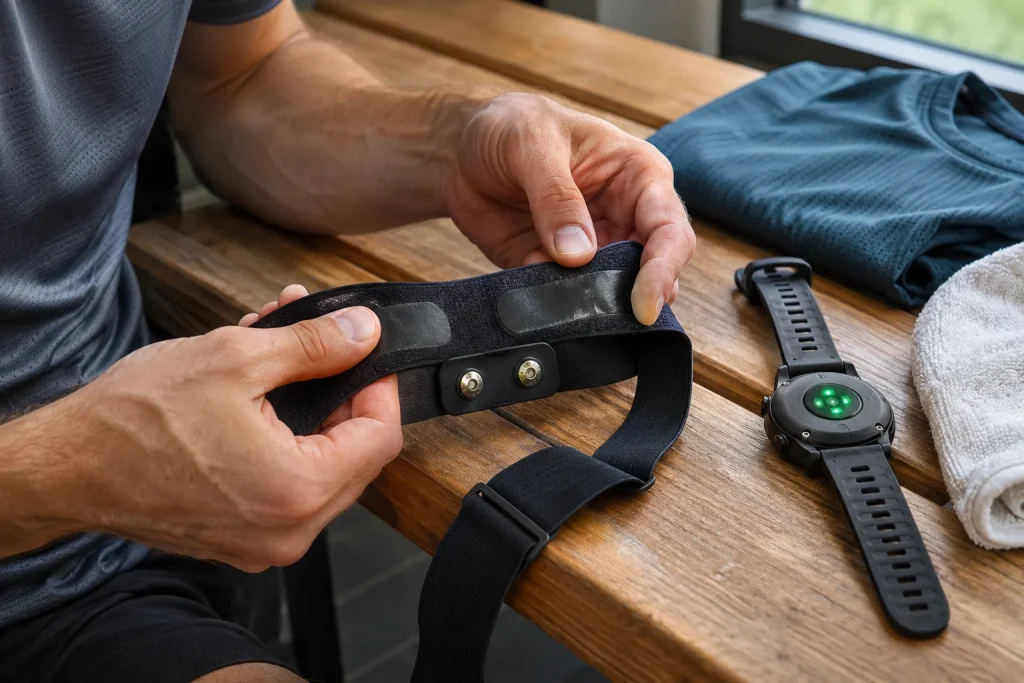
One heart-rate number appears on a running watch, but devices do not all reach it by the same route. Wrist measurement is convenient because the watch is usually already on you. A chest strap requires separate fitting and care but offers a useful alternative in some training situations. The choice is not a dispute between “serious” and “comfort-loving” runners. First clarify your use for the data, how quickly changes need tracking and which device you can wear consistently and correctly. The best system is one whose limitations you know too.
Two signals lead to the same number
Wrist optical measurement uses light to observe blood-flow changes near the skin. Chest-strap electrodes instead detect an electrical signal associated with heart activity and calculate heart rate from it. The particular device’s construction determines details. The Polar technology explanation describes the optical principle and practical limitations accessibly. Different principles mean the systems are not necessarily sensitive to the same external circumstances.
Sports heart-rate measurement and medical examination are separate tasks. Electrical sensing does not automatically make a chest strap a diagnostic ECG examination. Any separate health functions on a watch are not the same as its continuous running heart-rate field either. Interpret functions according to the manufacturer’s current intended purpose. This article concerns training data, not methods for ruling out heart disease, diagnosing arrhythmias or reassuringly reclassifying symptoms. With symptoms, do not continue the equipment debate.
What do you need heart rate for?
General tracking of an easy run needs different precision and handling from detailed analysis of short, rapid changes. A mostly stable wrist trend can help observe overall demands. If training uses narrow target zones, signal quality and sound zone boundaries matter more. These are separate: zones can be poorly set even with an accurate monitor. Before buying, ask not which device is “most accurate”, but what decision you would make from its number.
Write specific examples. Do you want to notice an unusually demanding familiar run? Examine changes between intervals? Work with a coach requesting particular data? Or simply view the summary? Purpose determines acceptable compromises in comfort, price and maintenance. Every run does not need equal data. If constant display-watching unsettles otherwise easy activity, simplify usage rather than necessarily adding another sensor.
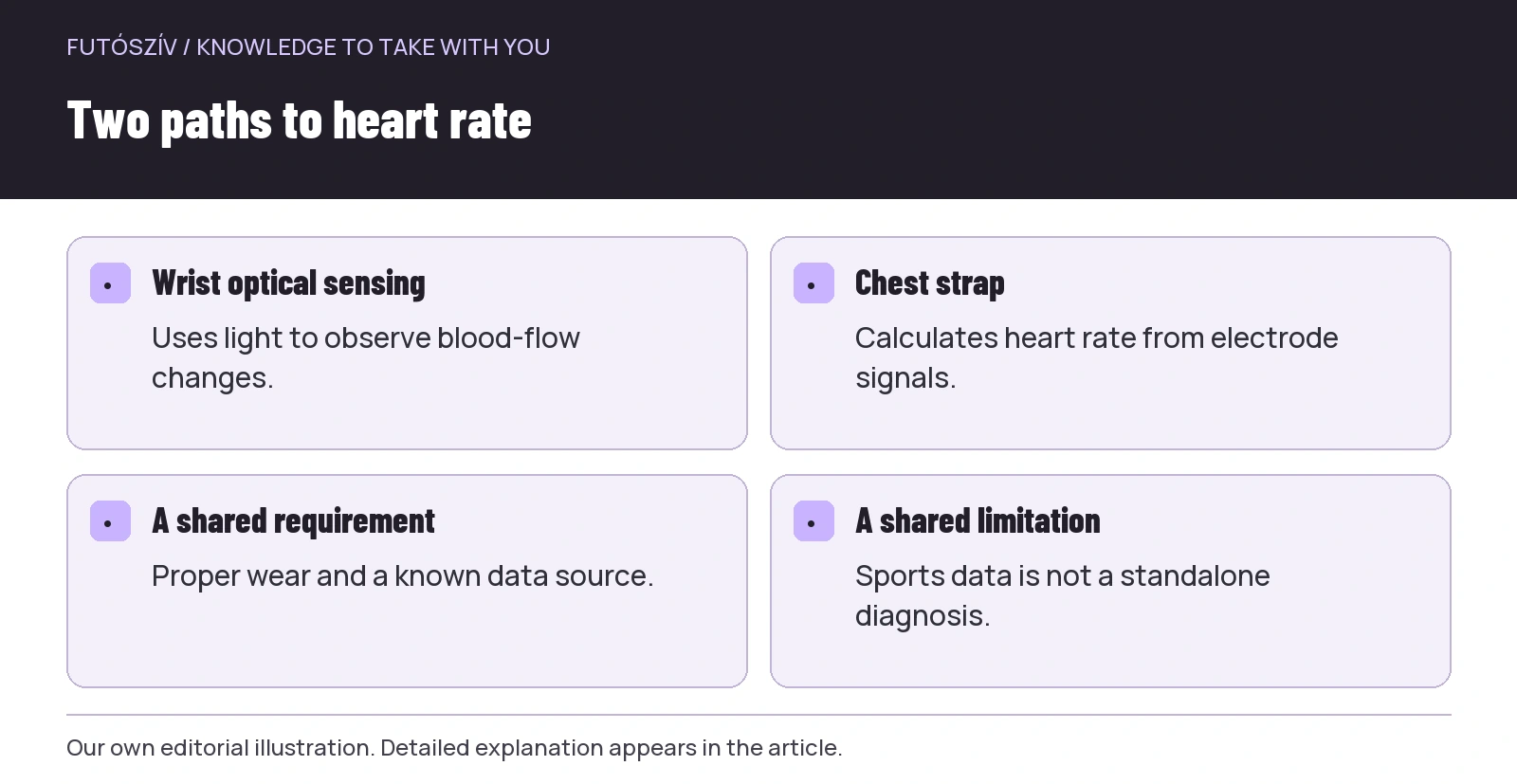 Enlarge diagram
Text version of the illustration
- Wrist optical sensing
- Uses light to observe blood-flow changes.
- Chest strap
- Calculates heart rate from electrode signals.
- A shared requirement
- Proper wear and a known data source.
- A shared limitation
- Sports data is not a standalone diagnosis.
Fit is fundamental to wrist measurement
Wear the watch at the manufacturer’s recommended position and snugness without sliding around. Proper adjustment does not mean uncomfortable constriction. Movement lifting it from skin can degrade the signal; excessive tightness makes wearing unpleasant. The Apple measurement-accuracy guidance also highlights fit and lists factors including skin perfusion, cold and some tattoos. These are possibilities, not personal diagnoses of why a particular run’s data went wrong.
Try the watch with the jacket, gloves and top you actually run in. An elastic cuff can shift it, while hurried dressing may place it over the wrist bone. Check stability and pressure before starting. Keep the sensor surface clean as instructed. Attachment and cleanliness are simple potential errors, yet often omitted when an odd curve immediately prompts a technological verdict. Checking does not guarantee flawless data but gives interpretation a better starting point.
Cold, movement and rapid changes
An optical system needs an adequate signal, while motion introduces interference. In cold, wrist-skin blood flow can change; a loose watch may shift; rapid effort changes pose a different task from steady jogging. Polar also describes such limitations and recommends a chest strap in certain situations. This does not make every wrist reading bad or every strap flawless. Ask what happens on your usual runs, and when.
Heart rate is a biological response, so its actual change does not coincide exactly with an instantaneous acceleration. For short intervals, pace, duration and sensation provide different information from heart rate rising later. Measurement and display processing can add further effects. Do not chase a target heart rate in the first seconds of a short acceleration simply because the number is still low. Understand the training purpose and guiding signal beforehand. With a coach, discuss which data matters when.
A chest strap is not a maintenance-free source of truth
Contact, positioning and condition matter. The Polar H10 manual describes, for example, moistening electrodes and correct fitting. For another model, follow its own manual rather than copying a friend’s routine. A loose, worn or misplaced strap can produce faulty data. Aim to keep it correctly positioned while allowing free, comfortable running.
A strap can conflict with a sports bra, vest strap or clothing seam. Test the whole setup together. Do not discover before an important session that the transmitter sits under a rigid buckle. With skin irritation, do not simply tighten more. Check fit, cleaning and instructions, seeking help if necessary. Getting accustomed and enduring discomfort are different here too. An accurate device regularly left unworn offers little to the training diary.
Pairing: are you really seeing the intended sensor?
With a separate sensor, check an actual connection to the correct device. Appearing among previously paired accessories does not always mean its data was recorded on this run. Learn the device indication and post-session source information. Several sensors or apps make connections especially easy to confuse. Configure calmly rather than trying to fix everything while running between screens.
Connection type, simultaneous connections and storage differ by product. Before buying, verify current compatibility of your watch and sensor through official sources. A setup working on a friend’s phone does not establish every desired function in yours. If you expect more metrics than basic heart rate, check them separately. Extra numbers may require specific support or processing. A precise compatibility question can be much cheaper than a later exchange.
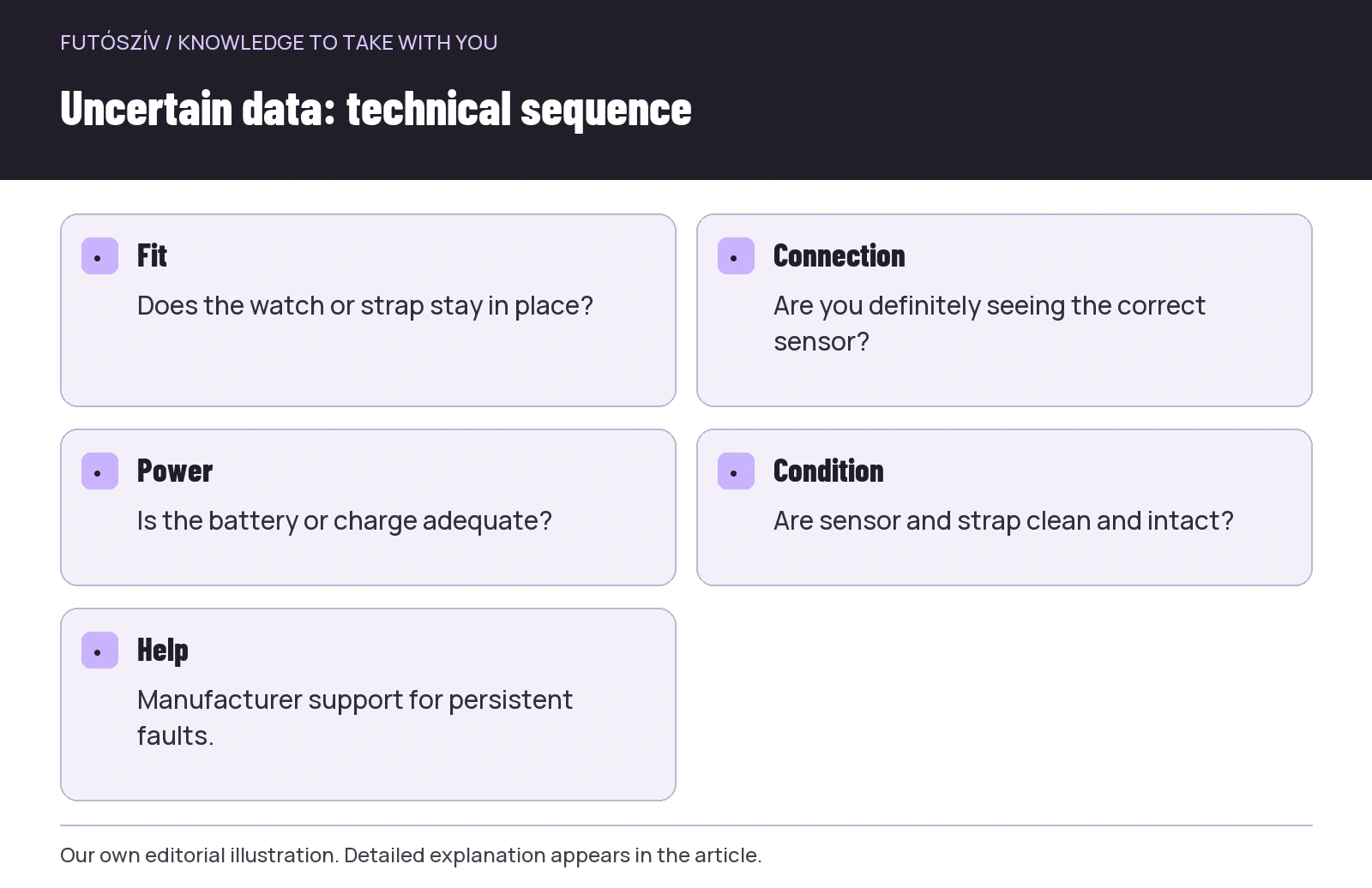 Enlarge diagram
Text version of the illustration
- Fit
- Does the watch or strap stay in place?
- Connection
- Are you definitely seeing the correct sensor?
- Power
- Is the battery or charge adequate?
- Condition
- Are sensor and strap clean and intact?
- Help
- Manufacturer support for persistent faults.
What can comparison studies teach us?
Original validation research compares sporting devices with reference methods. The study by Gillinov and colleagues found differing accuracy among the wearables tested during aerobic exercise. Such results matter but always concern particular models, participants and tasks. A device list from years ago is not a current shopping ranking. The central lesson is that measurement quality depends on circumstances and a confident consumer display should not be treated as error-free.
Comparing your own devices can reveal usual behaviour but is not medical certification. When readings differ, you cannot always know which is wrong or by how much. Compare during a predetermined, suitable easy run rather than maximal effort performed for the data. Inspect attachment, connection and the time curve. Describe the specific phenomenon: noisy at first then stable, delayed on acceleration or missing during a section. This also helps manufacturer support more than simply “inaccurate”.
| Observation | Technical check | Interpretation limit |
|---|---|---|
| An odd number at the start | Wear, contact, attachment and connection | Do not automatically declare every discrepancy an error |
| A different curve during a short acceleration | Signal source, display mode and measurement conditions | Heart rate is not an instantaneous pace meter |
| A drifting or interrupted signal | Battery or charge, strap condition and pairing | Missing data does not equal low effort |
| Two devices disagree | The same run and a precisely known source | Two consumer measurements do not provide a standalone diagnosis |
Read the curve alongside the session’s story
Before post-session detail, recall what happened: stops, climbs, taking off the watch and how you felt. An average can conceal many stories, and the highest outlier may be unrepresentative. Trends need adequate-quality data from similar circumstances. Note switching from wrist one week to strap another. An apparent change may partly reflect a changed measurement system rather than training adaptation alone.
Keep measured values, algorithmic conclusions and personal experience separate. Heart rate is data; calculated training load or recovery advice is already a model’s output. Uncertain input calls for more caution with its score too. Do not rearrange an otherwise suitable session for a single attractive score. A useful diary adds a sentence: “cold start; the first ten minutes’ signal seemed uncertain” or “comfortable run, stable strap”. Differences become easier to understand later.
Clean and store according to your own manual
A fabric strap and transmitter may not be washable in the same way. The H10 care guidance treats components separately and emphasises cleaning and appropriate drying. Read this as a model-specific example. Follow your own device’s temperature, detergent, separation and storage instructions. A strap may be a replaceable wear item; a faulty signal does not automatically require replacing the whole system.
Create a routine you can actually sustain. After running, separate components as instructed, clean, dry and store them. Check the watch sensor and band’s cleanliness too. For repeated errors, follow a simple order: use and fit, connection, power, condition and manufacturer support. Do not try to “fix” health symptoms through that technical sequence. Sports data is a useful companion in its proper place: helping understand training without taking over bodily signals or medical assessment.
Sources and further reading
- Polar: how wrist optical measurement works
- Apple: more accurate activity and heart-rate measurement
- Gillinov and colleagues: heart-rate monitor accuracy during aerobic exercise
- Polar H10: correct fitting
- Polar H10: care
How Futószív articles are prepared: our editorial guidelines.