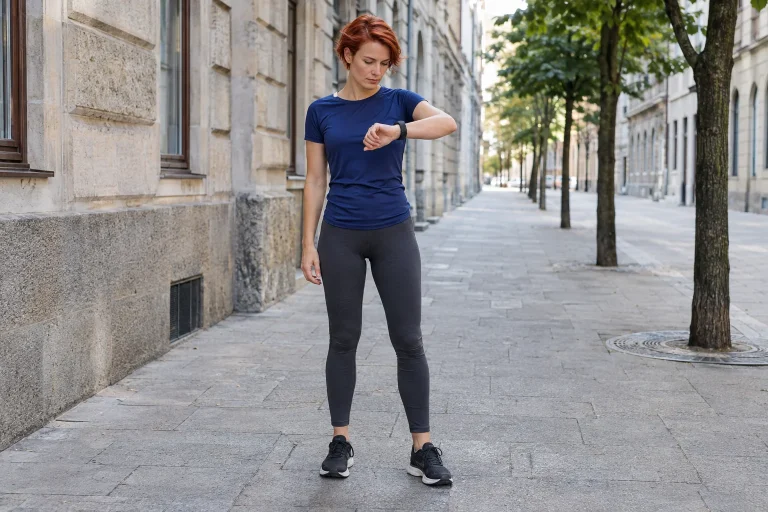
The hDrop Gen 2 is a reusable electrode-based sensor that comes into contact with sweat. You do not need a new sweat-collection patch for each recording, but the system still has requirements: appropriate skin contact, correct placement, an activity started in the app and checked synchronisation. Whole-body fluid and sodium losses are algorithmic estimates, rather than direct collection of all the body’s sweat.
This guide, checked on 21 November 2026, is not our own product test. It compares manufacturer descriptions with two 2026 research sources showing different situations and limitations. It separates the local signal, whole-body estimate, watch display and final app analysis. We do not turn sodium estimates into automatic salt-dosing instructions or describe a hydration score as a medical diagnosis.
A reusable sensor: what disappears, and what still needs doing?
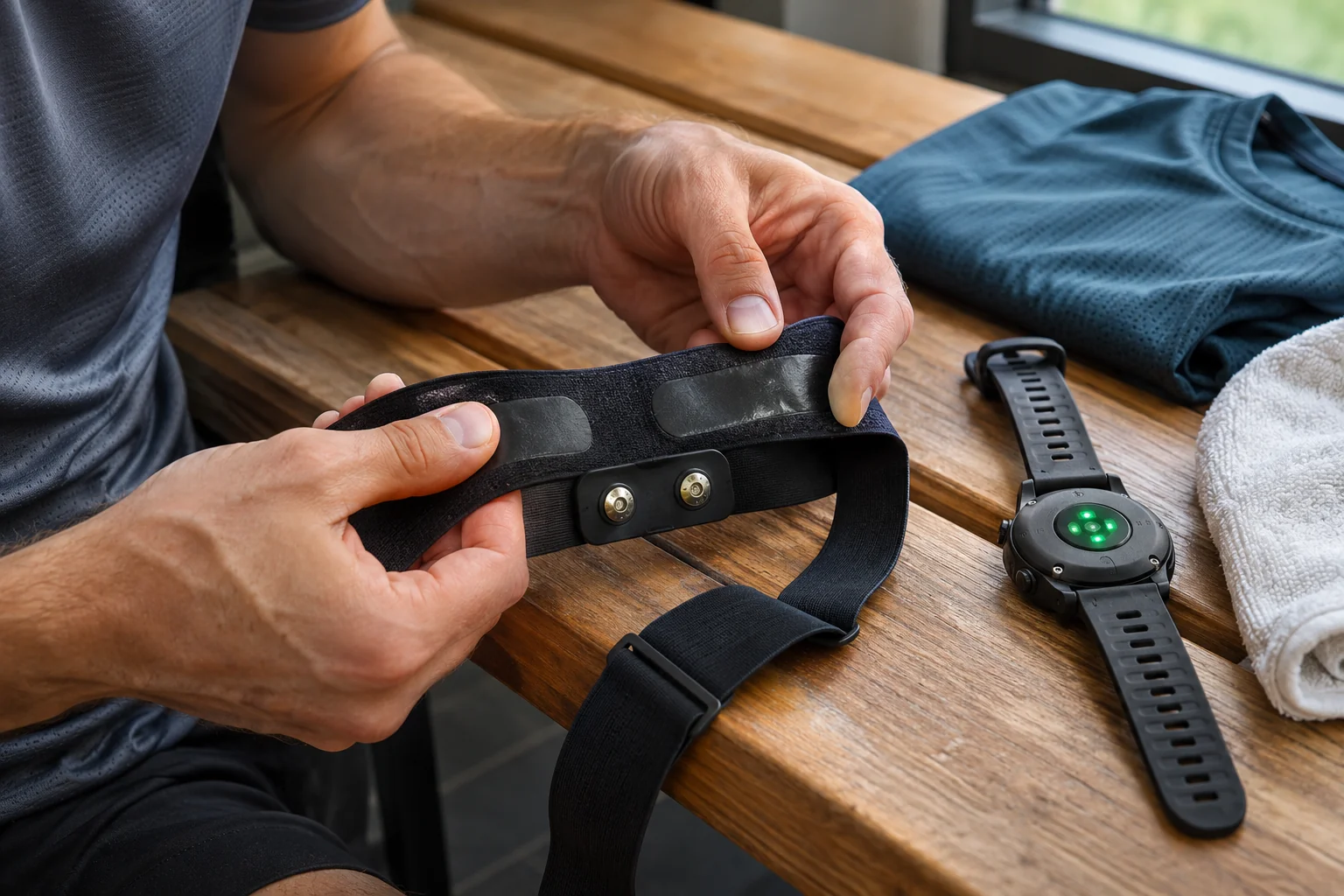
hDrop offers its skin-contact sensing surface as reusable hardware. Current documentation describes an attachment strap or placement on a suitable chest strap instead of a disposable patch. This gives the product a different cost structure from a system requiring a new microfluidic patch each time. It does not make it maintenance-free: contact cleanliness and attachment condition matter for every recording.
Gen 2 must also be distinguished from the earlier Gen 1. A battery-removal troubleshooting step for the old version should not be transferred to rechargeable Gen 2. The current setup guide describes waking it by charging and adding a new device in the app. A shared family name does not authorise hardware procedures from any earlier manual.
First define the repeated observation you want to make. Reuse may be convenient if you want to compare your different training situations. If you expect one certain drinking answer for every run, the sensor cannot resolve that question. More sessions add value only if recording locations, circumstances and data quality remain traceable.
Loss figures calculated from a local electrical signal
The manufacturer describes the electrode sensor as observing electrical properties of sweat present at the skin and using proprietary processing to generate loss data. Sweat Rate concerns sweating per unit time, Fluid Loss is total loss, and Sodium Loss is estimated sodium loss. The metrics description treats temperature as that of the device or near-skin environment; it is not estimated core body temperature.
Sodium concentration and sodium loss are different. Our arithmetic example: if two imaginary recordings have the same concentration but one has twice the estimated fluid volume, their total calculated sodium loss may differ too. This only illustrates the relationship between quantity and concentration; it is neither an hDrop accuracy figure nor a replacement dose. Blood sodium still cannot be read directly from it.
Do not simply look for the largest number in the app. Interpret the unit, duration and calculation level together. A steadily rising total-loss curve does not itself mean faster sweating: cumulative quantity increases even at a constant rate. Slope and total are separate observations worth distinguishing when reviewing a log with a professional too.
Placement: a heart-rate strap does not imply heart-rate measurement
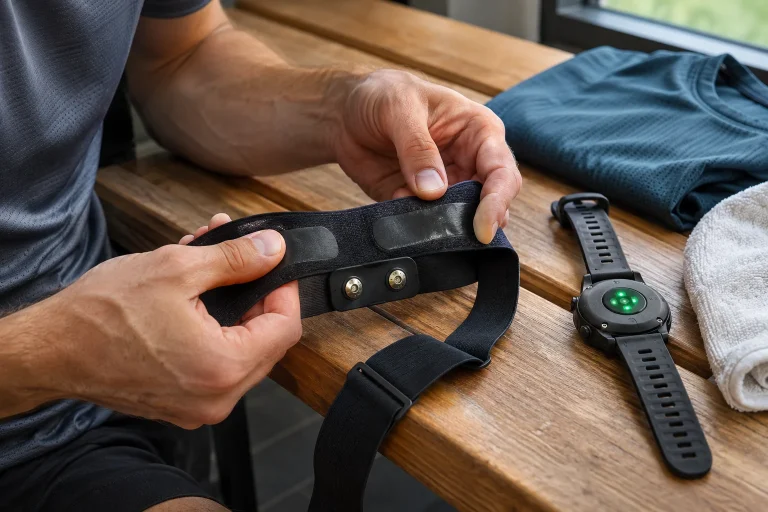
Current hDrop guides describe both the back of the upper arm and a specified chest-strap position. The Wahoo guide, for example, mentions placing the sensor towards the front of a chest strap without covering its heart-rate electrodes. Always check exact placement in your own current instructions. Some earlier general FAQs mention only the upper arm, so differing descriptions should not be randomly combined.
The chest strap may serve as an attachment surface here, rather than proving that hDrop itself becomes a heart-rate monitor. Heart-rate data require their own sensor and data path. Likewise, an electrode touching a damp garment does not necessarily provide the same contact as a device correctly worn against the skin. Mechanical placement can directly affect the processed signal.
In a fit check, assess stability and comfort rather than seeking the tightest possible strap. Sensor movement, contact with another liquid or interrupted contact are important notes to keep with the data. Record a change of body location between recordings too. Portability does not mean the device works everywhere using the same whole-body conversion.
 Enlarge image
What the May 2026 conference abstract actually says
Sellner and colleagues described two matched one-hour treadmill or cycling trials in nineteen active participants at 27 degrees Celsius and 50 percent humidity. In this sample, hDrop’s mean fluid-loss figure did not differ significantly from the laboratory comparison. However, it estimated sweat sodium concentration higher: the reported mean difference was around 12 mmol/L, with wide individual limits of agreement.
The publication is a 2026 American Physiology Summit conference abstract in a Physiology supplement. The publisher notes that the journal’s editorial board was not involved in its peer review. We do not describe it as a full product validation with every detail available and editorial peer review. Fluid-loss and sodium findings must be treated separately too; a more favourable observation for one does not automatically validate the other.
We therefore do not use the manufacturer’s approximately 92 and 87 percent accuracy wording as a guarantee for every environment and individual value. Average agreement can coexist with wide individual differences. Ask which conditions, reference method and outcome the research concerned. The word “validated” alone cannot tell you.
The September 2026 field study found further limitations
Snyder and colleagues’ Nutrients paper evaluated hDrop Gen 2 during training in male university football players. Eighteen of 38 training observations produced a sweat-loss estimate; where data were available, substantial individual discrepancies and proportional bias were found. The immediate hydration score showed no demonstrated relationship with the urine specific gravity assessed. The findings therefore did not support straightforward interchangeability with the reference procedures.
This is a small exploratory field study, rather than a final verdict for every athlete and subsequent algorithm. It reports 2025 training sessions, a particular app version and a specific group. Nevertheless, that evidence cannot be hidden behind more favourable product marketing figures. Accurate presentation preserves both the study’s limitations and its practical warning.
Together, the two 2026 sources show why one percentage label is insufficient. Controlled running or cycling, variable football training, fluid estimation and an instantaneous score are different research tasks. Claim only what the data path and circumstances support for your own recording. A term with health implications needs stronger evidence than an attractive time series appearing in an app.
Garmin: the app handoff and three-session baseline
The documented Garmin connection uses the hDrop Scores Connect IQ data field. The manufacturer’s guide separately discusses a baseline formed after the first three app activities and setting up the data field. It must also be assigned to a screen in the sport profile used. A watch-family name alone does not establish compatibility; check the particular model in the Connect IQ listing.
Start the activity in the hDrop app first, then use Connect with Garmin to hand the connection to the external device. The manufacturer says the phone can then stay at home in the documented Garmin workflow. At the end, after closing the watch activity, reconnect to the hDrop app for full synchronisation. Live data on your wrist do not automatically replace this subsequent step.
Baseline and Sweat Zones are terms specific to this system. The metrics description discusses newer zones replacing the previous score, while the data field may still be named hDrop Scores. This does not establish medically normal or abnormal hydration. Manage your baseline’s development and settings according to the current app, rather than applying the colours of an old screenshot to every current version.
One Bluetooth receiver and the limits of cycling integrations
The current Wahoo guide describes one simultaneous Bluetooth connection for Gen 2. Handoff between the app and external display is therefore a real operational step. The documented Wahoo models are ELEMNT ACE, BOLT 3 and ROAM 3; support cannot automatically be extended to earlier ELEMNT generations. Suitable app and firmware versions are part of the requirements too.
Through the appropriate route, Wahoo may display live fluid- and sodium-loss fields and record FIT data, while detailed post-activity analysis happens in the hDrop app. Hammerhead has a separate extension. These are cycling-computer integrations: they do not prove that any running watch or Bluetooth treadmill automatically supports the sensor. As a runner, choose a receiver for your own use chain.
When troubleshooting, first check which receiver is currently connected. If the app occupies the only connection, searching on another device alone will not help. Live transmission and the sensor’s own memory are distinct concepts too. Later backfilling into the app is not the same as automatically repairing an incomplete file on an external device. Review the log of one complete trial before regular use.
TrainingPeaks and Strava: summaries appear in different places
The TrainingPeaks integration describes a metrics card and a comment associated with the corresponding activity. A FIT graph saved through the Garmin data field follows another data path. Both the manufacturer and TrainingPeaks support note that the watch’s simplified algorithm summary may differ from the app’s final processing. Your final hDrop summary and an interim display value therefore need not represent the same calculation state.
The currently available Strava connection adds the analysed workout’s available total sweat, sodium and potassium losses to the corresponding Strava activity description. It is not a live Strava stream. The activity must already exist on Strava, internet access is needed, and opening the appropriate hDrop analysis initiates the documented synchronisation. The manufacturer says existing personal notes are retained.
Consider visibility when sharing too. A summary added to a workout description may appear where others view your run. Third-party access and the audience for your sports log are separate settings. On the first transferred activity, check what entered the description and who can see it. Successful synchronisation is no reason to authorise every account you can connect.
 Enlarge image
Hardware without a mandatory subscription, optional hDrop Lab
The manufacturer does not require a subscription or disposable patches for basic Gen 2 sensor use. However, the publisher’s App Store page also lists a separate hDrop Lab membership for deeper analysis and additional personalised guidance. This is an optional, automatically renewing add-on. “No mandatory subscription” is therefore not the same as every current and future app feature being included free with the hardware.
Separate sensor price, accessories, optional membership and the final shipping total on your purchasing list. Store region and platform may show different fees or available packages. Read the contents and renewal conditions on the payment screen; we do not describe a US list price as a Hungarian final price here. Owning the hardware does not automatically make the extra membership necessary.
The phone app requires a compatible hDrop sensor; installation alone does not enable sweat measurement by the phone. The publisher’s current Google Play page also notes sensor, firmware and device dependencies. If planning your own log export or analysis with a professional, check the access level for the fields you need rather than inferring it from a general “detailed analysis” label.
Cleaning and the estimate’s role in running decisions
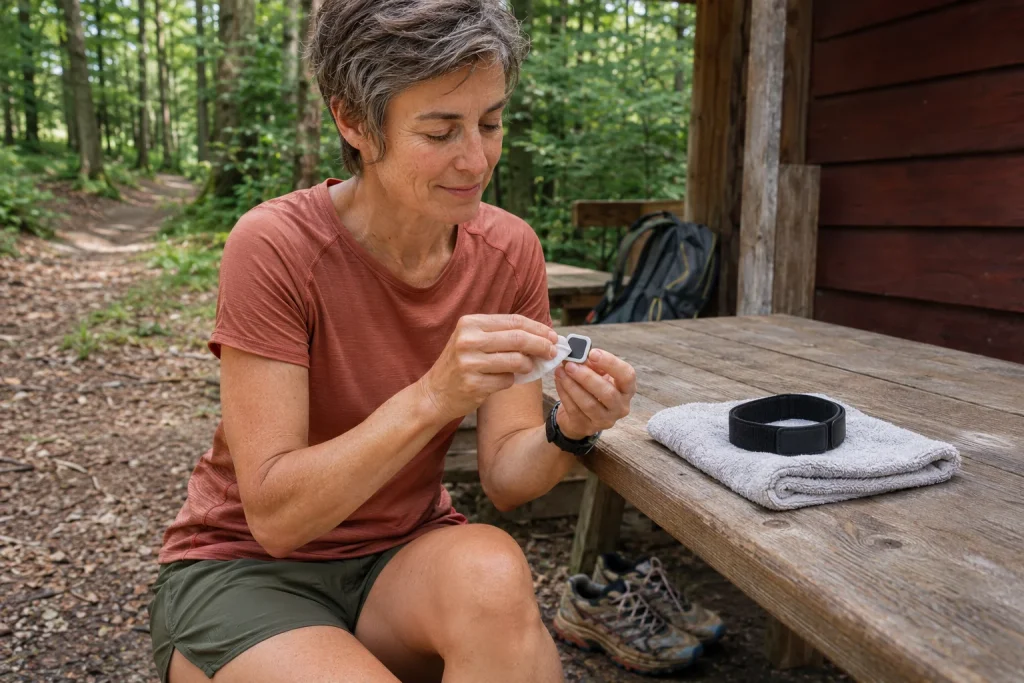
The manufacturer’s care instructions call for gently cleaning the electrode surface with an alcohol prep wipe and allowing it to dry, rather than washing it with water. Detach the strap, hand-wash it separately with soapy water and dry it fully. Water-rinsing care for another sensor cannot automatically be transferred to hDrop. The photographic illustration does not show electronics being cleaned under running water either.
Offline mode means app use without an internet connection and later upload; it does not necessarily mean phone-free starting and stopping along every route. The product’s activity-duration limit is a technical boundary, rather than a recommended ultrarunning duration. Even with suitable power, a started recording and completed synchronisation, retain contextual notes. Do not replace a missing result with zero loss.
hDrop can provide sporting information, but does not replace blood tests or assessment of illness. The manufacturer explicitly defines it as a non-medical device. Reusability and convenient integration are useful features, while uncertainty around sodium estimation is a real limitation. A sound decision considers both: what the system actually adds to your log, and what must not be inferred from its numbers.
Sources and verification context
Manufacturer and app-publisher documentation, a conference abstract and a primary field study; checked on 21 November 2026. We do not present overall accuracy claims as our own testing.
- hDrop current product and care overview
- Gen 2 basic use, reusability and subscription
- Manufacturer’s explanation of operation and accuracy claims
- Sellner and colleagues, 2026: conference abstract with 19 participants
- Snyder and colleagues, 2026: Gen 2 field pilot study
- Garmin setup, baseline and connection handoff
- Wahoo models, one Bluetooth connection and FIT data
- Gen 2 setup and care
- Loss fields, temperature and Sweat Zones
- TrainingPeaks – distinction between summary and watch FIT data
- Strava – post-activity summary in the activity description
- hDrop publisher’s App Store listing – optional Lab membership
- hDrop publisher’s Google Play listing
How Futószív articles are prepared: our editorial guidelines.