After a few runs, your watch displays a VO2max value, assigns a coloured category and perhaps reports improvement or decline. The number sounds scientific, making it easy to associate more certainty with it than the particular method warrants. Yet the wrist value is an estimate generated from defined data and an algorithm. It may help personal observation if you know how it was produced and its limits. This article explores the concept, calculation conditions, interpretation of research and logging practice. It provides neither a personal health rating nor a maximal-exertion home-testing programme.
What does VO2max mean?
VO2max concerns maximal oxygen uptake: it describes the maximum rate at which the body can take up and use oxygen under appropriate exercise conditions. Running watches usually display it relative to body mass, for example in ml/kg/min. This is not blood oxygen saturation, heart rate or the total oxygen consumed during a run. Do not treat values on similar health screens as interchangeable. Clarify the concept before examining your own device’s number.
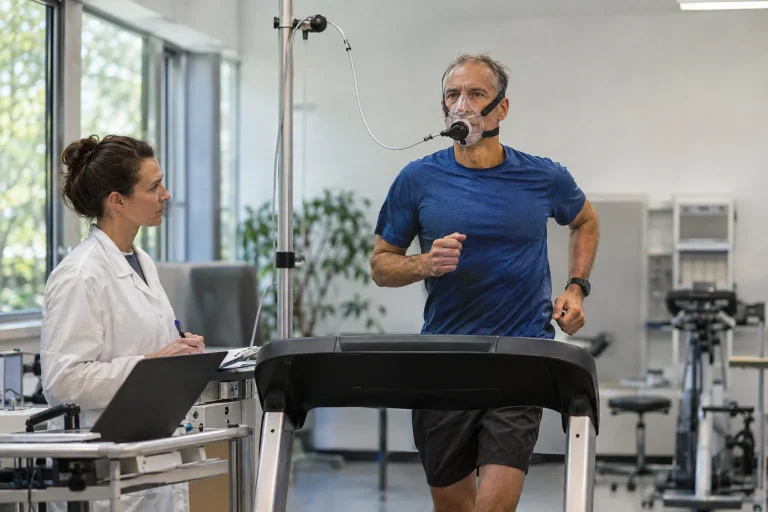
The Apple technical information also distinguishes an exercise test with respiratory-gas analysis from a watch estimate. Such testing requires appropriate professional conditions and procedures; it is not the same as looking at your wrist after running. If you need precise assessment data interpretable for a particular purpose, discuss the method with an appropriate professional. The watch number’s usefulness can be considered separately within its limited role.
What does a watch do without respiratory-gas measurement?
Manufacturer models estimate from different inputs. The 2017 Firstbeat methodological document describes, for example, a procedure using the relationship between heart rate and movement speed and selecting sections considered reliable. This document presents one developer’s method, not the complete algorithms of every current watch. Find which activities, data and conditions your model uses in its official description. Sensor input and the physiological estimate calculated from it are separate steps.
The current Apple support description mentions specific outdoor activities and personal profile information in its own system. Supported activities, initial requirements and limits are product-specific. If the number does not update after an indoor run or another profile, check this first. Not every workout produces a new estimate, and a missing new point is not automatically decline or device failure. Recording an activity and its suitability for a VO2max estimate are separate questions.
Profile information may form part of the number
Check date of birth, height, body mass and any further settings used by the system. Inaccurate personal details can affect the estimate or category, but correct entries do not make the whole method flawless. Do not change them to obtain a more favourable score. If information genuinely changed or was mistyped, correct it through your system and note the date of a significant change. This provides context for a possible jump in the later trend.
Apple’s description also mentions the setting for medication affecting heart rate. This implies no advice to alter medication. Do not change treatment for a watch number; clarify relevant questions with your healthcare professional. Complete the device field only according to reality and official instructions. Understanding circumstances considered by the algorithm belongs to interpreting measurement, but medical decisions should not be transferred into a sports app.
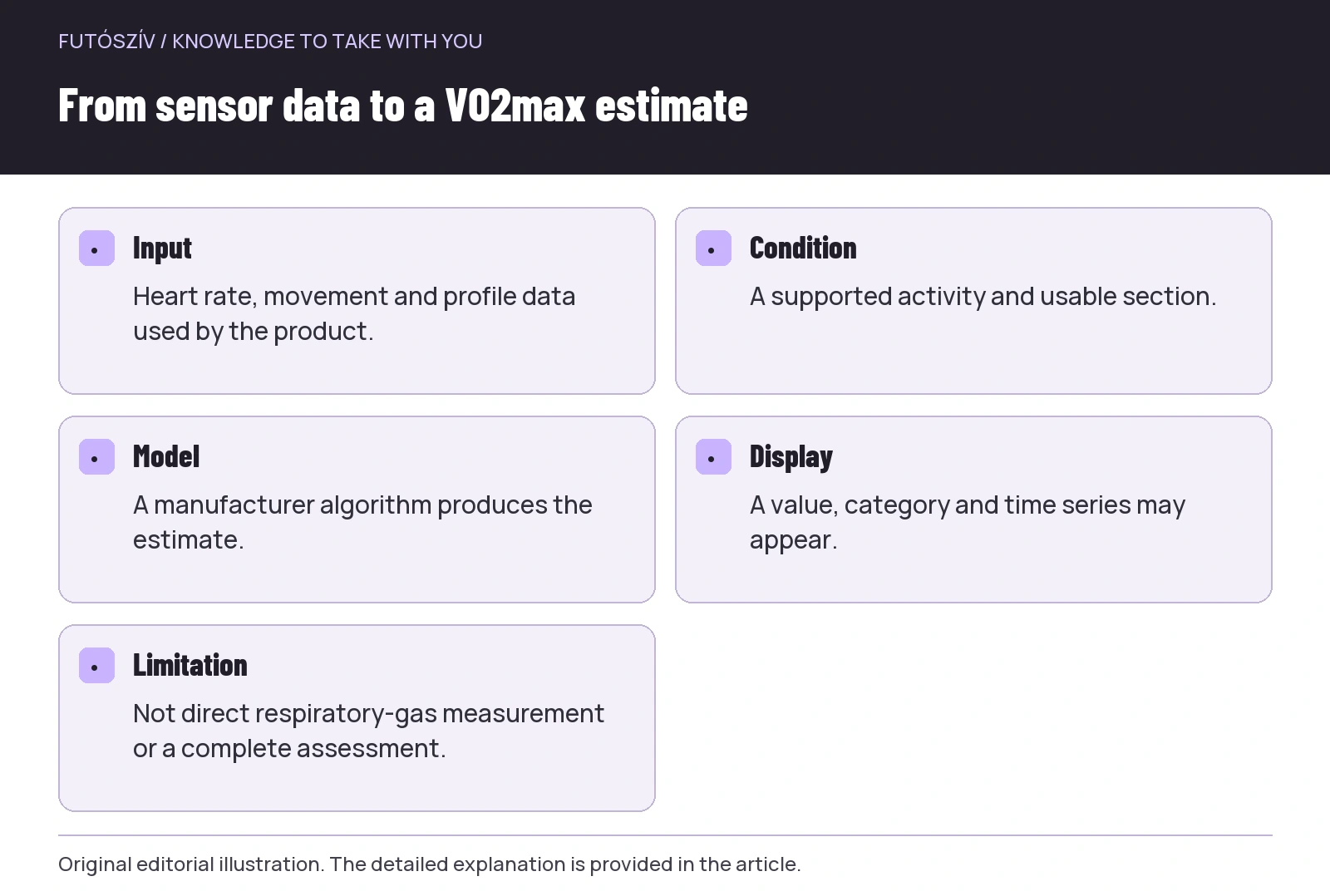 Enlarge diagram
Text version of the illustration
- Input
- Heart rate, movement and profile data used by the product.
- Condition
- A supported activity and usable section.
- Model
- A manufacturer algorithm produces the estimate.
- Display
- A value, category and time series may appear.
- Limitation
- Not direct respiratory-gas measurement or a complete assessment.
Absolute value and trend are different tasks
The absolute value raises the question of how closely the estimate matches data from a suitable reference procedure. A trend shows how estimates in your system change over time. These questions relate but are not identical. A method may consistently differ for one person while following certain changes; elsewhere, time changes may also reflect data or conditions. Do not automatically regard a trend as an exact measure of actual physiological change. Check consistency of measurement conditions first.
The Garmin description of training status also discusses its system’s VO2max estimates within longer-term relationships. One fresh point is not the same as a series from several recordings made under appropriate conditions. If the number changes by one, do not immediately translate it into a fitness change within one day. Check when it updated, which recording it relates to and whether settings or surroundings changed. A time perspective is part of reading a log, not a guarantee that every point is accurate.
What does a validation study establish?
For a study, the exact watch, software, participant group, reference and test conditions matter. The Forerunner 245 study involving thirty-five endurance athletes compared that device’s estimates with laboratory respiratory-gas analysis and found underestimation in the group. This does not show that every current running watch errs by the same amount or in the same direction for everyone. The study provides evidence for a defined situation. Retain that scope and its limits when drawing conclusions about your own device.
A group’s mean discrepancy is not your personal correction number. Adding a study’s average difference to your watch value and calling it more accurate is poor practice. Individual differences and test conditions may vary. Likewise, strong association between two series does not automatically mean they give identical values person by person. When reading research, ask for which task and population the device was assessed. A scientific reference is informative when this question stays attached.
| Claim | What should you ask alongside it? | What should it not become? |
|---|---|---|
| My watch shows VO2max | An estimate from which inputs? | Proof that direct respiratory-gas measurement occurred |
| The weekly graph improved | Based on how many points and which conditions? | Proof that every change is an exact physiological increase |
| A study found a good result | Which model, sample and reference? | Validation of every watch for every user |
| Two devices differ | Are the methods and conditions the same? | The assumption that the more favourable value is correct |
| The category is favourable | Based on which comparison group? | Personal health clearance |
Interpret the category within its own system
A textual level or colour often relates to a reference class. Read which age or other category the system compares with. Crossing a classification boundary can look more dramatic than the small numerical change itself. This is a display characteristic, not necessarily a sudden transformation. One brand’s label and another’s colour cannot be directly converted. Understand your value through its unit, time and category basis, rather than reading only the evaluative word.
Do not attach a quick story to other runners’ numbers either. Identical categories may conceal different histories, body-mass relationships and estimation methods. Many factors shape race results, so one VO2max estimate is not a complete ranking of runners. Practical use should begin with understanding your own consistently collected series. The display does not measure the value of your runs or judge your effort. It attempts to summarise an estimate of a particular physiological concept within defined limits.
Conditions and data quality alongside the trend
If a change recurs, examine the related recordings and sources. Was heart rate questionable, pace uncertain, a sensor new or a profile changed? Temperature, route and other conditions may differ too. Learn from your device’s documentation which effects the model handles and under what conditions. Assume neither that every condition was perfectly removed nor that nothing is considered. Learn the actual product’s operation rather than rely on a general advertising claim.
A short contextual note may suffice for a genuinely significant change. For example, “new wrist device”, “another source replacing the previous sensor” or “different route types this week”. The aim is retaining known events rather than inventing retrospective explanations for every value. If a recording used for estimation looks faulty, examine the underlying data before trying to improve the final VO2max number manually. The quality of a complex estimate also depends on inputs.
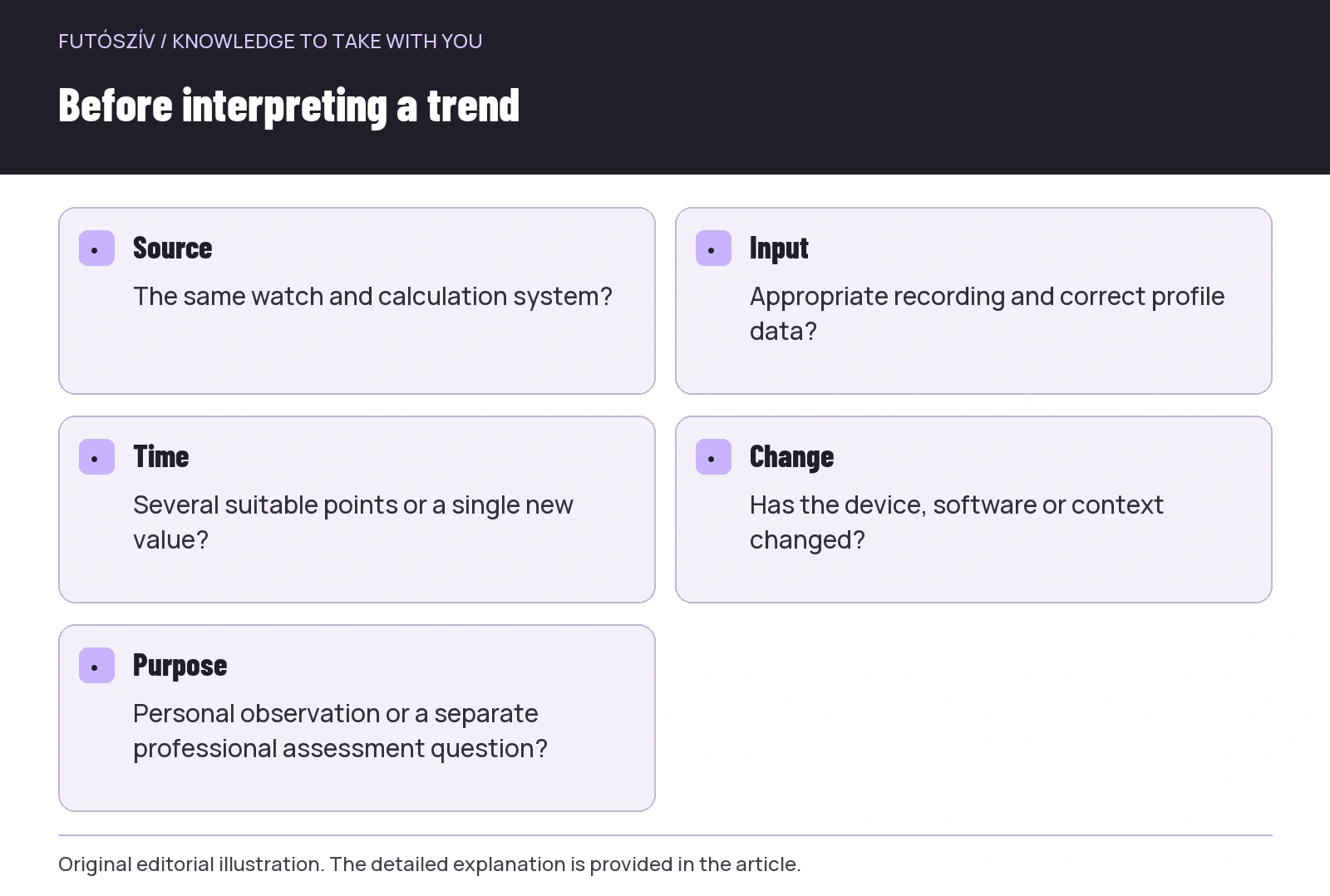 Enlarge diagram
Text version of the illustration
- Source
- The same watch and calculation system?
- Input
- Appropriate recording and correct profile data?
- Time
- Several suitable points or a single new value?
- Change
- Has the device, software or context changed?
- Purpose
- Personal observation or a separate professional assessment question?
Mark the break when software or devices change
An update can alter calculation or display, while a new watch may use different sensors and processing. Apple’s support page, for example, also describes updating earlier estimates within its system. If the log reports such a change, read the explanation and note when it happened. Do not interpret every numerical jump solely as a change in your body. The measurement system’s history also appears in a long trend. Clarify the relationship between earlier data and new processing through the service documentation.
If using two watches in parallel, treat their different estimates as separate sources. Do not automatically average them into a third “true” value or choose whichever you like more each day. Have one clearly named system and interpretive framework for your observation. Comparison may be interesting, but two consumer devices do not necessarily provide independent references for one another. For a precise assessment question, seek suitable professional measurement rather than an arithmetic compromise between wrists.
What can a consistently collected series offer?
It can provide a starting point for questions about when the value updated, after which runs it changed and how consistent it is within your system. It may help reveal a longer-term difference to examine alongside other properly interpreted data and circumstances. This does not require seeking maximal exertion daily or rewriting training to increase a watch score. Understanding the manufacturer’s normal usage conditions comes first. Let the trend remain one view in your log, rather than the exclusive basis for every decision.
Add run tasks, comparable results and your own brief feedback alongside the estimate. With a coach, these together can prompt a more precise conversation than one coloured card. Distance, time and circumstances still concern your running directly, while VO2max adds a model layer. Neither removes the other’s value. Transparency means using each value with weight appropriate to its meaning, without building excessively precise conclusions on uncertain parts.
When should you seek a different kind of help?
If the device gives no value, first check compatibility, supported profiles and data conditions with the manufacturer. If unsure how to interpret it for a training goal, coaching or sports-science support serves another role. Health symptoms, recurring unusual exercise tolerance or worrying signs need clarification with a healthcare professional. These three questions do not merge. A favourable watch estimate does not rule out a health problem, and an unfavourable value alone does not diagnose illness. Digital data can accompany the appropriate conversation.
Finally, retain five things when reading your own VO2max screen: it is an estimate, the method is product-dependent, underlying data quality matters, trend conditions need checking, and the value does not summarise your entire running performance or health. Understanding this makes the number less of a daily judgement and more traceable information. You can ask useful questions and seek answers in the appropriate place. The wrist estimate then becomes part of your deliberate data reading, with its limitations understood.
Sources and further reading
- Apple – Using Apple Watch to Estimate Cardio Fitness with VO2 Max
- Firstbeat – Automated Fitness Level Estimation, 2017
- Apple – Track Your Cardio Fitness Levels
- Garmin – Training Status
- Validity of VO2max Estimates from the Forerunner 245 in Trained Endurance Athletes
How Futószív articles are prepared: our editorial guidelines.