You complete a familiar loop and the watch displays a long recovery time. The next day the score is good, yet you feel tired. These situations can tempt you either to obey the device unquestioningly or dismiss it as worthless. A more useful approach is to understand which question the measure addresses, what it calculates from and what it cannot know about your day. Watch feedback can then inform your own decisions within an appropriate professional framework. This article concerns interpreting consumer-device data; it provides no individual training clearance, diagnosis or symptom-management plan.
Find the feature’s full name first
Recovery time, training readiness, overnight recharge and training status may concern related subjects, but are different measures. An hourly countdown is not the same as a score or feedback across several textual categories. Note the exact name and manufacturer’s official definition. Check which model version and software support it. Green on a friend’s different-brand watch does not necessarily mean the same as on yours. Clarifying meaning is the first comparison step, rather than placing numerical scales side by side.
The Garmin information on recovery time describes estimating readiness for another workout of similar intensity. By contrast, the Garmin Training Readiness manual definition discusses a score formed from several factors and updated throughout the day. These are two features in the same ecosystem. Do not merge them on your device into one universal answer to “should I rest?”.
Which inputs does the system see?
Find data sources in the manufacturer description: recorded exercise, heart rate, sleep estimates, longer history or answers to personal questions may appear. Not every measure uses all of them. If a feature needs information you lack, examine the consequences too. The system cannot interpret an unrecorded workout just like a fully available recording unless it offers a supported input or synchronisation method. All workouts listed on the watch and the data actually used for calculation may differ in scope.
The Polar Recovery Pro description also explains the role of personal history built from measurement and subjective information in its system. This does not mean every watch uses the same questions and procedures. The important lesson is a transparent data journey: what the device measured, what you supplied and what it estimated from these. Separating them makes it easier to understand why feedback can change even when that day’s running distance seems similar.
The initial period may still be building history
A new watch or newly enabled feature does not automatically have a long personal history of you. Manufacturers may specify particular history and usage requirements. Exact duration and necessary data depend on the function, so do not generalise one number of days or weeks to every system. Find how the watch indicates insufficient data and under which conditions it offers fuller feedback. Changes among the first few values are not necessarily the same phenomenon as a shift in a system used consistently for a long time.
A manually imported old run may not provide the same history for every new calculation as a recording made on the device under appropriate conditions. Clarify this from platform support information. A continuous calendar and a continuous series required by a function are different concepts. If changing watches or resuming after a long break, note the date. It may matter when explaining values. You need not manually “persuade” the algorithm into an expected state; understand the data requirements first.
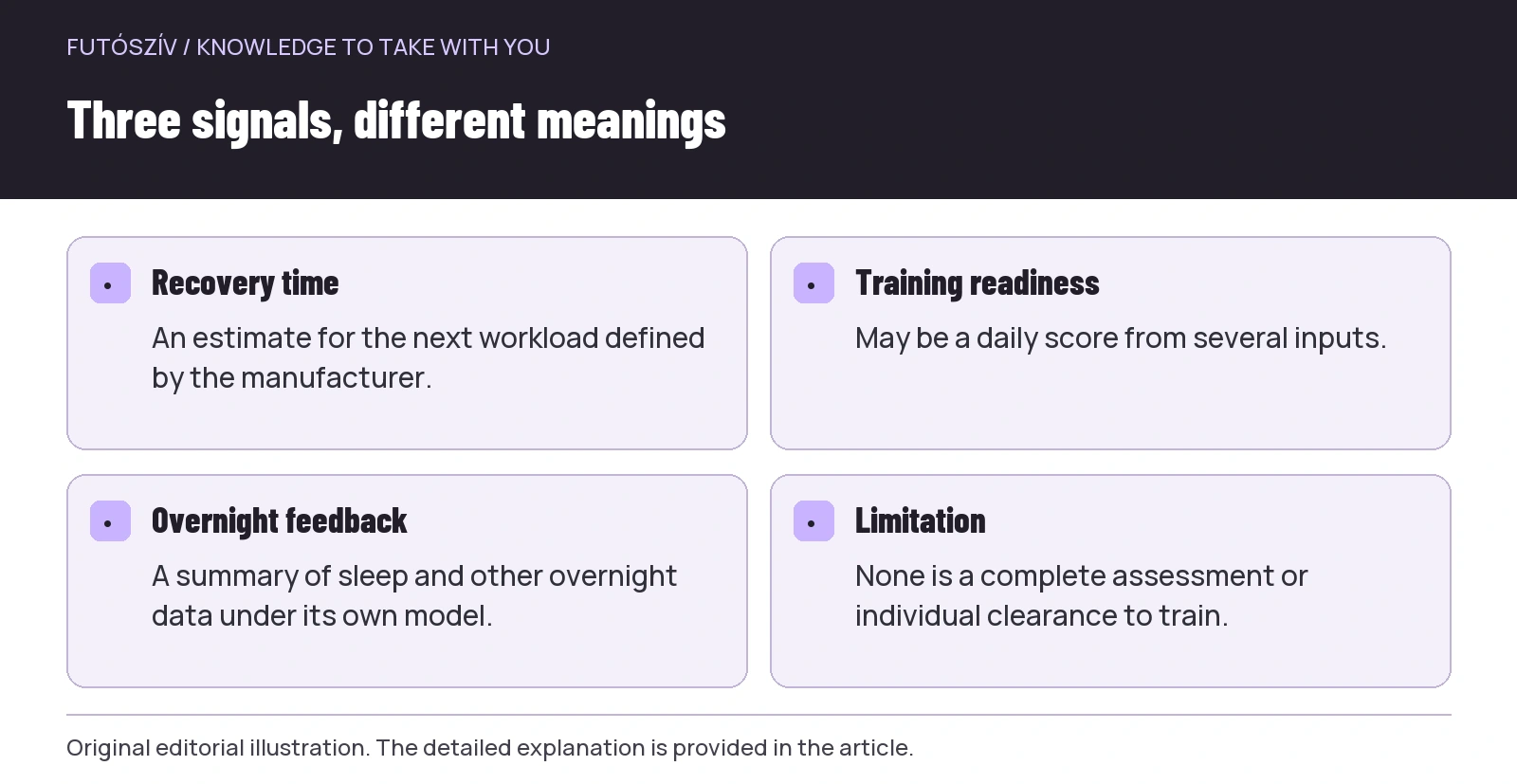 Enlarge diagram
Text version of the illustration
- Recovery time
- An estimate for the next workload defined by the manufacturer.
- Training readiness
- May be a daily score from several inputs.
- Overnight feedback
- A summary of sleep and other overnight data under its own model.
- Limitation
- None is a complete assessment or individual clearance to train.
Do not guess what a long countdown means
If the watch shows many hours, read what they refer to. An estimate for a next demanding session should not automatically become an order for complete immobility. Conversely, a manufacturer not defining its feature as a total-rest prohibition does not give you personal permission for the next run. Your plan, background, wellbeing and professional guidance where needed still matter. Correctly interpreting the feature and making your training decision are connected but separate tasks.
A countdown’s change is not necessarily simple clockwork either. New activity and further information used by the system can alter the estimate. Garmin’s official information also notes that recovery times for several activities are not simply added into one figure. If two similar runs yield different values, look beyond that day’s kilometres. History or data may differ, but narrowing the explanation requires knowing the actual system. A useful question is “which input changed?”, rather than “why are the two numbers unequal?”.
A good score is not a complete assessment
A daily readiness value summarises the inputs specified by the manufacturer. It does not examine every tissue, symptom, loading situation or life circumstance. A favourable colour does not override pain or suspected illness. Clarify questions about your condition with an appropriate professional, particularly for recurring or worsening symptoms. The watch data may at most provide supplementary information with known limitations. Do not turn a consumer score into medical evidence ruling something out.
In the reverse situation, do not immediately manufacture a diagnosis from a low score. Check whether the underlying data was complete, the watch worn correctly and a known circumstance recorded. The “poor” label belongs to the algorithm’s interpretation, not a judgement of the whole person. Do not try to disprove questionable data with an unusually hard test. Let the value prompt understanding rather than a compulsion to prove yourself. Make training decisions in the wider professional and personal framework.
| Watch feedback | A useful first question | What should you not automatically infer? |
|---|---|---|
| Long recovery time | Which next workload does the feature concern? | That all movement is forbidden or definitely permitted |
| Low daily score | Are the inputs available and usable? | That the number alone diagnoses illness |
| High daily score | What does this system examine and what does it omit? | That you can automatically exercise despite symptoms |
| Fluctuating value on a new watch | Has the required personal history been established? | That a few points show a complete trend |
| Two brands give different feedback | Do the functions have the same meaning and inputs? | That the scales can be directly converted |
Overnight data has its own requirements
Overnight feedback may require wearing the device and correctly enabling the function. The Polar Nightly Recharge manual describes, for example, an assessment combining several components and comparing them with your usual level. This is not simply another name for hours slept, nor the same operation as Recovery Pro. Name the specific feature when discussing the morning screen. Several separate data points and comparisons can lie behind a single displayed phrase.
If you did not wear the watch one night, it fitted poorly or reported missing data, account for that in interpretation. Do not randomly replace missing sensor information with an expected good value. Examine overnight numbers consistently within your own system too. Another device’s sleep score may use different inputs and an algorithm, so is not automatically an independent judge. Nor should you address persistent sleep problems by cosmetically improving the daily score. Measurements or estimates and actual experience together create a picture you can question.
Keep brief notes rather than checking hourly
Choose a consistent observation time and record the relevant value with its meaning. If the feature updates during the day, morning and evening points may not summarise the same state. Timing matters in comparison too. A short daily line can include feature name, data completeness, one known circumstance and the agreed training decision. You need not reopen the app constantly to learn from it. Frequent checking yields more numbers, not necessarily more useful information.
Keep notes descriptive, such as “did not wear watch overnight”, “different schedule due to travel” or “yesterday’s heart-rate recording questionable”. Record experienced fatigue in your own words too, without automatically turning it into a formula for rewriting the score. If working with a coach, agree which signal and contextual description they expect. The aim is not explaining every daily movement of the system, but retaining context for important discrepancies. A simple, sustainable routine can span more weeks than an overly detailed spreadsheet quickly abandoned.
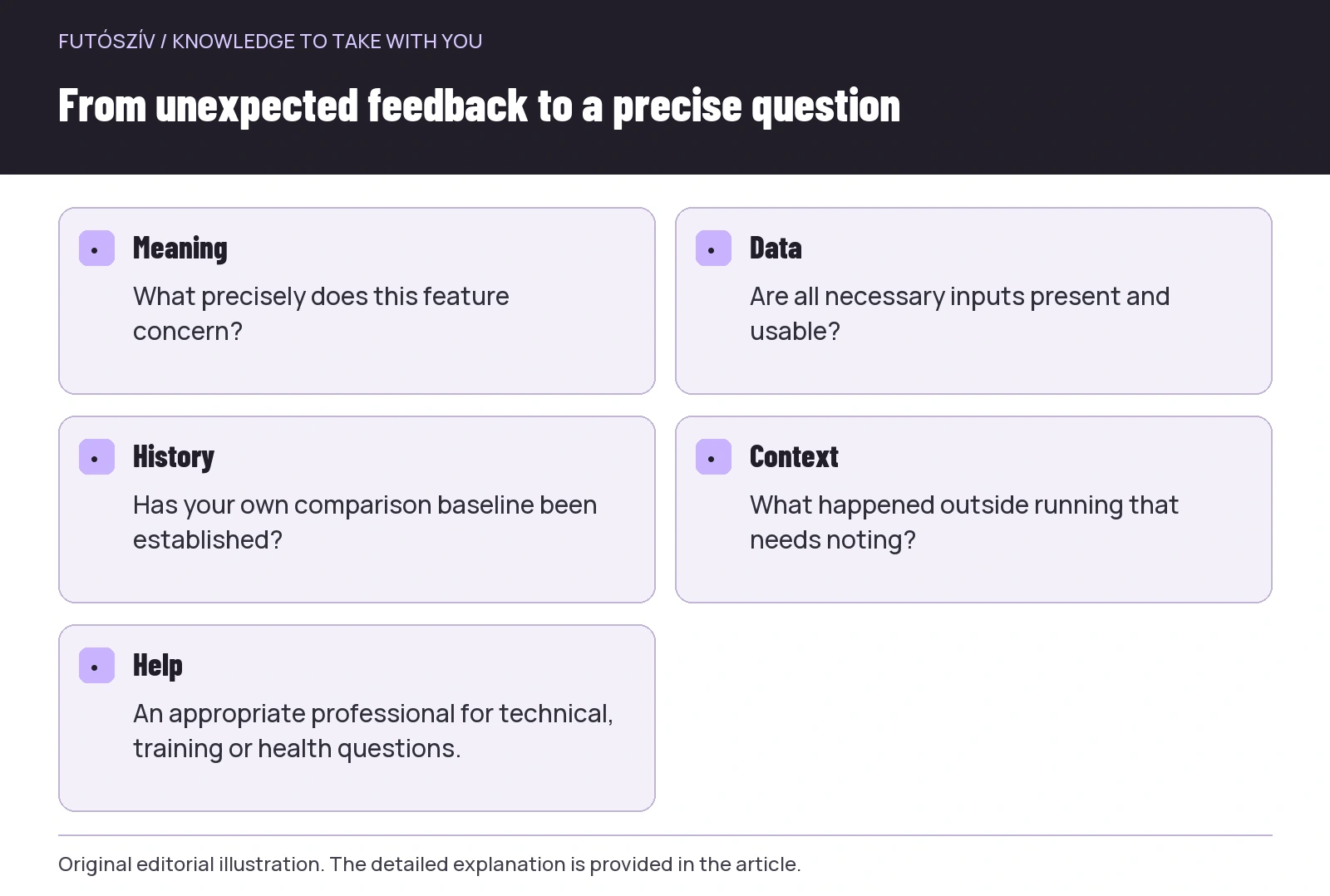 Enlarge diagram
Text version of the illustration
- Meaning
- What precisely does this feature concern?
- Data
- Are all necessary inputs present and usable?
- History
- Has your own comparison baseline been established?
- Context
- What happened outside running that needs noting?
- Help
- An appropriate professional for technical, training or health questions.
Four situations call for different next questions
With a new watch, ask whether the necessary history and correct settings exist. For unexpectedly long recovery time, ask which workout data and previous state it used. For feeling unwell despite a good score, ask which personal information the feature lacks and whom to consult. For an incomplete recording, ask whether the underlying data can support the conclusion at all. These are not scenarios prescribing training decisions. They are questions preventing one answer being forced onto different problems.
For differences between brands, compare full function names, inputs and your own history. Do not choose whichever device gives a more favourable answer each morning, or average different scales simply because all produce values around a hundred or expressed in hours. Comparison may be interesting observation, but is not automatic validation. To follow your own system, consistency and known limitations matter more than a daily contest between devices. Choose specific data for a specific question.
Do not make feedback a performance target
A recovery score is not a task to maximise daily. If you change schedules, watch use or recordings to improve the display, measurement’s original purpose may be lost. Sleep and rest do not derive their value from an app badge. Likewise, do not omit a harder run from data collection to make workload feedback appear more favourable. An accurate log follows real events within known limitations. The device should support decisions rather than become another sporting task to solve.
If you notice daily feedback disproportionately determining your wellbeing, simplify the display or routine. Adjust feature visibility according to your device’s options and keep important decisions within the appropriate professional framework. Every measure need not appear on the first screen. A few meaningfully selected values and your own log are often clearer than following many partly interdependent scores simultaneously. Technology’s usefulness can also be measured by clarity.
Be able to explain these things about your feature
What is its exact name, which data does it use, how much and what kind of history does it require, when does it update and what is it unsuitable for? Answering these five questions puts you in a much better position to read the screen. At the next unexpected value, check data quality and meaning first, then ask a question fitting your circumstances. Help may mean manufacturer support for a technical fault, a coach for the plan or a healthcare professional for genuine symptoms. These three roles do not replace one another.
Recovery advice then remains what it is: a product-specific estimate made from defined inputs. It can be useful when understood and used appropriately, but does not completely summarise your wider story. An hourly countdown, daily score and overnight feedback can sit alongside one another without being merged into an unlimited judgement. Sound data reading produces a more precise next question, giving the device’s data, history and your actual experience a place together.
Sources and further reading
- Garmin – Recovery Time Feature
- Garmin epix – Training Readiness
- Polar – Recovery Pro
- Polar Grit X2 – Nightly Recharge
How Futószív articles are prepared: our editorial guidelines.