
A running diary can be a carefully formatted spreadsheet or three sentences in a notebook. Its usefulness depends on finding something later that helps a choice. Which route worked after dark? Why was departure rushed? How did you decide to shorten? Kilometres alone do not always answer; precise observations can.
If you dislike numbers, you need not adapt to an elaborate system. Keep a diary you actually use, with room for enjoyable, difficult and missed outings. This guide concerns recording methods. A diary is not diagnostic, does not replace coaching or healthcare and need not turn every run into performance assessment.
Define its purpose in one sentence
Choose a main task: easier route choices, understanding scheduling, following an agreed coaching process or remembering good runs? Race preparation and urban exploration need different fields. Serving every aim simultaneously can create administration difficult even to begin.
The Athletics Ireland diary project combines young athletes’ training and study commitments, for example. It serves a specific task. Similarly, make visible what could inform a decision. You need not copy every field from another athlete to create valuable notes.
Start with three sentences
The first describes the outing, the second an important circumstance or event and the third what to retain or change. For example: “I chose an easy run–walk in the local park. The first loop was crowded, so I moved to the wider area. Next time I will start there.” No elaborate data, yet a retrievable situation and next step.
If you like brief labels, use a few consistent words: route, time, company, equipment and decision. They help searching but should not create work. Three consistent fields often beat twenty with different blanks each time. Let the diary fit running, not the reverse.
Observation and interpretation need separate lines
“I stopped twice on the second loop” is observation; “I am a bad runner” judgement. Many useful questions lie between: why stop, how did you start, what happened on the route and what was intended? An immediate general label loses details that could improve the next plan.
Write assumptions separately too. “Perhaps I started fast” is more precise than a confident untested explanation. A similar outing can add information. This matters with symptoms too: describe experience and timing without making a self-diagnosis. Accuracy also supports later professional discussion.
| Less useful statement | More precise note | Possible decision |
|---|---|---|
| It failed again today | Effort felt high soon after starting | Observe the way I start next time |
| The route is awful | I waited a long time at two crossings | Choose another time or fewer crossings |
| These shoes are bad | I adjusted at the right heel on this distance | Check fit and use conditions |
| I was lazy | I got home from work an hour later | Rethink the backup window |
| It was great | A calm start, empty park and clear agreement with company | Try to retain those elements |
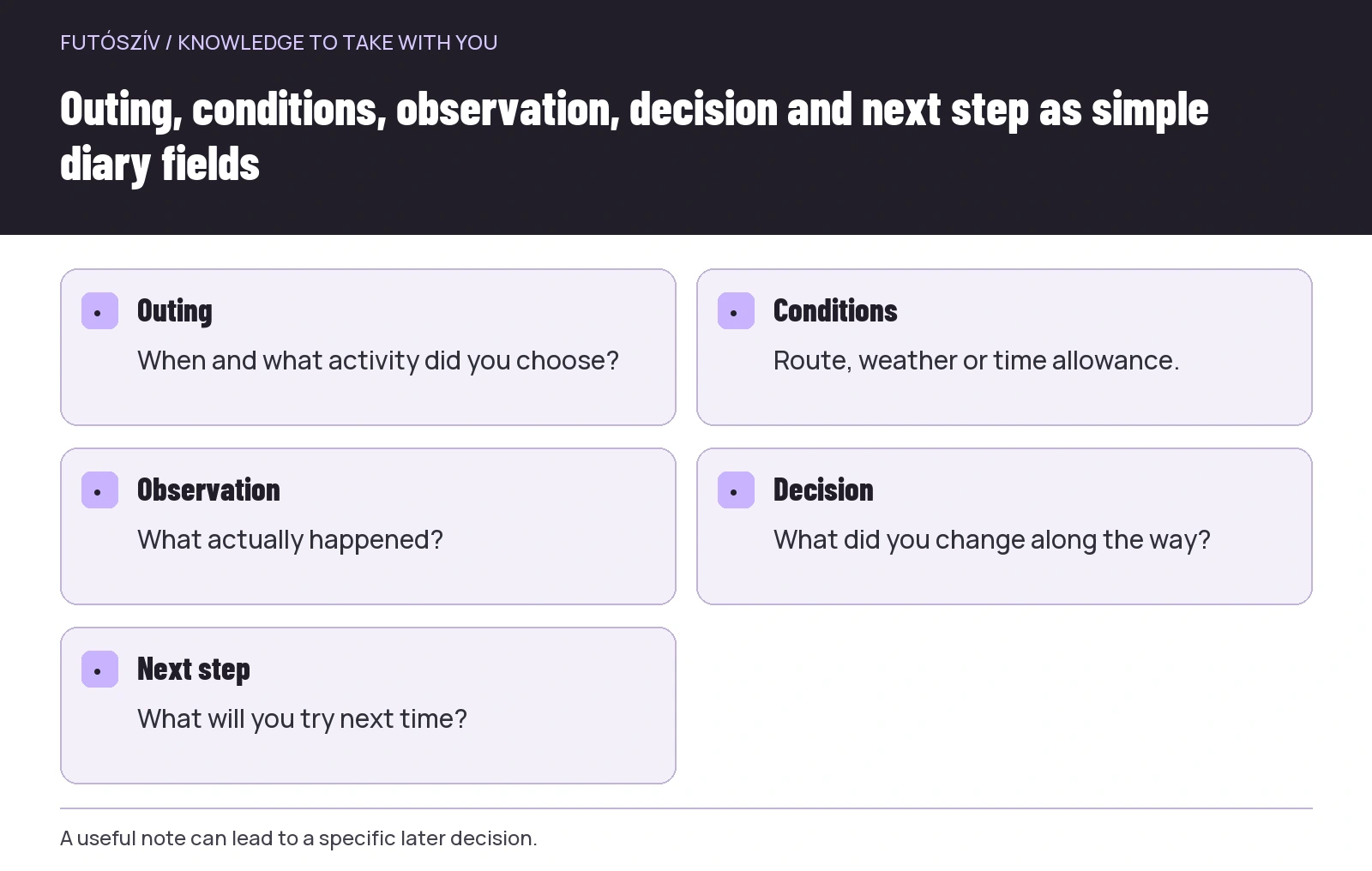 Enlarge diagram
Text version of the illustration
- Outing
- When and what activity did you choose?
- Conditions
- Route, weather or time allowance.
- Observation
- What actually happened?
- Decision
- What did you change along the way?
- Next step
- What will you try next time?
Five fields that later form a story
Outing. Briefly describe easy loop, group run, course exploration, race or run–walk. “Running” alone eventually becomes too broad. Use the session name from a coaching plan if applicable. Details already stored somewhere accessible need not be rewritten.
Conditions. Record only what mattered: strong wind, darkness, unfamiliar company, limited time or changed surfaces. Describe the usage situation rather than every weather figure. “The first riverside section had a headwind” may be clearer later than a temperature without context.
Observation. What happened worth preserving: a shifting phone, good key placement, difficult junction or comfortable shared space? Joyful details belong too. Beautiful light, conversation or a discovered park are real experiences without performance data.
Decision. How did you adapt: shorten, turn into another street, choose a separate pace or wait for a partner? Running skill often appears in these choices. Distance alone hides deliberate adaptation that may provide the next outing’s main example.
Next step. What one thing would you try or retain? Make it achievable and linked to observation. Testing simpler carrying is specific; “be more disciplined” less so. Every run need not launch an improvement project. Repeating a reliable loop can suffice.
Missed outings can have a factual place too
Blank days often look like deficits to erase. Yet they can inform scheduling. Briefly record why you did not go and whether planning needs change. Every rest day need not be explained; deliberate rest fully belongs in the calendar.
Distinguish one-off obstacles from recurring clashes. Unexpected family matters may need no revised plan. The same work task consuming every Tuesday is a pattern. The diary supports organisation, not a prettier row of completed days. Aim for a more workable next week.
Do not leave positive experience as generic praise
Name what made “good” good: simple routes, prepared clothing, agreed pace or less watch-checking? Writing it lets you deliberately restore it. Development includes recognising working answers, not only fixing problems.
The World Athletics article about Nicola Olyslagers shows reflection and journalling in another athletics discipline. You need not copy it as a complete method. The useful idea is that notes can reflect athletes’ own attention rather than only instrument-generated numbers.
Read back weekly rather than judging daily
A brief weekly review reveals patterns. Seek repeated successes, recurring obstacles and exceptions. Every line need not generate a conclusion. New rules after every outing soon overwhelm routine. A few review minutes should simplify.
Five lines can suffice: two outings fitted after work; the distant park took too long to reach; the phone pocket worked; group pace needs clearer agreement; next week use the nearer loop. This preserves organisational knowledge without a score or ranking.
| Review question | What are you seeking? | What excess can you avoid? |
|---|---|---|
| What repeated? | A real pattern across outings | Generalising from one day |
| What worked? | A condition or decision to retain | Noticing faults only |
| What blocked departure? | A specific planning point | Inventing a character label |
| What should stay? | A stable foundation | Changing everything continually |
| What is the one new trial? | A small interpretable change | Solving ten problems at once |
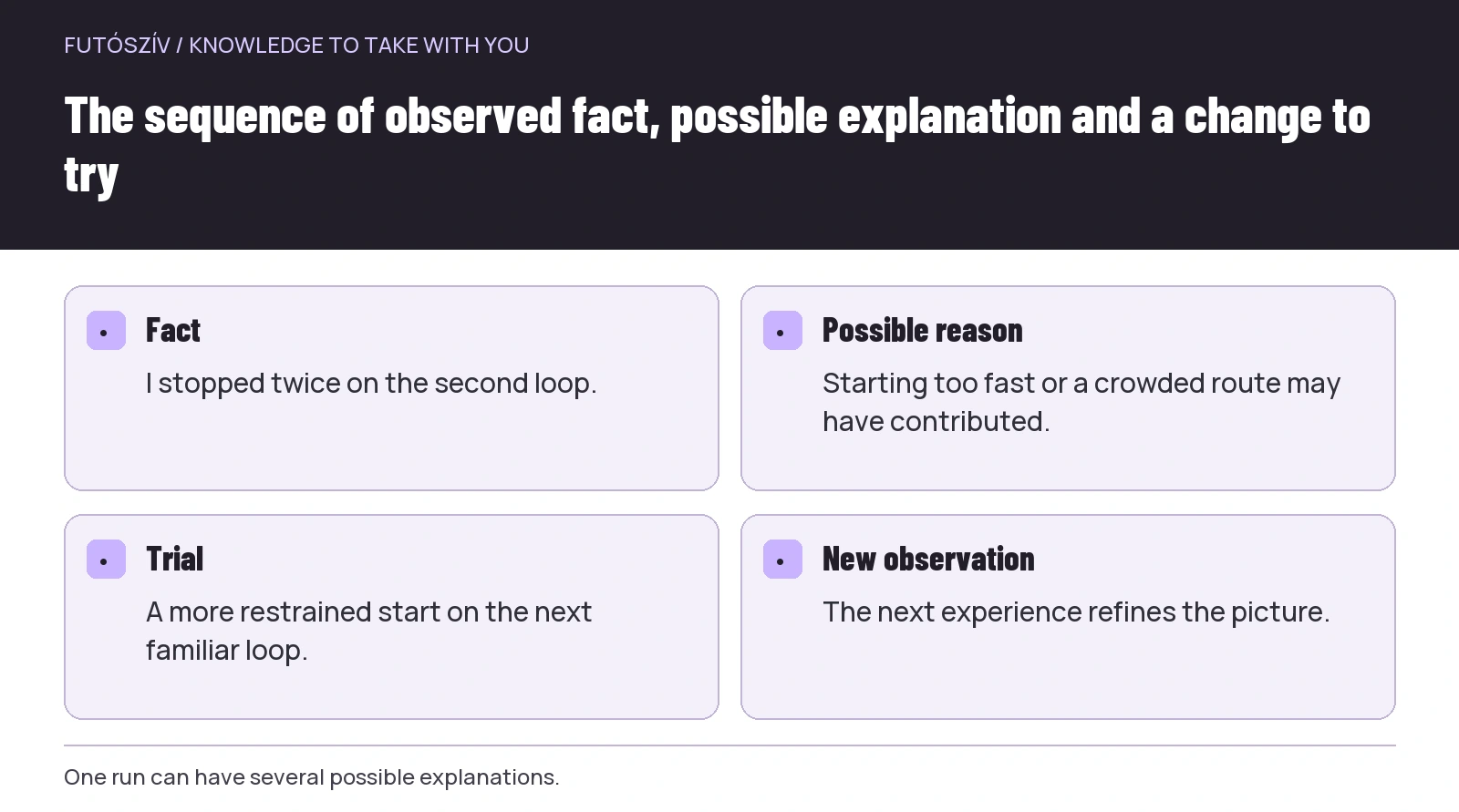 Enlarge diagram
Text version of the illustration
- Fact
- I stopped twice on the second loop.
- Possible reason
- Starting too fast or a crowded route may have contributed.
- Trial
- A more restrained start on the next familiar loop.
- New observation
- The next experience refines the picture.
Paper, notes app or sports platform?
Paper permits free writing without automatic comparisons beside each line, but searching and copying are less convenient. Simple digital notes suit consistent tags and dates. Sports platforms allow personal sentences beside an already recorded session. Choose what you genuinely return to afterwards.
Do not maintain three diaries merely for different appearances. If a watch stores distance, personal notes may simply reference the outing. Loving paper does not require a digital companion. The goal is readability later. Excessive copying can consume the energy intended for preserving experience.
Personal diary and public post have different jobs
Private notes may contain routines, meeting points, personal remarks or a partner’s name you do not want public. Inspect visible details before sharing screens or routes. Honesty is easier when every sentence is not prepared for an audience.
Another person’s story during a shared run does not automatically become your publishable material. Describe your decisions without judging a partner’s pace or situation. When sharing with a coach, agree helpful details. Required fields and personal notes may differ; handle the distinction clearly.
Three entries from one imaginary week
Monday, a short park run. “I chose the nearby loop with limited time. A crowd stood at the entrance, so I started on the wider stretch. It worked and I will start there again.” This preserves route-choice experience without minute-by-minute data, including a clear reason for change.
Thursday, a group outing. “We interpreted the advertised easy pace differently. Halfway I said I would continue separately, and we met at the end. Next time we will discuss activity type and duration too.” This records communication without a general judgement of a friend or shared running.
Sunday, rest instead of the planned outing. “Weekend plans changed and leaving would have been rushed. I did not compress the run into the same evening. I will agree an earlier window for next week.” This helps if repeated, supporting the next calendar decision rather than dressing up a missed run.
When should you add a field?
If repeatedly seeking an answer absent from current notes, add a relevant field. Lighting can help compare dark routes; pockets during a carrying trial; arrival for race travel. Give new fields a specific reason and expected use. Omit them freely if unread after several weeks.
One England Athletics community example connects notes with personal goals and development. Your diary stays useful when adapted to your questions. It need not become more detailed; greater clarity about what matters can make it shorter.
A good diary gives something back
A better time slot, reliable loop, shared memory or more precise coaching question can be enough. Value does not come from daily entries or more data than others. It appears in your own decisions.
Start with few fields, write factually and review for a few minutes weekly. Leave joy, changes and uncertainty in it. The diary then becomes a small manageable memory rather than another task beside running, preserving what is useful before next time.
How Futószív articles are prepared: our editorial guidelines.