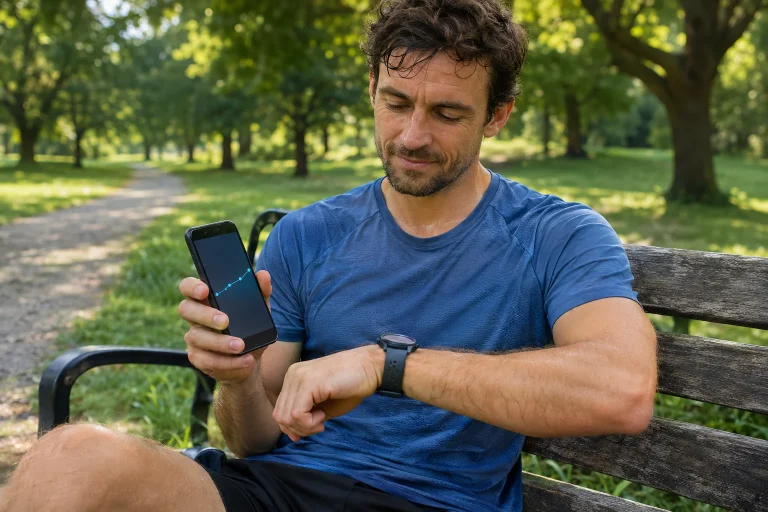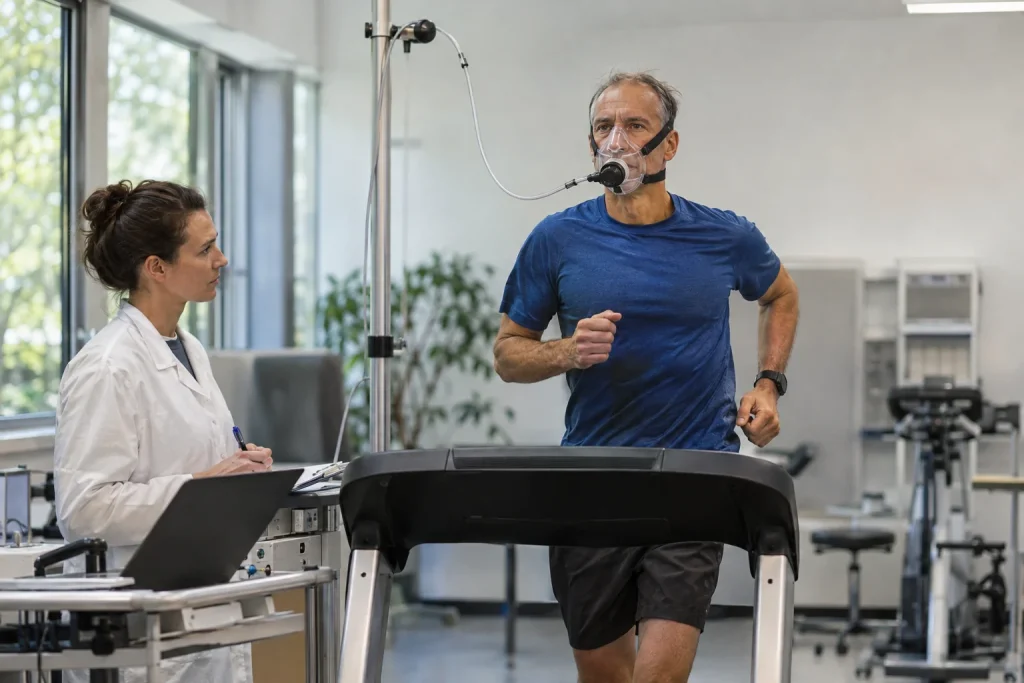
VO2max denotes the maximum oxygen uptake attainable during heavy exercise. It is a useful physiological measure, but not a complete score of running ability or a judgement of personal worth. The number on a watch is also usually an estimate, produced differently from laboratory measurement analysing respiratory gases.
To understand it, ask three questions: exactly what does the number report, how was it produced and which decision does it help? This approach can prevent a single daily change causing excessive excitement or needless concern.
What does oxygen uptake mean?
The working body takes up and uses oxygen as part of energy supply. VO2max aims to describe the upper value attainable during heavy exercise. It is not merely the quantity of air inhaled, and lung size or willpower alone do not determine it.
A laboratory assessment follows oxygen uptake by analysing inhaled and exhaled gases under a defined exercise procedure. The treadmill or cycle ergometer supplies the workload; the mask and analyser belong to the system measuring physiological response.
The measurement’s purpose is not always the same. It may analyse sporting performance, form a clinical exercise test or address a research question. To interpret the result, know the service you used and which additional data were evaluated.
Litres per minute and millilitres per kilogram per minute
Absolute oxygen uptake can be reported, for example, in litres per minute. A body-mass-relative value appears as millilitres per kilogram per minute. Running watches usually show the second type.
A simple calculation illustrates the difference: dividing the same absolute oxygen uptake by a different body mass changes the relative value. This is mathematics, not automatic proof that cardiovascular function or muscular oxygen use improved by the same amount.
This does not mean runners should improve the number by reducing body mass. Appropriate energy supply, health and sustainable training matter more than chasing the displayed ratio. Do not derive a personal body-composition decision from one VO2max figure.
What makes a measurement maximal?
In an incremental test, workload increases and professionals assess under which conditions the oxygen uptake can be considered maximal. VO2peak may denote the highest value reached in that particular trial. Always link use of the two terms to the assessment’s own methodology.
Measurement criteria are themselves research questions. A study using repeated exercise tests , for example, compared reliability of a plateau and a separate verification phase. The findings show that classification as maximal is more than the runner’s subjective statement.
In practice, ask which protocol was used, what limited the test and how its ending was interpreted. You do not need to organise another exhausting trial yourself to prove the number. Maximal testing may require appropriate screening and supervision.
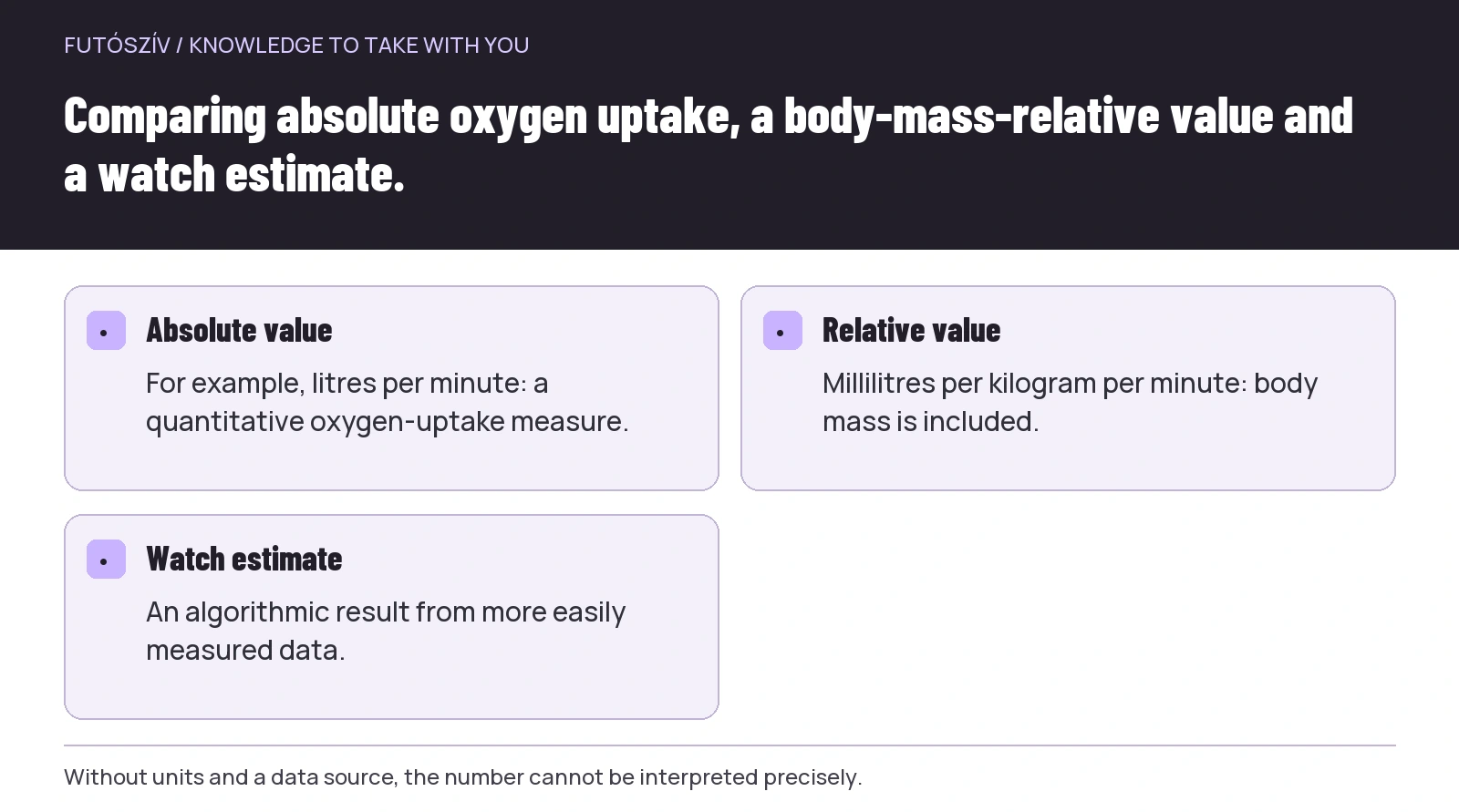 Enlarge diagram
Text version of the diagram
- Absolute value
- For example, litres per minute: a quantitative oxygen-uptake measure.
- Relative value
- Millilitres per kilogram per minute: body mass is included.
- Watch estimate
- An algorithmic result from more easily measured data.
What does the watch do instead of using a mask?
A sports watch usually estimates from more accessible information, such as movement speed, heart-rate response and entered personal data. The exact procedure depends on device and software. A wristwatch does not analyse respiratory gases like the laboratory system.
A validation study of a particular sports-watch model found different accuracy in moderately and highly trained participants. This matters: a group average does not guarantee the same accuracy for every user.
Another primary study examining Apple Watch Series 7 likewise used laboratory comparison for evaluation. Tie such findings to the particular model, software, sample and test conditions instead of turning them into an eternal accuracy ranking for every watch.
Why might the estimate fluctuate?
The estimate comes from input data. If heart-rate measurement is wrong, speed inaccurate, terrain differs from assumptions or personal data are incorrect, the result may shift. A changing number is therefore not always an immediate physiological change in your body.
Check your device’s official instructions: which activity, circumstances and conditions update the estimate? Not every easy walk, trail run or indoor session enters the calculation identically. A missing new value is not necessarily a fault either.
Treat a sudden shift as data first. Check device changes, updates, sensor issues or unusual environmental changes. If how you feel and running performance also deteriorate persistently, assess those separately in the appropriate health context.
A better VO2max does not write the results list
Endurance running performance also involves the energy cost of a given pace, how much of your capacity you can sustain and how you tolerate fatigue. Pacing, terrain and an event’s practical conditions matter too.
The running study examining factors in threshold speed analysed the combined relationships of several measures. Maximum oxygen uptake is an important part of the picture, but does not alone determine the speed you can use sustainably.
Two people with the same VO2max can therefore have different race times. A watch-predicted result contains further assumptions too. You do not have to achieve the predicted time immediately, and running slower than the estimate does not prove lack of effort.
How can training change it?
Training can modify maximal oxygen uptake, but individual responses differ. One primary paper from the HERITAGE Family Study examined within-family similarity of responses to standardised training. The finding emphasises individual differences.
This is not a genetic verdict on someone’s future. Group-level variance cannot define a final personal ceiling. Follow progress within the actual training history, programme and measurement conditions.
Even with little VO2max change over a period, another part of running may improve: pace regulation, repeatability of training or retaining control longer. An unchanged number does not automatically make the entire preparation unsuccessful.
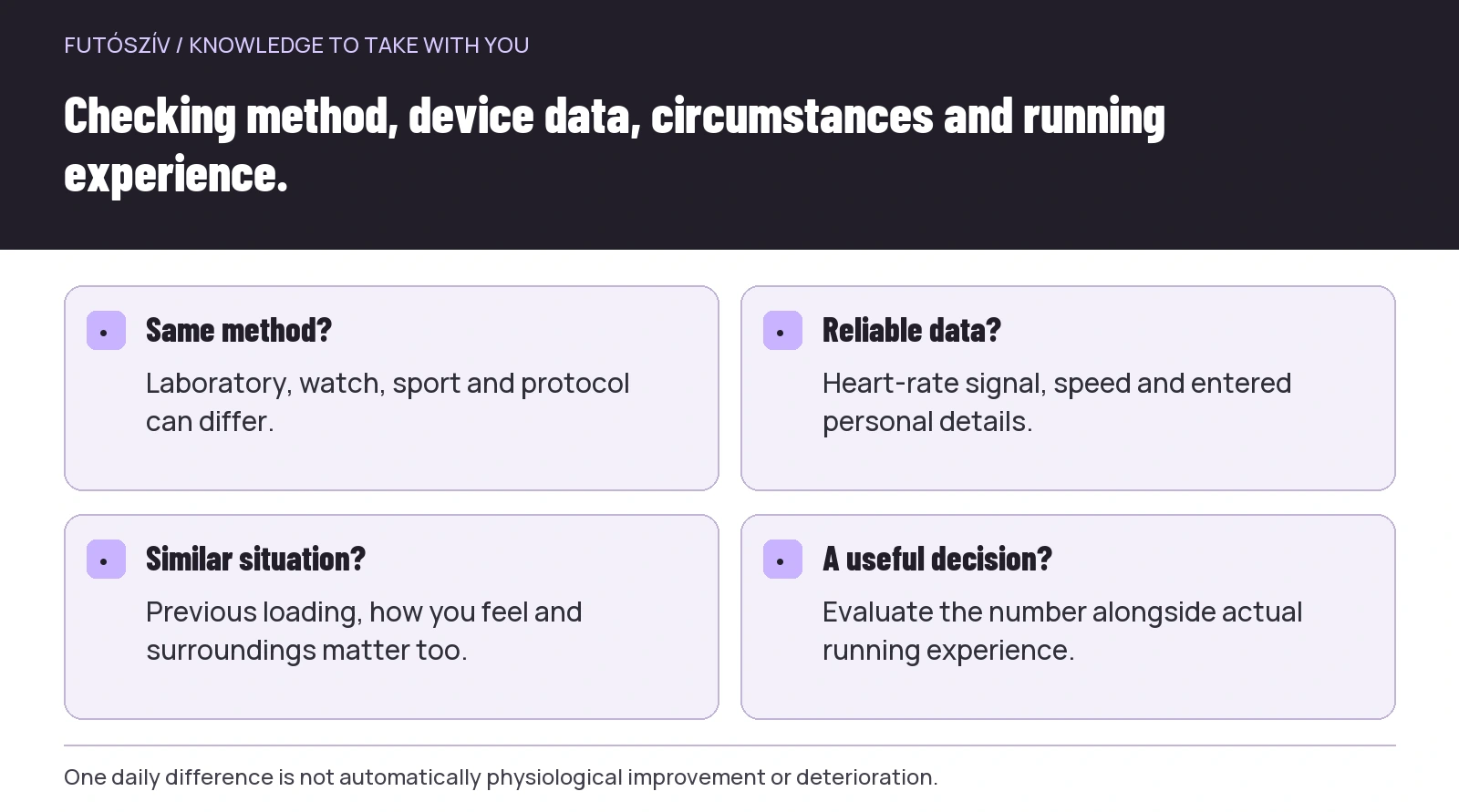 Enlarge diagram
Text version of the diagram
- Same method?
- Laboratory, watch, sport and protocol can differ.
- Reliable data?
- Heart-rate signal, speed and entered personal details.
- Similar situation?
- Previous loading, how you feel and surroundings matter too.
- A useful decision?
- Evaluate the number alongside actual running experience.
Why is the programme not only VO2max training?
An eight-week randomised trial compared different running sessions; the intense interval versions studied showed greater VO2max improvement than certain continuous sessions. The result concerned specific male participants and protocols.
Improving the main measure differs from meeting every need across an entire season. Easy running, gradual adaptation to longer loading, strength development and rest can have different roles. Every session does not need to target the same number.
Do not let the watch’s label determine the number of intense days. “VO2max” in a log is neither health clearance nor a quality seal. Aim, history, recovery opportunities and health together determine appropriate total load.
What does it say—and not say—about health?
Cardiorespiratory fitness is clinically meaningful, but a home estimate must not diagnose disease. A watch value classified as normal does not exclude every health problem, and a lower estimate does not name its cause.
If you experience new, unusual exercise intolerance, symptoms matter more than a reassuring display colour. Stop activity for chest symptoms, fainting or severe breathing difficulty; urgent help may be needed. Persistent unexplained performance decline is also worth taking to a professional.
Distinguish the assessment’s purpose: are you seeking training data or clarification of health symptoms? The latter needs appropriate healthcare, not another watch test or ranking.
How should you compare two measurements?
Keep the method the same where possible. Differences of a few units may not be directly interpretable between laboratory and watch, treadmill and bicycle, different protocols or data processing. Ask for a short method description alongside the result.
Agree preparation with the testing provider. Previous loading, how you feel, food intake and test timing can be relevant. Comparison does not aim to eliminate every variable perfectly, but to know important differences.
Do not compare peak numbers alone. Test progression, exercise sensations and other reported measures can help explain what happened. If a professional says the difference lies within measurement uncertainty, do not translate it into certain improvement or decline.
Which aim makes data collection worthwhile?
When building your first regular running weeks, consistently manageable movement and good load management may be more useful goals than increasing a laboratory value. For a competitor, targeted testing can help evaluate part of the programme when the data lead to a real decision.
Before collecting data, write: what would I change for a different result? If nothing, this may not be the most important measurement now. Curiosity is itself an understandable reason, but regular checking need not become an unnecessary compulsion.
Personal progress can have several forms of feedback: a familiar route feels more comfortable, fewer pacing mistakes, greater training consistency or improved results in similar conditions. Do not let these disappear because one estimate has not moved.
Sources
- Verification-phase tests show low reliability and add little value in determining VO2max in young trained adults.
- Validity of VO2max estimates from the Forerunner 245.
- Assessing the Accuracy of Smartwatch-Based Estimation of Maximum Oxygen Uptake.
- HERITAGE: Familial aggregation of VO2max response.
- Aerobic high-intensity intervals improve VO2max more than moderate training.
- Factors Influencing Running Velocity at Lactate Threshold.
This article helps interpret the measure. Individual test results or health symptoms require personal professional assessment.
How Futószív articles are prepared: our editorial guidelines.