A load score appearing after running can easily look like a grade. A larger number may suggest a more successful day and a smaller one less work, especially when an app presents coloured bars and a target zone. Yet load measures do not capture a workout’s entire value. They describe part of the work from defined data under a selected model. They may help a consistent log, but their meaning differs from whether your task was fulfilled. This article helps read different scores; it gives no personal workload limit, injury prediction or universal weekly increase rule.
The measure’s name leads to its method
First note the exact name. TSS, Cardio Load, Exercise Load, Acute Load and a value based on perceived exertion are not the same scale. The TrainingPeaks glossary links its TSS measure to duration and intensity, with several possible data sources, for example. The Garmin Training Load technical description presents a different, EPOC-based estimation framework. These numbers cannot simply be treated as one common load currency because both appear as points.
Even within a system, the value assigned to one workout can differ from a summary formed across several days. Short-term load is not necessarily a simple sum of recent run scores. Weighting and time windows may apply. Find the exact period and calculation in your device documentation. Do not add cards manually then call a different main figure an error. Your arithmetic may ask a different question from the product’s summary.
External volume and internal response provide different views
Running distance, time and elevation show certain external characteristics of work. A measure formed from heart rate or your own exertion assessment provides another view. The Polar Training Load Pro manual separately discusses cardiovascular, perceived and supported power-data-based load approaches. Product names need interpretation within that model. Always identify the specific input behind a score. Everyday “total workload” can be much broader, so do not expect one channel to measure every detail.
The same running duration and distance may involve different personal experiences. Likewise, a similar score does not prove two runs were identical in every respect. Surface, movement task, interruptions, descents, weather and many other circumstances may not appear in the model in the same way. The point is understanding resolution rather than dismissing the measure. Ask which part of load is being discussed and what lies outside the calculation. This gives the summary its proper place in the log.
Personal assessment can be consistent data too
Several systems treat the experienced difficulty of the whole session as separately recordable feedback. The 2001 study by Foster and colleagues is an original research source for the session-RPE approach. This does not mean entering an arbitrary daily mood number in place of the watch score. Know the selected scale’s meaning and use, particularly when working with a coach. Personal assessment adds information rather than pits a device result against an impression.
In a simple illustrative product, forty minutes multiplied by a rating of three gives one hundred and twenty units; twenty minutes multiplied by six also gives one hundred and twenty. Identical results can therefore conceal different time and experienced difficulty. This is a mathematical example of a two-factor measure, not a training suggestion or claim of complete physiological equivalence. Retain both components in the log, not merely the product. A score is more useful when you can trace its origin and your written note where needed.
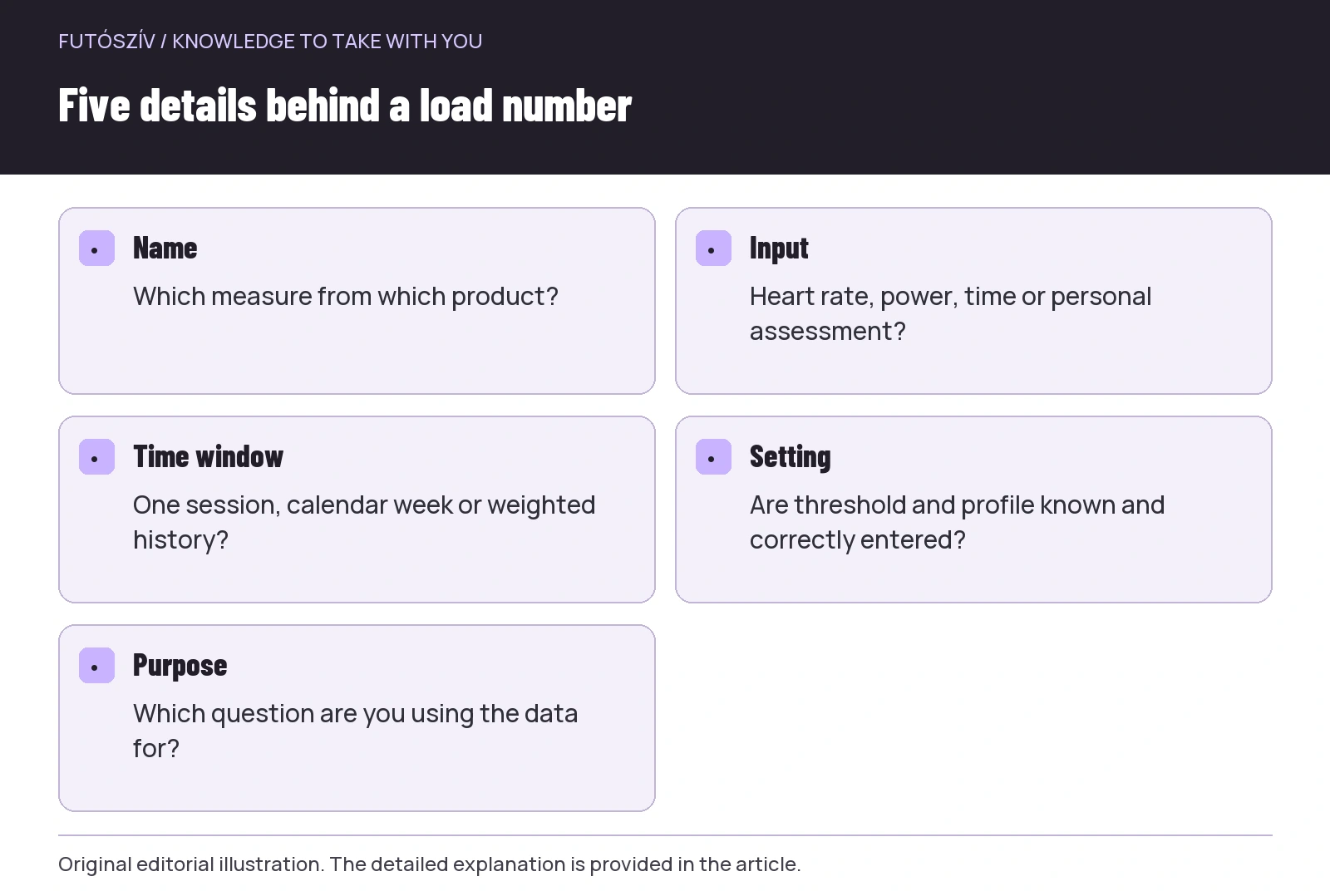 Enlarge diagram
Text version of the illustration
- Name
- Which measure from which product?
- Input
- Heart rate, power, time or personal assessment?
- Time window
- One session, calendar week or weighted history?
- Setting
- Are threshold and profile known and correctly entered?
- Purpose
- Which question are you using the data for?
Set thresholds can shape the model too
If a measure references an intensity threshold or zone, the entered boundary’s meaning matters. Old, poorly transferred or accidental profile data can influence the summary. Arrange thresholds according to the appropriate professional and manufacturer framework for your training, rather than the score desired. Boundaries from different methods are not always interchangeable. A menu number is not valid merely because the app reports no error. Include its source and determination method in your records too.
If a threshold changes, mark the date and examine how the platform handles previous recordings. The new value may affect only future work, while another system offers different recalculation. Clarify from your own service’s description. Do not automatically read a graph jump as a sudden change in total work. The calculation basis may have changed. In a consistent log, meaningful settings changes are context just like a new route type or recording device.
Bad inputs can still produce an orderly score
The algorithm may generate a final value despite a questionable input. If the heart-rate curve has a long gap or visible spike, examine that first. A neat summary number does not prove input quality. The same applies to a wrong sport, incorrect duration or duplicate workout. Under the service’s operation, any recorded activity may affect a summary. Technical checks precede individual training conclusions, particularly for an unexpected large change.
A brief data-quality note may help: which channel, period and phenomenon are questionable, and what action you took. If the platform supports editing or exclusion, read its precise effect and retain the necessary original. Do not randomly enter a “more realistic” load score to smooth the weekly curve. Label estimates or manual values differently from directly processed recordings. Traceable correction is worth more than an unexplained cosmetic improvement.
| What you see | What to check | What else to add |
|---|---|---|
| One workout’s score | Data source, duration and method | Task and circumstances |
| Weekly or acute load | Time window and weighting | Underlying activity list |
| Coloured category | Does it reference personal history or another boundary? | Completeness of required data history |
| Another brand’s score | Does it calculate the same thing? | Separate interpretation instead of direct conversion |
| Unexpected jump | Error, setting or actual data change? | A brief note of the known event |
A technique-learning session’s value is a different question
A running outing may primarily aim to learn a movement, handle new equipment or explore a route. A low load score does not disprove achieving that goal. The model may not measure attention, understanding a skill or resolving pre-race logistics. This concerns matching the goal and measure, not a claim about physiological effect. Name what you intended before evaluating the session. Choose suitable feedback for that purpose.
Likewise, on a planned easy day, you need not chase high points to make it seem worthwhile. Comparing the task stated beforehand with actual execution offers another view beside the number. An unexpected score may start a question, but is not an automatic grade. Note what was completed and what differed. If working with a coach, agree this framework together. The display does not know all your intentions unless it can infer them from plans and data supplied in that system.
The same score may hide a different time structure
A longer steady outing and a shorter, more segmented run may yield similar totals under some measures. That does not make them identical tasks. Section sequence, duration, rests and movement surroundings are separate information. To ask how a session went, the lap list and timeline may be needed too. A summary supports overview without preserving every detail. A score is a targeted model output, not lossless compression of the entire run.
Equal total points do not fully describe weekly structure either. Sessions can differ in number, proximity and distribution. In a professional discussion of workload, show the calendar alongside the sum. Sunday evening and Monday morning may occupy different columns while close in time. A rolling window and calendar week provide different views. Knowing your measure’s operation helps explain why its curve does not change like a weekly sum calculated mentally.
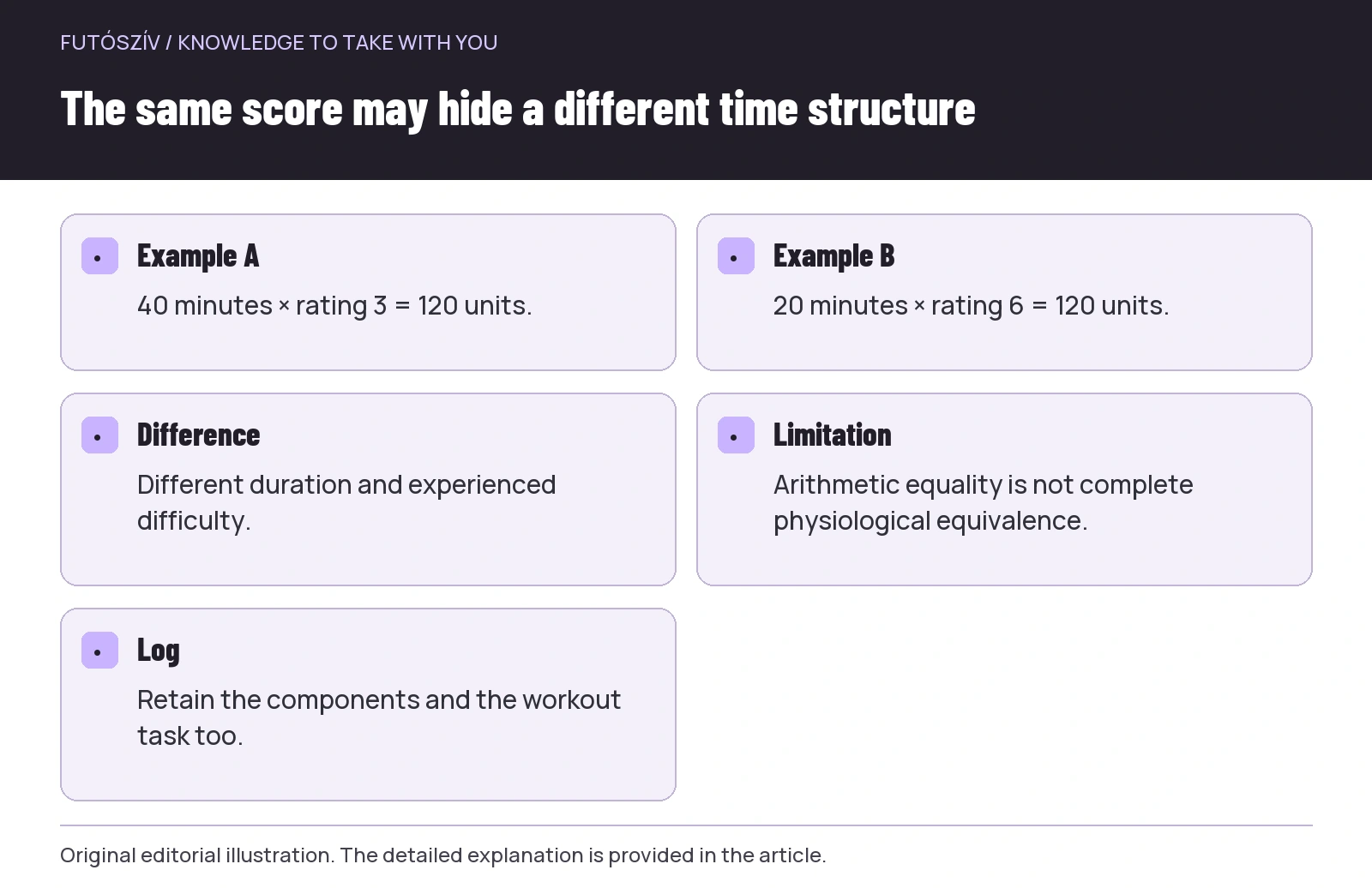 Enlarge diagram
Text version of the illustration
- Example A
- 40 minutes × rating 3 = 120 units.
- Example B
- 20 minutes × rating 6 = 120 units.
- Difference
- Different duration and experienced difficulty.
- Limitation
- Arithmetic equality is not complete physiological equivalence.
- Log
- Retain the components and the workout task too.
A relative category may depend on personal history
A “high” or “low” classification may reference your history rather than a universal boundary. The same absolute score can receive different wording at another time if the system uses adaptive comparison. The cited Polar manual distinguishes absolute value from history-adjusted presentation too. Read the exact window and conditions for your product. A text change alone does not prove the physical task changed by the same amount. The comparison baseline belongs to the story.
The initial period matters particularly with a new device or after a long incomplete series. Until fuller history develops, the category may rely on less information. Do not build far-reaching personal load rules from the opening days. Do not equate a daily score automatically with health either. A favourable category provides no clearance when symptoms are present, and an unfavourable one alone is not diagnostic. Seek appropriate help for personal professional questions and manufacturer documentation for technical requirements.
Do not build a homemade conversion between brands
When switching systems, a few parallel scores cannot produce a reliable general conversion ratio. Methods may respond differently to run character and inputs. A ratio appearing similar one day may differ for another task. Keep the old log with its meaning; in the new system, mark the switch date and learn the function. Shared distance and duration can help historical review without automatically replacing understanding of the models’ differences.
Different points for the same run on two watches are therefore not an unambiguous accuracy competition. A reference would need defining too: what should count as accurate, and against which procedure? Consumer scores may have different aims. In personal use, a clear method, consistent recording and data quality are more tangible goals than reconciling every daily output. Rather than argue numbers, ask which information helps review your professionally grounded plan and with which limitations.
A short load-data sheet
Make a personal sheet with measure name, source system, main input, calculation window, important setting and intended use. Add where to find official help. You need not rewrite it every session, only update substantive changes. Record actual task, duration, distance and brief observation separately with the activity. The summary score then has a place without swallowing the whole workout story. Reading the log lets you step back to underlying data.
In a weekly review, first check underlying recordings, then the load view, and finally whether tasks were achieved. If a question arises, identify whether it concerns data quality, interpreting an algorithm or personal training. This sequence prevents large conclusions from bad inputs. You need not react immediately to every graph change. Consistent observation and appropriate professional discussion frame understanding your plan, rather than one daily colour or number.
Let the score remain a tool
A load measure is useful when you can explain what it summarises and omits. You know its source, how history may change it and the data-quality requirements behind it. A large number does not by itself make a task successful, and a small one does not invalidate a deliberately easier outing. Evaluating training requires purpose, execution and appropriate context. The score may offer one technical view with its own meaning.
A running log then becomes a traceable account of work and experience rather than a point-collecting game. The number helps reveal patterns, the detailed recording shows components and brief text preserves intention and circumstances. Together, these can improve later reviews and professional conversations. A load score’s value is not deciding everything for you, but supplying correctly interpreted information for a clearly named question.
Sources and further reading
- TrainingPeaks – Glossary, TSS
- Garmin – Training Load
- Polar Vantage V2 – Training Load Pro
- Foster et al. – A New Approach to Monitoring Exercise Training
How Futószív articles are prepared: our editorial guidelines.