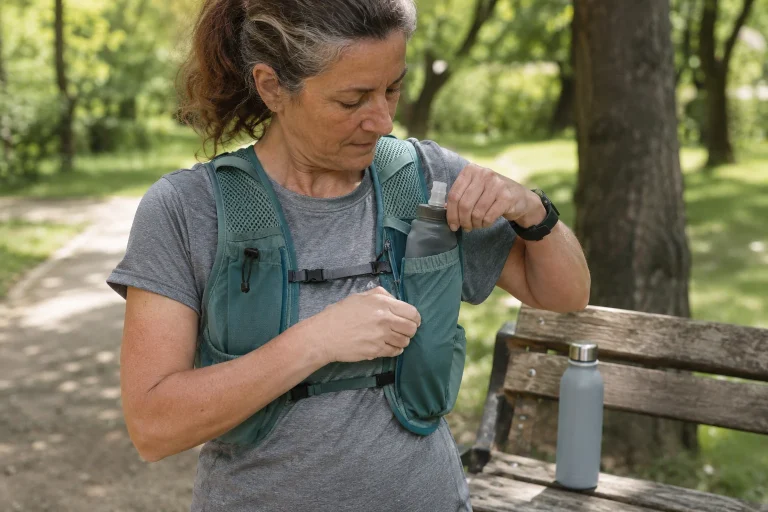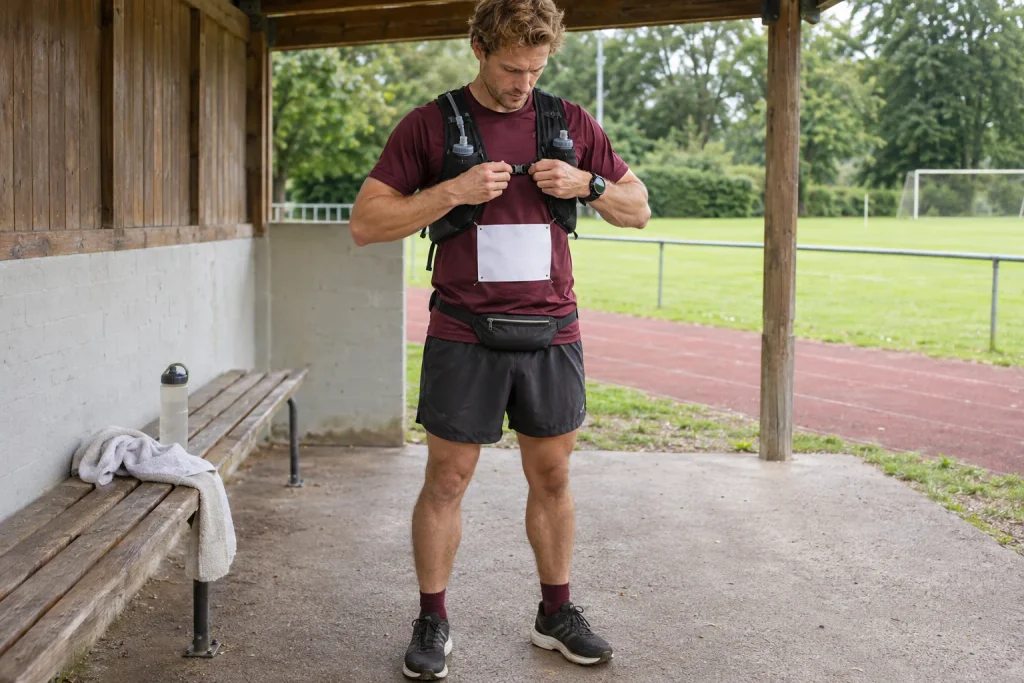
Many small things fall into place on race morning: shoes, socks, race number, watch, pocketed supplies, phone and perhaps a vest and jacket. Each may seem familiar separately but together they form a new system. A full pocket pulls shorts down, the number covers a zip or a vest buckle meets a seam. Rehearsing equipment therefore means more than having worn the shirt once. Test the complete expected setup during a planned, suitable run, leaving fewer unknowns for the race.
Give the rehearsal a question, not a new record
Testing kit does not require another hard session. Choose an appropriate outing already in your programme and respect its demands. If adjusting for clothing, favour a familiar route that is easy to leave. The aim is noticing awkward details, not proving race pace with every item. Urban 10 km clothing and mandatory long-trail equipment are different tasks; adapt the test accordingly.
Write the main question: “does the loaded belt bounce?”, “can I reach the bottle with the jacket?” or “does the shorts liner cut in?” Precision supports observation without judging everything together. If the whole system is new, build familiarity through brief home and easy-movement trials first. Several unfamiliar products’ problems can merge on a long run. A useful rehearsal ends with what worked, what changes and what remains uncertain.
Organiser rules are part of the setup
Before finalising a personal list, read the chosen race’s current information. Check mandatory equipment, prohibited items, number placement, bag drop and inspections. These vary by event and distance. The rules for one UTMB event separately address mandatory kit and checks, for example. This is not a list to copy into Hungarian races, but illustrates why your own official document is the basis. A community group’s memory does not replace it.
Keep two lists: organiser requirements and your needs arising from conditions or individual circumstances. Compulsory minimum and personal suitability differ. Certain weather or longer completion may justify more. Equally, avoid untested, unnecessary objects merely copied from someone else. Check final organiser notices too, as conditional kit or venue arrangements can change. Interpret rehearsal results alongside rules.
Do not test a full-pocket race with empty pockets
Shorts, belts and vests can behave differently loaded. Put intended objects in their actual places, or use safe substitutes reasonably approximating the load. Keys, phone and packaged fuel must remain manageable in motion, not merely fit on the kitchen table. Observe bouncing, slipping and pressure. Excessively tightening a waistband may not solve poor distribution. Space, mass and attachment matter together.
Test item order too. Frequently needed supplies should not lie beneath the least accessible layer. Rarely used backup should not block everyday functions. Arrange packing around equipment required to stay accessible for safety or by rules. Consuming fuel and changing fluid volume can alter behaviour too. Start and finish loads may differ. Knowing this beforehand beats constant later readjustment.
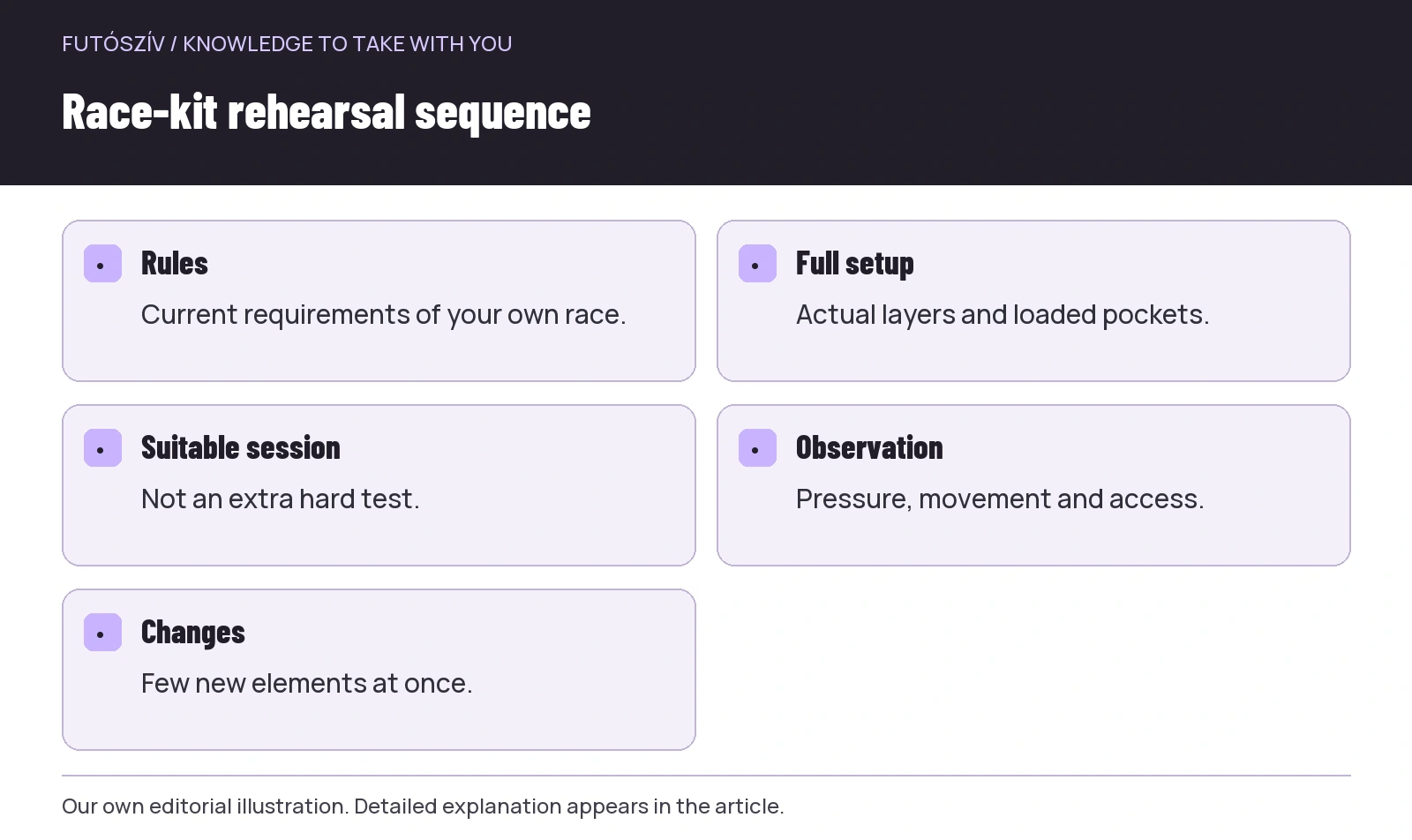 Enlarge diagram
Text version of the illustration
- Rules
- Current requirements of your own race.
- Full setup
- Actual layers and loaded pockets.
- Suitable session
- Not an extra hard test.
- Observation
- Pressure, movement and access.
- Changes
- Few new elements at once.
Look for problems where garments meet
Sock edge and shoe collar, shorts waistband and belt, sports bra and vest buckle can be comfortable separately but awkward together. Observe these meetings. Every small sensation is not danger, but name growing pressure and rubbing precisely. Instead of “the clothing was bad”, record “the full pocket pressed the seam into my right hip”. Specific observation suggests a change; vague discomfort easily leads only to more shopping.
Before running, try natural arm swing, a slight forward lean, turning and a few steps. Constant adjustment already needed at home is useful feedback, without waiting for a long session to prove it. Riding layers, hidden zips and flapping cords are often obvious. This movement check is not a new exercise programme: use only movements appropriate for you. Equipment must serve familiar movement, not the reverse.
Race number: check access too
Organiser requirements take priority for number placement. Also check whether it covers a belt buckle, pocket or jacket zip. Choose attachment only while retaining prescribed readability and wear. Check permission before using your own number belt. A correctly sized paper sheet at home lets you rehearse access without crumpling or altering the actual number. Rehearsal does not justify changing it or hiding information.
Check putting on and removing the jacket around the number. If visibility is required, another layer cannot simply hide it. Settle this beforehand rather than improvising in the start area. Fasteners should not press uncomfortably against skin or catch arm movement. For an important event, do not rely on an unfamiliar solution bought the night before. Simple, compliant, tested attachment often beats an impressive novelty you do not yet understand.
Know how to handle the watch and packaged fuel
Wear the watch with intended clothing and check button access. Tight cuffs may press buttons or hide the display. Rehearsal lets you simplify fields: a few necessary values are easier to read than many tiny numbers. Fit according to manufacturer instructions, particularly for optical heart rate. The manufacturer accuracy guidance includes fit among measurement conditions. A well-positioned watch gives handling and signal a better starting point.
Practise reaching and opening packaged fuel while stopped or in a safe, calm situation. The aim is not a one-handed demonstration on a busy pavement. Check storing used packaging, a separate rubbish space and the effects of wet hands or gloves. Testing food or drink is also a nutrition task; equipment rehearsal concerns carrying and access. Prefer familiar solutions to piling up new products on race day.
| Rehearsal detail | What to test | What to note |
|---|---|---|
| Full pockets | Actual item arrangement | Bouncing, pressure and access |
| Layers | Putting on, removing and zipping | What covers what, and what rides up? |
| Number position | A compliant, readable arrangement | Can you still reach pockets and buckles? |
| Watch and sensor | Wear and controls | Does clothing press, and is the data source known? |
| End of the run | Changing and packing | What needs to be quickly accessible? |
Weather rehearsal: seek similarity, not danger
For expected cool, windy or rainy racing, explore the setup in safely similar conditions. Do not seek dangerous weather to test a jacket. In Hungary, check current HungaroMet warnings before leaving and adapt the route. Clothing trials do not justify running in thunderstorms, dangerous wind or ice. Ask which adjustment works in a condition, not how much bad weather equipment lets you endure.
Make weather notes specific: an open windy stretch, a rain-soaked outer or a long walk at the end. Experience then becomes more useful. Identical temperature does not mean identical surroundings. Record sensation and intensity too: easy running and standing before the start may need different layers. On race morning, do not rule out every adjustment from one trial. Have a familiar alternative for current conditions.
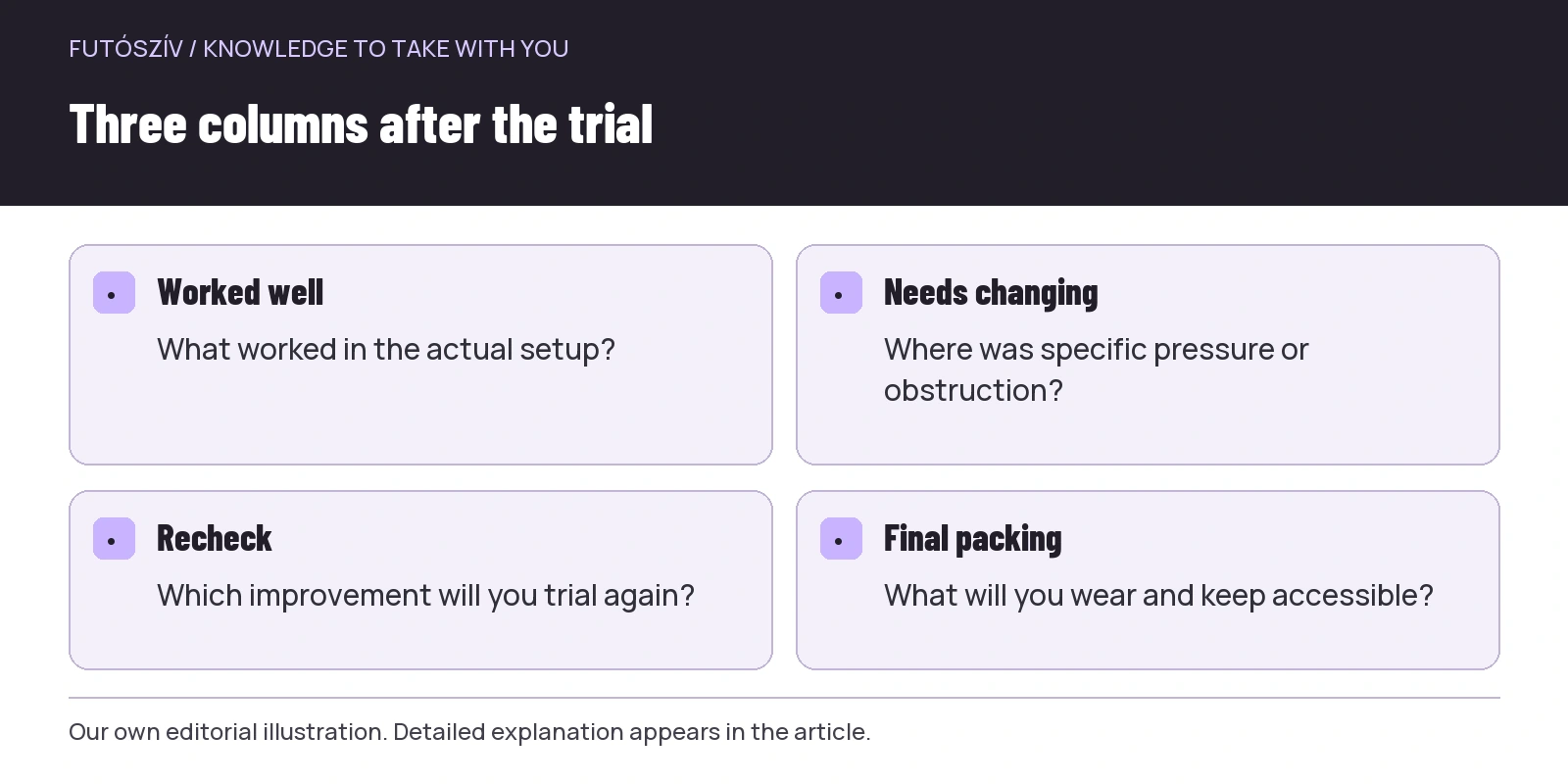 Enlarge diagram
Text version of the illustration
- Worked well
- What worked in the actual setup?
- Needs changing
- Where was specific pressure or obstruction?
- Recheck
- Which improvement will you trial again?
- Final packing
- What will you wear and keep accessible?
Waiting before the start is a separate equipment situation
You warm while running but may stand a long time beforehand. Consider arrival, bag drop and entering the start area. A top you must carry throughout differs from a layer you can leave or give a companion. Follow current organiser arrangements; do not leave objects on the course assuming collection. Pre-start logistics belong to equipment just as much as running clothes. A workable plan reduces final-minute rushing.
With a companion, agree meeting point and handovers if rules permit. Alone, self-manageable packing matters more. Keys, transport items, phone and necessary belongings should not end up inaccessible afterwards. Bag storage may be far from the finish. Include venue maps and walking distances. One rehearsal outcome may simply be a better packing order.
What to do after the trial
Record experience while fresh. Three columns suffice: worked well, needs changing and recheck. Do not trust small irritations to memory; they soon fade. Where possible, change only one component to understand the next result. Revised lacing or a moved phone then has a clearer effect. One unsuccessful detail does not invalidate all kit. Rehearsal exists to reveal small faults while repair remains possible.
Avoid planning a complete equipment restart in the final days. If the trial reveals a major problem, choose a known suitable alternative. A race is a poor first test for unfamiliar emergency purchases. Mark what you wear from home, pack accessibly and check at the start. Everything need not look perfect. Clothing and items must do their jobs without constant reorganisation while running.
A successful rehearsal can be boring
If pockets do not bounce, buckles do not press, controls work and supplies are reachable, there may be no spectacular lesson. That is success. The system did its job while you focused on training. Rehearsal guarantees no trouble-free race and does not replace assessing current weather, instructions or condition. It reduces unknown, easily preventable details. You then arrive with familiar equipment arranged for your use rather than a heap of objects.
Sources and further reading
- UTMB organiser example: mandatory equipment and rules
- HungaroMet: current severe-weather warnings
- Apple: wear and measurement accuracy
How Futószív articles are prepared: our editorial guidelines.