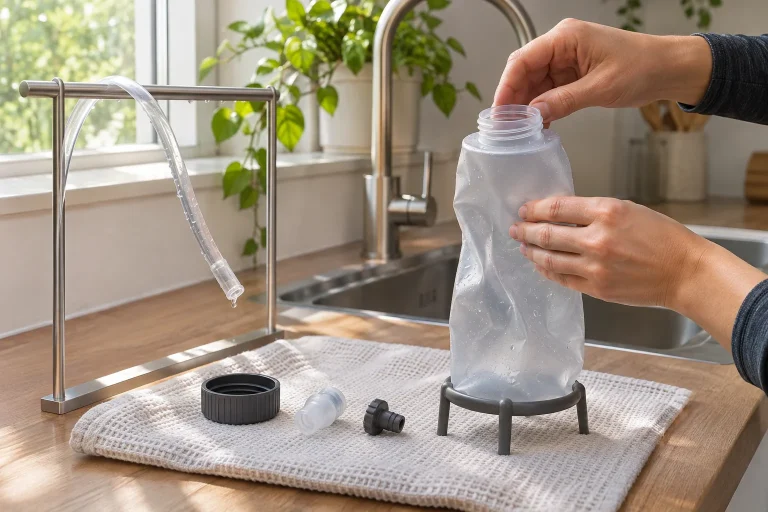
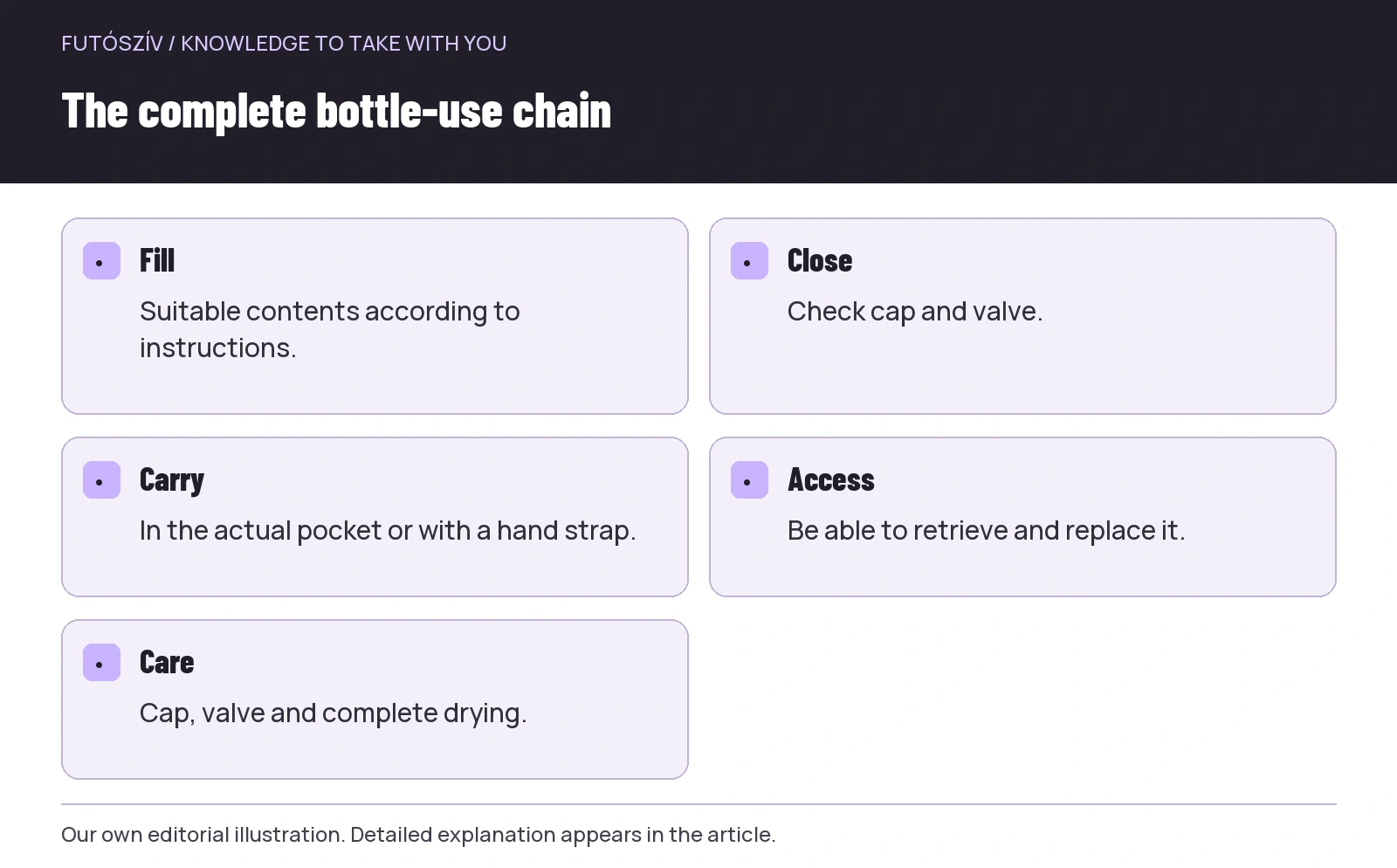
A bottle seems easy to choose from specifications: capacity, weight and material. While running, access, attachment, opening and replacement matter just as much. A rigid bottle retains shape while a soft flask changes as contents diminish; in hands, belts and vests, each may require different handling. Good selection tests the whole chain: fill, close, carry, retrieve, drink, replace, clean and dry. A persistently awkward step can also disrupt running.
Choose the carrying position first
Handheld use, a front vest pocket and a belt need different shapes, centres of mass and closures. Hand grip and any strap matter for handheld use; pocket depth, width and retention for a vest; positioning and loaded stability for a belt. State where you want to carry it and neighbouring items. A good bottle can bounce or press in an unsuitable holder. Product properties and overall usability are separate levels.
Without an existing carrier, do not buy parts independently assuming they will fit. Check manufacturer compatibility and sizes. The HydraPak soft-flask range includes different shapes and tasks, for example. This helps explore designs, but does not prove every flask fits every vest. Nominal volume is only one figure beside height, width, cap and mouthpiece. Confirm the actual pairing through a trial.
Rigid and soft: observe behaviour before claiming advantages
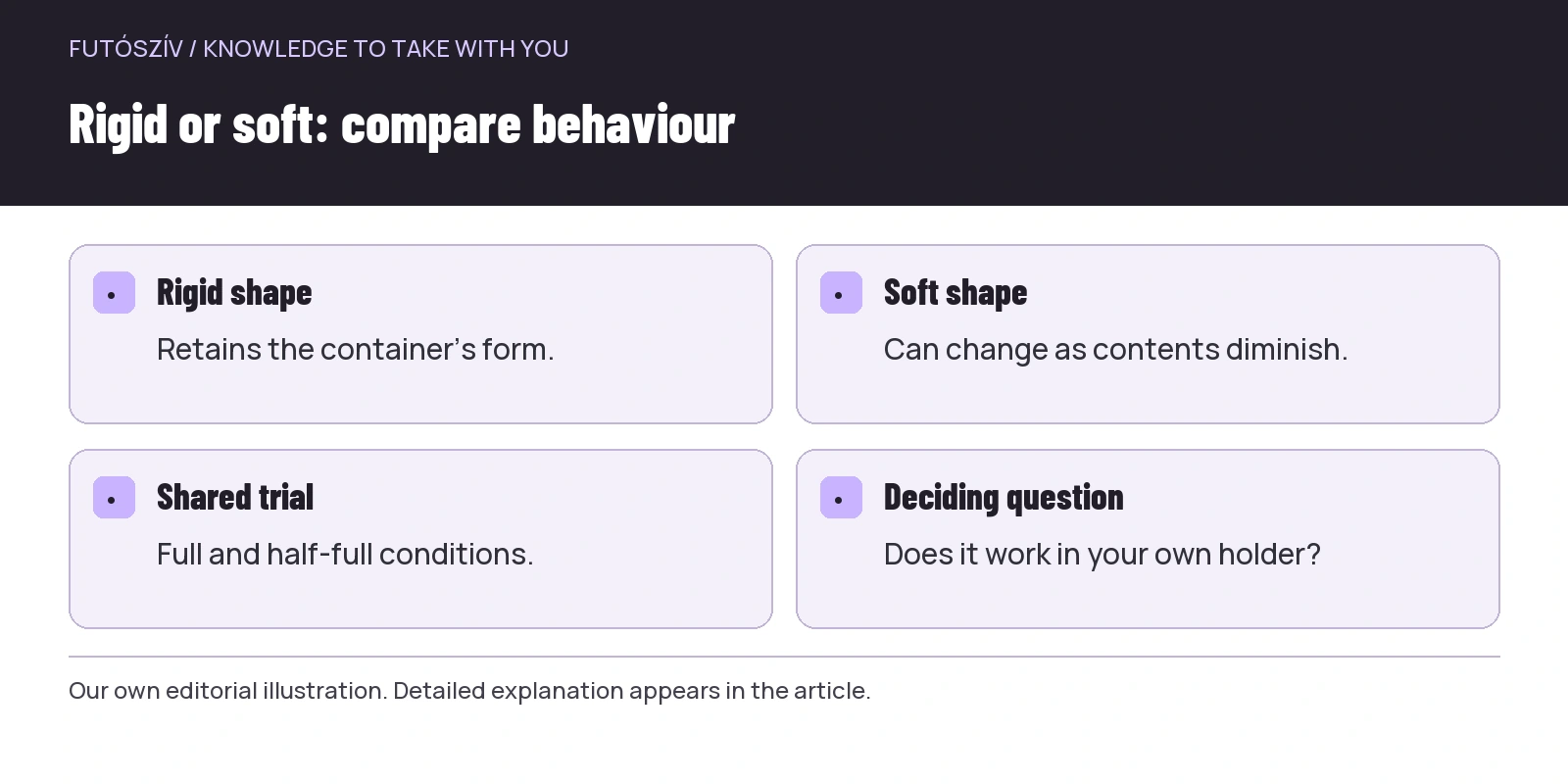
A rigid bottle generally offers a more predictable shape for removal and replacement, without necessarily being more comfortable in every hand or pocket. Collapsing soft flasks can occupy less empty space, but replacing and securing them may need different actions. Manufacturer solutions vary greatly. The description of one CamelBak soft flask gives specific storage and use information, for example. Interpret product data against your carrying needs.
Do not assess candidates only empty. Filled shape, the cap area and half-full condition matter. Diminishing fluid changes load and shape, so initial comfort may not describe the finish. Do not seek stability through maximum tightening. Adjustment helps only so far with an oversized pocket or mismatched shape. Intended attachment should keep the bottle predictably placed without correction at every step.
 Enlarge diagram
Text version of the illustration
- Fill
- Suitable contents according to instructions.
- Close
- Check cap and valve.
- Carry
- In the actual pocket or with a hand strap.
- Access
- Be able to retrieve and replace it.
- Care
- Cap, valve and complete drying.
Cap and valve handling need a separate test
First learn opening and closing somewhere calm with clean water. Check any lockable valve, its required movement and the indication of correct seating. Bite valves, push mouthpieces and screw systems work differently. Follow instructions rather than automatically inferring from a familiar product. Cross-threading a cap can differ from proper closure. Check leaks under basic conditions before packing beside other equipment.
Test with hands as used during running, perhaps wet or in intended gloves, somewhere safe. Running fast is unnecessary. Ask whether you can reach and operate it without straining or holding it insecurely. With a straw accessory, observe length, attachment and head movement too. Do not cut or alter parts before reading instructions. A small comfort modification can cause malfunction if not designed for it.
Know how to replace it, not only remove it
Removal often feels simple while sliding a half-full flask back is harder. Test your vest or belt while stationary first. Pocket edge, surrounding contents and softness shape the action together. An overfilled neighbouring pocket can reduce bottle space. The problem may be arrangement rather than the flask. Check access with the whole intended load instead of starting a long run from an empty-vest impression.
Use retaining loops or elastic as intended. Do not omit them for easier access or stretch them around unrelated objects. A falling bottle creates new difficulties on technical terrain or in traffic. If handling while moving is unsafe, stop appropriately. Selection should not require every operation during continuous running. A good system suits your abilities, route and comfortable handling, as trials can reveal.
Compatibility: the same number is not the same thread
Opening diameter, thread, valve and attachment are not identical across product families. One original Salomon bottle description specifies compatibility linked to an opening size, for example. Do not arbitrarily extend it to other sizes or brands. Check current official information for replacement parts, straws or filters. A cap apparently screwing on does not establish all required properties.
Keep matching components organised if you own similar bottles. Mixing them after washing can surprise you before departure. Do not force difficult threads or tighten ever harder against leaks. Check the correct part, cleanliness and condition. A damaged seal or valve may be separately replaceable depending on product support. Faults can often be identified more precisely than discarding the whole container immediately.
Filling: openings and markings matter
A wider opening can ease certain tasks while changing outer shape and pocket fit. Try filling where intended: a home tap, known fountain or race station. Rushing into a small opening differs from filling on a kitchen table. For drink powder, follow both product and container guidance rather than invent a mixing ratio from convenient bottle size. This article examines carrying, not a universal fluid amount.
Choose contents according to manufacturer guidance too. The official HydraPak contents guidance separately explains intended use of its products. Do not copy permissions to another material or model, particularly for hot, carbonated or special drinks. Material behaviour is more than preference. Ask using the exact product name when unsure. “Plastic bottle” is too broad for one temperature or contents recipe.
| Carrying method | May suit when… | Always test |
|---|---|---|
| Handheld | You want direct access | Grip, hand strap and natural arm swing |
| Running belt | You want supplies around the torso | Stability full and half-full |
| Front pocket | It forms part of your vest | Compatibility, removal and replacement |
| In a bag or as backup | Access is less frequent | Closure, seal and protection of other items |
 Enlarge diagram
Text version of the illustration
- Rigid shape
- Retains the container’s form.
- Soft shape
- Can change as contents diminish.
- Shared trial
- Full and half-full conditions.
- Deciding question
- Does it work in your own holder?
A bottle does not decide how much to drink
Confusing capacity with need can produce poor planning. A container’s size does not mean consuming precisely that amount every run. Expected time, conditions, access and individual strategy are separate. Choose the carrier for those needs, rather than adapting needs to capacity. If uncertain about fuelling during longer or more demanding conditions, individual sports-nutrition support may be justified. This technical guide does not replace it.
Check current, reliable route-water information before leaving. An old map symbol or experience does not guarantee a fountain works now. Alongside capacity, have a backup for unavailable refill points. Assess filters only by exact intended use and limitations; an equipment name does not make every natural source suitable. Carrying helps access, while water origin and safety remain separate questions.
Cleaning: the mouthpiece belongs to the container too
Inside, cap, valve, threads and any tube may all need cleaning. The official CamelBak care page gives separate instructions by product type; other systems need their own manufacturer guidance. Do not assume every soft flask tolerates dishwashing, turning inside out or identical cleaners. Learning care can inform buying too. Choose something you can genuinely maintain in your home circumstances.
Drying is often harder than washing. Soft walls can touch, hidden cap areas retain water and valves need separate attention. Use recommended open positioning or drying arrangements and do not store closed while wet. Remove food and drink residue before the next run. A good routine is simple and repeatable. It need not involve a new cleaner collection, but consistently follows supported methods. Awkward care can leave a container unused in daily life.
A trial programme after purchase
Start at home with closure and handling, then a short easy run in the intended position. Observe arm swing, strap movement, removal and replacement. Next time, examine half-full behaviour without designing a special workout. Note discomfort and the effect of another pocket. Accurate experience matters more than a final first-day verdict. Check the whole chain, not drinking while running alone.
If comfortably carried, manageable, correctly sealed and maintainable in your setup, the bottle is likely a useful choice. You need not recommend it to every partner. Different hands, vests, routes and access needs lead elsewhere. Rigid versus soft is not a ranking but different behaviour. Sound choice comes from learning that behaviour in your running and choosing for the task with its limitations in mind.
Sources and further reading
- HydraPak: soft-flask types and care basics
- CamelBak: Quick Stow soft flask, a manufacturer example
- Salomon: example of specific cap compatibility
- HydraPak: intended container contents
- CamelBak: care and cleaning
How Futószív articles are prepared: our editorial guidelines.