
Before a first half marathon, one question often dominates: was the longest training run long enough? The answer may matter, but alone it is insufficient. One big run cannot describe how consistently you prepared, your effort, what happened afterwards or how you will manage the practical tasks of racing.
Reviewing readiness is not a home fitness examination and cannot promise a finish. It helps turn the preparation actually completed into a realistic goal and considered starting decision. Review several areas together rather than chase one kilometre figure.
Read the completed weeks, not the downloaded plan
Open your recent diary and examine what actually happened. Which runs recurred regularly, where were longer gaps and how did the week’s largest task develop? Lines on a paper plan are not the same as preparation completed.
This is not fault-finding. If illness, work or family circumstances changed the weeks, reflect this in your current goal too. A useful decision comes from the real foundation rather than clinging to earlier intent.
Check continuity between sessions too. An occasional successful long run means something different within a stable, manageable routine than after several empty weeks. Preparation is a history, not a single screenshot.
What can a long run tell you, and what can it not?
A longer outing can show how you manage sustained movement, clothing and part of your fuelling and hydration. Alongside duration, effort and after-effects matter. A distance fought through with great difficulty is not necessarily the same experience as controlled, manageable running.
An observational study following people preparing for half marathons and marathons associated greater training volume and longer endurance runs with faster finishing times. This was not a comparison of randomly assigned programmes, nor does it establish one compulsory distance above which every first-time half marathoner is certainly prepared and below which certainly unprepared.
Record the training context too. Route, elevation, weather and intermediate stops play different roles. A long outing with many stops and a continuous run are not the same trial, even if the same distance appears at the end.
A research threshold is not personal permission to start
Another study of race-related injuries described relationships between outcomes and factors including previous injury, training history and certain load characteristics. The survey’s group-level associations should not be converted into an individual safety boundary or used to justify sudden training increases.
If an article shows better outcomes at higher weekly volumes, it does not mean you should rapidly jump there now. Experience and volume may also occur together; a study category cannot replace your own response to load.
The question before a first half marathon is therefore not ticking off one number. Preparation completed, current condition and the expected race task need consideration together. If they differ substantially, coaching or healthcare help when necessary may be worthwhile.
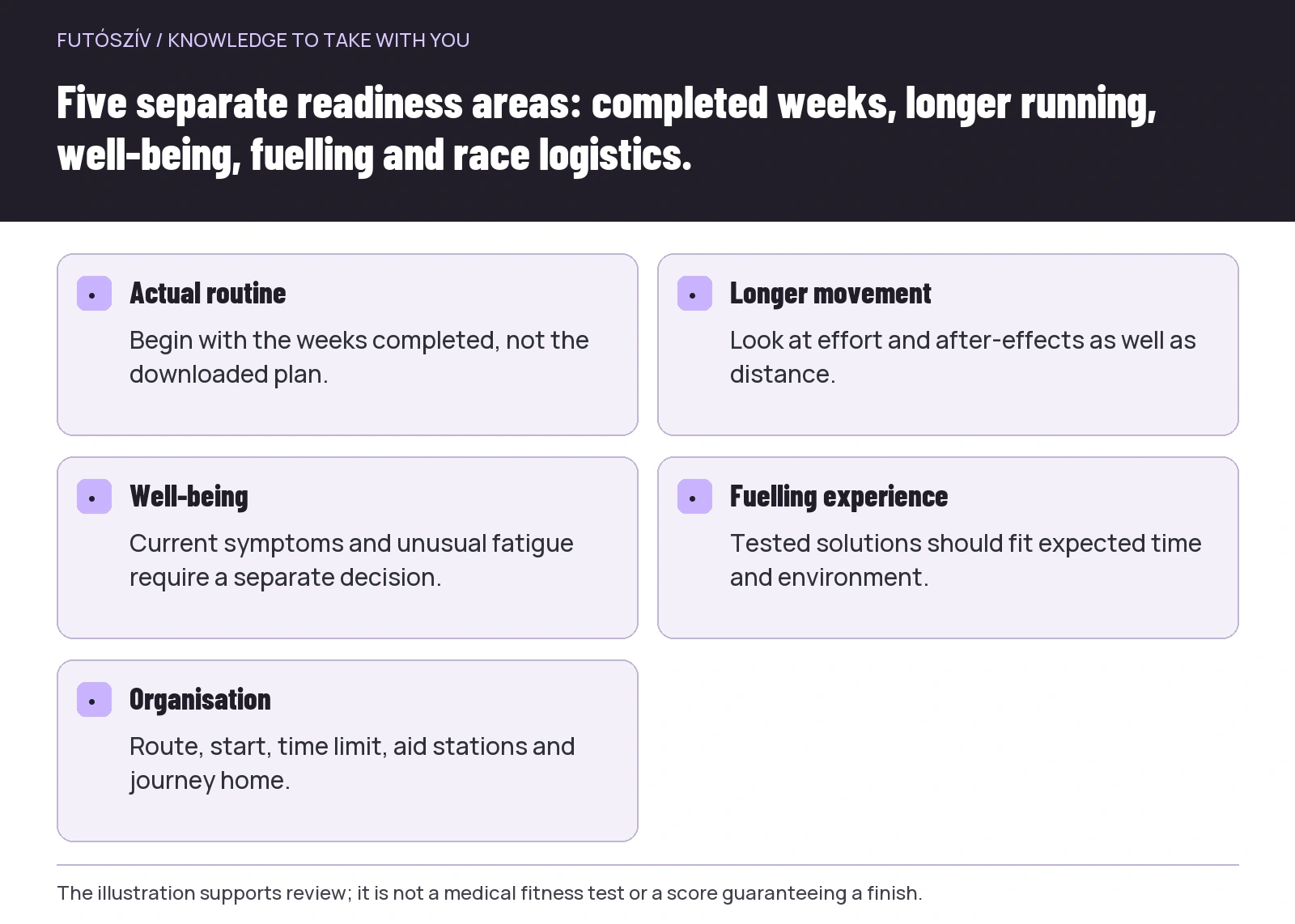 Enlarge diagram
Text version of the illustration
- Actual routine
- Begin with the weeks completed, not the downloaded plan.
- Longer movement
- Look at effort and after-effects as well as distance.
- Well-being
- Current symptoms and unusual fatigue require a separate decision.
- Fuelling experience
- Tested solutions should fit expected time and environment.
- Organisation
- Route, start, time limit, aid stations and journey home.
Current well-being is a separate decision area
Do not automatically explain new, worsening or recurring symptoms as natural companions of preparation. If running or everyday movement is painful, an appropriate professional assessment may be needed for the decision to start. A previously successful long run does not settle today’s symptom.
The American College of Cardiology information includes chest symptoms, dizziness and feeling close to fainting among exercise-related warning signs, and recommends healthcare discussion before continuing with such a history. Sudden severe illness requires urgent help.
Prolonged unusual exhaustion or illness is not simply a pace-selection question either. Entry and travel costs do not change the current situation. Postponing the start can be considered when preparation or health questions remain unresolved.
Plan expected duration, not only kilometres
A half marathon is the same distance, but runners spend very different times on the course. Clothing, fuelling, weather and pre-start waiting therefore cannot automatically be copied from a faster acquaintance’s routine.
Make a plan suited to your own expected duration. If the finishing time is uncertain, allow several scenarios. Know what changes if you move more slowly and what this means for the event’s time limit or aid stations.
Check current organiser information on the race’s official platform. Time limits, route and refreshments can change; a previous year’s blog account may not describe this year. Clarify uncertain details before leaving.
Keep the fuelling plan tested and simple
Practise pre-start eating, using drinks available on the course and handling what you carry during appropriate training beforehand. You need not change everything at once. A familiar, manageable solution may be worth more than a complicated system adopted at the last moment.
Specific needs depend on duration, conditions and individual circumstances. If a health condition or recurring digestive difficulty affects fuelling or hydration, a sports dietitian or another appropriate professional can help. A general checklist cannot replace an individual plan.
Practise execution too: reaching equipment you carry, collecting a cup and moving predictably among others. Fuelling and hydration are not only about purchased products. Movement and race logistics are equally part of the task.
For equipment, time in use matters
Socks, tops or carrying systems suitable for a short loop may feel different over longer time. Actually use your chosen equipment on an appropriate run and record what bothered you. Opening packaging is not use experience.
Where possible, leave no basic adjustment question for race morning. Know where the number will go, what belongs in pockets and how you will manage layers. You need not optimise everything perfectly, but can reduce common rushing beforehand.
Choose from several familiar options for the weather. If conditions differ from expectations, the task and goal can change. A carefully calculated target pace does not oblige you to ignore the environment.
The final weeks should not become replacement preparation
If you feel something is missing, identify it precisely first. Experience of longer movement? Uncertainty about fuelling? Concern over a current symptom? Different questions need different answers, and another big run does not solve all of them.
A proof-seeking long trial placed immediately before the race adds new load; it cannot retrospectively make earlier weeks consistent. If preparation differed substantially from the plan considered necessary, reviewing the goal or start may be more realistic than cramming.
A shorter familiar task or calm equipment trial can provide practical information, but do not give it the meaning of a complete fitness assessment. An honest review of preparation must leave some uncertainty intact.
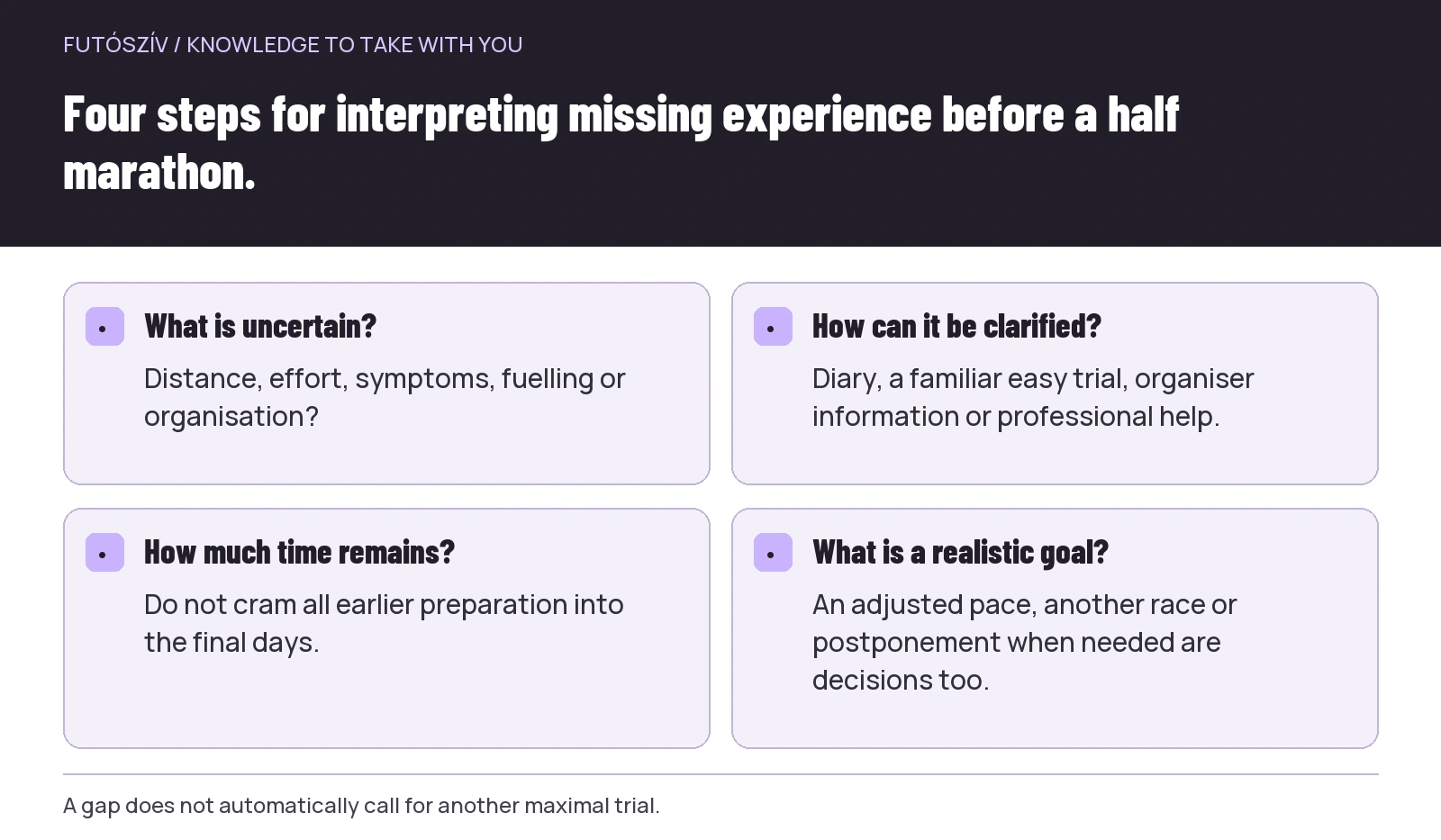 Enlarge diagram
Text version of the illustration
- What is uncertain?
- Distance, effort, symptoms, fuelling or organisation?
- How can it be clarified?
- Diary, a familiar easy trial, organiser information or professional help.
- How much time remains?
- Do not cram all earlier preparation into the final days.
- What is a realistic goal?
- An adjusted pace, another race or postponement when needed are decisions too.
Plan the day before the start too
Race-pack collection, travel, accommodation, meals and reaching the venue all take time. If they remain until the final evening, the period intended for rest can easily vanish. Organisation aims to reduce unnecessary rushing, not create a perfect day.
Include a whole day’s sightseeing and prolonged standing too. Not recording them as running does not mean they are not time on your feet. For shared activities, agree shorter journeys and breaks with companions beforehand.
Make a short departure list: necessary documents and race details, familiar equipment, route to the start and a meeting point after finishing. These simple tasks let you increase predictability before the start.
Make the first half your own task
The field’s momentum does not indicate whether a pace is realistic for you. In the opening section, find your own effort chosen beforehand. Do not try to regain time lost in congestion through sudden weaving and sprints.
Keep simple checkpoints: is progress controlled, is the fuelling plan working, and how is effort developing relative to the course? These can guide holding or adjusting later. Acceleration is an option, not a duty to fulfil under all conditions.
If planning walking sections too, have prior experience and a clear role for them. The strategy is not a health guarantee and does not override the need to stop if unwell. The value of finishing does not depend on every step of the day being a running step.
Three realistic outcomes for deciding whether to start
The completed foundation and current situation align: a simple, realistic race plan can be made, with a goal adaptable to the day’s conditions. Complete certainty is unnecessary; the first start naturally brings new experience too.
The target time looks overambitious: completion or more even pacing can take priority if the situation is otherwise appropriate. Make the adjustment genuine, not merely a spoken easing of expectations immediately overridden after starting.
Preparation or health remains unclear: professional discussion, another goal or postponement may be needed. A checklist cannot grant permission to start in every case. Sometimes a good decision is leaving more time before the next attempt.
Leave room after the finish too
Do not automatically plan the following day as though you completed an ordinary easy run. A first half marathon is a new task, and its after-effects provide information too. Allow time for food, the journey home and a calmer routine.
Review what worked before the start, on the course and afterwards. Lessons about pacing, fuelling and organisation are as valuable as finishing time. One difficult section does not describe your entire running journey.
A successful first half marathon can also mean understanding the tasks of longer distances more precisely and choosing the next goal with greater experience. Readiness is not a certificate from one long run. Completed weeks and considered decisions together form its foundation.
Sources
- Training for a (half-)marathon – observational research on training characteristics, performance and injuries.
- Factors Associated With Half- and Full-Marathon Race-Related Injuries – questionnaire data around a race and group-level associations.
- American College of Cardiology: exercise-related warning signs – health information.
How Futószív articles are prepared: our editorial guidelines.