Consecutive long running days, often called back-to-backs, are one possible tool in preparing for an ultra. On the second day, you set off while the effects of the previous effort may still be present. This is a complex task, not a simple shortcut to completing a longer race with less preparation.
To understand the approach, view both days and the period afterwards as a single unit. Adding the distances is not enough: terrain, intensity, recovery between runs and life circumstances together determine the workload involved.
What might its purpose be?
The task may be considered to practise for a multi-day event, distribute a greater training volume or learn organisational skills associated with prolonged exercise. Fuelling, organising equipment and starting again the next day can be genuine race tasks for certain goals.
For a single-day ultra, two days do not precisely reproduce the race’s continuity. Overnight sleep and meals between runs create a substantially different starting point from uninterrupted movement. It helps to recognise the similarities and differences together.
Make the statement of purpose specific. For example, you may want to observe how equipment management and supplies work across two days. “I need to learn to suffer” provides little guidance for choosing the workload or deciding when to finish.
The two days are not independent workouts
Choices on the first day affect the second departure. An unusually fast or downhill-heavy first run may leave you in a different condition from a restrained run on a predictable route. The second plan therefore cannot be carried out without considering how the previous day actually unfolded.
The interval matters too. A quiet afternoon and sleep differ from a long drive, few opportunities to eat and a late bedtime. Recovery does not automatically happen between two runs placed side by side in the calendar.
Make the start of the second day a new decision point. Your morning condition may override the task imagined in advance. Defining conditions for shortening or omitting the run beforehand can be a worthwhile part of the two-day plan.
What does research on multi-day running show?
A study comparing single-stage and multi-day mountain ultras found different patterns of fatigue and recovery. Rest between stages did not simply remove the consequences of the workload. The study analysed racing, not the long-term effectiveness of two weekend training sessions.
This distinction matters. Observing multi-day exertion does not prove that back-to-backs are the best preparation for every ultrarunner. A studied event and your own training cannot be equated without explanation.
The direct lesson is narrower: distribution changes the nature of fatigue, and after-effects have a role of their own. More rest points do not automatically mean a smaller total recovery requirement.
A concentrated training block is not a cost-free shortcut either
A running study examining five consecutive training days assessed the relationship between acute fatigue and later adaptation. Its protocol was not the same as two long easy days, so it provides no direct dose for them.
The useful methodological question is when the outcome is measured. Fatigue visible at the end of a block and performance assessed afterwards with suitable recovery represent different states. A very hard weekend does not prove improvement by itself.
In your own programme, examine whether training remains manageable afterwards too. If planned sessions repeatedly fall away after the block, the weekend’s total distance does not tell the whole story. The time needed for adaptation is part of the planned unit.
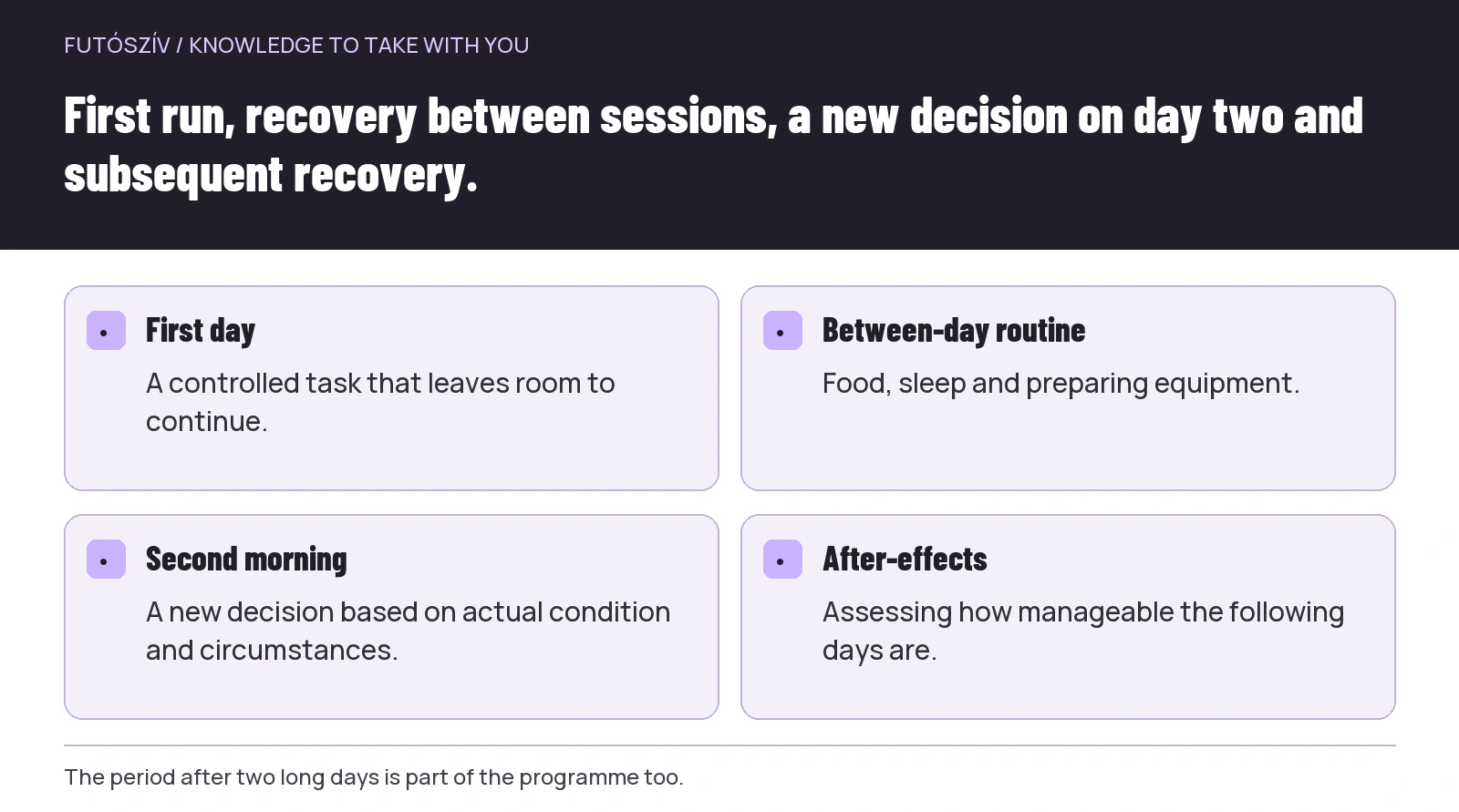 Enlarge diagram
Text version of the illustration
- First day
- A controlled task that leaves room to continue.
- Between-day routine
- Food, sleep and preparing equipment.
- Second morning
- A new decision based on actual condition and circumstances.
- After-effects
- Assessing how manageable the following days are.
When is the rationale particularly weak?
If a single long run regularly produces disproportionate after-effects, adding another long run the next day is not an obvious step. If weekday running is irregular, a weekend double does not automatically make up for it.
Uncertainty before a first longer race is understandable, but an exceptionally exhausting workout may not be the best way to manage anxiety about the distance. Getting to know the route, setting a realistic goal and preparing a supply plan can often be practised separately.
Introducing the approach during illness, return from injury, recurring pain or persistent unusual exhaustion requires an individual assessment. A race entry already paid for is not proof of medical fitness.
Look at total time and terrain before distance
In ultrarunning, the same kilometres can mean very different durations and mechanical demands. Elevation gain, long descents, technical trails and a backpack’s load add to the task. Record these to compare the two days too.
Walking is not necessarily a rest, especially on steep climbs or difficult ground. It may be an important movement pattern for your target race and worth incorporating deliberately. It still remains part of the total time under load.
If the second day’s terrain is much harder, a shorter distance does not necessarily mean an easier task. A rule of “only half as much the next day” does not by itself describe the session’s difficulty or provide a general safety guarantee.
The first day must leave some room
A restrained pace is particularly important when the plan centres on the two days as a combined task. An impressive finishing surge on the first run may remove the opportunity for useful work the next day. The goal should not be a first-day app record.
Do not introduce new shoes, unusually extensive descending, a large distance increase and a long run the next day all at once. With several new variables, identifying what caused symptoms or excessive fatigue becomes difficult. Simpler planning helps evaluation.
At the end of day one, already think about the next: was there chafing, pain, a supply problem or difficulty navigating? Solving these can be a genuine learning outcome from the weekend, even if the second run needs modification.
The routine between days can be practised
Allow time to change, eat, drink, dry equipment and prepare for the next departure. These skills can matter at a multi-day event. Practising the routine does not necessarily require maximum training volume on both days, however.
Notice what you forget when tired: charging the light, saving the next day’s route, clean socks or planning breakfast. Make a short personal checklist. Tailor it to your actual problems, rather than creating a catalogue of every imaginable item of equipment.
Protect the opportunity to sleep. Night racing and sleep deprivation are separate subjects with separate risks; deliberately shortening the night is not necessary for back-to-backs. Starting again while tired and depriving yourself of sleep are not the same task.
Fuelling: the second day begins the previous evening
The ISSN position stand on ultrarunning discusses nutritional, digestive and logistical issues in training and racing together. Supplies after a long day are more than a matter of comfort if you plan further exercise the next morning.
Personal quantities should be chosen according to duration, intensity, conditions and tolerance. Do not treat the fuelling used in a research protocol as an automatic prescription for yourself. Recurring digestive symptoms or particular health circumstances may warrant individual professional help.
Do not turn deliberately inadequate eating into a mental test. The purpose of the approach is not to neglect basic needs. Do not force unlimited fluids either: excessive drinking can be dangerous and does not replace appropriate planning.
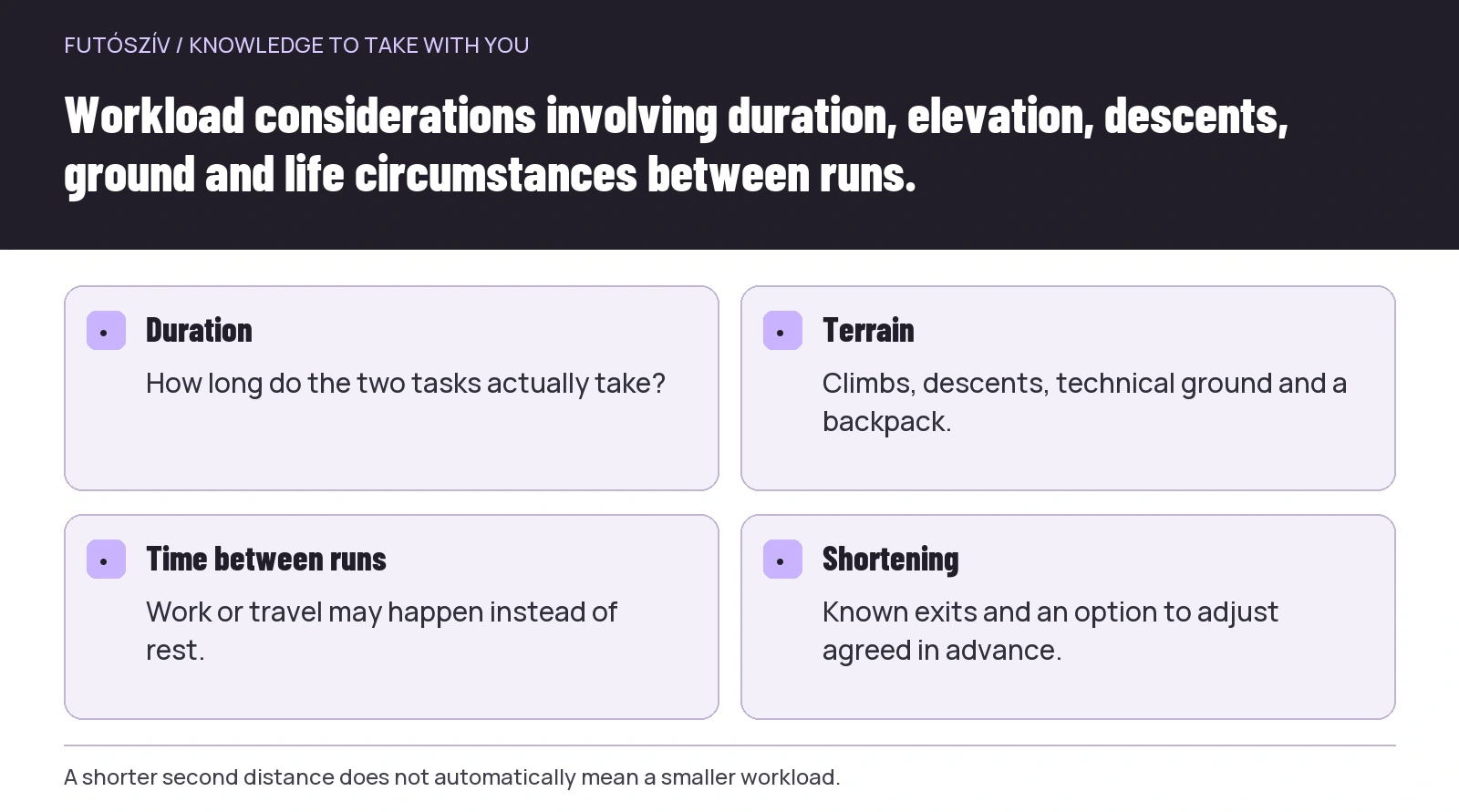 Enlarge diagram
Text version of the illustration
- Duration
- How long do the two tasks actually take?
- Terrain
- Climbs, descents, technical ground and a backpack.
- Time between runs
- Work or travel may happen instead of rest.
- Shortening
- Known exits and an option to adjust agreed in advance.
Decision points on the second morning
First observe your general wellbeing and everyday movement. Is there pain that changes your walking? Have you felt unusually unwell? Are supplies and a safe route workable? These matter more than the calendar entry.
Even feeling only general fatigue does not automatically make the full original plan appropriate. Assess your condition against the second day’s purpose. Shorter, easier or different movement may be suitable, but you do not need a test run to diagnose symptoms.
Conditions for shortening agreed in advance are especially useful in a group. Companions should not pressure you to continue when the situation is clearly wrong from the opening minutes. Freedom to decide should be real, without a requirement to justify yourself.
Make the second route easy to shorten
When more fatigued, a remote route that is hard to leave creates a greater logistical risk. Several short loops, known exits and predictable ground can make adjustments easier. The plan should not turn getting back into another compulsory performance.
Concentration and secure movement matter on technical descents too. The second day may not be a good opportunity to try new, harder terrain. Conditions similar to the target race can be useful, but that similarity should be built gradually with an appropriate background.
For a longer trail run, have a way to seek help and a navigation solution. Know where you are and how to shorten the route. Device charge, weather and network limitations are part of the task.
Which signals mean you should stop?
For sharp, increasing or movement-altering pain, limping or feeling unusually unwell, do not continue training for the planned number’s sake. Chest symptoms, fainting, confusion or severe breathing difficulty may require urgent help.
After a large workload, severe, unusual muscle symptoms or other concerning signs should not be treated as an ordinary training experience either. A healthcare professional needs to assess the severity of the condition. Another run is not a safe check of whether it will pass.
Symptoms disappearing does not automatically authorise making up the whole day’s programme either. Continuing should reflect your individual situation. A general article about ultras cannot set a return-from-injury deadline.
Plan the days after the weekend in advance
A concentrated workload makes sense only alongside opportunities for recovery. Do not plan as though every previous intense task must fit immediately after two long days unchanged. View the workload of the following days as part of the unit too.
If the weekend is followed by a week of heavy physical work, that is a real circumstance. Recovery means more than an exercise-free spreadsheet cell. Work, travel and opportunities for sleep count just as much.
Do not stop evaluating at Sunday’s completed tick. Examine wellbeing, movement and continuation of the programme over the following days. Excessive after-effects provide information for adjusting a future dose.
What should you learn if you use it?
Keep the first day, the routine between runs, the second departure and your later condition separate in the log. Describe which race task you genuinely managed to practise. A specific lesson about shoes, fuelling, navigation or restrained pacing may be more valuable than total distance.
If there is no clear benefit relative to the goal, leaving out the approach is reasonable. Ultra preparation has no single compulsory weekend format. A personal programme works well when it provides an appropriate background and a manageable continuation for the chosen task.
Sources
- Fatigue and Recovery after Single-Stage versus Multistage Ultramarathon Running.
- Is Functional Overreaching or Acute Fatigue the Key to the Effects of Concentrated Block Training in Running?
- ISSN Position Stand: nutritional considerations for single-stage ultra-marathon training and racing.
Observations from races and training blocks do not establish a universal back-to-back dose. This article offers considerations for decision-making; a personal programme with a high total workload requires suitable coaching and, where necessary, healthcare support.
How Futószív articles are prepared: our editorial guidelines.