
Marathon photographs usually show the finish gantry. Most preparation, however, is everyday life: when running fits, who looks after the children during a longer outing, what the next working day will be like and where you will test fuelling. A first marathon becomes a good goal when the process has room in your life as well as the finish photo appealing to you. A 42.195-kilometre commitment has too many components for one enthusiastic decision to solve them all.
This is a decision-making guide, not a marathon training plan or fitness assessment. The training demands needed for preparation differ between people. Previous injury, illness, an existing health problem or new symptoms require discussion with an appropriate professional about training and starting. Good organisation can reduce much uncertainty, but cannot replace medical clearance.
A beginner marathoner and a beginner runner have different starting points
A marathon programme labelled for beginners often means the participant is new to the distance, rather than putting on running shoes for the first time. The official London Marathon website offers sixteen-week programmes for different experience levels. The length of the calendar alone, however, does not establish whether the programme’s first week fits your current training.
Read the first weeks first, rather than searching for the final long run. If even the opening week asks for much more running, more time or harder work than you currently do regularly, building a foundation before that programme is also a task. Instead of “there are still sixteen weeks”, ask more precisely: where am I starting, and is the chosen route’s first step manageable now?
A marathon is more than twice a half marathon
Mathematically, the distance doubles, but the personal task is not simple multiplication in every respect. You spend longer moving, clothing, shoes and fuelling arrangements must work for longer, and event logistics extend too. A detail that barely bothered you in a half marathon can become significant over more time, such as a chafing seam or hard-to-reach pocket.
Previous half-marathon experience is a useful foundation, but carry forward more than the finishing time. Review preparation, the second half of the race and the following days. If the half marathon came together only with great difficulty after many disrupted weeks, consider that when choosing the next distance. If the process worked well, specific routines can be developed further.
Make an honest inventory of your time
A marathon plan involves preparation, travel, washing and rest as well as exercise time. A longer outing can therefore occupy more calendar space than the app’s moving time shows. Squeezing everything into the final free slot can make running a continual negotiation. A manageable plan needs to work on ordinary days, not only in ideal circumstances.
List an average week’s fixed commitments, then the particular demands of the coming months. Work deadlines, exams, moving home or family care leave different amounts of room. You need not abandon running in every difficult period, but choose the race date with these demands in mind too. Choosing a marathon should be a decision about your whole situation.
| Resource | What to check in practice | An example of a hidden cost |
|---|---|---|
| Weekday time | Is there a regular, predictable slot? | A later bedtime after evening training |
| Weekend | Do longer activity and the arrangements around it fit? | Public transport to the chosen route |
| Rest | Is there room to recover after the effort? | A full day of standing work after a long run |
| Family arrangements | Have you discussed the schedule? | Childcare and changing shared plans |
| Budget | Can you afford entry, travel and necessary replacements? | A separate trip to collect the race pack |
| Attention | Do you have capacity to learn and observe? | New routes, fuelling and many data points at once |
 Enlarge diagram
Text version of the illustration
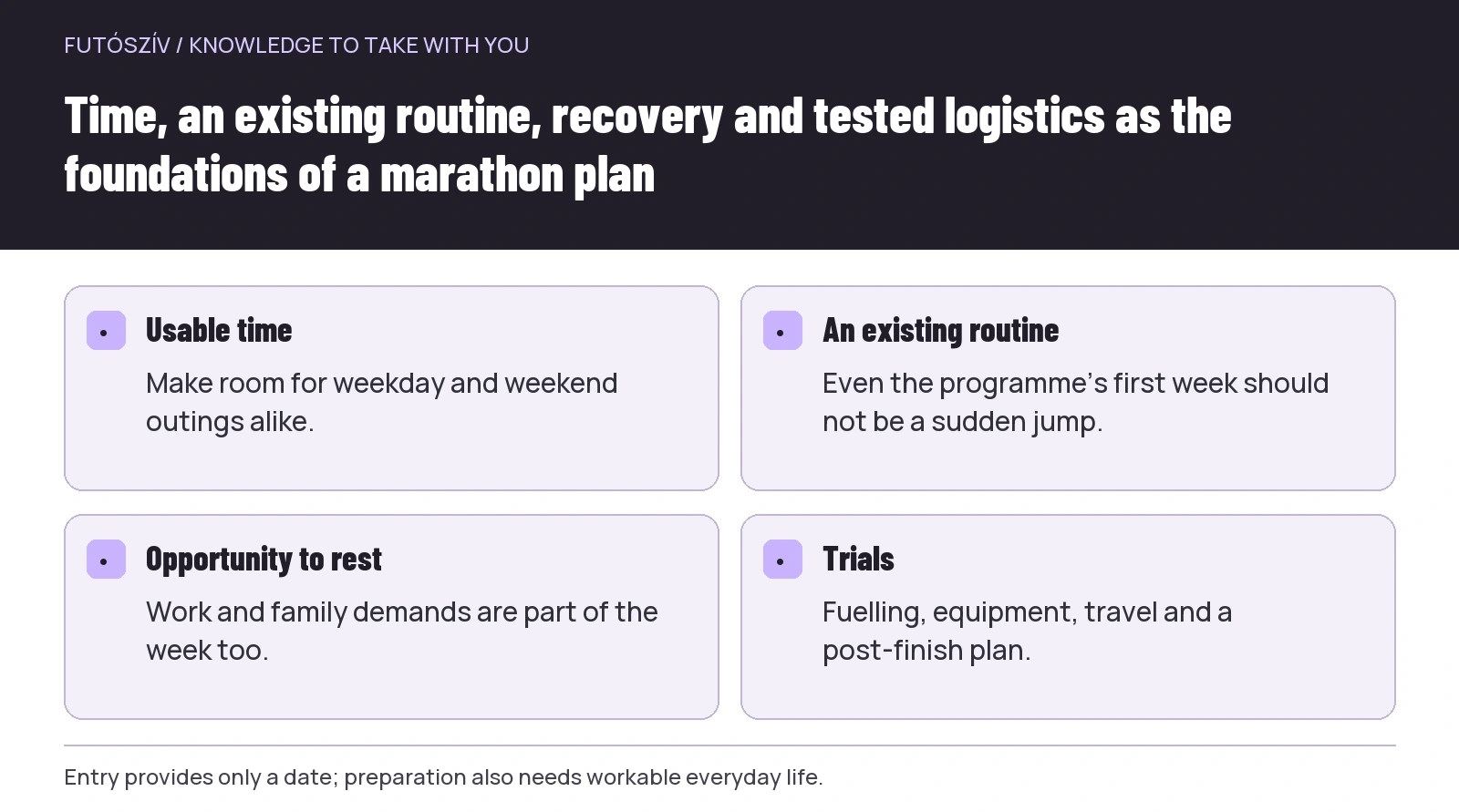
- Usable time
- Make room for weekday and weekend outings alike.
- An existing routine
- Even the programme’s first week should not be a sudden jump.
- Opportunity to rest
- Work and family demands are part of the week too.
- Trials
- Fuelling, equipment, travel and a post-finish plan.
Make the training diary a decision-making tool
With a marathon goal, weekly kilometres can easily take the lead. Add a brief explanation to the number: why the week developed that way, how you managed and what you learned. Shortening twice because of fatigue may be more important information than eventually collecting the same distance the next day. A diary helps when it preserves the reasons for changes too.
Choose a few consistent questions. What was the week’s most demanding part? Which run remained genuinely easy? Did eating, carrying supplies and scheduling work? Were there symptoms requiring professional discussion? Let the answers lead to weekly decisions. If you collect more numbers while the plan always stays unchanged, the data is not doing its job.
Do not base fuelling on the race-pack contents
Marathon fuelling is a complex, individual matter. Expected moving time, weather, training experience and tolerance affect quantity planning; a sports dietitian may help where needed. Check the organiser’s aid-station selection, but do not assume everything offered will suit you. Race-day surprises are of little use here.
Practice should include thoroughly ordinary details. Can you open the packaging while moving? Where does rubbish go? If the belt gets wet, can you still reach its contents? What if you fail to collect the expected item at a station? You do not need to dramatise every possible mistake. Simple, tested answers to likely situations are enough.
Do not justify entry with a single long run
There are many striking claims about peak training: without this many kilometres you should not start, while after that many you are certain to manage. Such rules hide differences in history, pace and recovery. The same distance can take very different amounts of time. Assess the whole process rather than one large test, and tailor training-load details with a coach.
A long outing can be valuable for testing clothing, practising fuelling or learning to hold back in time. If every session proves the greatest possible distance, these lessons recede. A preparation run is not an early version of the marathon. It should be work after which the following weeks’ tasks remain possible.
Ten questions to place alongside your entry
- Why am I choosing this marathon? Do its location, date and course suit me, or has a video just inspired me?
- What forms my present foundation? Can I show regular weeks, or am I relying on one or two big performances?
- How much usable time do I have? Have I counted the full time required by weekday sessions and longer outings?
- What do I know about the course? Have I included elevation, surface, shade, wind-exposed stretches and access to the start?
- How does my fuelling work? Have carrying and consuming it both been tested, or do I only have a product list?
- What is the time limit? Have I compared it with my whole expected time, including slowdowns?
- What happens after missed training? Do I have an approach to adapting, or will I automatically compress the missed work?
- Whom can I ask? Do I know how to access coaching, dietetic or healthcare support if needed?
- What does withdrawing mean? Do I know the transfer, deferral and withdrawal conditions?
- What happens after the finish? Do I also have a plan for getting home, changing clothes and the following days?
 Enlarge diagram
Text version of the illustration
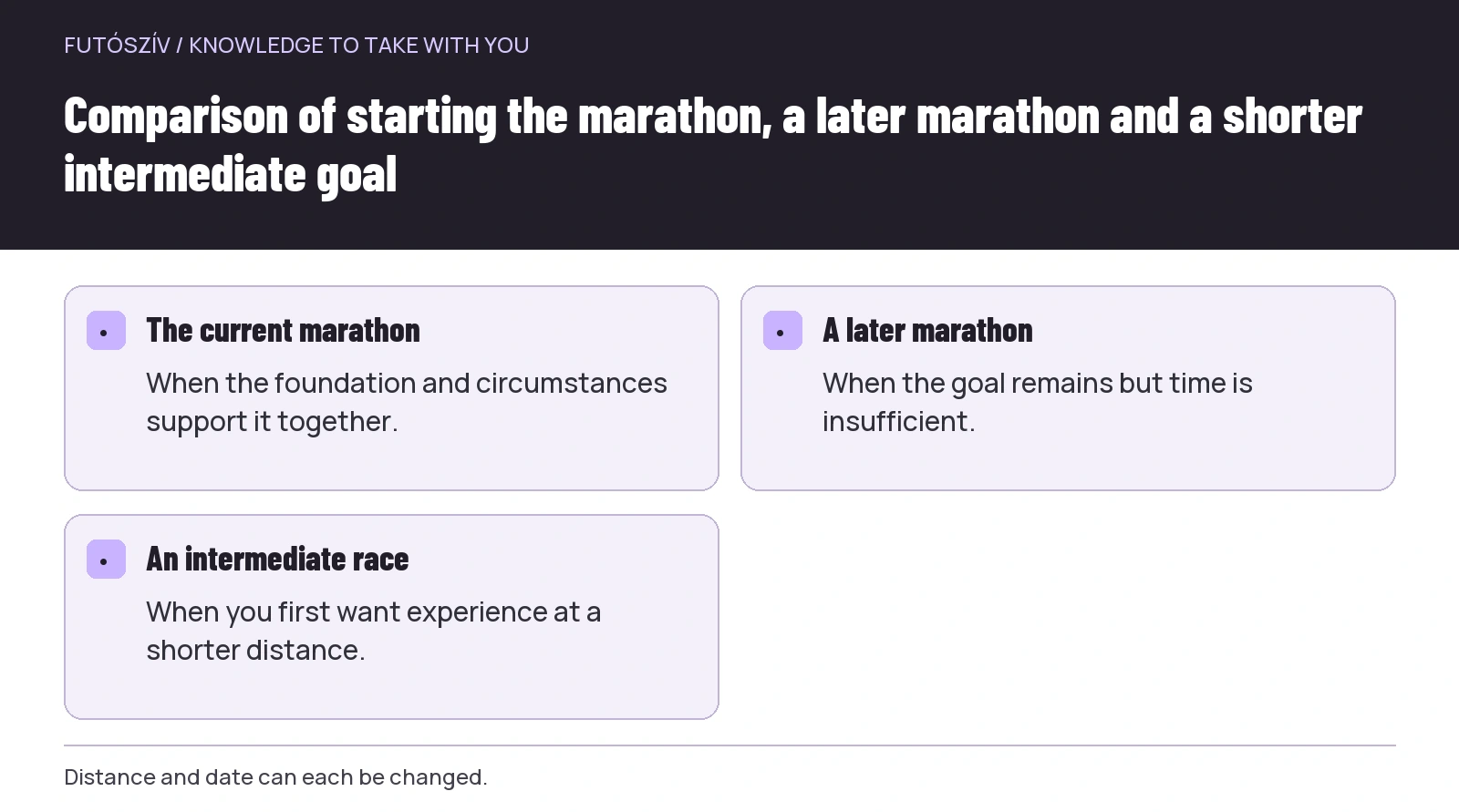
- The current marathon
- When the foundation and circumstances support it together.
- A later marathon
- When the goal remains but time is insufficient.
- An intermediate race
- When you first want experience at a shorter distance.
When is it worth rethinking the date?
If important parts of preparation keep being missed, ask more than how to save the entry. Ask what the work you can reliably complete is enough for now. A shorter race can provide plenty of start-line experience without taking on the marathon distance at any cost. A good intermediate goal is not a consolation prize, but a task suited to the present situation.
The London Marathon Events medical advice emphasises not making up missed training in the final period and arriving at the start fresh. This need not become an elaborate slogan. If the main plan for the last weeks is rapidly acquiring the missing foundation, the race goal itself needs review.
Three situations in which postponing provides different benefits
The calendar has become too tight. The runner is healthy and motivated, but work arrangements have changed. A later start allows the necessary sessions without constant time pressure. Here, postponing primarily solves an organisational problem. The next plan can begin from the new rhythm rather than trying to maintain a previous situation that no longer exists.
There is too little race experience before tackling the distance. Running works in training, but starting areas, aid stations and crowds are unfamiliar. A smaller event lets you test arrival, equipment and fuelling actions. The missing element is not necessarily physical fitness; carrying out the whole day needs practice. You can learn this with smaller consequences.
Symptoms interrupt the process. Diagnosis and return are professional matters here. Postponing leaves space for decisions not to be directed by an already paid entry. Earlier work does not lose its value, but does not automatically justify starting either. The next goal can emerge from a clarified condition and rebuilding that is genuinely manageable.
Race information is part of preparation
The official Budapest Marathon website presents the start, distance and participation information for the relevant year together. Always read your own year and event: conditions for shorter festival races differ from those for the marathon. Check the time limit, race-number collection window, age limit, entry transfer and any health information too.
At a larger event, walking between locations, closed roads and travel can also be demanding. When choosing accommodation, consider race-day access rather than only straight-line distance from the finish. Agree a simple meeting point and backup communication plan with supporters. After finishing, a long search in a crowd or on a dying phone may not be comfortable.
Choose a first marathon that leaves room to continue
A first marathon does not require flawless preparation, but it needs a manageable foundation and genuine freedom to decide. Completing the distance can be a great experience when you do not have to dismiss every earlier warning along the way. How you reached the start and your relationship with running afterwards matter alongside finishing.
The sound decision is therefore sometimes entering, sometimes choosing a later date and sometimes another season of experience over shorter distances. The marathon does not disappear forever. You define more precisely a place in your life with room for preparation, the race and everyday life afterwards.
How Futószív articles are prepared: our editorial guidelines.