
The idea of a first marathon often arrives in a moment: a friend finishes, entries open or your first half marathon goes well. The commitment, however, affects months of scheduling and many successive decisions. Place the reality of everyday preparation alongside the image of the finish line.
The question is not whether a universal running age or weekly mileage exists after which you have “earned” a marathon. Rather, consider your current foundation, time available to build and how the plan fits your health and life. Doing this before entering is worthwhile.
A marathon should be more than a calendar date
The selected race date may be fixed, but the preparation needed depends on your background. A tight calendar does not automatically call for more weekly runs and a bigger weekend distance. Sometimes a later start is more realistic.
Write down why the goal matters to you. Experience, community, a personal story or finishing time can create different emphases. Understanding the reason helps you adjust the date or performance expectation if needed without feeling that running itself has lost its meaning.
Imagine the full programme when deciding: regular runs, longer weekend outings, preparation, eating and rest. Entering takes minutes; preparation requires recurring time. Think honestly about the difference.
Describe your current foundation from actual weeks
Do not use only your best month or an old race as the starting point. Look at what you have done regularly recently: sessions, duration, difficulty, interruptions and other sports. Your current routine is the real basis for the next plan.
Alongside consistency, observe after-effects. How manageable does the week remain after a longer run? Do work and family life fit alongside movement? If the current programme already creates continual exhaustion and time pressure, restructuring it may be the main task before a marathon goal.
Choosing a more stable foundation period first is not failure. It gives more experience of sustainable load. The start of marathon preparation need not follow only the countdown on a race website.
Previous longer-distance experience is useful, not a talisman
In a New York study following first-time marathoners, previous half-marathon experience was associated with lower injury incidence. This is an observational relationship, not proof that one half marathon protects everyone or automatically prepares them for a marathon.
An intermediate race often provides learning: pre-start routine, longer movement, pacing, fuelling and post-finish experience. These can reveal what works and what needs more attention. Experience gained and interpreted matters more than the medal alone.
If your regular running experience is still limited to shorter distances, an intermediate goal can have value in its own right. Every race need not be a stepping stone to a marathon. The right next step fits your own situation.
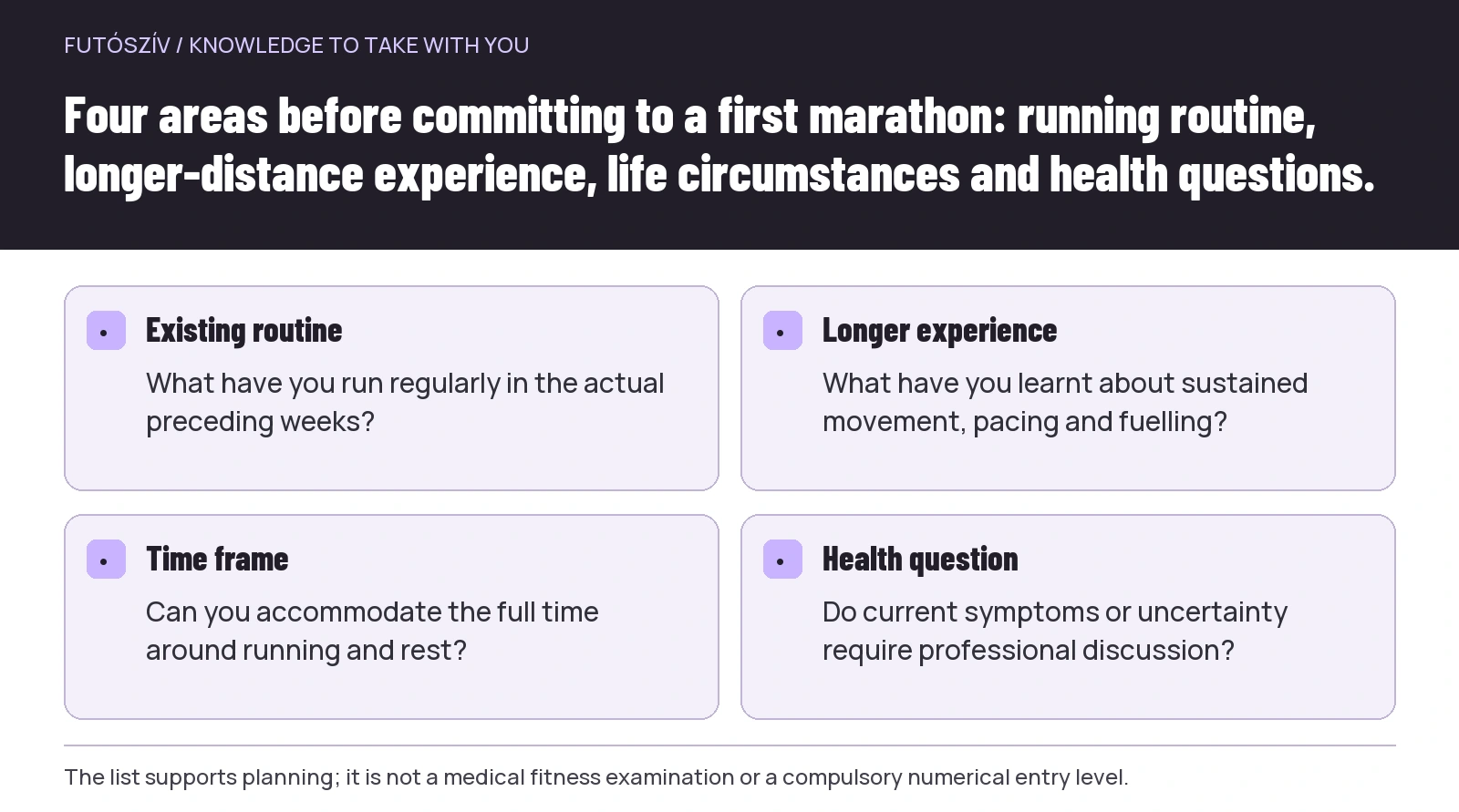 Enlarge diagram
Text version of the illustration
- Existing routine
- What have you run regularly in the actual preceding weeks?
- Longer experience
- What have you learnt about sustained movement, pacing and fuelling?
- Time frame
- Can you accommodate the full time around running and rest?
- Health question
- Do current symptoms or uncertainty require professional discussion?
More training is not a simpler solution in every situation
The same first-marathon study also found relationships between training frequency and certain injury outcomes. It would be wrong to generalise that a particular number of weekly sessions is good or bad for everyone. Background, load structure and limitations of self-reported data matter too.
Do not narrow progress in your own plan to one number. Adding another running day, a longer weekend outing and a more intense main set simultaneously means several changes. If difficulties appear, identifying which decision was too large becomes hard.
Make the programme manageable and adjustable. If working with a coach, share the work actually completed and life circumstances too. It is difficult to decide well from a plan completed on paper when different loads regularly occurred in the background.
The long run matters, but is not the whole preparation
A study following half-marathon and marathon trainees also analysed relationships between weekly volume, longest run and performance. Such results do not establish one compulsory long-run distance for every first-time marathoner or provide personal permission to start.
A big weekend outing does not automatically replace the rest of the week. If running around it is irregular or the following days always fall apart, examine the whole plan. An even longer run is not necessarily what is missing.
Evaluate the long task through duration and effort too. Identical kilometres take very different times for different runners. When comparing, the complete load context matters more than copying someone else’s distance.
The time commitment should work for those involved
Preparation involves more than minutes in motion. Getting there, changing, eating, returning home and the next day’s tasks all require time. If these fit only at the expense of sleep and family activities, consider another plan or date.
Discuss the recurring time requirement with those close to you. Treat it as shared organisation rather than asking permission. A pre-agreed weekend slot often creates less tension than every longer run becoming a family discussion at departure.
Leave room for unexpected events too. A plan that works only with perfectly uninterrupted weeks fits real life poorly. Illness, travel or major work demands will require adjustment, not automatic catch-up.
Clarify health questions before the performance goal
Previous illness, current symptoms, recurring problems or uncertainty about exercise tolerance may warrant appropriate healthcare discussion. Not everyone needs the same examination or approach. A general article and home watch data cannot provide an individual fitness decision.
The American Heart Association scientific statement considers the benefits of regular movement alongside risks of intense exertion in certain situations, especially for inadequately prepared or susceptible individuals. A gradual approach suited to individual circumstances matters more than a sudden large commitment.
Chest symptoms, feeling close to fainting, exercise-related illness or other concerning symptoms are not simply training difficulties. Appropriate professional help may be needed before continuing; sudden severe symptoms require urgent care. A marathon goal is no reason to dismiss warning signs.
Fuelling and hydration are separate learning processes
During a long race, taking on supplies is not a minor addition. The pre-start routine, food and drink available on the course and handling your own equipment need prior experience. Specific solutions depend on duration, environment and individual circumstances.
Do not leave every trial until the last long run or change many new products at once. Record what you tried, under which conditions and your experience. A sports dietitian or another appropriate professional can help with recurring digestive or other difficulties.
More fluid is not automatically better. The research involving Boston marathoners associated weight gain linked to excessive fluid consumption with low blood sodium. The lesson is not one mandatory drinking quantity for everyone, but that forced overdrinking can also carry risk.
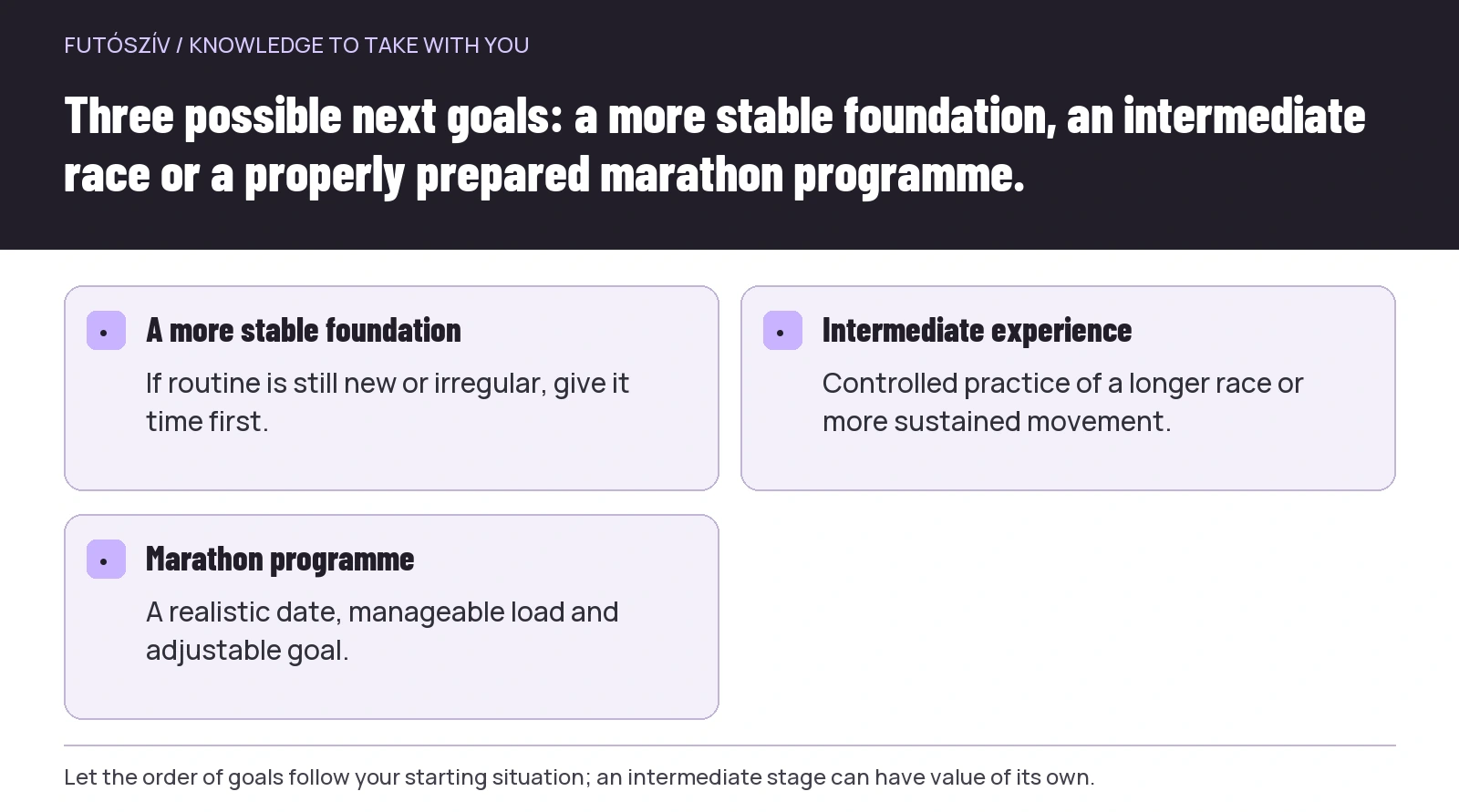 Enlarge diagram
Text version of the illustration
- A more stable foundation
- If routine is still new or irregular, give it time first.
- Intermediate experience
- Controlled practice of a longer race or more sustained movement.
- Marathon programme
- A realistic date, manageable load and adjustable goal.
Choosing the race is also a preparation decision
Look at course character, expected environment, time limit and travel to the venue. The event with the most impressive video is not necessarily right for a first marathon. Conditions suited to your goal and expected duration matter.
Check current organiser information before entering and again before leaving. Start arrangements, refreshments, baggage handling and route details can change. Other runners’ earlier accounts may offer good ideas but cannot replace official information.
Include the journey home after finishing too. Long travel or fixed commitments may make post-race days less restful. These belong to the full undertaking alongside the distance between start and finish.
Three possible starting points
New running routine, little longer-distance experience: establishing a regular, manageable foundation and intermediate goal may be more realistic first. A marathon can remain a longer-term direction while the coming weeks have another, smaller task.
Stable running, a previous half marathon and enough time: a marathon programme can be planned if current condition and life circumstances support it too. A previous result does not automatically require doubling the duration at that same pace.
Good old results, but currently irregular running or symptoms: reassess today’s foundation. Past experience has value but does not replace current capacity. Clarify the next step with professional help if necessary.
When should the goal change?
If preparation persistently fails to happen, planned load repeatedly proves too large or a health question arises, review the goal too. This may mean completion instead of a time target, another distance or a later start. Slowing pace does not resolve the whole problem in every situation.
Do not postpone the change until the final day simply because you entered. Recognising the mismatch earlier leaves more options for an orderly decision. An earlier commitment does not make all later circumstances unchanging.
You can communicate simply to your community too: the plan is changing based on the preparation actually completed. You need not prove that you wanted it enough. Running’s long-term place in your life matters more than one deadline.
Leave the post-marathon period more open too
After a first marathon, you need not immediately fill the calendar with another major goal. Evaluating the race and entire preparation may take time. Leave flexibility for how you feel and unexpected after-effects.
Review which parts were sustainable: weekly arrangements, organising longer runs, learning fuelling and hydration, or race logistics. Alongside finishing time, these can produce the most useful adjustments to your next programme.
A first marathon becomes valuable running experience when the undertaking and your decisions begin with your own situation. You need neither achieve a universal entry level nor choose the nearest start at all costs. Plan a next step you can genuinely build towards.
Primary and official sources
- Factors associated with injuries in first-time marathon runners from the New York City marathon – observational follow-up of first-time marathoners.
- Training for a (half-)marathon – relationships between training characteristics and outcomes.
- Hyponatremia among Runners in the Boston Marathon – observations of risks associated with fluid intake.
- AHA scientific statement on exercise-related cardiovascular events – interpreting benefits and risks within individual circumstances.
How Futószív articles are prepared: our editorial guidelines.