An annual running plan can easily become a long list of races: a spring half marathon, summer trails, an autumn marathon and several community events that feel unmissable. The calendar fills with goals while leaving little room for preparation, rest and everyday life. A usable year plan starts differently: it first recognises real possibilities, then fits sporting goals to them.
You do not need to prescribe every session for twelve months. The annual view is a compass showing each period’s role, expected busy circumstances and the goals you truly want to work towards. Experience and current condition shape details later.
Make the first calendar a life calendar
Enter known work peaks, holidays, travel and important family commitments. Mark months with limited daylight training or route access. These are not distractions around the “real” plan; the plan will happen within them.
Then review weekly time. How many sessions fit when changing, transport and recovery count too? A free weekend does not always mean a long running window. Accounting for this beforehand reduces repeated choices between sport and other important tasks.
The integrated periodisation approach considers coordinating several factors beyond physical training. For recreational runners, the useful lesson is that preparation cannot be built solely from kilometres. Environment and life circumstances shape possibilities together.
Name what you want from the year
You may have a result goal, such as improving a distance; a skill goal, such as more confident trail movement or regular strength work; or an experience goal, such as new places, community or comfortable outdoor time. Every year need not follow the same story.
Choose a few goals you genuinely value and write why. “Others entered too” may be less stable than wanting to develop a particular skill. If the goal changes, its reasoning helps identify what remains worthwhile.
Pair the main goal with a process you can influence directly: a manageable training rhythm, planned rest or practising race logistics. Weather and many circumstances affect finishing time; do not judge the entire year by one number.
Rank the role of each start
Write why each event is in the calendar: main target race, preparation trial or an experience with friends? If every start demands the best possible result, everyday training and recovery become harder to fit between them.
The ranking should mean more than a letter. If an event is practice, name the skill: restrained starting, equipment, aid stations or travel routines. Define acceptable effort too, reducing the chance of a rehearsal spontaneously becoming a main race.
Community participation can have agreed limits too: a shorter distance, comfortable pace or letting go of completion. Discuss before entry rather than after starting, when everyone already follows their own rhythm.
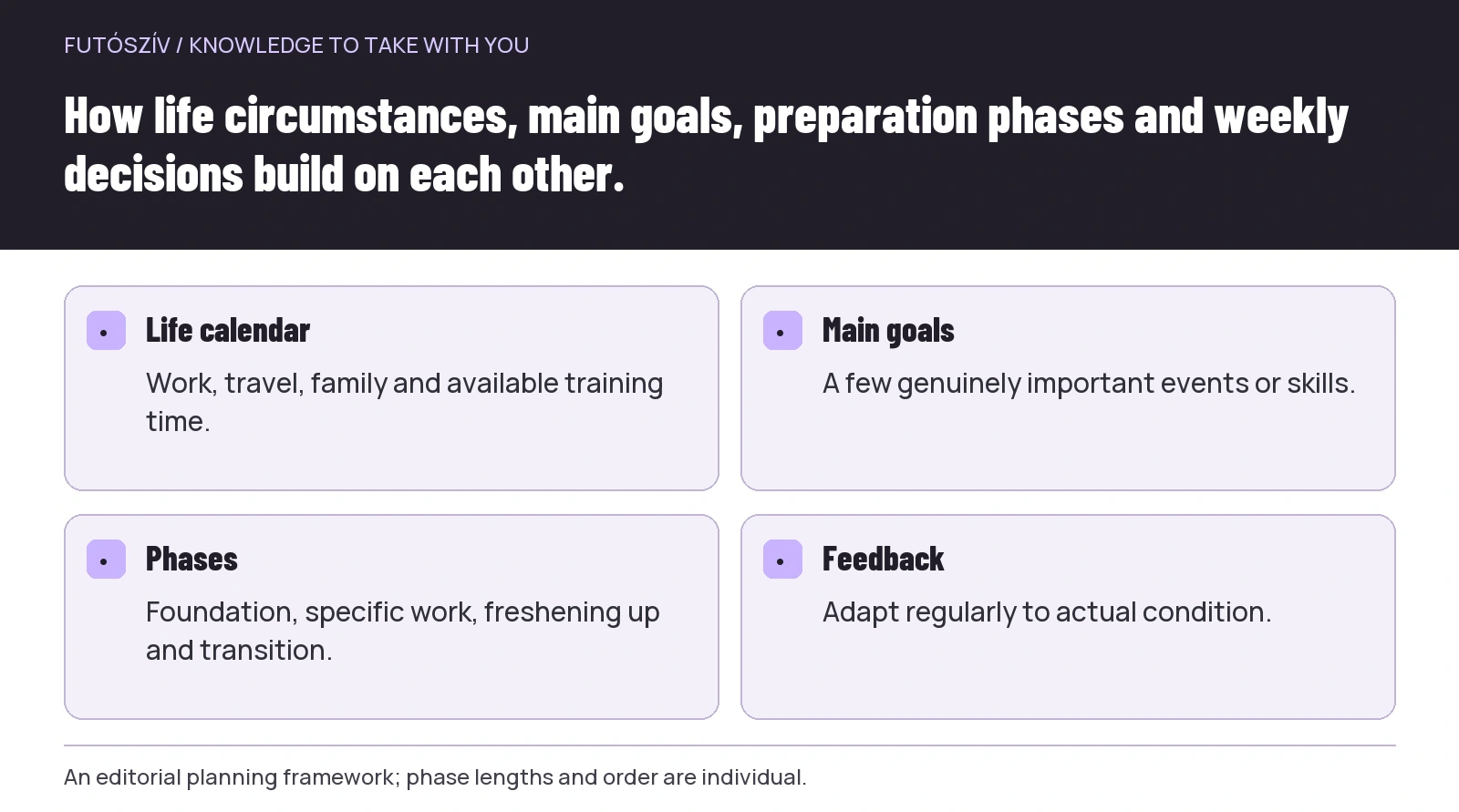 Enlarge diagram
Text version of the illustration
- Life calendar
- Work, travel, family and available training time.
- Main goals
- A few genuinely important events or skills.
- Phases
- Foundation, specific work, freshening up and transition.
- Feedback
- Adapt regularly to actual condition.
What does dividing training into phases mean?
Broadly, periodisation organises training emphases and load over time. It need not mean rigid blocks of equal length. One period may focus on consistency and general endurance, another on tasks closer to the goal race, then freshening up and transition.
Kiely’s critical work cautions that not every detail of classical periodisation theory has evidence as strong as ready-made systems sometimes suggest. Planning can help, but human adaptation is not a completely predictable mechanical process.
A good plan therefore includes feedback points. It explains not only the destination, but when to review whether the current route works. When reality differs, modifying is part of planning rather than its failure.
Foundation work need not be uneventful kilometre collecting
A general preparation period can establish a stable week, teach basic movements, build strength habits or explore routes. Think beyond the greatest possible mileage. The purpose is a foundation for later specific work.
With little winter daylight, consider safe indoor or short outdoor options. With frequent summer travel, a simple portable routine may suit better than a location-bound track programme. Season is an implementation setting, not a compulsory training philosophy.
At the end of the chosen foundation period, assess more than distance. Did you attend consistently? Retain enthusiasm? Combine strength work and running? These answers reveal how stable the next phase’s foundation is.
Specific work approaches the real task
Near the goal race, understand its required skills. Flat roads, long climbs, technical descents and multi-start relays create different situations. Specificity does not make every session a full race rehearsal.
Choose a defined element: planned effort, trail navigation or equipment use. Reduce unknowns. Weekly full demonstrations of readiness can upset the rest of preparation.
The review of elite distance runners’ training describes patterns of load and racing in relation to the sporting task. These are useful professional references, but professional volumes should not be copied unchanged into recreational life.
Leave room before and after the main race
Pre-start tapering and post-race recovery both require calendar time. Placing major goals immediately beside each other may leave neither enough preparation nor recovery. Consider this when entering, not only date clashes.
The post-race period should not automatically become another demonstration. Decide beforehand to allow easier activity and rest suited to your condition in the following days. Returning depends on distance, effort, symptoms and individual circumstances.
If injury or illness ended preparation, returning is no longer simply a calendar question. Appropriate assessment and a personal plan may be needed. Annual goals cannot override health.
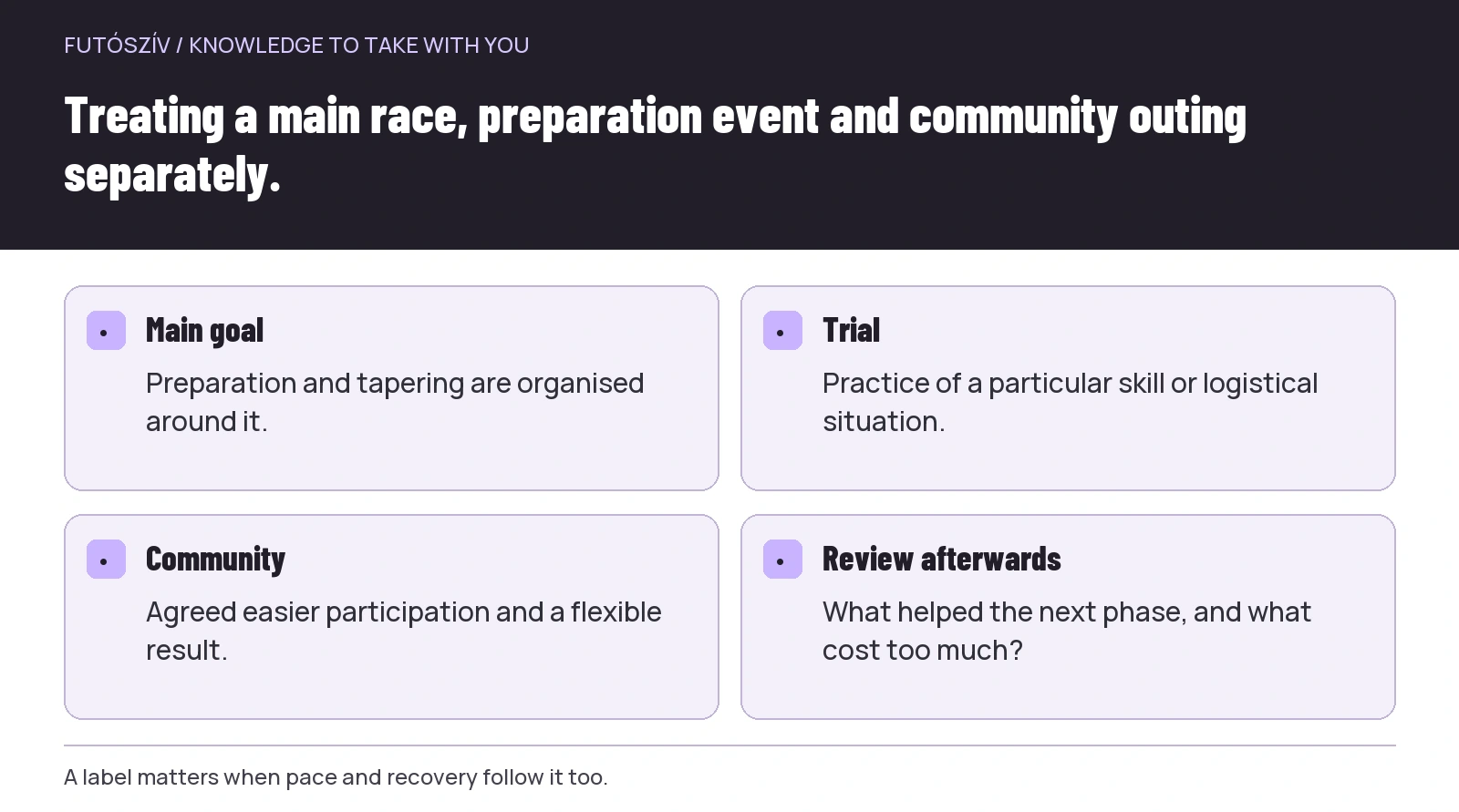 Enlarge diagram
Text version of the illustration
- Main goal
- Preparation and tapering are organised around it.
- Trial
- Practice of a particular skill or logistical situation.
- Community
- Agreed easier participation and a flexible result.
- Review afterwards
- What helped the next phase, and what cost too much?
Prepare a manageable and a reduced version
A long-term plan should expect imperfect weeks. Add a reduced version: what remains with less time? Which session matters most, and what can be omitted without later catching everything up?
This reduced option is not a compulsory minimum for illness or pain. It addresses busy life circumstances. Symptoms may call for complete rest and professional discussion.
Do not schedule the largest increase for a predictably difficult period. A more modest goal fitted to visible circumstances often enables greater consistency than continually feeling behind.
Mid-year review should be more than a results table
Choose dates to review the plan. What happened, and at what cost? Which phase was enjoyable and manageable? Where did travel, events or training become excessive? Record answers briefly while circumstances remain fresh.
Alongside performance changes, consider availability: how much time could you spend on the planned sport without symptoms or forced interruptions? This is not a medical risk metric, but an important part of your year’s story.
If a goal no longer motivates, ask what changed. Different circumstances, another kind of running or simple fatigue after a busy period? A new entry is not the answer to every uncertainty. A calmer month may clarify things.
An illustrative year without fixed months
Imagine a runner selecting a longer spring event and shorter autumn race as main goals. Between preparations, rather than automatically adding another peak, they allow more community running, strength work and enjoyable experiences. This is one planning example, not a universally recommended season.
Another runner may organise the year around one major trail goal, while another builds consistency without racing. A plan’s value is not the number of race bibs. It connects appropriate preparation and next steps to chosen goals.
Weeks can remain open. Openness need not mean uncertainty; it can deliberately preserve room for current condition, weather or shared outings. Every month need not be filled in advance.
What to discuss with your coach or running partners
Show constraints outside sport and explain each goal’s importance. Ask how planned races fit together and where choices are necessary. In good collaboration, an annual plan is more than a handed-over task list.
With partners, clarify which event is a shared experience and which a personal performance goal. You need not run identical years to remain a community. Respecting different goals also simplifies shared sessions.
Sources and editorial note
This article cites an integrated periodisation overview, critical theoretical work and research analysing elite runners’ practice. Planning questions and examples are our own editorial tools, not individual training programmes. Persistent symptoms or illness require appropriate healthcare advice. Sources checked: 18 November 2026.
How Futószív articles are prepared: our editorial guidelines.