A first race number can mean many things to a child. It may be an interesting piece of paper on a shirt, an invitation to a shared adventure or a sign they think now makes running fast compulsory. Racing customs adults take for granted may still be unfamiliar. Before first entry, therefore, the need is not a performance plan but an understandable conversation about what will happen and what they can expect from you.
The conversation is not one major preparation lecture. A few brief exchanges, looking at a map together and answering the child’s questions may offer more than many rules recited beforehand. The sample sentences below are original communication ideas. They are not child psychological treatment or a training plan and do not replace the chosen event’s participation conditions.
Find out what the child imagines behind the race number
Begin with an open question: what do you think happens at an event like this? Their answer may reveal they have seen only the finisher medal, find the start exciting or believe every participant must reach the podium. Do not immediately try to correct them. First understand which detail appeals and which they cannot yet picture.
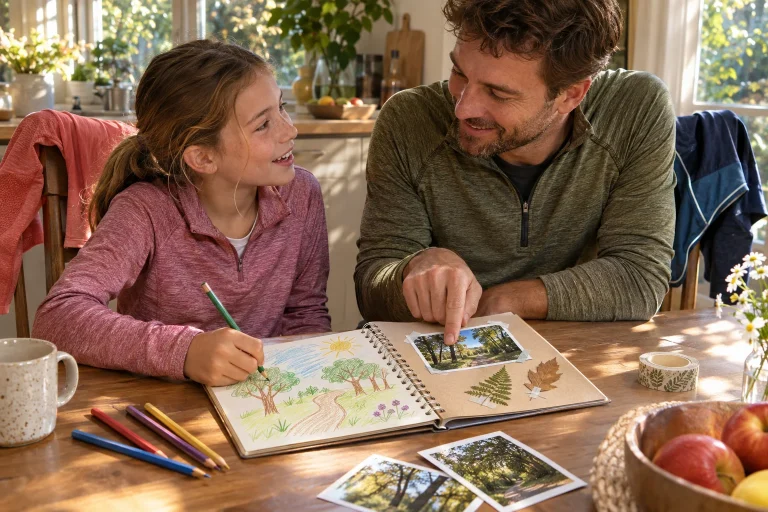
Then show the actual programme. A brief course drawing can identify where you start, where you go and where it ends. If event pictures come from an earlier year, say so: they show atmosphere but do not prove this year’s route or precise start location. Discuss concrete situations instead of the adult’s imagined “little run”.
The Play Their Way professional resource on children’s voices highlights making the effect of listening to children’s opinions understandable afterwards. In a family setting, explain what they can decide and which details the event or adult caring responsibilities determine. The following conversations are original examples, not text taken from the resource.
Say why you are going
If the first occasion aims to learn about a shared event, state this clearly. Do not mix it with secretly expecting a good placing or wanting a sibling’s previous time. Expectations are understandable when the child hears the same thing before and after. Encountering unfamiliar situations may itself bring plenty of novelty.
You might say: we would like to see together what an event with race numbers is like, and I will be with you according to its rules. If timing and prizes exist, do not speak as though they do not. Instead, separate how the event operates from what you want to experience. A results list does not mean family conversation must revolve only around placing.
Keep parents’ own running ambitions separate. If preparing for a fast time at your distance, that is your goal. The child’s shared event should not become proof that every family member thinks identically about racing. Their enthusiasm need not immediately translate into a longer distance or a sequence of future entries.
 Enlarge diagram
Text version of the diagram
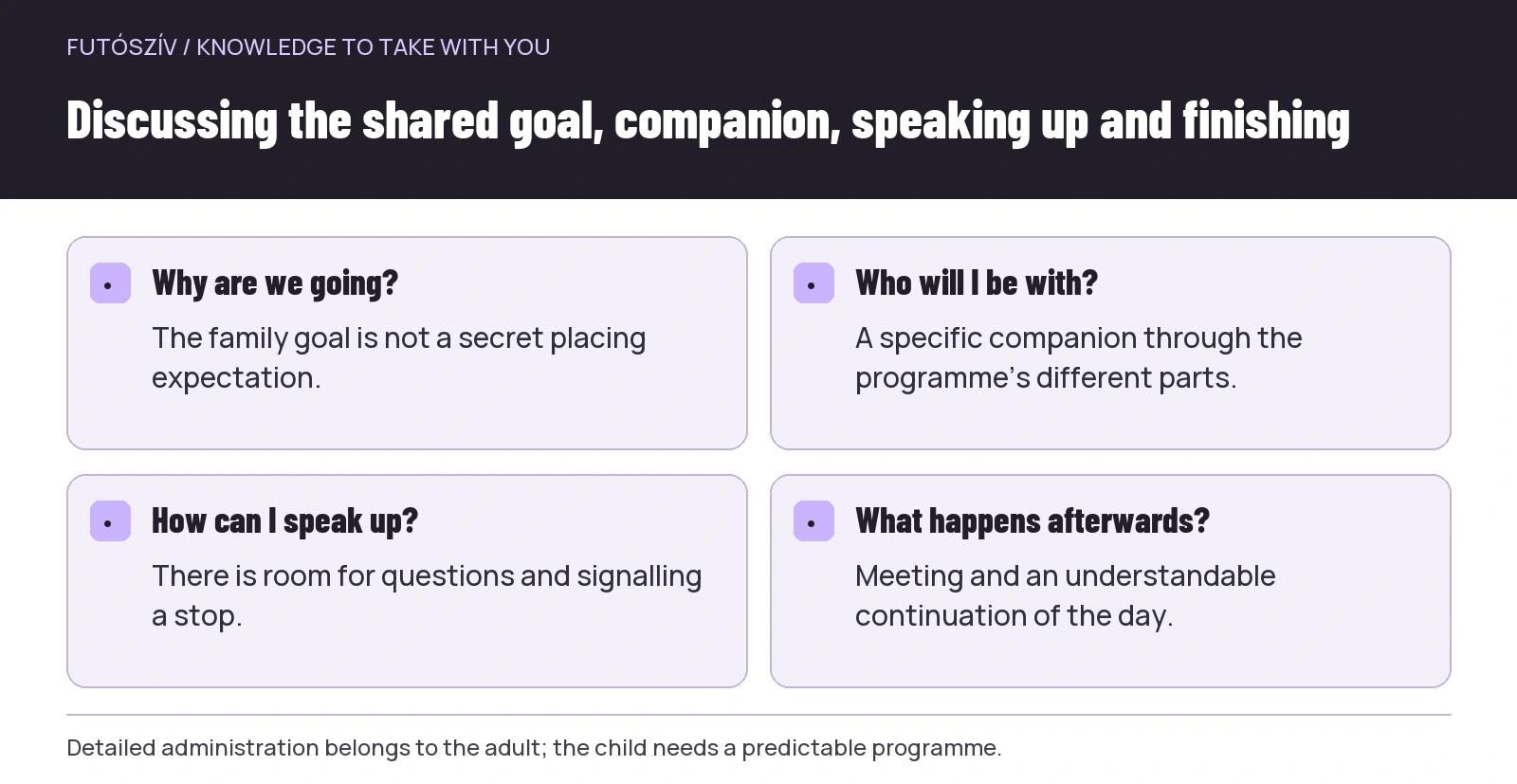
- Why are we going?
- The family goal is not a secret placing expectation.
- Who will I be with?
- A specific companion through the programme’s different parts.
- How can I speak up?
- There is room for questions and signalling a stop.
- What happens afterwards?
- Meeting and an understandable continuation of the day.
Separate optional and fixed elements
Some details allow a child’s choice: whether to start now, whether to have a shared picture, which permitted shirt to wear or whether to go straight home afterwards. Others are fixed: the course, organiser instructions, designated companion and start-zone entry conditions. Presenting the latter as free choices then overriding them on site does not help.
Keep choices small enough to understand. Two real options are better than “you can do anything” when the day is already fully scheduled. For example, agree whether to watch another start after their event or leave for home after meeting. Before deciding, explain if an option involves longer waiting too.
If you cannot be flexible on something, give a simple reason. The course can be left or crossed at designated points, not merely because an adult happens to prefer it. State the rule beforehand rather than using it afterwards to reject a request. Do not promise a certain answer to an unresolved question before checking organiser information.
Discuss waiting before the start too
Collecting a race number does not mean the event starts immediately. There may be administration, finding toilets, assembly and queueing. Explain this as a short sequence: arrive, collect or check necessary items, find the start and set off at the organiser’s signal. Match the exact order to the particular event.
If loud music, announcements or a costumed crowd can be expected, show this beforehand from reliable event descriptions. Do not promise it will be quiet if you do not know. Ask the child which details interest them and which need more explanation. The organiser can provide specific information on on-site help for individual needs.
Instead of “there is nothing to fear”, a useful action sentence is: if you have a question or something is wrong, tell me and we will see together what can be done. This does not claim every discomfort can be removed but that the adult remains available. Clarify whom they can tell if another designated adult accompanies them during a particular organiser process.
Do not promise a compulsory finish
Before entry, make clear that payment does not make participation compulsory under every circumstance. Do not place the family’s financial or organising decision on the child by saying they now have to start. If uncertain, first identify what the uncertainty concerns: not understanding the programme, not wanting to be alone or simply not wanting to run now.
The NSPCC guide for parents emphasises listening to children and helping them feel supported in raising questions and concerns. This is UK sport-safeguarding information, not a Hungarian legal procedure. In family conversation, its perspective can guide attention to the child’s experience alongside results.
Discuss stopping specifically too. If they do not want to continue, resolve it with the designated adult and according to venue rules; they should not run away independently from the agreed route. Illness or injury needs appropriate help, not a motivational argument. The child should not have to prove a reason is serious enough to report.
Show how a race number is used rather than testing knowledge
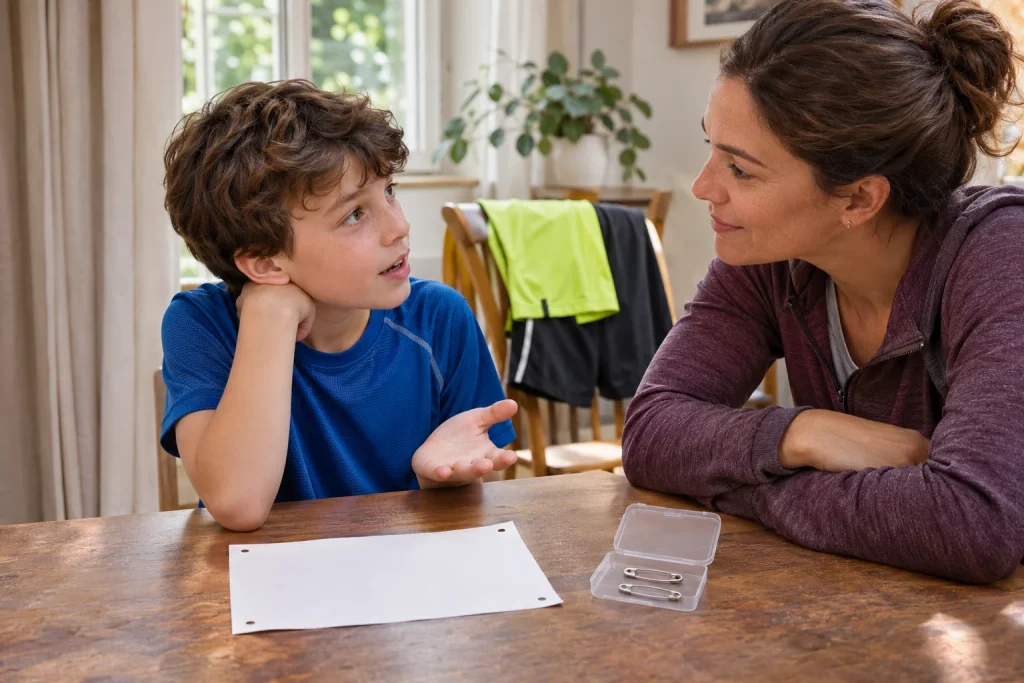
A brief joint check can explain its role. Check that it belongs to the right event, where it must be worn and whether a part must be retained at the organiser’s request. Handle fastening and any contact-information field according to event guidance. There is no need to impose another race’s rules.
The child need not learn every technical detail. It may be enough to know it helps identify the participant, is worn as organisers request and should be reported to an adult if something detaches or is unclear. Precise administration is the adult’s responsibility. The number should not become another thing the child worries about getting wrong.
The official Fuss Neki declaration information requests a separate document for minors at its own events. This illustrates the adult administrative part of family preparation. Arrange it separately from conversation with the child; remembering which document was left where should not be their task.
 Enlarge diagram
Text version of the diagram
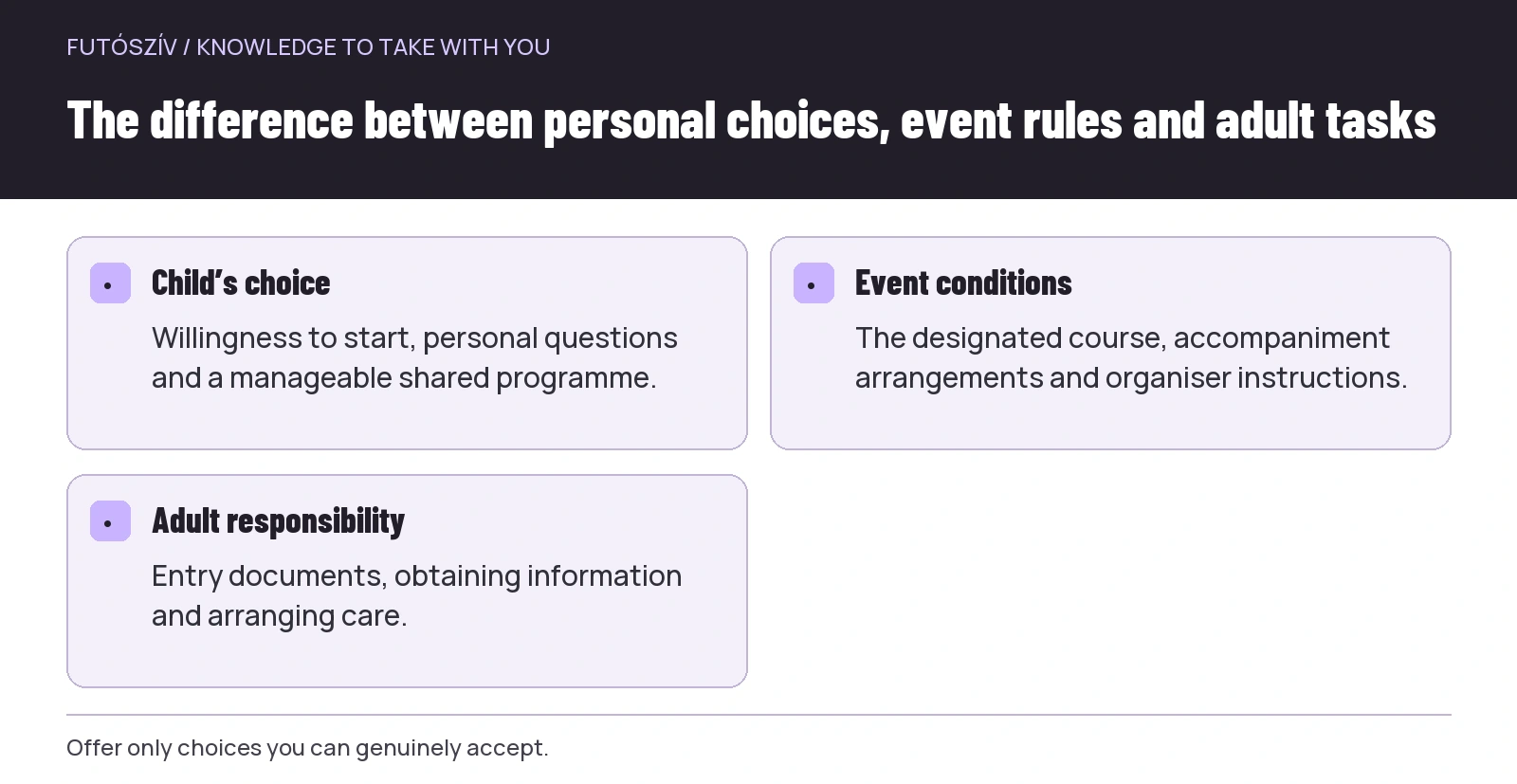
- Child’s choice
- Willingness to start, personal questions and a manageable shared programme.
- Event conditions
- The designated course, accompaniment arrangements and organiser instructions.
- Adult responsibility
- Entry documents, obtaining information and arranging care.
Original example sentences for harder questions
The table below is not a compulsory parenting script. It shows ways to begin an answer, after which hearing the child’s further thoughts is worthwhile. Actual event rules and the meaning of their question matter, not reproducing a memorised sentence exactly.
| Child’s question or statement | Possible opening response | What should you clarify afterwards? |
|---|---|---|
| Could I be last? | People will arrive at different speeds. | What you want from the shared session |
| Will you stay with me? | I will explain exactly who you will be with and where. | Actual accompaniment and post-finish arrangements |
| What if I want to stop? | You can tell the designated adult; we will resolve it together. | How to stay together and follow the venue procedure |
| My sibling is faster. | Their event and your day are separate stories. | There should be no family time requirement |
| I do not want to now. | Tell me what changed or what is wrong. | Reconsidering participation after listening |
| Will you take a photo of me? | Let us discuss when you would like a picture. | Photography should not interrupt care |
Use your own language for answers. If the child does not ask about placing, there is no need for a long lecture on finishing last. If interested, however, do not dismiss it by saying results do not matter at all while everyone around checks the list. You can acknowledge the interest while clarifying the family’s actual expectations.
What can the child expect from supporters?
Before the event, explain who will be there and where they can meet lawfully. Seeing a family member beside the course should not require changing direction or forcing through other runners. If relatives watch farther away, explain that this does not mean a lack of support. Adults should not promise a close finish photo where spectator access is uncertain.
Include family members in advance conversation too. Ask them not to shout unagreed placing or time targets and not compare the child with a sibling. Encouragement can be simple, personal and liked by the child. Every movement need not receive an instruction, and people beside the course cannot see everything happening.
If photos or video are planned, explain intended use beforehand. A family keepsake and public social sharing are different situations. Take the child’s request seriously in family practice and do not make camera appearance a participation condition. Applicable rules require separate attention when handling images of other participants; this is not a model data-processing policy.
Do not immediately follow the event with an assessment sheet
First complete the actual meeting and the next simple part of the day. If the child wants to talk, listen; if they want another topic or silence, a detailed account need not be demanded immediately. The moving finish imagined by an adult may differ from the child’s current reaction. This alone judges neither the event nor the family relationship.
Later, ask one specific question: which part stayed with them, what differed from expectations or what they would change next time. Do not turn conversation into a hidden entry campaign. Liking the music or enjoying a medal does not automatically mean wanting to start again next week.
Review your own adult decisions too. Was travel too long? Did you plan waiting not discussed beforehand? These provide concrete organising lessons without seeking explanations in the child’s performance. Next time could simply mean watching or another shared activity involving movement.
End with a predictable agreement
By the end of conversation, a few things should be clear to the child: why you are going, whom they will be with, how to speak up and what happens afterwards. They need not pass an event-rules exam. Detailed entry, transport and organiser administration remains with adults, who coordinate tasks among themselves too.
The first number then becomes part of a programme understood rather than a promise that cannot later change. The child can experience room for questions, being listened to and a shared day about more than one time result. Whether another race number is wanted can be discussed together after the first experience.
How Futószív articles are prepared: our editorial guidelines.