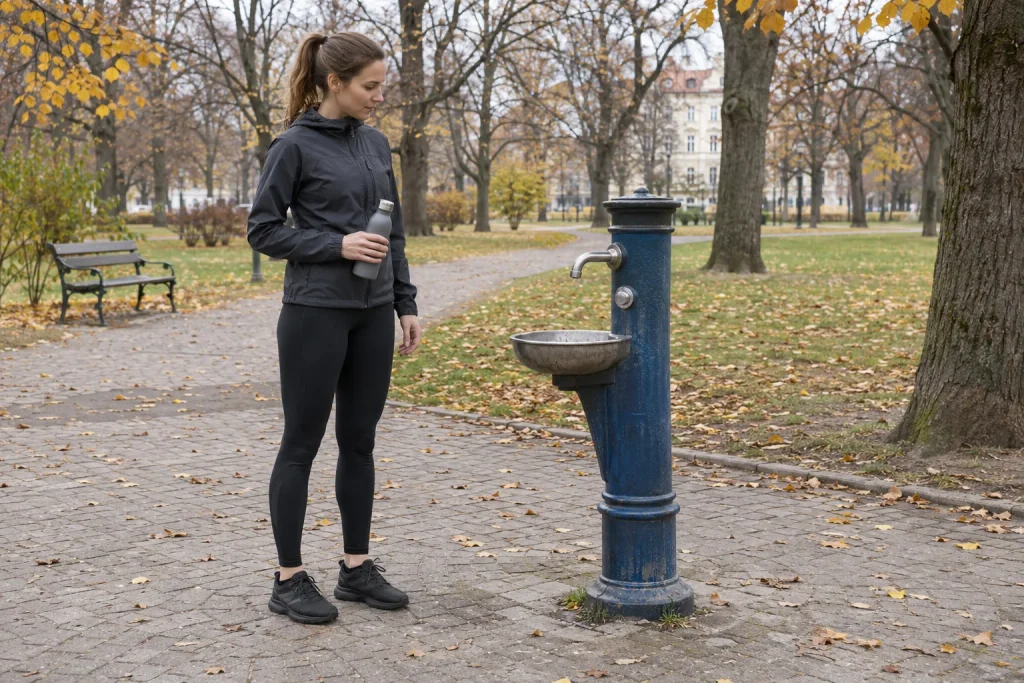
A drinking fountain familiar from summer may be closed in autumn, and even a pleasant sunny spring weekend does not mean it is operating. Its location may remain on the map while water collection is unavailable. Seasonal checking therefore means updating status information rather than finding the fountain again. For a runner, what matters is actual access to water intended for drinking at the particular time.
This guide helps interpret public information and record your own observations precisely. It gives no nationwide opening date, live operating status or promise that any particular fountain works. Examples include dated official reports applying to their own time and area. Rather than personal fluid quantities or medical hydration advice, we examine how to check a service you intend to use.
Winterisation is planned operational work
The report published on Székesfehérvár’s official city portal on 18 October 2026 explains closing fountains and draining systems as protection against frost damage. The announcement gave the end of October as the expected completion of that work. This is a specific local example of seasonal closure, not an annual schedule for every Hungarian drinking fountain. Find another municipality’s or operator’s timing separately.
Do not automatically describe a planned closure as a fault. Your own pre-run question remains the same: is the point usable at the planned time? But the next information step may differ. Winterisation information can indicate the local season, while a broken control needs specific fault information. Confusing the two can produce inaccurate group messages and unnecessary attempts on site.
Do not assume one switch even within the same city
The Józsefváros Management Centre work report of 11 November 2026 also lists closing and winterising the district’s drinking fountains. It concerns work in that district. It cannot establish that all Budapest fountains are handled at the same time and in the same way. Preserve the local announcement’s geographical limit in your own notes, particularly when planning a run across several districts.
The difference is practical: a nearby fountain may have a different operator from one in the previous street. Nor should you assume equipment in a park operates like another type of street water point. When naming the location, do not merely write ‘the city-centre fountain’. Identify the particular facility or give an unambiguous description so that the responsible operator and fellow runner understand the same point.
Keep three statements separate
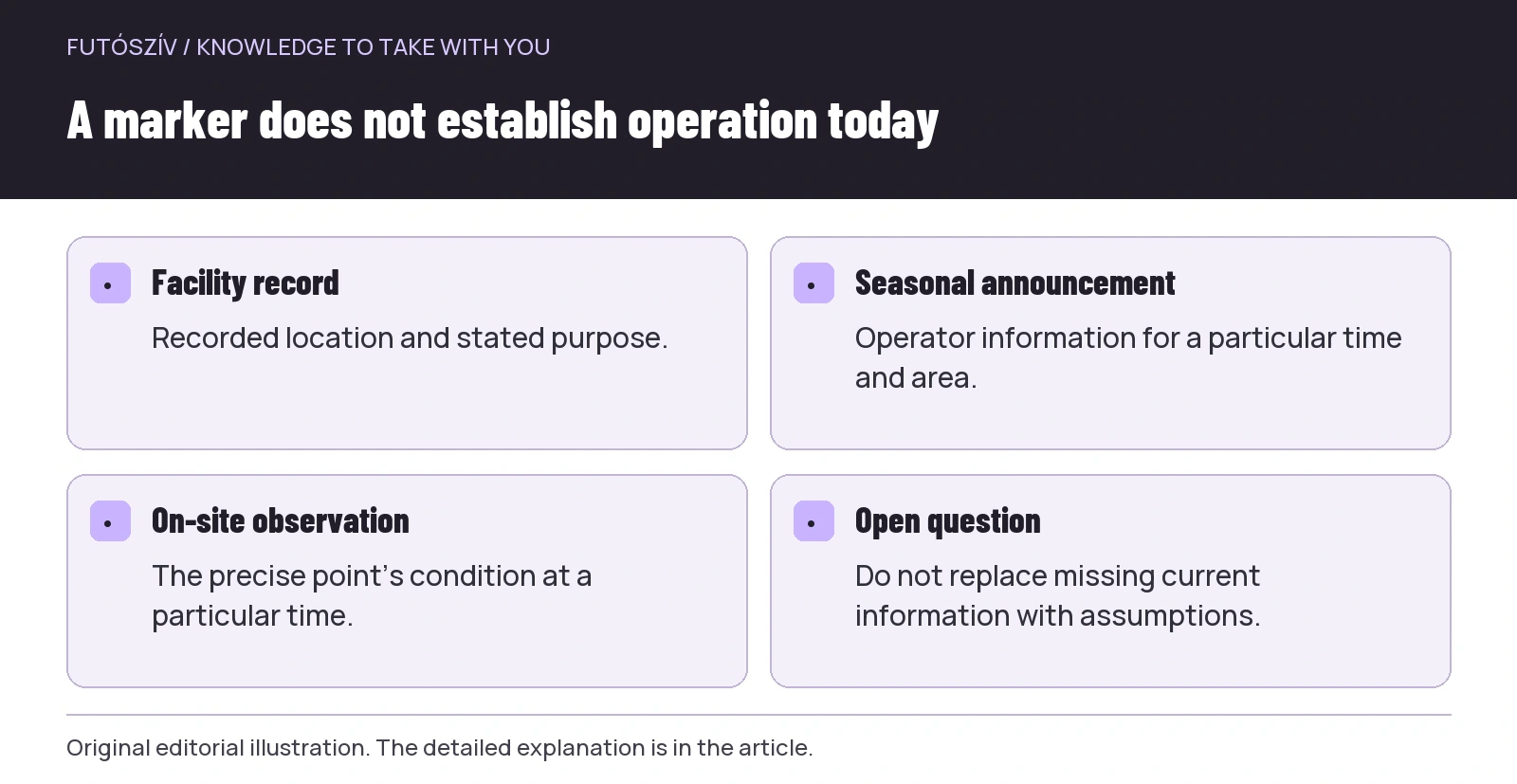
The first statement is that the fountain exists there. A map marker or older description can support this. The second is that its operating season includes your planned run. This needs more current operational information. The third is that the particular point was actually usable at the observed time. A fresh on-site experience may establish that, but still gives no unlimited future guarantee. Compressing everything into one field easily loses these distinctions.
| Information | What it actually tells you | What needs separate clarification |
|---|---|---|
| A drinking fountain on a map | Its recorded location and designated purpose | Current access and operation |
| Local winterisation news | Work within the stated area and time | Other areas and seasons |
| An on-site experience this morning | The observed condition of that point then | Later operation and possible changes |
| Memory of a previous run | Use experienced in the past | Almost every current circumstance |
 Enlarge diagram
Text version of the illustration
- Facility record
- Recorded location and stated purpose.
- Seasonal announcement
- Operator information for a particular time and area.
- On-site observation
- The precise point’s condition at a particular time.
- Open question
- Do not replace missing current information with assumptions.
A source’s date is not the same as the event date it contains
A page opened now may contain information several years old. A search result, today’s browser date or the year at the bottom of the page is not necessarily the update date of an operational announcement. Find the specific notice’s publication date and the period it concerns. Reading about an earlier winter closure does not let you calculate this year’s spring opening. Keep fact and your own assumption on separate lines.
The wording of the event matters too. ‘Has begun’ does not mean work has finished everywhere, while ‘expected’ indicates a plan rather than verified completion. If news discusses the city network generally, do not mark your own point as individually checked. Precise reading need not involve lengthy research: noticing a few keywords and preserving geographical scope prevents many exaggerated conclusions.
In spring, use operator information rather than the weather
A warm morning does not prove a particular facility has been brought into operation. Preparation for summer use involves technical work that a runner does not perform by pressing the button harder. If opening information is unavailable, treat access as uncertain in your plan. Choose a run whose water access can be properly arranged without it. Hope that a fountain works is not a reserve supply you can carry.
The same applies in reverse in autumn. A water jet seen a few days earlier does not override a closure announced since. If a runner’s observation apparently contradicts operator information, first check whether the precise place and time match. They may concern different equipment, phased work or an older status. You need not settle the dispute for your run; choose workable access instead of the uncertain point.
Find the responsible operator for the actual facility
The Budapest Waterworks fault-reporting information distinguishes blue lever-operated public standpipes from water networks in parks and playgrounds, naming another responsible contact for the latter. The lesson is not that every city has the same division. Find who operates your particular location and which channel provides current information. A large utility’s name alone does not prove that fountain belongs to it.
When searching, try the precise place name and ‘drinking fountain’ on the local authority’s or operator’s website too. Read search results on the original page so the date and context are visible. A sentence cut from a social media share can lose its geographical or time limits. If further questions are needed, use the appropriate public customer-service channel rather than sending every enquiry as an urgent fault report.
Keep your own observation narrow and verifiable
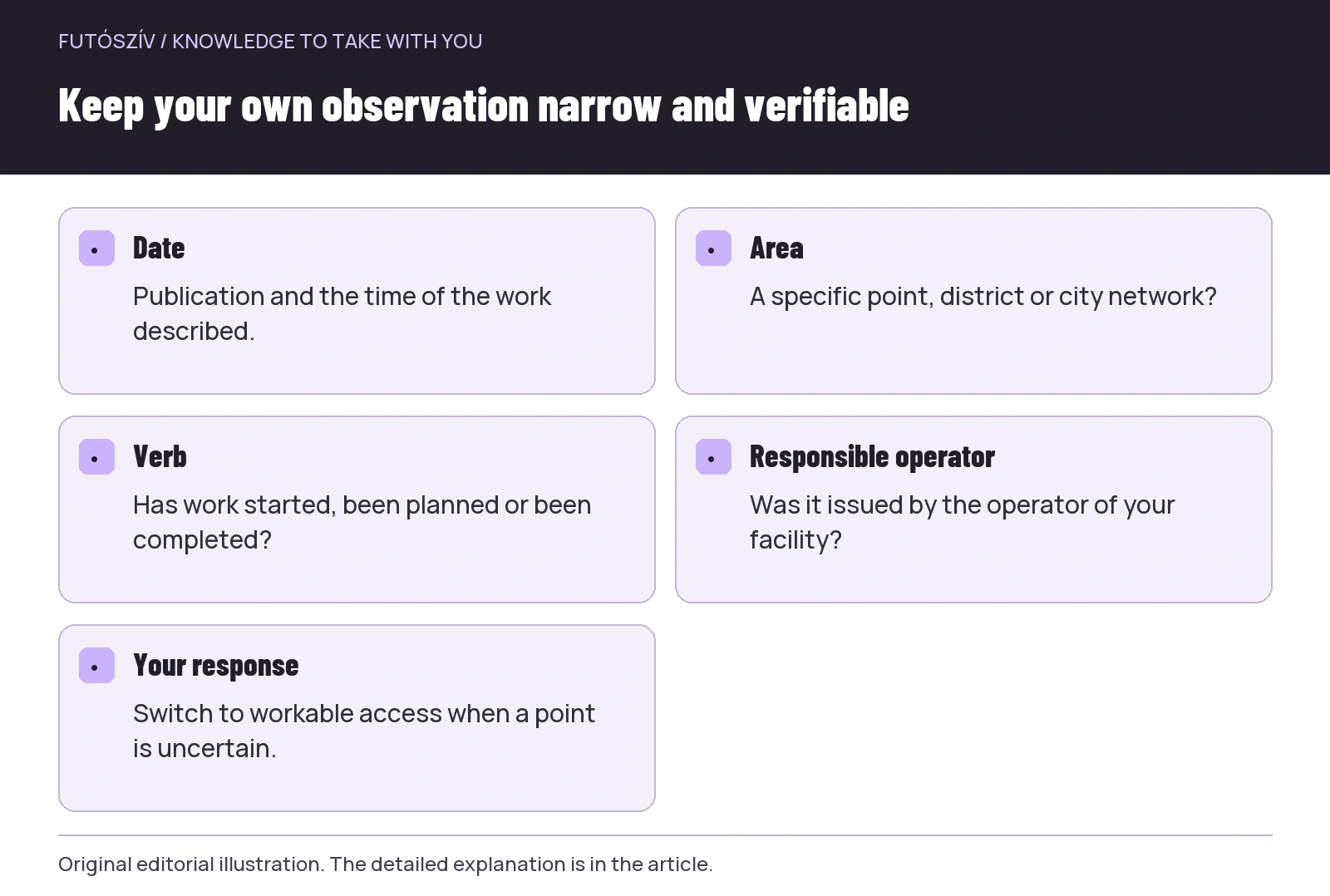
A useful observation might be: ‘At the specified location this morning, I could not obtain water using the usual control; I saw a closure sign.’ This clearly separates experience from a presumed cause. ‘Every fountain nearby is broken’ is less useful if you checked only one. Alongside location and time, state whether access was closed or water collection itself failed. These are different problems.
Take photos only in a way that makes the facility, sign and surroundings clear while respecting others’ privacy. You do not need to diagnose an unknown technical fault from an image. Visible surfacing or fittings do not authorise DIY repairs, opening valves or removing closures. A runner’s own role is to observe conditions, make necessary reports and adjust their route; technical intervention belongs to the responsible operator.
 Enlarge diagram
Text version of the illustration
- Date
- Publication and the time of the work described.
- Area
- A specific point, district or city network?
- Verb
- Has work started, been planned or been completed?
- Responsible operator
- Was it issued by the operator of your facility?
- Your response
- Switch to workable access when a point is uncertain.
Leave room for two timestamps in your notes
One is the information’s original time: when the announcement appeared or when your own or someone else’s observation happened. The other is when you checked it again. With last year’s news read today, these differ considerably. Later use then immediately shows whether the status is genuinely fresh or an old fact has only just caught your attention. The two dates clarify the limits of your knowledge.
You can use simple status descriptions on a point card: present in the records; affected by a seasonal notice; usable according to a recent observation; unchecked; found closed on site. Do not attach invented reliability percentages. Words help when you know what they mean and they claim no more than the evidence. A green indicator alone can imply too much certainty without a date and clear status definition.
Send corrections to the same place within a group
When sharing water-point information in a running group, send the precise location together with the status time. If conditions later improve or the news turns out to concern another fountain, clarify that in the original place too. People may find the old message again through search without seeing a later correction elsewhere. A brief correction helps more than a new conversation assuming everyone knows the background.
The person preparing a shared route should check the run’s conditions separately too. A member’s old experience is a valuable starting point, but not a personal guarantee of the whole team’s access to water next weekend. Whoever shares the current plan should name uncertainty and the available adjustment. Participants then need not prepare from a confidently repeated fragment.
No fresh answer is useful information too
‘Unchecked’ is not failure, but a real input to the plan. You do not need to manufacture a stronger claim from an old photo or last year’s post. Arrange your own appropriate access differently, leaving the fountain as an additional possibility at most. This matters particularly around seasonal changes, when familiar summer habits and current operation can easily differ.
A few targeted checks before leaving may be enough: are you looking at the same facility, does the information concern the right year and area, and is your run still workable if the point fails? Handling seasonal operation thoughtfully is simple information discipline. You do not need the whole network’s status memorised; you need to understand precisely the information used for your own decision.
Sources and further reading
- Székesfehérvár City Portal: Winterisation of drinking and ornamental fountains has begun, 18 October 2026
- Józsefváros Management Centre: Maintenance work, 11 November 2026
- Budapest Waterworks: Fault reporting and responsibility information
How Futószív articles are prepared: our editorial guidelines.