
A starting zone may bring together people expecting similar progress. Yet at a first large road race, numbers and colours can easily look like a ranking: farther forward seems better. Your zone is actually organisational information. It helps when the data entered are realistic, assembly follows the rules and you know which gate to approach on site.
There is no single zone rule for every race. Some ask planned pace, others expected finish time or verified previous performance. Certain events assign separate starting waves. The first step is therefore understanding your event’s current system, rather than consulting a general online table.
A zone and a wave are not always the same
Starting zone may mean the area where an appropriate group waits. A wave may mean a start separated in time. The concepts can connect, but events use them differently. Follow markings on your own bib or participant information, not a remembered colour from another race.
Check the details you have: zone number, colour, entrance, wave and planned starting time. Ask before the event if anything is absent or contradictory. At the venue, many people seek the same gates, making unresolved basics particularly awkward.
The information for the Budapest Half Marathon pairs race , for example, links the zone and its marking to entered planned pace. Check the exact table for the current edition. The example teaches the operating principle: zone marking and registration data may belong together.
Be honest about your expected progress
Do not enter a time that might motivate you someday, but an estimate you consider realistic from current preparation and today’s undertaking. Zone selection is not a wish list. If you have a coach or another appropriate professional helper, discuss the estimate with them too. The aim is a place suited to your own start.
A short, fast section’s pace is not automatically the expected average for the whole race. Distance, terrain, stops and chosen completion format may differ. Uncertainty is natural at a first race; do not invent precision. Understanding the estimate’s basis and indicating it appropriately in that system matter more.
If planning run–walk alternation, consider progress across the whole outing, not only running-section speed. Planned stops at aid stations or elsewhere also add to total time. Check event cut-offs separately. An appropriate zone does not alone resolve every question about the undertaking.
 Enlarge diagram
Text version of the diagram
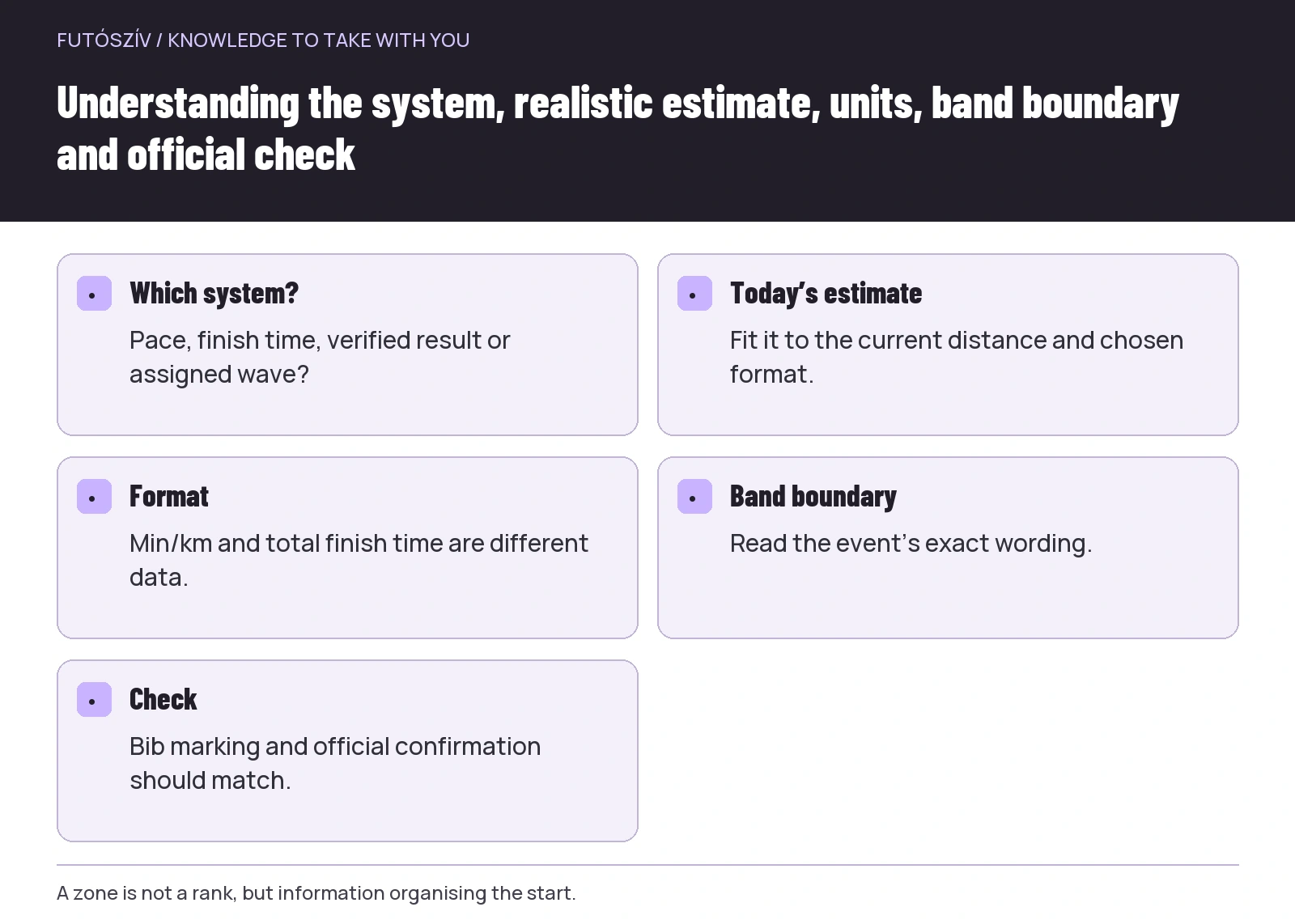
- Which system?
- Pace, finish time, verified result or assigned wave?
- Today’s estimate
- Fit it to the current distance and chosen format.
- Format
- Min/km and total finish time are different data.
- Band boundary
- Read the event’s exact wording.
- Check
- Bib marking and official confirmation should match.
Pace or finish time: read the unit
Minutes per kilometre, kilometres per hour and total finish time are easily confused if you focus only on the number. Read the registration field label and required format. A pace of 6:30 min/km and 6.5 km/h are entirely different. One does not become the other by replacing a colon with a decimal point.
In a simple calculation, 10 kilometres in 65 minutes gives an average of 6:30 min/km. This is not a recommended target, only an explanation of units. Allowing 70 minutes over the same distance gives 7:00 min/km. Enter your own estimate in the event’s required format, using its band boundaries.
| Entered data | What do they mean? | What should you watch? |
|---|---|---|
| Min/km | Average time for one kilometre | Minutes-and-seconds format |
| Total finish time | Expected complete time for the chosen distance | Hours, minutes, seconds and the correct distance |
| Previous result | Data from an already completed event | Accepted event, period and proof |
| Assigned wave | A starting group specified by the organiser | Your marking, gate and current timetable |
The table distinguishes system types rather than describing one registration platform. Your event specifies which data and proof it accepts. If a field has an explanation, read it before saving. Incorrect units can produce incorrect grouping.
At band boundaries, follow organiser guidance
If your estimate lies exactly between two bands, check which includes the boundary. Tables may use “within”, “above” or a specific interval. Ask if unclear. Do not assume the interpretation most convenient for you is certain.
With an uncertain estimate, explain your starting information. Organiser customer service can clarify using the system but may not assess your individual performance capacity. Separate the questions. First develop your own realistic plan, then fit it into the event’s grouping.
If preparation or the intended format changed since entering, check modification options. There may be an administration deadline or on-site procedure, but verify for each event. A zone printed earlier is not a reason to avoid reporting a changed situation through the permitted process.
Want to start with a friend? Check rules first
Entering the same expected finish time does not necessarily guarantee the same wave. London Marathon Events’ The Big Half 2025 northern participant guide explicitly states this for its system then. This is a year-specific example and does not claim every event allocates places identically.
If given different zones, find that organiser’s rules for moving or changing. Do not assume friendship overrides assembly procedures. A suitable shared solution may exist, but choose under official conditions. If none exists, meeting at the finish or starting separately can still work.
Starting together does not automatically determine shared pace either. If completing the race together, agree the format followed on course too. If only waiting together and then following separate plans, state that. Do not mix the organisational zone question with an unspoken shared race commitment.
Find the entrance on the site plan
Seeing a zone flag does not reveal where entry is possible. Barriers, cross-routes and separate gates may lead to assembly areas. On the plan, check your zone’s approach from the race centre, baggage and toilets. This also makes task order more precise.
Note an assembly time if provided. Starting time and entry deadline may differ. Reaching the gate takes time too, particularly in a crowd. There is no universal number of minutes, so use your route and tasks as the basis.
If uncertain on site, ask staff. Climbing barriers or entering through an undesignated gap is not an appropriate navigation solution. Leaving room for others also matters in runner flows. Finding the correct gate earlier can support pre-start calm.
 Enlarge diagram
Text version of the diagram
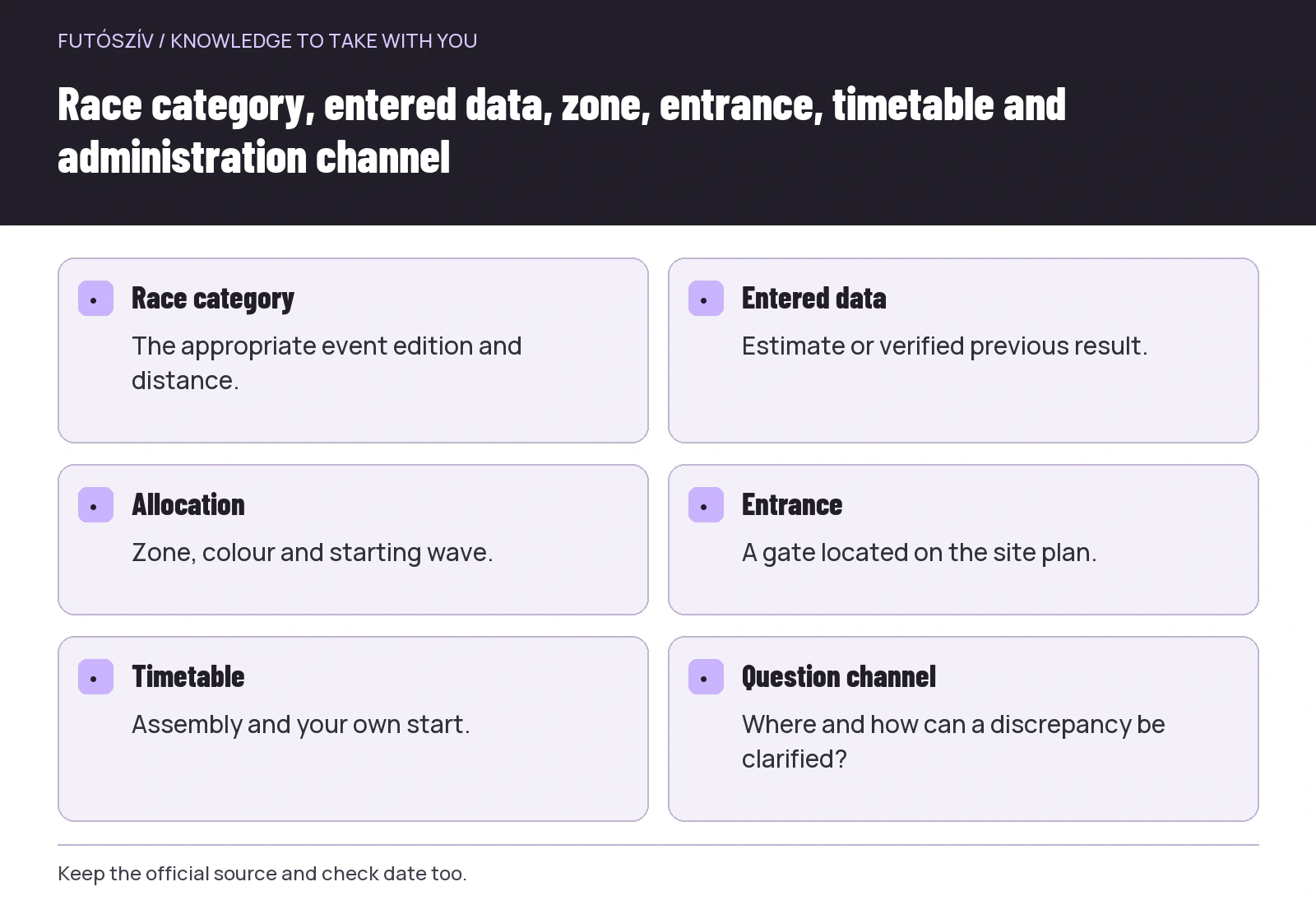
- Race category
- The appropriate event edition and distance.
- Entered data
- Estimate or verified previous result.
- Allocation
- Zone, colour and starting wave.
- Entrance
- A gate located on the site plan.
- Timetable
- Assembly and your own start.
- Question channel
- Where and how can a discrepancy be clarified?
Keep the programme clear while waiting too
Before assembly, decide what stays with you and what you handed in. Clothing needed after finishing must be accessible, while items brought into the zone follow event procedures. Do not leave belongings behind simply because a previous race handled this differently. Read your own information.
Race number and zone marking should be recognisable as required. If receiving a sticker or other marker, check it at collection. Missing or incorrect data are easier to clarify at an appropriate administration point than at the assembly gate. Keep registration confirmation in the required form for questions too.
At the end of waiting, move forwards under staff instructions. A nearby group beginning to move is not necessarily the start of your run. Approaching the line and entering the course may be different moments. Prepare watch controls so you can still follow the surroundings.
After the line, do not try to prove your zone number
The selected zone is not a performance promise you must prove under every condition. Adapt today’s progress to your own thought-through programme and circumstances on site. Early on, many people’s rhythms and course bottlenecks can matter. Zone membership does not oblige unnecessary overtaking or scrambling.
If others start faster, your estimate does not become wrong. You do not know their aims and background. A zone may be only approximate grouping, not a guarantee of identical progress at every metre. Awareness and courteous, predictable movement remain tasks.
If switching to walking or stopping, do so appropriately for the place and with consideration for others. You do not need to justify modifying your plan because of the zone. With health symptoms, appropriate help and decisions come first. A pre-start group number does not override the current situation.
Three illustrative decisions
A beginner sees total finish time during entry while having thought only in kilometre pace. First they clarify distance and format, then convert their own estimate appropriately. They read it back before saving rather than accidentally choosing the first visible field.
Another runner changes their race aim during preparation. Instead of the earlier faster zone, they ask about an option fitting today’s plan under the event’s modification procedure. They begin administration early and check the marking at collection. Zone choice follows the current undertaking.
Two friends receive separate waves. They read official rules and choose only a permitted solution. If unable to start together, they agree a post-finish meeting point and contact. A shared day can remain even when a few pre-start minutes happen in different places.
Six details for your starting-zone sheet
Category and edition. Entered or verified data. Assigned zone and wave. Entrance. Assembly and start times. A modification or enquiry channel. Add the official source and last check date. Review new announcements before departure too.
When these six details are clear, the zone loses unnecessary ranking significance. It becomes a specific place in the race-day plan with a known approach and rule. After the line, your running can still fit today’s aim and circumstances.
How Futószív articles are prepared: our editorial guidelines.