A tune-up race helps a later goal when you know beforehand which question you want it to answer. It may offer a chance to learn the race-day routine, carry out a planned task or gain experience that fits your own programme. An event does not automatically become suitable preparation merely because it takes place before the main goal.
When choosing, distance, route, participation conditions, travel and the whole preparation process matter alongside the date. Integrating it into individual training depends on your circumstances and, where necessary, appropriate professional help. This guide offers a selection and evaluation framework. It does not prescribe the same number of trial races or a compulsory gap between events for everyone.
Name the main goal first
Write down which later event you are preparing for and what you want to achieve there. A first finish, new distance, specific result or different kind of experience may create different preparation questions. If the main goal is uncertain, selecting the tune-up race will lack precision too. Filling the calendar does not replace clarifying the commitment.
Learn the main event’s requirements: route character, cut-off time, start format, mandatory equipment and your own participation conditions together provide a framework. You do not need to practise all of these at a tune-up race. Select what you genuinely need and can meaningfully observe on that occasion.
The official Copenhagen Marathon article on test races also treats trying the race environment and race-day procedures as separate possible purposes. You can use this general principle: give the occasion a named task. The organiser’s examples do not automatically become personalised prescriptions for every runner.
Give one occasion one primary question
If you want to improve your time, test new equipment, complete an unfamiliar distance and try a new fuelling approach at once, it will be difficult to identify what you learned from each. Naming the primary question helps selection. “I want to follow my pre-start timetable” may require a different event and commitment from a specific sporting task.
Make the question answerable. For example: was the time allowed from collection to entering the starting area sufficient, was the selected equipment manageable, or did your progress follow the previously agreed plan? “I will prove I am ready for everything” is too broad a claim for one occasion. A tune-up event can provide detailed experience more readily than a complete guarantee.
If working with a coach, agree the selected question and event with them too. More information may determine its place in the whole preparation than a race calendar reveals. Do not make the entry a done deal before coordinating the training aspects. This preserves a genuine choice.
Compare candidates using the same information sheet
| Field | What should you look for? |
|---|---|
| Primary task | Which question can it provide experience about? |
| Event character | Distance, terrain, elevation and start format |
| Total time required | Travel, collection, participation and return home |
| Conditions | Cut-off, mandatory equipment and participation rules |
| Fit with the programme | What does it change in your own preparation? |
| Uncertainty | What remains unchecked? |
The table is not a scoring contest. You do not need to declare the largest event or cheapest entry the winner. Information suited to your goal and a manageable overall programme are what count. A nearby, easily organised occasion may sometimes teach more than an impressive weekend involving extensive travel.
Use the organiser’s current official page for details. Check the season of both the date and other information separately. If a calendar lists the event but its own announcement has not yet been updated, mark that as uncertainty. Do not copy a definite answer to a missing condition from another year or event.
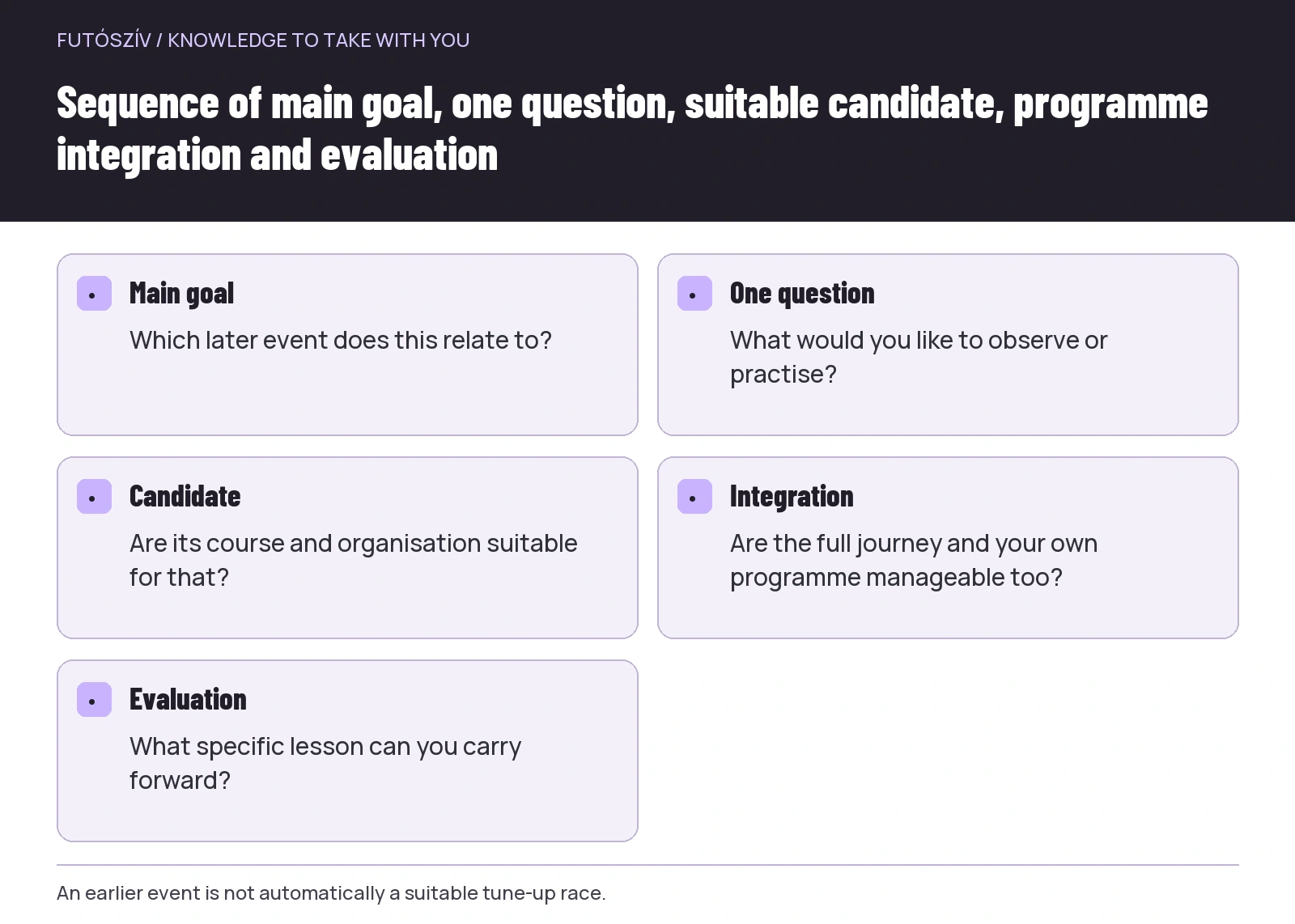 Enlarge diagram
Text version of the illustration
- Main goal
- Which later event does this relate to?
- One question
- What would you like to observe or practise?
- Candidate
- Are its course and organisation suitable for that?
- Integration
- Are the full journey and your own programme manageable too?
- Evaluation
- What specific lesson can you carry forward?
Look for similarity relevant to the task
If you want to learn about starting in a large road-race field, a very small, informal local occasion may not give the same experience. If you only want to test your own preparation sequence, however, a simpler event may provide a suitable setting. Measure similarity against the primary question rather than every detail at once.
Before a trail goal, route character and navigation requirements may have particular importance. A shorter distance is not automatically simpler in every respect. Surface, elevation and weather conditions may create different tasks. Select a programme suited to your experience and do not infer the demands from the race name.
If your goal involves a particular pacing task, planning that professionally is a separate question. The tune-up race’s setting and rules may support or complicate the task. Numerous narrow points, substantial elevation or a different distance create a different framework. Make the entry decision using actual course information together with your own programme.
Travel is not an invisible extra
A distant event may involve an earlier departure, accommodation, collection and a longer journey home. This affects the organisation of the whole week. When looking for experience useful to the main goal, name the task added by the logistics too. Testing a new travel arrangement can be a deliberate aim, but if that is not your question, it may add unnecessary complexity.
Alongside work and family commitments, examine the days before and after the event too. More than the few hours around the start need calendar space. Companions’ time, equipment handling and finishing the travel arrangements also have consequences. The tune-up race fits when the entire programme is manageable.
Assess cost in this complete form too. Entry, transport, accommodation and related expenses may carry different conditions. Read the options for amending participation beforehand. This article provides no prices or financial recommendation; build a precise framework from your own current bookings.
Make fitting it into the training plan an explicit decision
London Marathon Events’ 2026 beginner marathon plan also includes an example involving an intermediate event and practising race-day routines. This belongs to a specific complete programme. Taking one line out of it cannot prescribe the same race or timing for everyone.
For your own plan, therefore ask how the event connects with the periods before and after it. If preparing with a coach, you can arrange this together. If following a plan independently, consider its conditions and your circumstances. An entry promotion’s deadline is not a training rationale for rewriting the programme.
Not every tune-up event has to be a race targeting a maximum result. It can be a predefined learning task if consistent with your own programme and participation rules. Decide its purpose in advance rather than renaming what happened only after the finish arch. A task known beforehand is easier to evaluate precisely.
Make a short trial scenario
Describe which details you want to handle similarly to the main goal. These might include packing, the venue-arrival timetable, finding the start zone or handling your chosen storage arrangement. There is no need to make every condition artificially identical. The point is following the selected learning question.
Include what you will observe and when you will note it. Before the start, for example, record how much time remained after necessary tasks; at the finish, what was accessible and what was missing. Notes can be brief. A detail is useful when it helps you choose a specific change later.
If something does not follow the original plan, treat that as experience too, without immediately making a general explanation for everything. A late bus, different weather or crowded collection changes the observation. Note the circumstances alongside it. This makes the lesson more precise and more useful for the main goal.
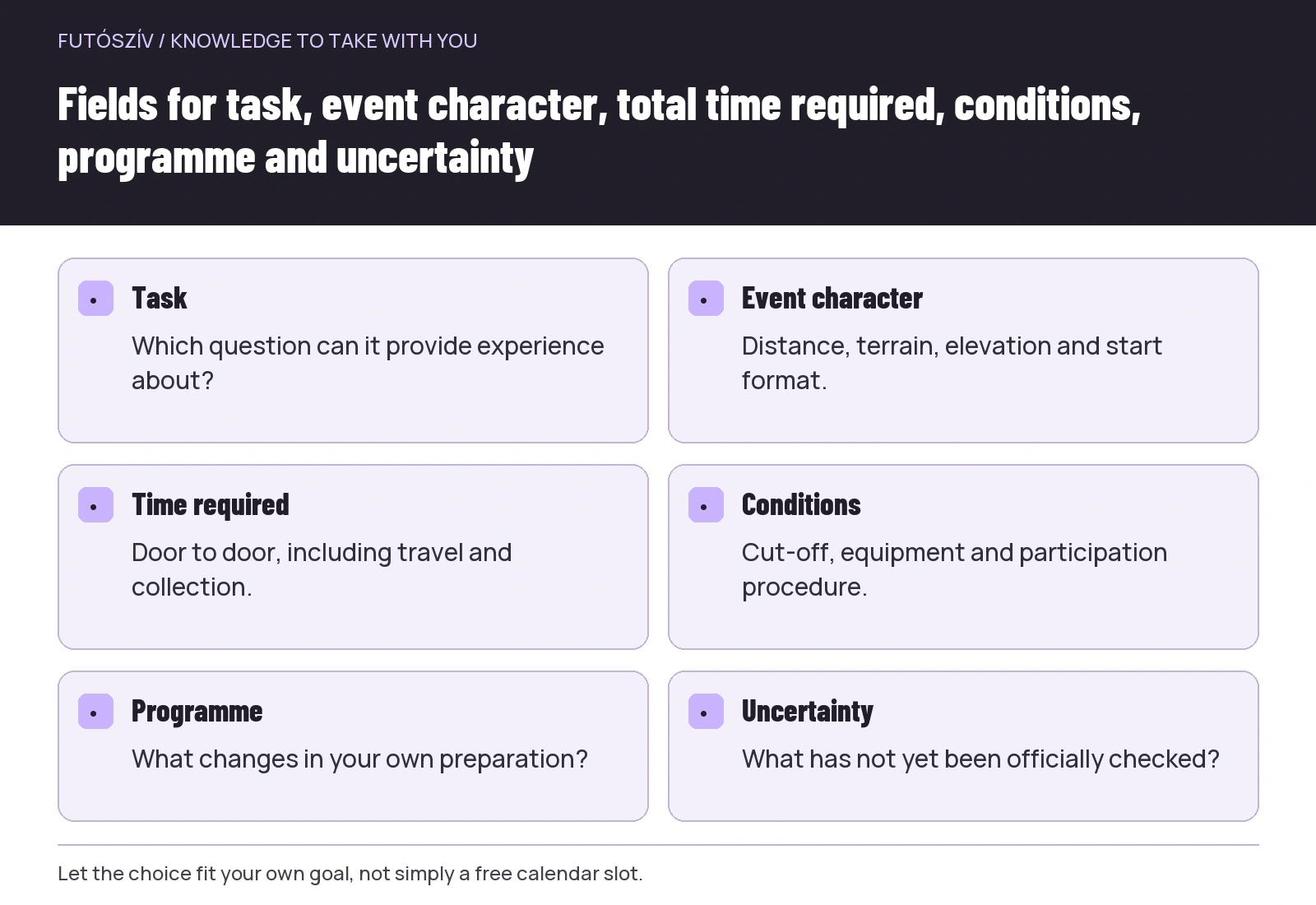 Enlarge diagram
Text version of the illustration
- Task
- Which question can it provide experience about?
- Event character
- Distance, terrain, elevation and start format.
- Time required
- Door to door, including travel and collection.
- Conditions
- Cut-off, equipment and participation procedure.
- Programme
- What changes in your own preparation?
- Uncertainty
- What has not yet been officially checked?
Comparing three illustrative candidates
A runner is preparing for a later large road event and wants to practise pre-start administration. The first candidate is nearby, with clear information and a familiar distance. The second is a distant weekend programme requiring much travel. The third is technical trail terrain for which they have little previous experience. For the selected question, the first may provide a simpler, more direct trial.
Another runner specifically wants to learn about a race day involving travel. For them, the second candidate may have a different value if the entire commitment and training programme are suitable. Different goals can produce different decisions from the same options. Both the reason and feasibility show the quality of the choice.
The trail candidate may be suitable if you genuinely seek relevant experience and it fits your own preparation. Do not choose it merely because it is shorter or has a more exciting name. These examples are not recommendations for specific events. Use the same sheet to compare your own candidates’ current details.
Draw only conclusions supported by the result
A tune-up race time reflects several circumstances. With a different distance, course and programme, it cannot automatically become a guaranteed target time for the later event. The number may be useful for professional evaluation, but it is not a complete promise. Retain the task and circumstances alongside it in the log.
If the organisational trial worked, say precisely what worked. For example, collection was completed in time, bag placement was suitable and the approach to the start zone became clear. These may be transferable details for the main event, after checking its different conditions again. The lesson is more than simply having a good or bad day.
If something failed, make the next change specific. You might try another pocket, earlier coordination or a simpler travel chain. Seek appropriate professional help for health or workload questions. The intermediate event should support preparation, rather than prompt self-diagnosis or a quick fix for every discrepancy.
When might skipping it be the right decision?
If the event does not answer the selected question, introduces too many new uncertainties or does not fit your programme, entry is not compulsory. Available places and a discounted fee do not themselves make participation necessary. A tune-up race is a tool for the later goal, not a separate calendar obligation.
If already entered when circumstances change, check the official amendment or withdrawal conditions. An earlier decision can be reviewed in light of new information. You do not have to persist with a programme that threatens the main goal or is unsuitable for your situation merely because of the entry. Discuss the specific sporting decision with a professional where necessary.
At the end of selection, explain its role in one sentence
“I am choosing this event to practise this one specific detail; the full programme fits, and I have coordinated it with my own preparation.” If you can complete that sentence precisely, the tune-up race has an identifiable role. Afterwards, return to the same question and decide what to retain and what to change for the later important event.
How Futószív articles are prepared: our editorial guidelines.