Activity for someone living with type 2 diabetes is about more than blood glucose readings. It can offer enjoyment, community, endurance goals and a personal rhythm just like anyone else’s running. Planning also requires understanding treatment, current health and the background from which a new task begins.
Running may be a good choice, but it is not a compulsory entry requirement for worthwhile movement. Walking, cycling, suitable strength work and everyday activity can also form part of the system. The aim is a programme that is medically appropriate and sustainable in real life.
Do not begin solely with a body-weight goal
Activity can have value even if the scale does not change in the short term. How you feel, exercise capacity, regularity and health measures assessed in care are separate areas. Do not let one number decide whether you regard every week as successful.
The ADA 2026 care recommendations also consider individual opportunities, barriers and motivations when planning physical activity. A programme does not become appropriate by trying to burn as many calories as possible at every session.
Choose a specific personal goal: more regular walks, a comfortable short run, a shared activity or an event later on. Discuss food and body weight with an appropriate professional where needed. Sport should not be punishment for eating or for a diagnosis.
Current activity is the starting point
Look at recent weeks: how much time do you spend moving, what feels good and what is difficult? Daily walking, physical work and other sports also provide information. The next step is not the same for a complete beginner returning to activity and someone who has run regularly for years.
The 2022 ACSM consensus discusses wider physical activity and reducing sitting as well as planned exercise. This helps you avoid treating only workouts recorded in a running watch as movement.
If you are establishing a routine now, begin with something manageable and repeatable. You do not need to choose continuous running or a race immediately. A smaller step can still represent concrete progress if it can happen again next week.
Which health questions need clarifying first?
Current symptoms, previous conditions and diabetes-related issues may influence appropriate activity. If you are preparing for a more intense programme or greater exertion, tell your clinician. The same examination or restriction is not justified for everyone.
The ACSM statement gives particular attention to cardiovascular symptoms and possible complications. The aim is not a blanket ban on activity but a task suited to individual circumstances. It is useful to add specific details of the plan to the question “I have diabetes; can I run?”
Describe the proposed session length, difficulty, environment and current background. If you have symptoms, do not try to address them as a lack of training. New or concerning symptoms may require appropriate healthcare assessment.
Treatment can affect the risk of low glucose
Type 2 diabetes does not mean identical treatment for everyone. According to the NIDDK information , low glucose can occur particularly with insulin or certain other glucose-lowering medicines. Clarify the significance of your own medication and situation with your care provider.
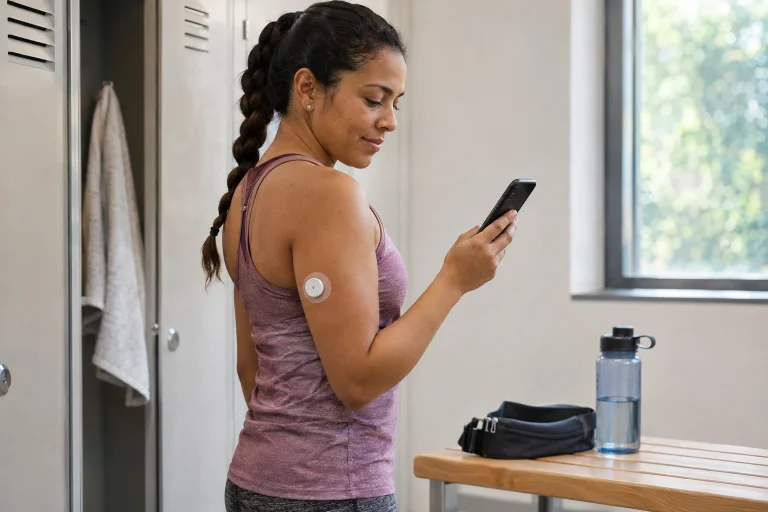
Ask whether and how to measure around activity, which signs to watch for and what your personal action should be if something differs. Do not automatically apply an insulin or eating plan given to another patient.
Do not change medication yourself for running. If you introduce new regular activity, tell your clinician; further monitoring and any changes form part of care. A positive training experience is not an independent reason to stop treatment.
 Enlarge diagram
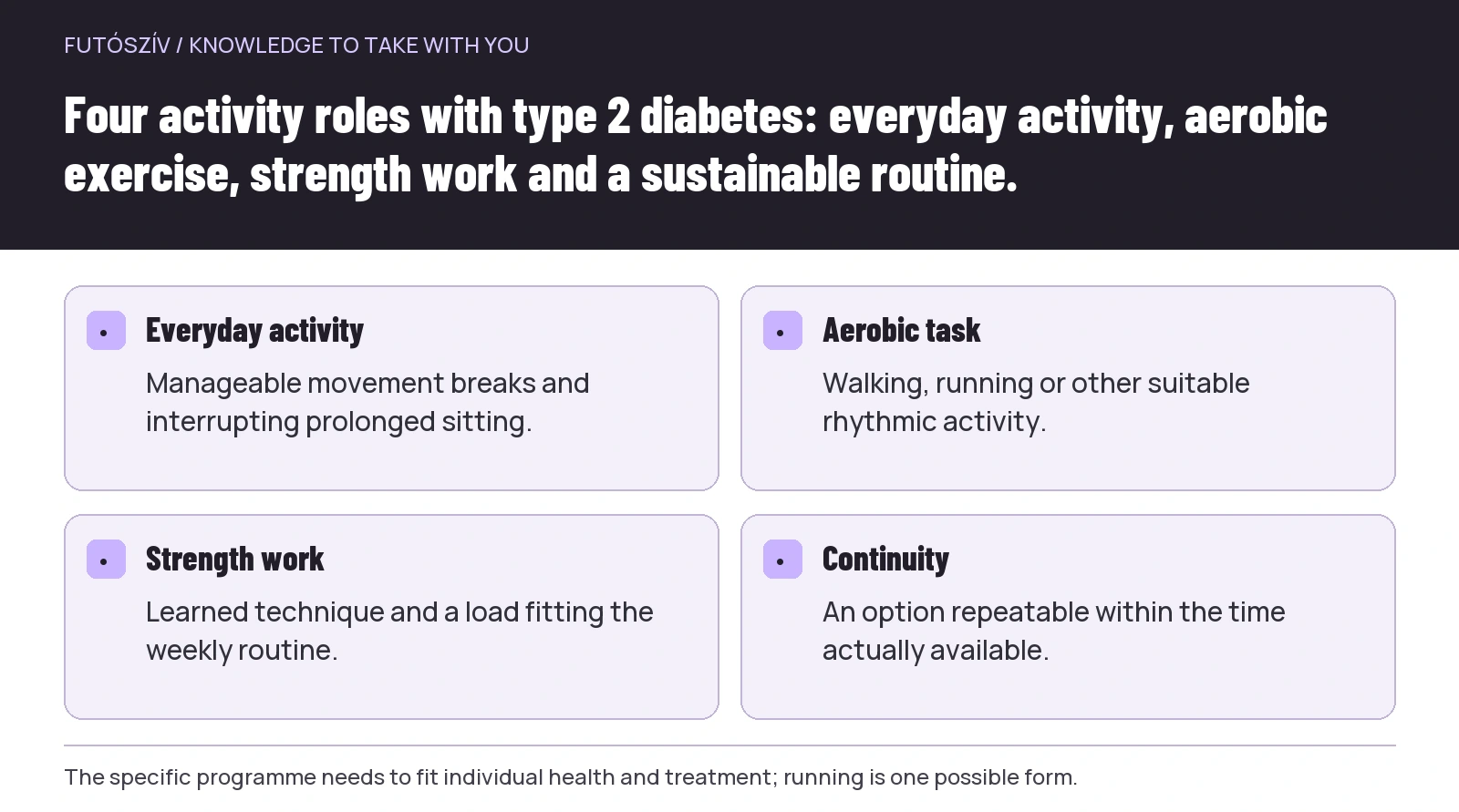
Text version of the diagram
- Everyday activity
- Manageable movement breaks and interrupting prolonged sitting.
- Aerobic task
- Walking, running or other suitable rhythmic activity.
- Strength work
- Learned technique and a load fitting the weekly routine.
- Continuity
- An option repeatable within the time actually available.
Checking foot condition is a specific task
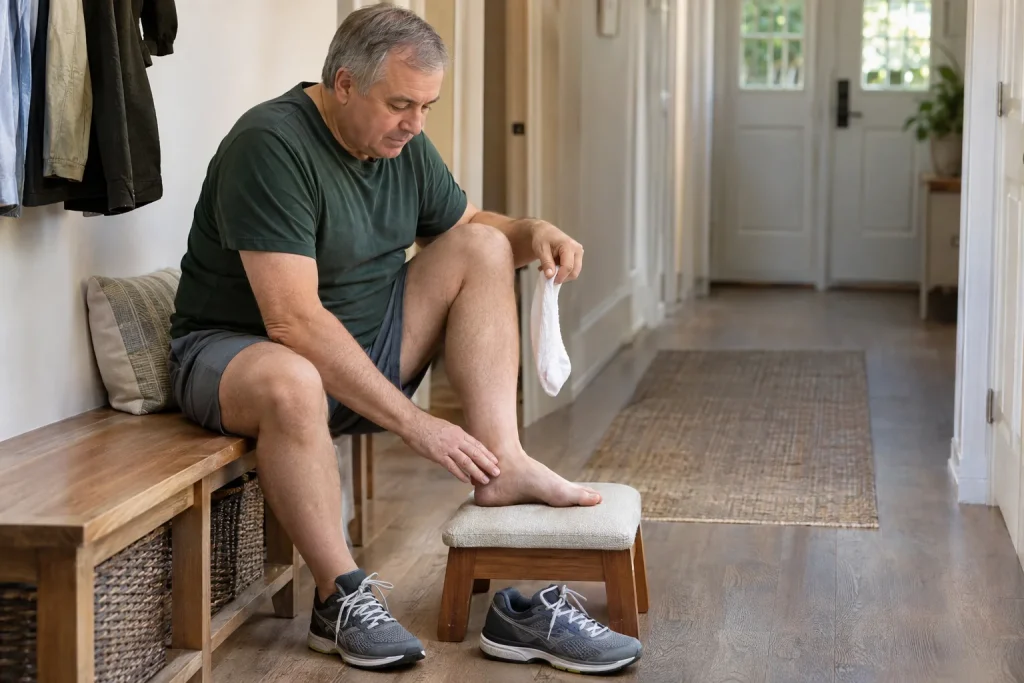
Diabetes-related sensory changes can make some foot problems less noticeable as pain. The NIDDK foot-care information therefore emphasises daily checking and early reporting of problems. An absence of symptoms does not always mean the skin and feet are fine.
Look for new injury, blisters, wounds, unusual redness or swelling, and seek help in the previously agreed way. With known sensory impairment, circulation problems or active foot disease, the appropriate form of activity is a separate professional question.
Comfortable shoes and socks matter, but a product does not replace assessment. Try new equipment first during a manageable session, and do not assume that something has to be broken in against your feet. Do not continue running with a wound or persistent symptoms while relying on your own solution.
There is no need to rank running above walking
If continuous running is too much at present, walking or appropriately planned alternating activity may provide a starting point. Let your current condition and personal healthcare framework guide the choice. The value of activity does not depend on the activity name appearing in an app.
A familiar route that can be shortened may reduce uncertainty. A park loop or a route with several turning-back options may be easier to manage than a distant task that requires a large detour to finish. The aim is the ability to make calm, independent decisions.
Company can help too if it accepts your own rhythm. Explain in advance that the task is manageable activity, not a shared pace competition. Time spent together need not conform to the intensity assigned to the faster runner.
Strength work can also form part of the programme
In a nine-month randomised study of 262 previously less active adults living with type 2 diabetes, a combined aerobic and resistance exercise programme improved HbA1c compared with the control. This particular study does not mean everyone can expect the same change or should copy the same task.
Strength work requires appropriate execution and a load suited to personal health. As a beginner, seek knowledgeable help and do not treat it as a major challenge suddenly added alongside running. The aim is a programme you can follow over the long term.
Running, strength work and other activity all contribute to the week’s load. If one is new, the next day’s experience matters too. There is no need to increase every area at once merely because several forms of activity may be useful.
Leave a plan for everyday activity too
The ADA 2026 recommendations also address interrupting prolonged sitting. One workout does not automatically make the rest of the day irrelevant. Short, achievable movement breaks or errands on foot may fit your opportunities.
You do not have to measure every minute as a separate achievement. Choose moments that connect naturally with your day: a phone call, brief break or nearby journey. If your work or mobility does not allow this, you can discuss another suitable option.
The aim is not another daily obligation. A step counter can help reveal habits, but every evening need not end with making up the missing steps towards an arbitrary number. Sustainability is more than a completed target on a display.
Let the log measure what decisions need
For activity, record duration, the task and effort. Where agreed with your clinician, glucose information and other observations may accompany this. The aim is useful feedback, not unlimited collection of every possible data point.
Assess clinical measures with your care provider. A single number after exercise or a brief period does not explain everything about longer-term health. The timing of monitoring and actions should belong to the personal plan.
Record positives in the activity log too: you got started more easily, rushed less, enjoyed the shared programme or better recognised your own rhythm. These help you choose a system you will want to return to later.
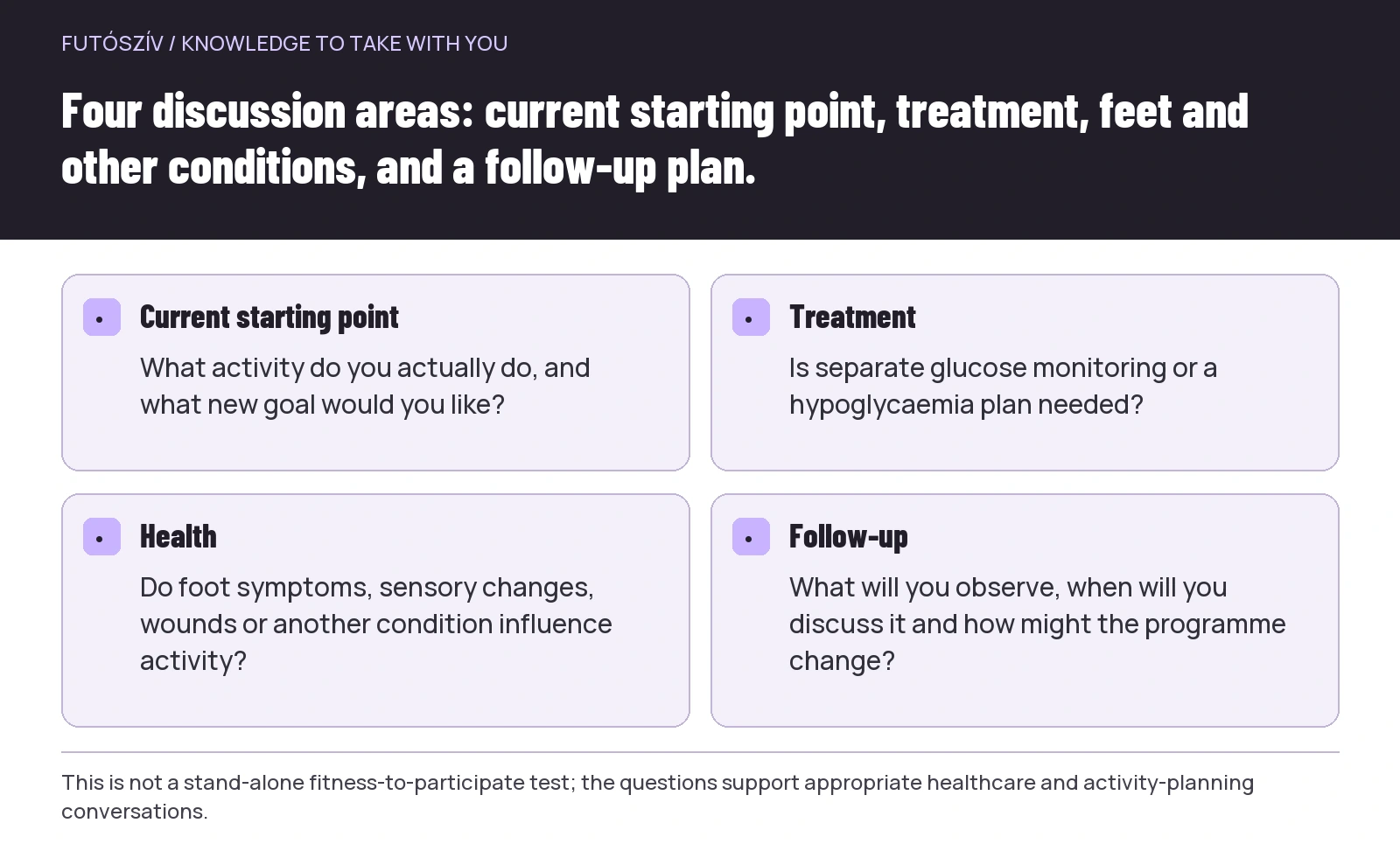 Enlarge diagram
Text version of the diagram
- Current starting point
- What activity do you actually do, and what new goal would you like?
- Treatment
- Is separate glucose monitoring or a hypoglycaemia plan needed?
- Health
- Do foot symptoms, sensory changes, wounds or another condition influence activity?
- Follow-up
- What will you observe, when will you discuss it and how might the programme change?
Three life situations, three beginnings
New diagnosis, little activity experience: first clarify treatment, necessary monitoring and the framework for suitable simple activity. You do not need to choose a race entry immediately as proof of change.
Regular walking, interested in running: build the next step from current capacity and the healthcare framework. After a manageable trial, how you feel and subsequent effects can guide the next decision.
Experienced runner, changed treatment or health: an old routine may need reassessment. Describe the actual training task to your clinician rather than assuming every previous rule remains applicable.
A race goal may need separate discussion
For a longer or more intense event, expected duration, weather and supplies also belong to the task. If the goal differs substantially from usual activity, bring it into the healthcare and training-planning conversation.
Fuelling, medication and monitoring should not be worked out on race morning. Prepare equipment required by your own plan and the procedure for seeking help in advance. Check the organiser’s current information directly on the event’s platform.
If preparation or current health does not fit the commitment, the goal can change. A shorter distance, later start or different programme does not make regular activity less valuable. Base the decision on the present situation.
When to stop and seek help
With a new, concerning symptom, do not try to finish the planned workout. For severe illness, severe chest pain, difficulty breathing or unconsciousness in Hungary, call the 112 emergency number . Current condition matters more than the diagnostic label and daily distance.
Follow your personal action plan for low glucose and seek help if you cannot manage the situation yourself. A running partner can know where to find necessary information and whom to notify. Discuss precise arrangements in advance.
Persistent foot symptoms, a wound or declining exercise capacity may require appropriate care even when it is not an emergency. Do not regard these as compulsory parts of adapting to activity.
The long-term goal is a functioning system
In an appropriate programme, activity fits regularly, treatment-related tasks are understandable and difficulties can be reported. If something repeatedly does not work, the plan can change. A lack of more willpower is not necessarily the problem.
At healthcare reviews, share the real experience: what fitted in, what caused uncertainty and what you want to continue. This can produce a next step suited both to personal goals and treatment.
Running with type 2 diabetes can be a source of enjoyment in its own right and a community experience. Good planning does not narrow your whole life around the diagnosis; it helps activity be a sustainable part of it within an appropriate framework.
Official and primary sources
- ADA Standards of Care 2026: activity, habits and well-being.
- ACSM 2022 consensus on physical activity with type 2 diabetes.
- Randomised trial of aerobic, resistance and combined exercise.
- NIDDK: diabetes and foot problems; hypoglycaemia.
- National Ambulance Service: urgent help.
How Futószív articles are prepared: our editorial guidelines.