Returning to sport need not be about proving something
After cancer, running can mean freedom, familiar company or the experience of choosing something in your day again. For someone else, even a short walk is currently a major task, and the old sporting goal does not matter. Both experiences are valid. Movement should not become a winner-and-loser story or a compulsory heroic act.
Diagnosis, treatments and current condition can differ enormously. After surgery, drug treatment, radiotherapy or a combination, individual questions are not the same. Treatment ending does not automatically mean every effect has ended either. Planning running therefore needs to connect with the oncology team and, where needed, the rehabilitation team.
This article does not give personal clearance for exertion or alter treatment. It helps explain which benefits have supporting evidence, which circumstances must be discussed and how you can receive an activity framework genuinely workable in your present life.
What benefits can be expected, and what must not be promised?
According to the US National Cancer Institute overview , appropriate aerobic and strengthening activity during and after treatment can improve certain symptoms and quality-of-life outcomes. It describes strong evidence in areas including fatigue, anxiety, depressive symptoms and physical function. This does not mean everyone experiences the same improvement or running is the only appropriate form.
Movement does not replace oncology treatment, follow-up or assessment of side effects. A charity-run story does not establish a particular programme’s personal safety either. Studies involve different patient groups and interventions, so a favourable finding in a headline always needs interpreting alongside the participants and purpose.
A benefit can be entirely everyday: getting to a meeting more easily, finding a usual task less tiring or wanting to go outside again. These goals are no less valuable than a finish arch. Do not measure your own outcome solely against pre-illness kilometres and pace.
What is the study behind the recent colon-cancer exercise news?
The CHALLENGE randomised trial included 889 people treated for defined stages of colon cancer who had undergone surgery and adjuvant chemotherapy. It compared a supported three-year exercise programme with health-education materials. The 2025 study reported more favourable disease-free survival and findings consistent with longer overall survival.
This is a significant research finding, but not a running prescription for every cancer type and treatment situation. It did not study one short session or an identical running distance for every participant, and the programme included support. Musculoskeletal adverse events were also more common in the exercise programme. Describe the result together with both benefits and loading considerations.
As a runner, the appropriate question is how similarly structured activity support can be accessed within your own care. Do not turn a percentage extracted from the news into a personal task, or feel that later outcomes depend solely on whether you complete training. The course of illness cannot be accounted for as an individual sporting achievement or sporting failure.
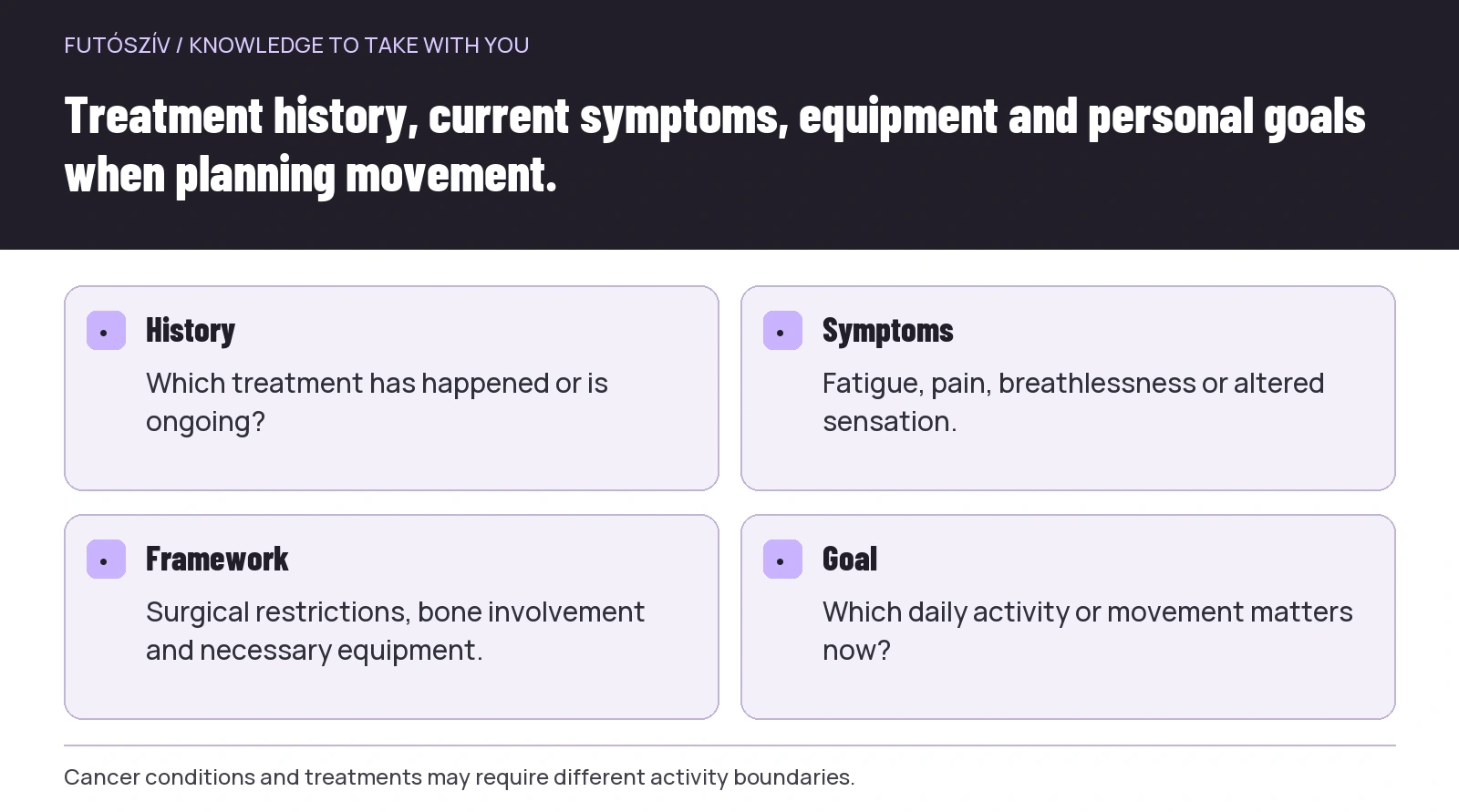 Enlarge diagram
Text version of the diagram
- History
- Which treatment has happened or is ongoing?
- Symptoms
- Fatigue, pain, breathlessness or altered sensation.
- Framework
- Surgical restrictions, bone involvement and necessary equipment.
- Goal
- Which daily activity or movement matters now?
Bring more than the diagnosis name to the first discussion
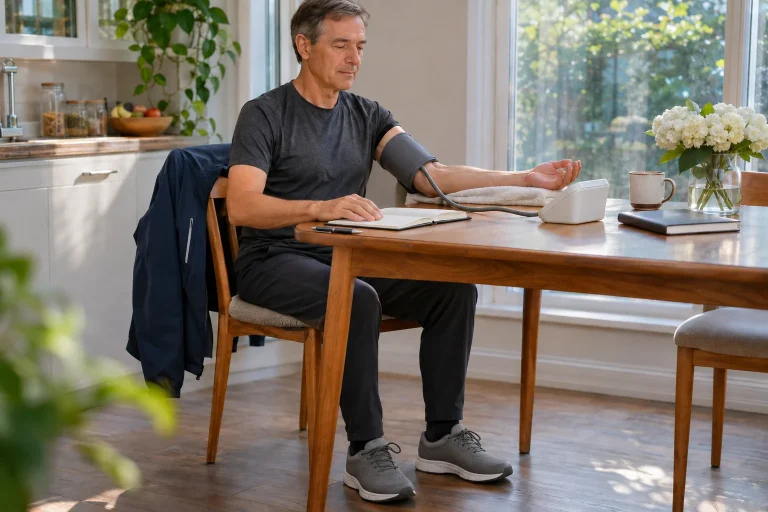
List treatment received or ongoing, when surgery took place and current restrictions you have been given. Mention important symptoms: breathlessness, dizziness, pain, wound problems, numbness or unusual fatigue. A list of medicines and devices can also help the discussion. You do not have to decide which detail will ultimately matter.
The ACSM multidisciplinary consensus emphasises conditions requiring prior assessment or modification alongside the general possibility of exercise. Bone involvement, cardiac and respiratory circumstances, substantial physical limitations or treatment side effects cannot be resolved with one general beginner plan.
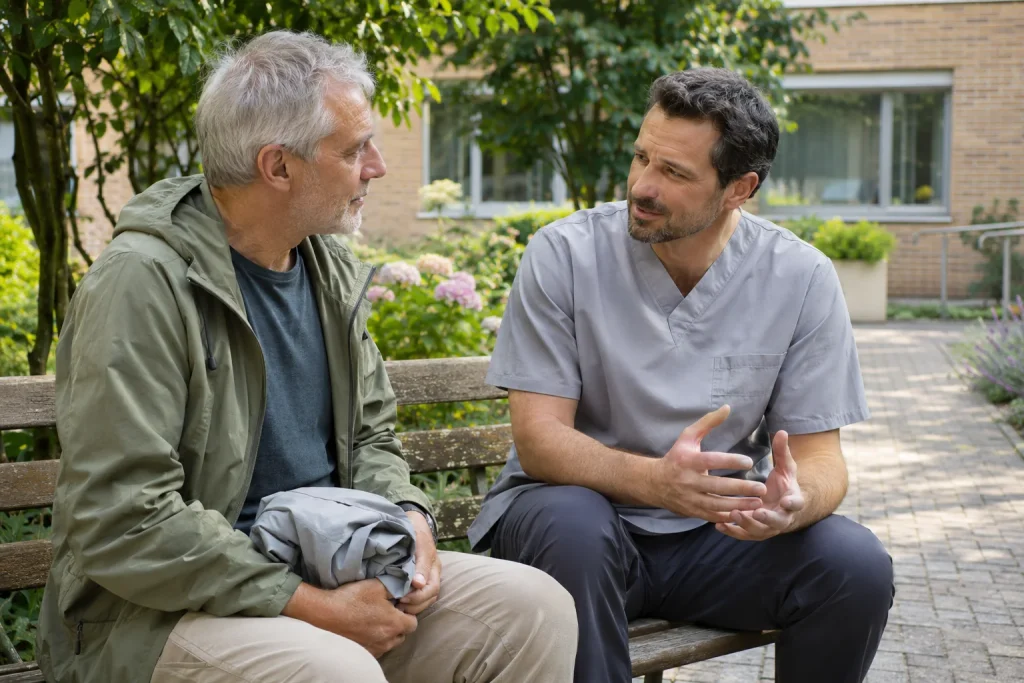
Ask who can provide help with expertise in oncology exercise rehabilitation and how they can coordinate with your care team. A coach may also need a precise activity framework, but choosing treatment from laboratory results is not their role. Clarifying roles makes it easier to avoid having to connect every professional decision yourself.
Fatigue and blood counts: why report your daily condition too?
Cancer-related fatigue is not necessarily the familiar feeling after training that can simply be overcome with willpower. Capacity for load can change alongside treatment and other symptoms. If your condition is new or unusually poor, tell your provider; do not decide for yourself that it must be mere lack of fitness.
The Macmillan guide to exercising safely discusses considerations associated with low blood-cell counts among other matters. With low white-cell counts, infection risk may matter; other abnormalities can involve bleeding or exertion risks, for example. Your care team determines individual activity limits arising from current blood results; this article does not assign exercise doses to laboratory values.
If you have a fever or feel unwell, follow the emergency instructions from your oncology team and do not go running. Clarify in advance the fever-reporting threshold and contact arrangements associated with treatment. Concealing symptoms and completing an event cannot take priority over timely care. In sudden severe illness in Hungary, you can call 112.
With neuropathy, terrain and foot checks take on different meaning
After certain treatments, numbness, tingling, pain, reduced sensation or balance difficulties may persist. The American Cancer Society information on neuropathy warns that changes in sensation and balance can increase injury risk. Review these symptoms with your provider, rather than treating them simply as poor shoes.
A familiar forest route may then become a different task. Roots, poor lighting, a long walk home and fatigue matter together. Ask for individual advice when selecting the activity and location. The general rule that load is fine as long as it does not hurt is insufficient if sensation is reduced too.
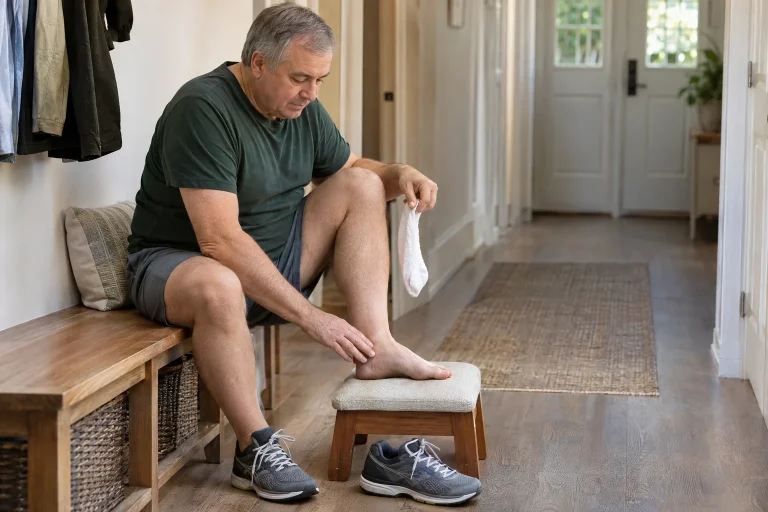
Discuss daily foot checks and appropriate footwear as well. If bending down or seeing an area is difficult, ask for practical help. A new wound, injury or worsening sensory change should not remain merely a note in the training diary. Adapt equipment and route to the individual condition.
Bone involvement, surgery and lymphoedema: separate questions
With bone metastases or reduced bone strength, precise selection of the loaded area and activity matters. Macmillan therefore emphasises discussing this with the care team beforehand. Running and jumping are not automatic general recommendations in this situation. Develop appropriate movement options through targeted assessment.
After surgery, wound healing, the nature of the procedure and any stoma or other device also belong in the plan. Ask when and which movement is appropriate, how to wear the necessary device and which signals mean seeking help. Pain easing does not, by itself, override surgical restrictions you received.
Lymphoedema does not mean a complete movement ban in every situation either. The NCI overview, for example, discusses the safety of appropriate exercise even with a risk of breast-cancer-related lymphoedema. Individual swelling, symptom changes and any compression equipment nevertheless need addressing with a suitably knowledgeable team. Another patient’s experience cannot replace this.
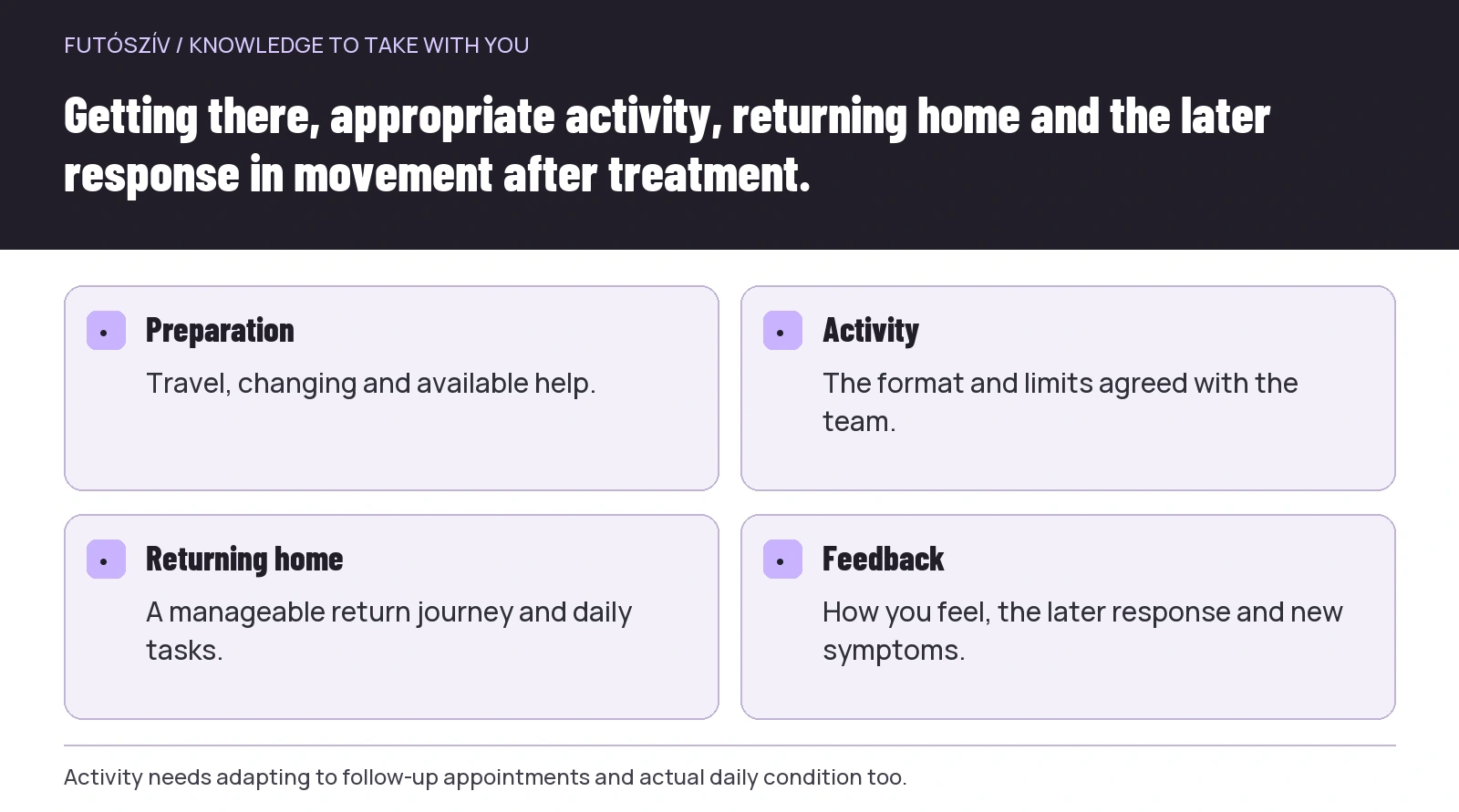 Enlarge diagram
Text version of the diagram
- Preparation
- Travel, changing and available help.
- Activity
- The format and limits agreed with the team.
- Returning home
- A manageable return journey and daily tasks.
- Feedback
- How you feel, the later response and new symptoms.
Cardiac and respiratory exercise capacity relates to treatment history
If heart or lung effects arose during treatment, or you experience new breathlessness, chest symptoms or palpitations, report this before planning running. Your provider can consider the treatment history when deciding whether further examination is needed. A previous running background does not erase a condition changed during or after treatment.
The ASCO guideline on exercise connects activity with oncology care, rather than treating it as an independent sporting challenge. Diagnosis, treatment, side effects and daily condition matter together for individual exertion. Do not try to establish suitability through an old maximum heart rate or a watch’s automatic zones.
Severe or sudden chest pain, breathing difficulty, fainting or another substantial episode of illness may require urgent help. A cancer history is not a reason to regard every new symptom as ordinary fatigue. Keep the care service’s contact details and your emergency plan at hand in advance.
The programme can begin with an everyday task
If the team considers movement appropriate, choose an important goal currently manageable for you. Examples include reaching the nearby park, walking briefly with company or performing a specified exercise safely. A goal is not good because it resembles a previous race. Independence and enjoying the day more are genuine outcomes too.
Plan the whole outing, including travel, changing and getting home. Treatment or review days may have different time and energy available. Ask for a format whose modifications are clear too: when to shorten it, when to skip it and when to request professional feedback. You do not need to fill a long-term training calendar immediately.
A few points are enough for tracking: what happened, how did you feel during it, what was it like later and what changed in important daily function? Report new symptoms separately. An activity diary does not replace follow-up and is not intended to hold you accountable for performance.
A supportive community does not prescribe a compulsory return
As a running companion, ask what contact and help would feel good. A short shared walk, accompaniment to appointments or taking over a practical task may be more useful than entering the next race. Do not organise a surprise sporting challenge as proof of someone’s recovery.
You decide whether to share your story. You do not need to turn movement into inspirational content to receive support. A good community accepts modified plans and no as an answer too. A charitable cause can matter, but is not a health obligation.
Let your next step be agreed with the care team and meaningful to you. Movement can be a valuable part of care and daily life, but does not replace treatment or measure your worth. Appropriately supported activity at your own pace has just as much a place within the running community.
Sources
- NCI: Physical activity and cancer fact sheet
- ACSM: Exercise guidelines for cancer survivors, multidisciplinary consensus
- CHALLENGE: Structured exercise after adjuvant chemotherapy for colon cancer, randomized trial
- Macmillan Cancer Support: Exercising safely with cancer
- American Cancer Society: Peripheral neuropathy
- ASCO: Exercise, diet and weight management during cancer treatment, guideline
How Futószív articles are prepared: our editorial guidelines.