
With a young child, the night is often the biggest uncertainty in a running plan. A morning session may look realistic in the evening, but by dawn you have been up several times and had little uninterrupted sleep. This is not a time to produce a more disciplined version of yourself. You need a plan that allows for changing capacity rather than paying for kilometres with your last opportunity to sleep.
Broken sleep can affect mothers, fathers and other caregivers. Physical recovery after childbirth is a separate consideration for someone who has recently given birth: a better night does not establish readiness to run. These practical ideas can be used within individual health and activity requirements; they are not intended to manage a baby’s sleeping or feeding.
Look beyond hours slept to the day ahead
The NHLBI explains that insufficient sleep can impair attention, decision-making and reactions. How well you can stay awake and concentrate therefore matters when planning a run. Heavy traffic, technical terrain or driving to the session create further demands on judgement.
Ask yourself: am I nodding off while sitting? Is following a simple task difficult? Am I much more irritable or inattentive than usual? You do not need to convert these observations into an exact score before changing the day. If you are markedly sleepy, driving to a running venue is not a good workaround instead of resting.
Everyday descriptions of fatigue and sleepiness are not always the same either. You may lack enthusiasm for intense activity while remaining alert; at another time, your eyelids may be closing. Say which is happening. This is more useful for making a decision than the general statement that it was a bad night.
Do not give a session only one possible version
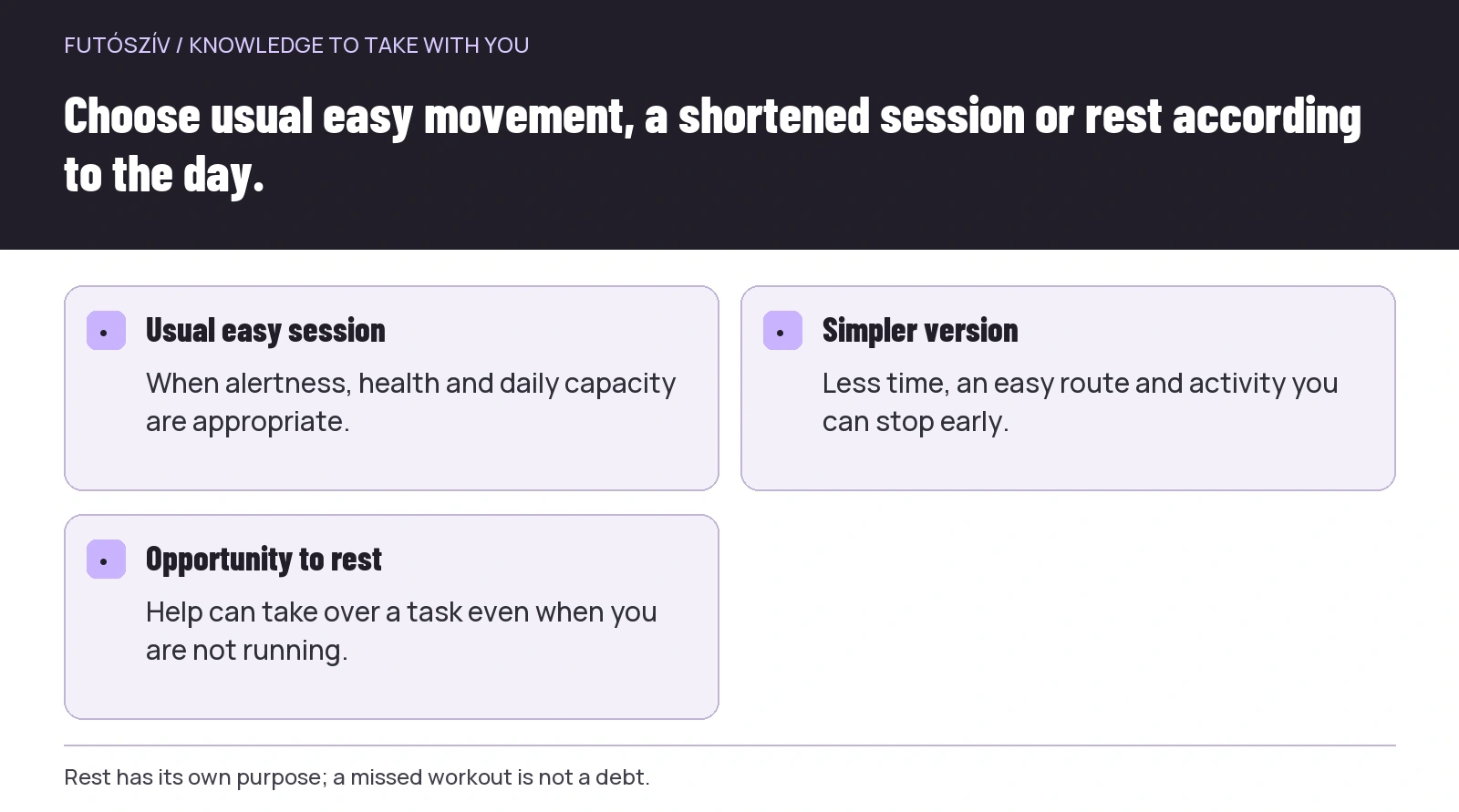
Prepare three options for the same time window. The first is your usual easy session appropriate to your condition. The second is shorter, simpler movement. The third is rest or an opportunity to sleep made possible by help. You should not have to decide what counts as acceptable on the morning after a difficult night.
These three versions should not form an imaginary ranking in which rest always means failure. Each has its purpose. Easy movement may provide time to yourself, a shortened session may preserve part of the routine, and rest may create room for recovery. You are choosing according to the day, rather than issuing yourself a report card.
Treat intense or long training separately. It should not automatically remain available under every sleep situation simply because it was previously entered in the calendar. If you postpone it, do not squeeze the full amount unchanged alongside the next two days’ other tasks. The weekly plan needs rearranging too.
Five practical questions may be enough for the morning decision
- How alert am I for basic daily tasks and travelling to the session?
- Is there pain, a sign of illness or another symptom needing separate attention?
- If I exercise now, will I still have time to eat and rest during the day?
- Can the route be cut short easily, and is the planned workload realistic?
- What help is available, and whom do I need to tell about a change?
These questions are not a medical test or a sleep-research scale. They are a practical aid that makes the circumstances of the decision visible. If an answer suggests a shorter session or rest now, a readiness score on a watch does not need to override it.
 Enlarge diagram
Text version of the illustration
- Usual easy session
- When alertness, health and daily capacity are appropriate.
- Simpler version
- Less time, an easy route and activity you can stop early.
- Opportunity to rest
- Help can take over a task even when you are not running.
An opportunity to rest needs arranging too
The NHS guidance for parents emphasises sharing tasks and night-time care where possible, along with help from family or friends. Advice to ‘rest when you can’ becomes real when someone actually takes over a responsibility.
Make a specific request: someone could take the older child out, prepare lunch or cover a period of morning care. Help should not be limited to the hour when you run. Rest can deserve protected time just as much as a sporting activity.
Single parents or people with little support may have fewer options. A more efficient app cannot resolve that. Make the plan smaller and more forgiving, and do not present seeking help as personal failure. The conditions for participating in sport are not the same for everyone.
Do not make the alarm your first adjustment
An early run is appealing because the house is still quiet and it seems not to take time from anyone. In reality, it may take away your opportunity to sleep, especially if early-morning wakings mean the final stretch would have been the most peaceful. Before setting an earlier alarm, consider its cost during the day ahead.
A short daytime session may fit less often but place fewer demands on you. Alternating days with a partner may work so that both have time to themselves. It may also be realistic to temporarily replace your previous weekly frequency with fewer sessions that are easier to arrange.
For an evening run, count the whole process too: changing, travel, movement, eating and winding down. If this regularly delays bedtime, a workout that looks short on paper may actually cost more sleep. The solution differs between people, but make the hidden time visible.
Movement can help, but it does not replace sleep
The 2025 Canadian postpartum guideline considers both physical activity and support for sleep important, and discusses social support among the available options. This does not mean completing training at the expense of sleep. Daily circumstances can distinguish activity that contributes to wellbeing from another exhausting task.
Notice what a restrained session gives you. Do you return with a clearer head, or does the rest of the day feel even harder? The answer can change, so do not create a permanent rule from one good or bad experience. Enjoying your own time matters too, but does not always require a running achievement.
An easy walk, a short time outdoors or another manageable activity may be the right choice that day. If it does not fit, your relationship with movement has not ended. The next opportunity does not require a punishingly long workout.
View the weekly plan as a rolling window
Instead of aiming for a perfect Monday-to-Sunday sequence, think about the next few opportunities. Which days have dependable help? Where is there time to eat and return more calmly? Training should fit your daily capacity, rather than simply occupy a calendar cell that appears free.
After a particularly difficult night, do not merely move the next few days’ plan along by one day. This can easily place the missed intense session beside the next long run. Instead, decide what remains important and which element can be dropped entirely.
You can review the timing of a race goal too. If there has been no room for appropriate training and recovery for weeks, the original start date may be too close. Choosing a later goal or shorter distance is a practical decision, rather than a judgement of your identity as a parent or runner.
 Enlarge diagram
Text version of the illustration
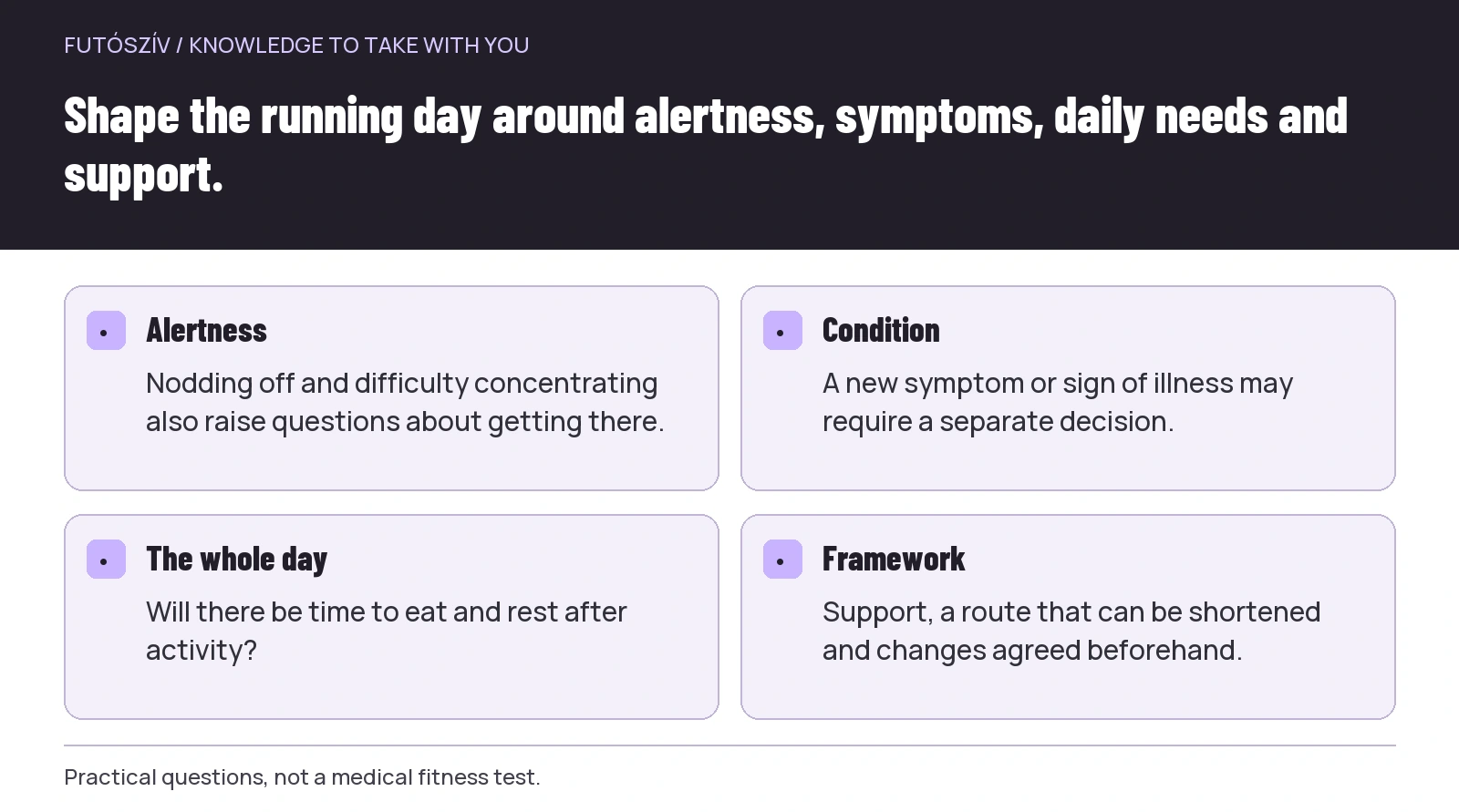
- Alertness
- Nodding off and difficulty concentrating also raise questions about getting there.
- Condition
- A new symptom or sign of illness may require a separate decision.
- The whole day
- Will there be time to eat and rest after activity?
- Framework
- Support, a route that can be shortened and changes agreed beforehand.
Family arrangements should not be a bargain over performance
Discuss movement, rest and caregiving separately. If running time is only allowed after every household task is done, it can easily become another obligation. If one person’s time to themselves regularly comes out of the other’s sleep, the system becomes difficult to sustain.
Try to agree time windows in advance during which tasks genuinely change hands. Adjust these according to the day’s condition. Everyone should be able to report exhaustion, and kilometres covered should not be the only visible outcome.
When arranging a run with someone, explain in advance that you may shorten or cancel it based on how you feel in the morning. A group that does not treat this as an excuse can help. A flexible framework reduces pressure to turn up despite a poor night.
Put your circumstances alongside the watch data
A sleep or recovery score cannot fully see what the night involved. It may have classified quiet wakefulness as rest or compressed interruptions into one number. The displayed value can be observational information, but should not be your sole daily instruction.
If you keep a diary, three short notes may suffice: how broken sleep was, daytime alertness and your response to movement. Do not turn sleep into another performance competition where a poor score makes the day feel unsuccessful before it has begun.
If the device shows an unusual change, or you experience persistent symptoms, you can show the data to a doctor if appropriate. Your symptoms matter even if the watch gives a good score. In particular, do not ignore an overwhelming need to sleep, substantial concentration problems or other new symptoms.
A young child does not explain every case of persistent exhaustion
The NHS information on tiredness recommends medical advice when fatigue persists, disrupts daily life or comes with other symptoms. Caring for a young child may genuinely explain limited sleep, but does not exclude another health cause. The need for assessment can be judged from the whole picture.
Report being unable to sleep despite having an opportunity, observed pauses in breathing or loud snoring, and persistent mood difficulties accompanying exhaustion. The NHS information on insomnia also emphasises daytime functioning and clarifying possible causes. Not everything has to be solved through willpower.
Limited opportunities to sleep and the care of insomnia are different situations. Do not blindly apply a general sleep rule to days with a young child. Individual advice should consider caregiving, feeding and the postpartum condition; do not start medication or another treatment on a running group’s recommendation.
A measure of a workable week
At the end of the week, look beyond kilometres. Were there a few manageable periods of movement, time to eat and rest, and support that worked? Where did the plan become too tight? Choose one specific adjustment for next week: a shorter route, later departure or a more dependable handover of care.
The rhythm of running with a young child can change, and sporting goals can adapt. A flexible plan does not mean taking running less seriously. It allows movement a sustainable place in your circumstances while recognising sleep and asking for help as equally real needs.
Sources
- NHS: Sleep and tiredness after having a baby, updated 2026
- NHLBI: Sleep Deprivation and Deficiency – Health Effects
- NHS: Tiredness and fatigue
- NHS: Insomnia
- CSEP: 2025 Canadian guideline for physical activity, sedentary behaviour and sleep throughout the first year post partum
How Futószív articles are prepared: our editorial guidelines.