
Pain may be common, but you need not adapt to it without limit
You calculate in advance whether the strongest cramps will coincide with the next long run, or cancel plans month after month because of menstruation. This is more than a training-organisation issue. Mild discomfort can be accommodated flexibly, but pain regularly obstructing everyday life or sport belongs in a medical consultation.
The American College of Obstetricians and Gynecologists information explains that you can seek help for both mild and severe period pain. You need not wait until you can prove your symptoms are stronger than someone else’s. Assessing symptoms is not a competition, and being sporty is no reason to receive less support.
This article separates the place of adjusting running from that of investigation. It gives no medicine dose, makes no diagnosis and does not prescribe either rest or running for everyone during menstruation. Decisions concern the specific condition, not compulsory performance tied to a calendar day.
Why can two people’s period pain differ?
Professional descriptions distinguish cramps occurring as primary menstrual pain from symptoms with another underlying condition. The NHS period pain page lists endometriosis, adenomyosis, fibroids and pelvic inflammatory disease among possible causes. This list does not mean you definitely have any of them.
History matters: when pain began, whether it changed over the years, whether it occurs only around bleeding or at other times too. Pain during sex, urination or bowel movements matters as well. You need not share these with your coach, but they may be important in healthcare assessment.
A previous similar symptom does not explain every new situation. If pain suddenly becomes much stronger or entirely different, do not treat it as part of the usual menstrual routine. A regularly recurring symptom and a new severe episode present different decisions.
Three running days, three reasonable choices
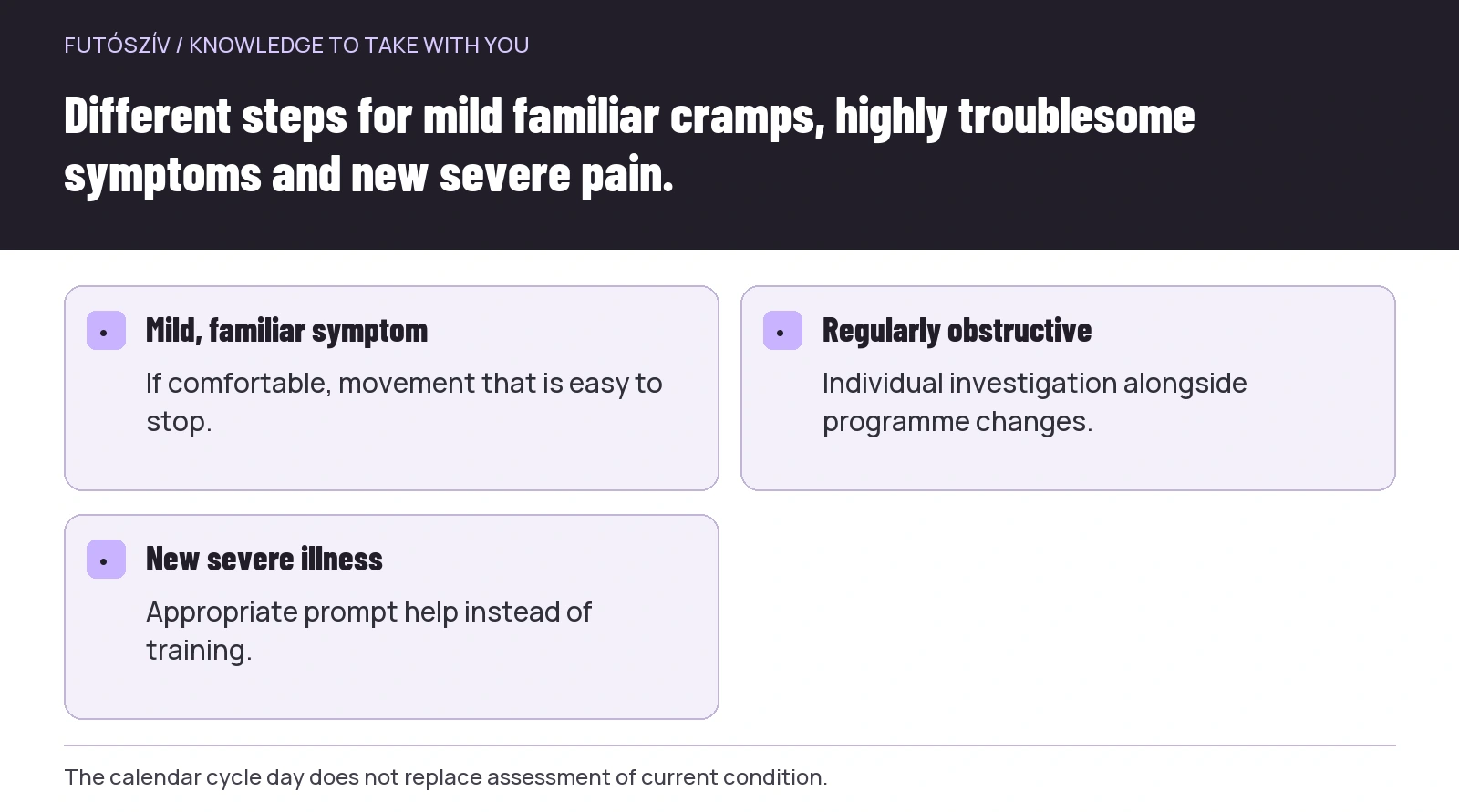
Mild, familiar cramps with otherwise good wellbeing. If it feels good, you can choose easier, shorter movement, such as walking or comfortable running on a route with an easy return home. Stopping all movement is not compulsory, but neither must a hard session prove that menstruation does not limit you.
Familiar but highly troublesome symptoms. If pain makes concentration difficult, alters movement or leaves the day’s other tasks barely manageable, rest and changing the programme are real options. Seek individual advice too, especially if this recurs regularly. A logistical workaround repeated every month does not replace assessment of the cause.
New, unusually severe pain or feeling unwell. Appropriate medical help comes first. Fainting, severe weakness, increasing abdominal pain or another sudden deterioration is not a training-adjustment task. Do not set off just to see whether it warms up, and do not wait until the run ends before seeking help.
 Enlarge diagram
Text version of the diagram
- Mild, familiar symptom
- If comfortable, movement that is easy to stop.
- Regularly obstructive
- Individual investigation alongside programme changes.
- New severe illness
- Appropriate prompt help instead of training.
Movement may help, but compulsory running is not treatment
ACOG mentions regular exercise, sufficient sleep and warmth among options supporting pain relief. The NHS also lists gentle movement, such as walking or other easy activity, as a possible self-help measure. These do not guarantee every cramp will disappear and do not replace investigation.
If you want to try movement, choose something easy to stop. A short loop near home offers more flexibility than a long, distant route. Decide from your experience: if symptoms worsen, there is no need to retain the original plan merely because movement is generally considered useful.
Use a heating device according to its instructions, taking care to avoid burns. Hot water or a heating pad is not intended to temporarily suppress unusually severe pain so you can continue the day without medical assessment. Symptom relief and clarifying the cause are separate tasks.
Medication support: a personal plan rather than improvising before the start
Effective medication and hormonal treatments for period pain exist. ACOG and the NHS discuss them too. Appropriate choice depends on history, other medicines, possible contraindications and personal aims; this article provides no dosing schedule or product switch.
If treatment does not help adequately, report it. Increasing the dose or combining several painkillers independently is not necessarily the next step. Explain what you used, under which instructions and how much it helped. This can support deciding whether an adjustment or further investigation is needed.
Appropriate management of menstrual symptoms and suitability for a running race may relate but are not identical. If you could run normally only by masking pain, clarify participation too. The day before a race is a poor time to independently introduce an untested medication strategy.
What makes a pain description useful to a doctor?
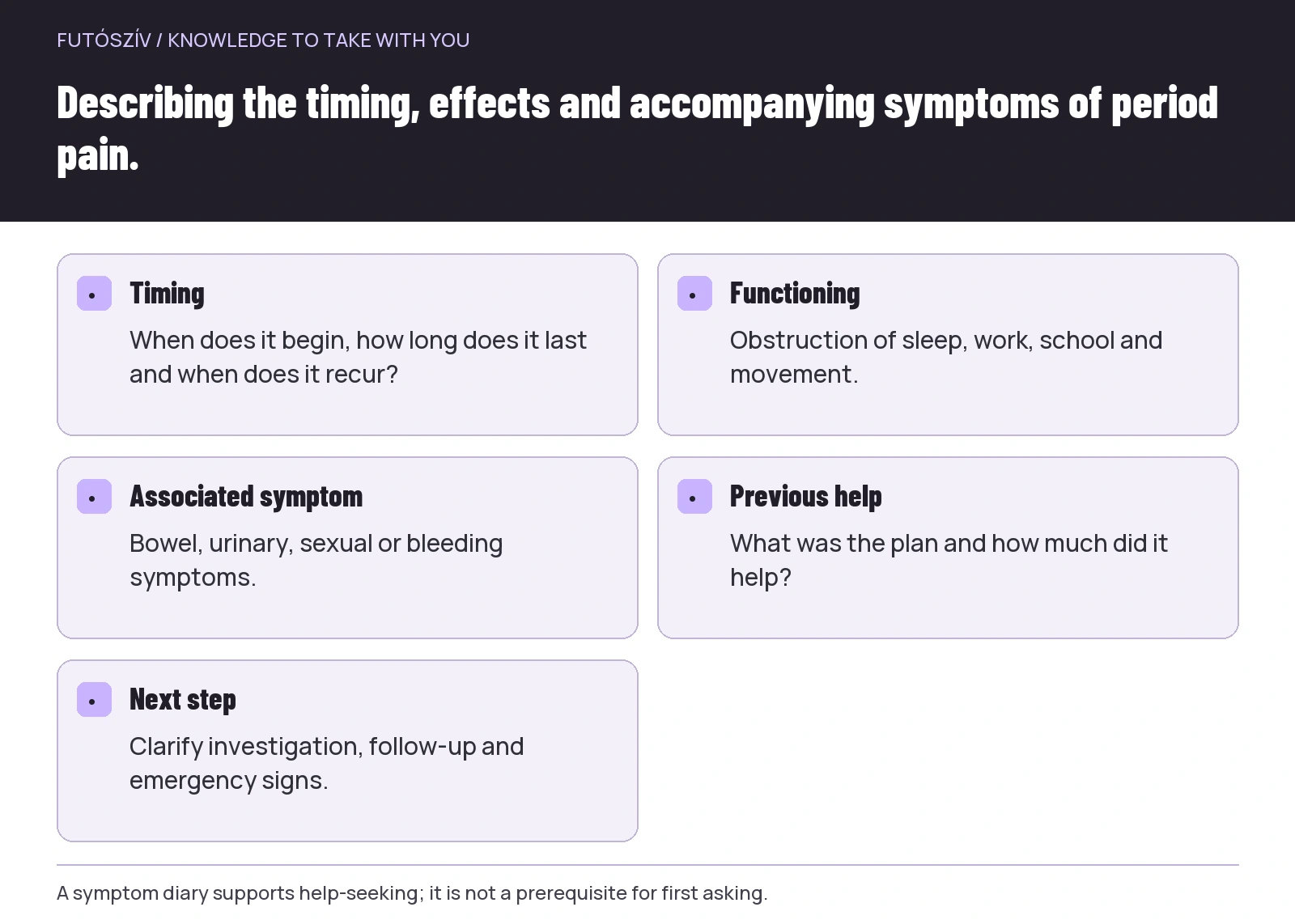
You need not rely solely on a number on a ten-point scale. Describe what pain prevented: working, sleeping without waking, attending school or training, or even your usual walk. Specific examples of functioning show clearly how it affects your life.
Record onset, timing relative to bleeding, duration and recurrence. Associated bowel or urinary symptoms, bleeding between periods, nausea and other symptoms may matter too. Record changes you actually observed; you need not name the cause in advance.
The NICE endometriosis guideline states that a pain and symptom diary may support discussion. This does not require waiting months for the first appointment while compiling a perfect dataset. You can legitimately seek help with a brief, precise history.
Why does the possibility of endometriosis matter without becoming self-diagnosis?
NICE describes considering endometriosis for period pain affecting daily life, persistent pelvic symptoms and certain cyclical bowel or urinary symptoms, among other situations. This is a direction for investigation, not a checklist giving a definite diagnosis when ticked off. Other conditions can cause similar symptoms.
The Royal College of Obstetricians and Gynaecologists information also emphasises that normal ultrasound or MRI findings do not rule out endometriosis. A reassuring result is valuable information, but persistent or recurring symptoms require clarifying further steps with a doctor.
Equally, a general article does not establish that everyone immediately needs surgery or a particular investigation. The sequence of investigation and treatment requires individual consideration. A useful question is what this test can show and, if it finds no abnormality, what the next step for your symptoms will be.
 Enlarge diagram
Text version of the diagram
- Timing
- When does it begin, how long does it last and when does it recur?
- Functioning
- Obstruction of sleep, work, school and movement.
- Associated symptom
- Bowel, urinary, sexual or bleeding symptoms.
- Previous help
- What was the plan and how much did it help?
- Next step
- Clarify investigation, follow-up and emergency signs.
When should you seek help more quickly?
The NHS recommends urgent assessment if pelvic or period pain is severe, worse than usual and usual pain relief has not helped. This does not mean you must first try medication for new, intense pain. Symptom severity and overall condition take priority.
The NHS information on pelvic pain explains that possible pregnancy, fever, vomiting, bleeding and other accompanying symptoms may affect urgency of care. If pregnancy is possible and you have pain, state that immediately. Do not use bleeding as certain home proof that pregnancy cannot be present.
Seek emergency help for collapse, fainting, severe breathlessness, confusion or unbearable, rapidly worsening pain. Do not drive when unwell. During running, a companion or medical point can help arrange care; you need not first complete the remaining distance.
A flexible running week can be specific, not merely permissive
For days with familiar recurring symptoms, plan activities that are easier to rearrange. This does not necessarily mean removing the same week every month. The aim is flexibility: which session has freer timing, which can be shortened and which is not important enough to retain at all costs.
If a hard day moves, review adjacent training load too. Crowding two difficult sessions together can easily remove the benefit of adjustment. A missed session is not a debt to repay the following week. The plan works when the whole week remains manageable.
It may be enough to tell your coach you need more flexible scheduling for a recurring health symptom and that medical assessment is underway. Your detailed gynaecological history is private. Support must not depend on making every intimate detail available to the team.
If you were previously told to put up with it
At the next consultation, show the specific consequences: how many days each month are affected, which tasks you cannot manage and how the previous plan failed to help. You need not prove high pain tolerance. Reduced quality of life is important health information in itself.
Ask which causes are being considered, the purpose of investigation, when a meaningful treatment change may be expected and when to report back. Persistent symptoms may warrant a further opinion. You need not manage lasting uncertainty solely through more training adjustments.
People around you can help too: a companion may attend, you can write questions beforehand or ask for more time for explanation. These are simple supports, not judgements on illness severity. A consultation is useful when you understand the next step and conditions for seeking help afterwards.
What should the aim be for next month?
- Name the symptom that obstructs you most, not merely how many sessions were missed.
- Have a followable individual pain-management plan and, where necessary, investigation plan.
- Keep an easily implemented alternative in the running programme.
- Know which new or severe symptoms require prompt help.
- At follow-up, assess changes in everyday functioning and quality of life too.
Adapting to period pain can be part of running life, but you need not organise your entire sport around it without seeking help. The aim is a condition and plan in which movement remains a choice, symptoms receive real attention and everyday wellbeing matters alongside ambition.
Sources and further reading
- ACOG: Painful Periods
- NHS: Period pain
- NICE NG73: Endometriosis, diagnosis and management
- RCOG: Endometriosis, information for the public
- NHS: Pelvic pain
How Futószív articles are prepared: our editorial guidelines.