
Your plan can be flexible during allergy season too
Spring blossoms, summer grass pollen and the later ragweed season do not mean the same thing to every runner. For one person the main problem is itchy eyes, for another a blocked nose makes activity unpleasant, and for some a respiratory condition also accompanies the situation. The aim is therefore not to identify one ideal running hour for everyone with allergies. Instead, develop choices fitting current conditions and your own treatment plan.
Common pollen-allergy symptoms include a runny nose, sneezing, an itchy nose and eyes, and nasal congestion. The Egészségvonal information also recommends following pollen calendars and current reports. As a runner, you can add your own experience: where you exercised, for how long, what symptoms occurred and what happened afterwards.
The information here is not medication-dosing guidance and does not establish whether a new symptom results from allergy, infection or another problem. If symptoms are new, worsening or interfering with everyday life, seek professional assessment. Running plans must respect agreed treatment and any asthma action plan too.
Do not confuse three kinds of information
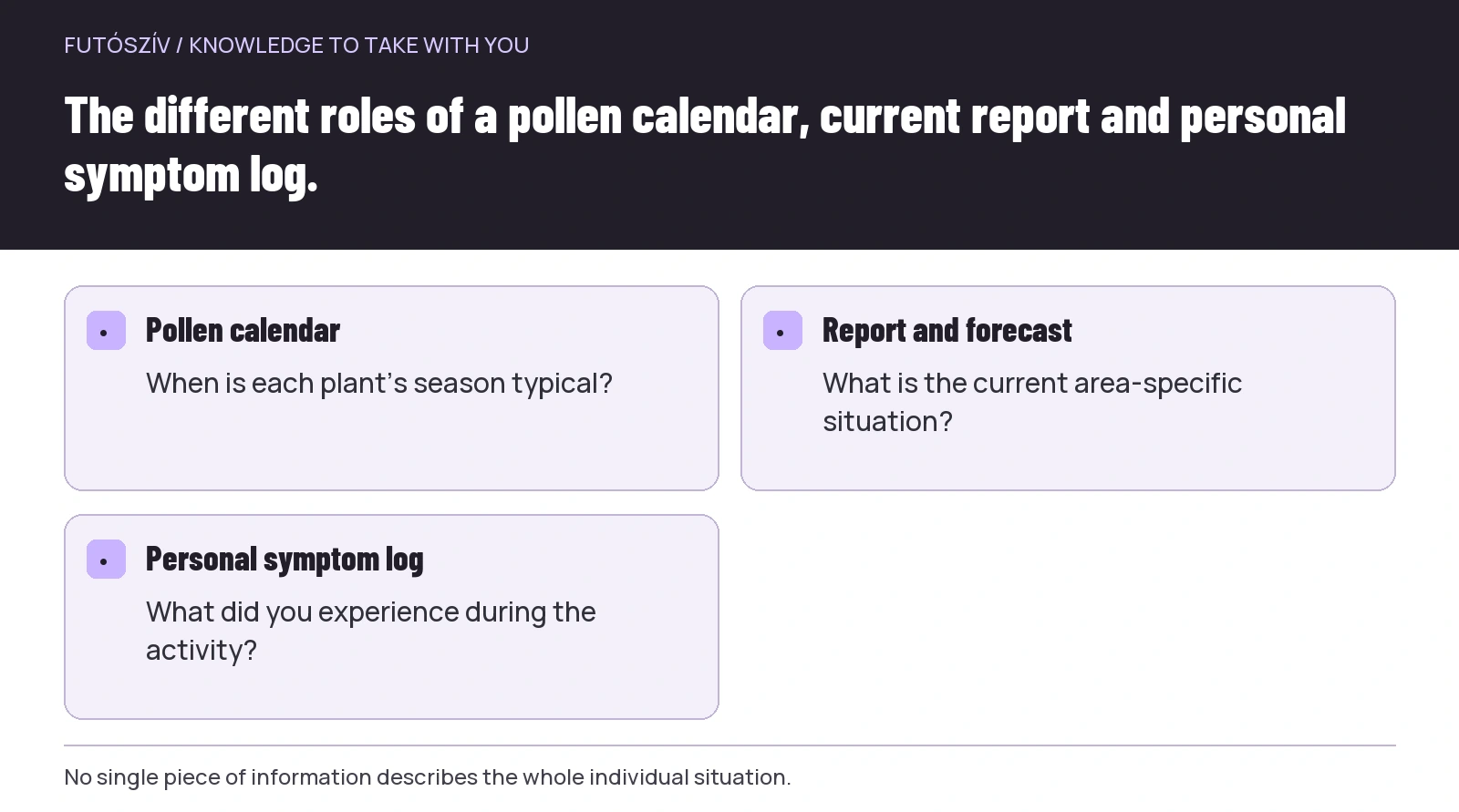
A pollen calendar shows the typical times of year when individual plants release pollen. It is useful background for seasonal planning, not a measurement for your park today. The NNGYK pollen calendar also directs readers separately to information on current and expected pollen conditions. A calendar month alone does not establish exposure on a particular day.
A pollen report and forecast are not exactly the same either. One describes the observed situation, the other the expected development. For both, check the date, area and plant or fungus concerned. The NNGYK pollen-information hub provides several reports and alert systems; do not decide from an old extract left in a search engine.
Your own symptoms are not a monitoring station. They are important signals, but one bad run cannot identify the trigger with certainty. Several environmental factors may coincide, and exertion may have changed too. The three types of information help together: seasonal background, fresh local information and personal experience. None replaces a necessary medical examination.
First know what you are sensitive to
Remembering only that “pollen is high” is insufficient. Different plants may be present at different times, and personal sensitivity varies too. If you have allergy-test results, ask which findings are significant in relation to your symptoms. Reading a test and interpreting the clinical situation are different tasks.
The EAACI position paper on sport discusses targeted investigation of allergic and respiratory symptoms. The paper on allergic and respiratory conditions in athletes is useful background because it does not treat every breathing difficulty during running as one disease. Nasal symptoms, bronchoconstriction and other exertional breathing disorders may coexist but do not automatically follow from one another.
Bring a few typical accounts to your review. For example: worse on a certain route, occurring indoors too, beginning only at the end of running or disturbing you at night. Ask not only whether you can run but also how to recognise worsening that needs treatment. The answer can then connect with your real circumstances.
 Enlarge diagram
Text version of the diagram
- Pollen calendar
- When is each plant’s season typical?
- Report and forecast
- What is the current area-specific situation?
- Personal symptom log
- What did you experience during the activity?
Be cautious about definite promises concerning time of day
It is often said that people with allergies may run only in the morning or only in the evening. Such statements ignore plant species, weather, location and current forecasts. Seek a usable time alongside these factors. Nor is another country’s general seasonal advice a precise weather rule for a Hungarian town.
If you can choose between two periods, examine fresh pollen and weather information and your routine too. A seemingly better time is of little value if you rush out, cannot change clothes after returning or can exercise only beside a busy road. A plan is usable when environmental and everyday conditions both fit together.
Prepare two versions for the same day: a short outdoor session easy to interrupt and an indoor option or one movable to another time. Do not begin searching for a backup in the last minute before running. An unfavourable report then means a planned change within the week rather than the whole day’s failure.
Rain is not a single switch for pollen
The air may seem fresh after a shower, but that does not mean every rainy situation is safe from an allergy perspective. Thunderstorm-related asthma events are a separate phenomenon. According to UKHSA, under certain conditions thunderstorm activity may coincide with increased breathing symptoms and demand for care, with high pollen or spore exposure also potentially involved.
The official thunderstorm-asthma information also notes that the mechanism is not completely understood. Not every thunderstorm causes such an event, and personal risk cannot be calculated merely from the sky’s colour. The practical conclusion is that an approaching storm is not an automatic invitation to a “pollen-free” run.
With thunderstorm risk, consider general weather safety too. Do not head onto a remote, exposed route or one difficult to leave merely because the temperature is finally more pleasant. With asthma or previous symptoms of this kind, ask your clinician separately about weather-related actions. The personal plan should remain understandable in unexpected situations too.
Plan routes with the option to turn back
On a seasonally difficult day, a short loop close to home may be more practical than a long one-way trail run. Consider where you can get home sooner and where help is available if needed. If a section regularly troubles you, choose another route, but do not claim every forest, riverside or urban park is allergen-free.
Avoiding freshly cut grass, immediate vegetation and other irritants may be more comfortable in some situations. You do not have to identify every plant with mapping-level accuracy to be active, however. Use personal symptoms and fresh information to seek a simple, repeatable solution that does not involve deliberately provoking symptoms.
For group training, explain beforehand if you currently need a route that can be shortened. Companions need not see an allergy report to accept the decision. It helps an organiser know, however, if someone may leave early and does not want to be alone. Flexible arrangements support you better than home remedies presented as certain to work.
After returning home: a few simple habits
The NHS hay-fever information mentions showering and changing clothes after being outdoors to remove pollen. Its practical advice also notes that clothes dried outside can collect pollen. Fit these into the day so they are actually achievable rather than becoming an endless cleaning task list.
Keep clean changes of clothing ready and consider where training clothes will go on arrival. If going directly to work or a meeting, include that in preparation before departure too. Even a shorter run can take substantial total time because of travel and changing. You need not omit all activity for this reason, but match the session to the real time available.
Clean glasses, equipment touching your face and caps according to manufacturer instructions. Do not rub itchy eyes forcefully or use someone else’s eye drops or nasal preparation merely because you feel uncomfortable after running. Persistent or unusual eye symptoms may require separate assessment; not every eye problem is an allergy.
 Enlarge diagram
Text version of the diagram
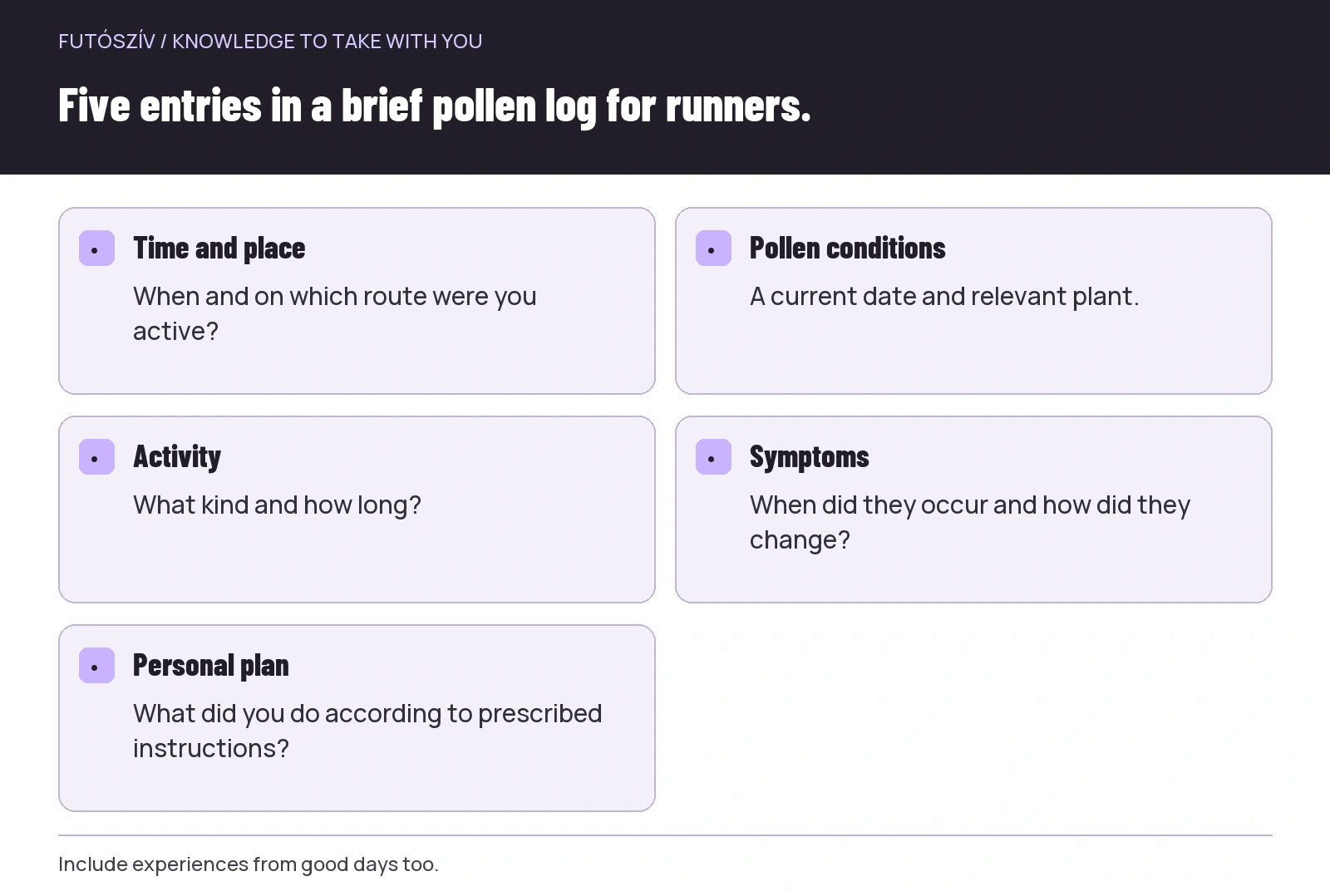
- Time and place
- When and on which route were you active?
- Pollen conditions
- A current date and relevant plant.
- Activity
- What kind and how long?
- Symptoms
- When did they occur and how did they change?
- Personal plan
- What did you do according to prescribed instructions?
Medication questions can be clarified before the season too
If symptoms worsen at a similar time every year, do not start looking for a solution in the hardest week. Discuss your personal plan, device use and timing of reviews with a doctor or pharmacist beforehand. The aim is not to independently increase doses or combine several preparations with similar effects for running.
The NHS warns that some antihistamines can cause drowsiness. For runners, this is also a practical issue for travel, route choices and equipment use. Ask the pharmacist what to expect from the particular medicine and read the patient leaflet. Do not try a new approach without discussion before an important race or a long journey involving driving.
If symptoms do not improve despite pharmacy advice and treatment, or health worsens, medical consultation is appropriate. A specialist decides on the possibility and suitability of immunotherapy; it is not an intervention for the few days before a race. A longer-term plan aims to make the whole season more manageable, not suppress symptoms at any cost for a single start.
Three running situations, three different decisions
Familiar, mild nasal symptoms on an easy day. First check current conditions and your own treatment instructions. A short, easy outing that can be shortened may fit, but do not judge your own condition from a friend’s symptoms. Whether you can move comfortably and finish early matters in the decision. A higher pace does not make the session compulsory.
New coughing or wheezing while running. Do not automatically classify this as usual hay fever. Stop that exertion and seek assessment; with known asthma, follow your action plan. Severe or rapidly worsening breathing difficulty needs urgent help; in Hungary, call 112. A runny nose does not prove lower-airway symptoms are harmless too.
Race day with unfavourable conditions. An entry fee is not a health consideration. Examine the start, route and withdrawal options, but also accept not starting if your personal plan indicates this. The organiser’s medical service does not replace prior care, and carrying medication does not provide unlimited exercise capacity.
Five details can make a useful pollen log
Record the day and location, relevant pollen report, type of activity, symptoms and observations relating to prescribed treatment. You need not record every breath or every environmental variable. A log helps when you can maintain it briefly and later show it to your clinician.
Describe better days too. If only unpleasant sessions remain in notes, the picture of the season can easily become too narrow. Mark route, time-of-day or session-length changes separately, because changing them together makes comparison harder. Observation is not a home clinical trial: it may show associations but does not prove a definite cause.
When planning the next week, choose one reasonable step from this information. It may be booking a review earlier, exploring a closer running loop or organising an indoor backup session. Adapting running to the season is not giving up activity. It creates an environment in which your daily condition and agreed actions actually matter.
Sources
- NNGYK: Pollen information
- NNGYK: Pollen calendar
- NHS: Hay fever
- EAACI: Diagnosis and management of allergy and respiratory disorders in sport
- UKHSA: Thunderstorm asthma
- Egészségvonal: Pollen allergy, hay fever
How Futószív articles are prepared: our editorial guidelines.