Knowing your cycle helps, but a calendar need not train on your behalf
Some runners experience strong cramps, fatigue or other troublesome symptoms around menstruation. Others notice little change, and even the same person may not experience every month identically. Personal experience matters; a universal training calendar based on an uncertain estimated cycle phase makes a much stronger claim.
The 2025 UEFA consensus states that the relationship between cycle phase, performance and injury risk does not currently support simple general rules. Tracking can nevertheless make sense to support health, symptom management and autonomous decisions. The document was developed for football; even its principles should not be transferred unthinkingly between sports.
As a runner, a useful aim is recognising your own changes and choosing adjustments that actually help. You need not assume yourself weaker in advance on an app’s coloured days. Nor do you have to tolerate a symptom requiring medical help as simply part of the cycle.
Three different kinds of information often confused
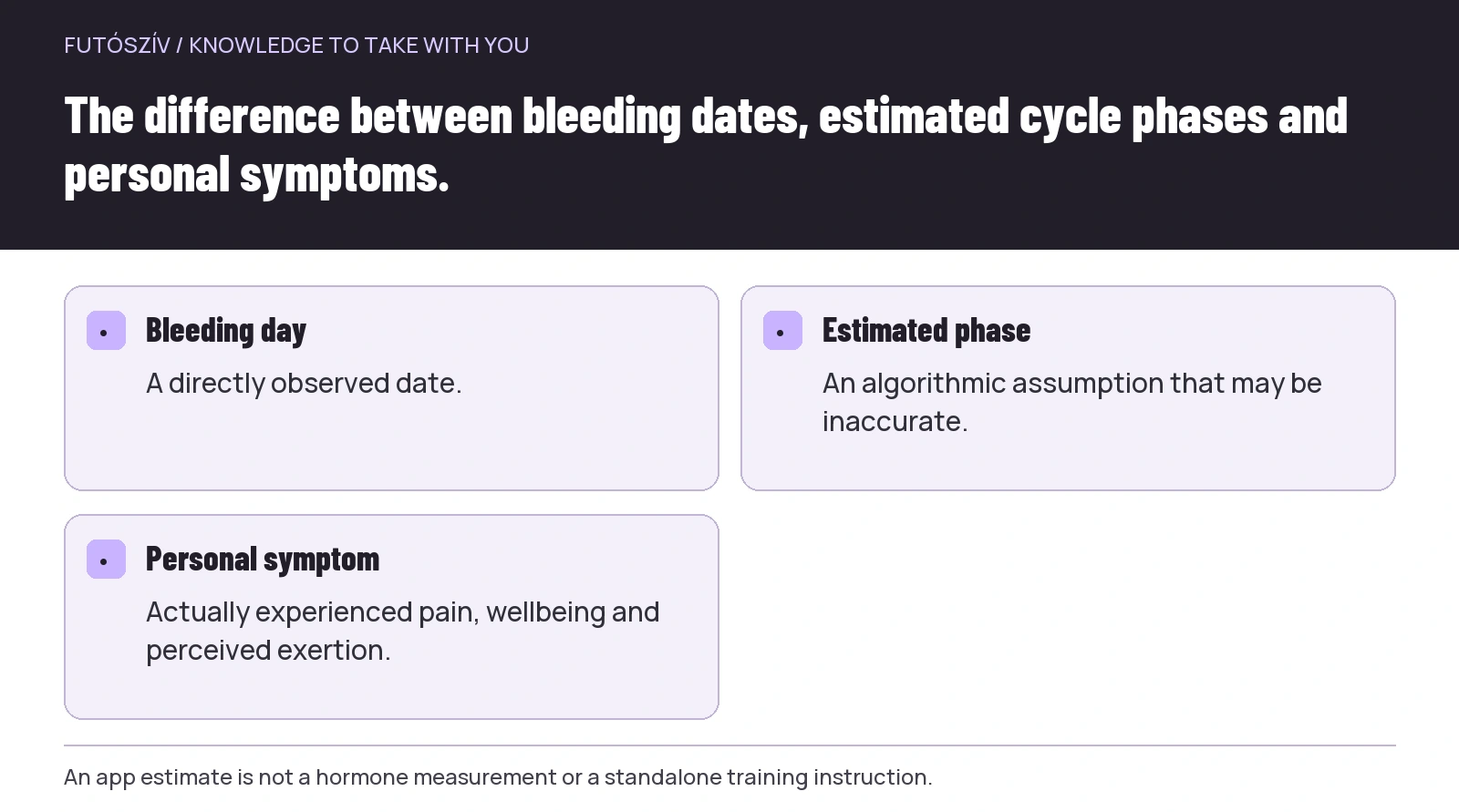
The timing of bleeding is something you can directly observe and record. Cycle phase is a physiological state whose precise determination in research may require several checks. Symptoms and perceived exertion are your own experience: pain, wellbeing, sleep or how difficult training feels. These three pieces of information may relate, but are not the same.
An app may estimate the next date and phase from previous bleeding. An estimate is not a measurement of hormonal status. The 2025 consensus on elite athletic performance does not recommend training, performance or nutrition decisions based on phase estimates from current cycle-tracking apps.
You can still use a simple diary or app as a reminder. The key is knowing which part is direct observation and which is an algorithmic estimate. If the app says you should have a bad day but you feel well, do not treat the display as a proven limitation. If you have strong symptoms, a favourable colour does not override them either.
What do two studies of particular interest to runners show?
The 2024 FENDURA project study compared several performance-determining variables across cycle phases in endurance athletes. At group level, it found no clear phase-specific pattern from which the same good or bad day could be assigned to every athlete. This was not a test of the reality of personal symptoms and does not make a general statement about every gynaecological condition.
In another running-training experiment from 2024 thirty-three moderately trained participants with natural cycles were assigned to two groups; twenty-six completed the eight-week programme. With equal training load, hard and easy sessions were timed differently relative to the cycle. At group level, the cycle-adapted version provided no additional benefit in measured endurance and cardiovascular outcomes.
Small samples, participant selection, phase determination and study duration limit generalisation. These studies do not mean that the cycle matters to nobody. They mean that a performance advantage from rigid phase calendars must not be sold as established fact, and your own symptoms may require a different kind of individual assessment.
 Enlarge diagram
Text version of the diagram
- Bleeding day
- A directly observed date.
- Estimated phase
- An algorithmic assumption that may be inaccurate.
- Personal symptom
- Actually experienced pain, wellbeing and perceived exertion.
A useful diary: brief, followable and made for your purpose
A starting point may be the bleeding day, the most troublesome symptom, a brief assessment of sleep and the reason for changing training. If cramps made you shorten a session, write that rather than bad hormone phase. Later, you will know whether the entry concerned direct experience or an assumed explanation.
A symptom-free day is useful information too. Recording only difficult days can make it seem that every particular cycle stage is necessarily problematic. Note important circumstances too: illness, travel, unusual heat or changed training load. Not every factor needs tracing to one hormonal cause.
Observing several cycles may reveal a recurring pattern, but you do not have to wait that long before seeking medical help. For strong pain, highly troublesome bleeding or significant change, the symptom matters more than a complete dataset. A diary supports assessment; it is not an admission ticket without which help is unavailable.
Two runners, two workable adjustments
The first runner regularly has cramps on the first day of menstruation but tolerates exercise well on other days. They can leave flexibility in the week to move a hard session or choose easy movement if needed. The plan responds to a recurring personal symptom, rather than asserting that everyone who menstruates necessarily performs poorly at that time.
The second runner mostly feels well despite the app’s indication and finds no consistent relationship between estimated phase and training. They need not disrupt a successful programme purely for the calendar. They can continue monitoring their condition and adjust when an actual reason appears.
Both may benefit from an alternative agreed beforehand: what happens if symptoms are strong in the morning, and what happens if not. Flexibility does not mean unlimited catch-up. Moving a hard session should not create two unnecessarily difficult consecutive days merely to retain every original task.
Menstrual symptoms are not a personality trait
The NHS information on period problems discusses pain, heavy bleeding and premenstrual symptoms, among other matters. Symptoms can differ in type and severity. If a symptom disrupts everyday life or sport, individual advice has a place; you do not simply need to learn a better attitude.
A shorter route adjusted for mild discomfort is different from pain regularly causing absence from work or school. The latter does not become normal because everyone in the family previously experienced it. Assessment aims to clarify causes and treatment options, not question your right to participate in sport.
Do not choose or alter medication or hormonal methods from a training-phase chart. Pain management, contraception, influencing bleeding and a sports programme may relate, but health decisions must follow individual circumstances. A running coach’s role differs from a gynaecologist’s or GP’s.
Missing periods: do not automatically celebrate them as a sign of fitness
The NHS page on missed or late periods lists several possible causes, including pregnancy, stress, life circumstances and hormonal changes, and substantial exercise demands. Running mileage cannot establish the cause reliably. Bleeding patterns also need different interpretation with hormonal contraception.
Seek medical assessment for new irregularity, consecutive missed periods or a change accompanied by other symptoms. If pregnancy is possible, clarify that appropriately too. Do not assume that running a lot means you cannot be pregnant or that absent bleeding is merely a convenient athletic characteristic.
Energy availability and bone health may also arise during an athlete’s assessment, but missing bleeding alone does not establish a REDs diagnosis. Sharing the full history and obtaining professional assessment is the appropriate step. Describing training load and eating habits helps; self-blame does not.
 Enlarge diagram
Text version of the diagram
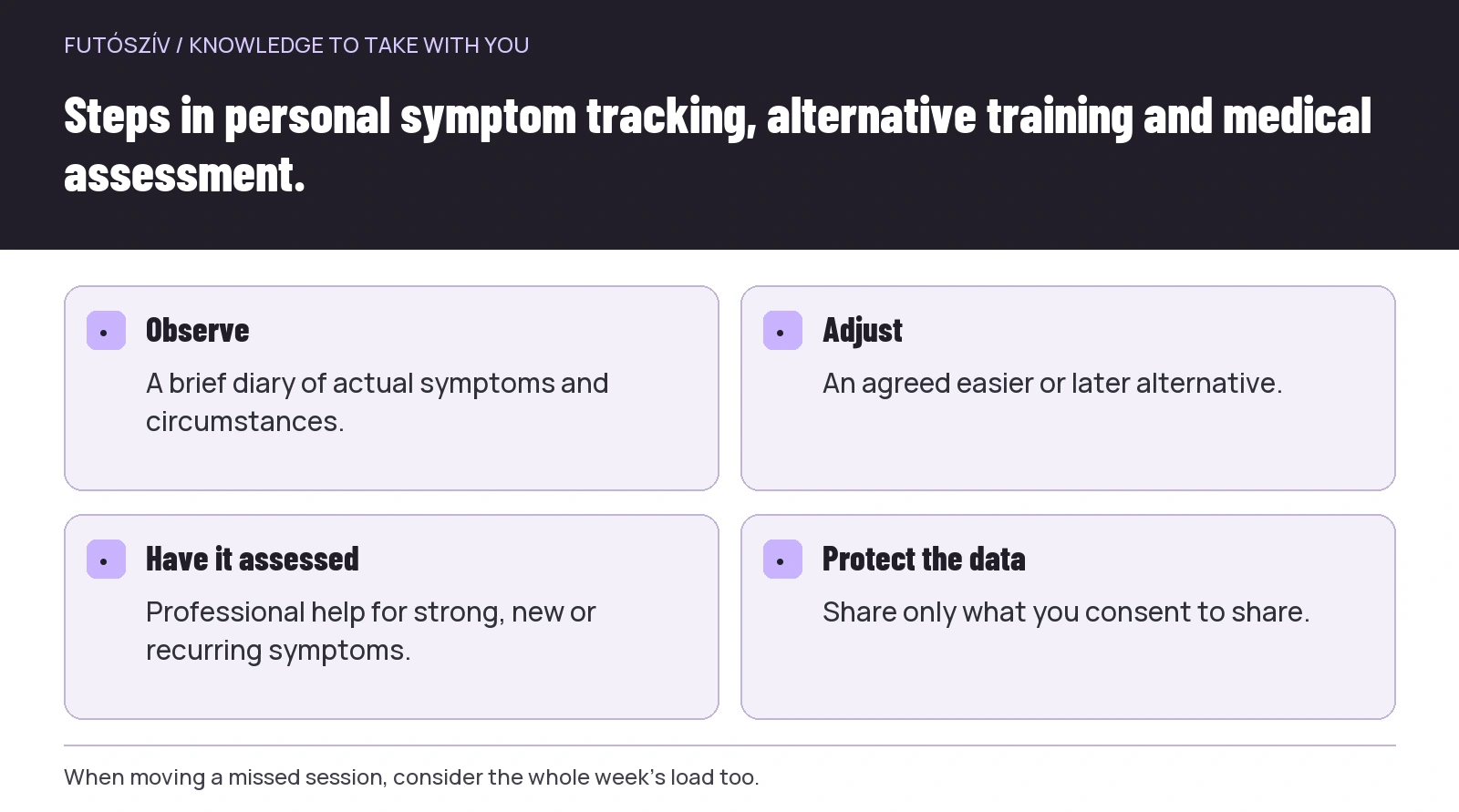
- Observe
- A brief diary of actual symptoms and circumstances.
- Adjust
- An agreed easier or later alternative.
- Have it assessed
- Professional help for strong, new or recurring symptoms.
- Protect the data
- Share only what you consent to share.
Race weekend: logistics can support performance too
Checking toilets, changing facilities and access to menstrual products you have already tried can help. Follow instructions for the chosen product. Do not time the first trial of a new product for the minutes before the start, or depart from safe-use conditions because of race duration.
You can choose comfortable clothing and spare supplies without turning this into a secret, complicated project. If anxiety about bleeding is substantial, simply having a trusted companion know where your bag is may help. You need not share intimate details with the entire running group.
With severe illness, fainting, unusually severe abdominal pain or another sudden deterioration, do not automatically interpret the situation as menstrual symptoms. Seek appropriate healthcare help. Knowing the cycle day before the race does not explain every new symptom.
Privacy: a cycle diary is your health information
The UEFA consensus also values athlete autonomy and appropriate data handling in tracking. As a recreational runner, you too can ask why data is requested, who sees it, where it is stored and whether equal support is available with fewer details shared. Uploading an entire diary is not necessarily a condition of working with a coach.
With a coach, information relevant to practical functioning is often enough: you want to shorten today because of strong symptoms, or request more flexible scheduling on certain days. Detailed quantitative bleeding and gynaecological information may belong in a healthcare consultation. The two conversations can be coordinated without everyone accessing everything.
If tracking creates anxiety or constant predictions of performance, you can simplify it. A paper calendar, a few data points or periodic review may suffice for your purpose. Running becomes informed not through the quantity of data, but through appropriate decisions based on important changes.
How to build a flexible week without a phase template
- Name the week’s main aim: developmental training, consistency or recovery.
- Have a manageable easier version if genuinely troublesome symptoms arise.
- Consider rescheduling alongside the entire week’s load, not simply as catch-up.
- Address the medical question of recurring, strong or new symptoms alongside organising training.
- Use only as much tracking as helps decisions and feels acceptable to you.
Cycle knowledge can be a useful part of self-understanding and monitoring health. It does not require dividing every month into four phases promising reliably predictable sporting performance. Personal symptoms, actual circumstances and appropriate professional help together provide a steadier basis for a running life you can follow.
Sources and further reading
- UEFA consensus statement on menstrual cycle tracking in women’s football, 2025
- Consensus Statements—Optimizing Performance of the Elite Athlete, 2025
- FENDURA: Menstrual Cycle Phase Has No Influence on Performance-Determining Variables, 2024
- Kubica and colleagues: Polarized running training adapted to versus contrary to the menstrual cycle phases, 2024
- NHS: Period problems
- NHS: Missed or late periods
How Futószív articles are prepared: our editorial guidelines.