
If you leak urine while running after childbirth, dark trousers, a pad and a route planned around toilets can seem like quick solutions. They may help with immediate comfort, but they do not explain the cause or how to address it. Urinary leakage is not a compulsory price of motherhood or running. Seeking help is worthwhile even if the amount is small or it happens only occasionally.
The aim is not to make you fear movement because of every minor sensation. Instead, gain a clearer understanding of the situation, allow room for assessment and obtain a plan suited to the symptom. Your postpartum condition, healing and running workload all matter; an online exercise routine cannot automatically assess them.
Start by describing when it happens
Leakage linked to coughing, jumping or running steps is a different pattern from not reaching a toilet after a sudden, strong urge to urinate. The NICE guideline treats distinguishing stress, urgency and mixed incontinence as part of the initial assessment. Here, stress incontinence refers to physical pressure or exertion, rather than meaning that nervousness simply causes the symptom.
You do not have to arrive at the appointment with a definite diagnosis. A few situations are enough: it happens with the first jogging step, towards the end of a run, when sneezing too, or with a strong urge even before leaving. Explain if the pattern varies. Variability does not make the symptom less real.
Consider when it began, whether it changed over time and whether anything similar happened before childbirth. Birth type, known perineal injury, surgery and other symptoms are also important background. They help the assessment, but no single detail provides the whole explanation on its own.
Small amounts of leakage matter too
Discuss the impact on quality of life as well as the amount. Do you choose different routes because of it? Avoid running with others? Avoid drinking, speeding up or laughing? These are not peripheral details. The NIDDK considers urinary leakage and other bladder problems symptoms worth discussing with a healthcare professional.
You do not need to wait until the problem becomes regular or involves an obviously large amount. An early conversation can clarify which assessment is needed and what to watch for meanwhile. Using a pad does not prevent seeking help, but it is not proof that the issue is resolved either.
If you were previously told that it happens to everyone, you can ask for a more precise answer. Being common is not the same as not needing care. Your goal can be simple: comfortable movement and a more predictable everyday situation.
What might happen at the first assessment?
The NIDDK information on diagnosis describes discussing medical history and symptoms, a physical examination and further tests as needed. A urine test or bladder diary may help the assessment. Not everyone needs the same set of investigations, and one symptom during sport does not automatically mean an immediate series of complex tests.
Bring a medication list and write down questions that might otherwise be missed at the appointment. Also report difficulty urinating, pain, vaginal pressure or bowel-control symptoms. Do not restrict the conversation to leakage during running if you have noticed other changes.
You can ask about the examination in advance, and your consent matters. If a previous birth experience makes you apprehensive, say so. You can request an explanation, a break or more time. Safe, understandable communication is part of an accurate assessment.
 Enlarge diagram
Text version of the illustration
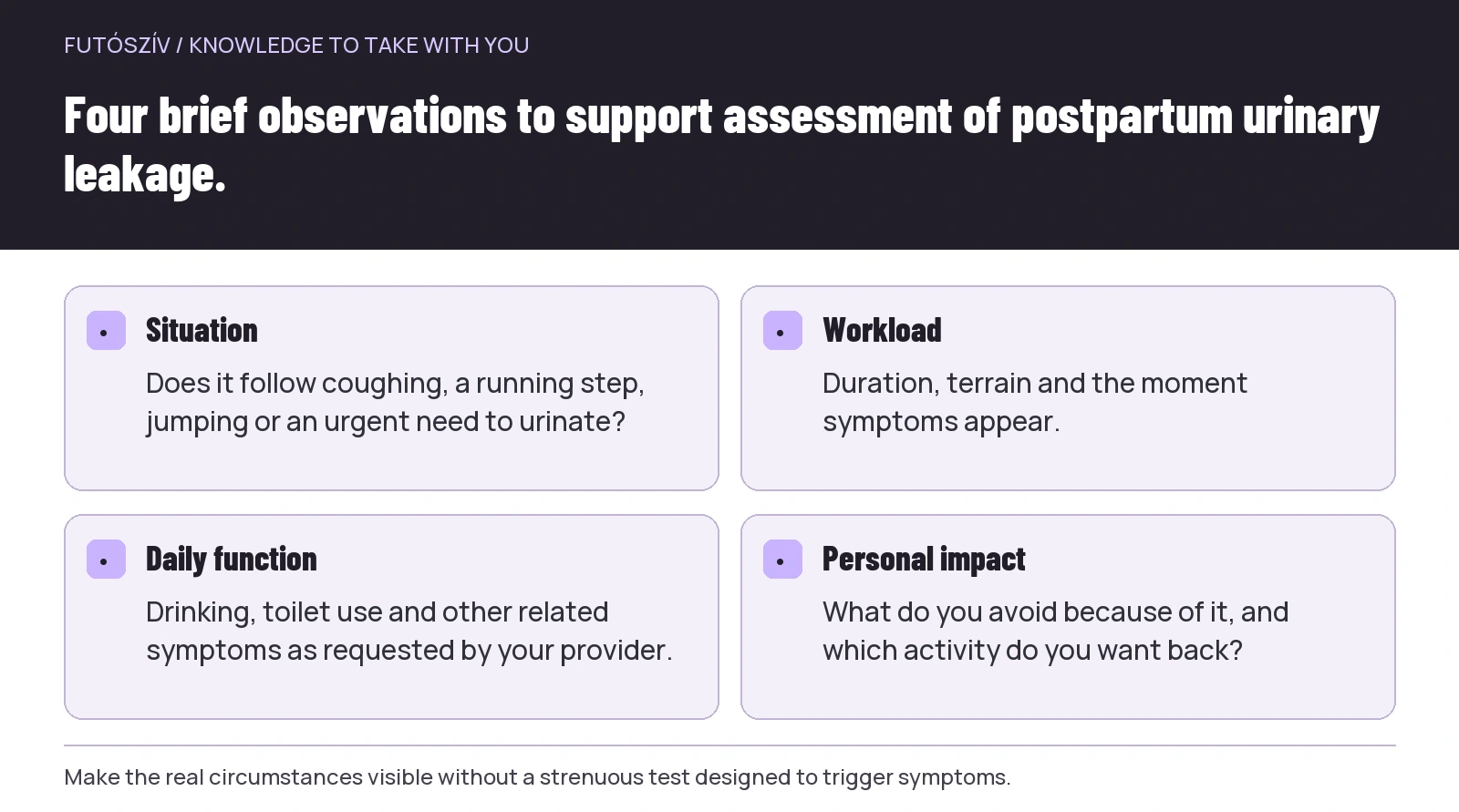
- Situation
- Does it follow coughing, a running step, jumping or an urgent need to urinate?
- Workload
- Duration, terrain and the moment symptoms appear.
- Daily function
- Drinking, toilet use and other related symptoms as requested by your provider.
- Personal impact
- What do you avoid because of it, and which activity do you want back?
How can a bladder diary be useful?
A diary is not intended to keep your attention on your bladder all day. Record drinks, urination times, urgency and leakage situations for the period and in the manner requested by your provider. The NICE guideline recommends a bladder diary as one assessment tool. Ask exactly what information is wanted so that you do not carry out unnecessary self-monitoring.
As a runner, you can add the type of session: walk-jog, continuous easy running, an incline or another workload. Alongside kilometres, duration and the circumstances in which symptoms appear are useful. There is no need to trigger leakage through harder training merely to put it on the sheet.
Try to show an ordinary day in the diary. Drastically reducing drinking or searching for toilets all day for the sake of the record creates a different situation. The aim is to understand actual functioning better, rather than produce a flawless dataset.
Pelvic-floor training is more than a few squeezes
The NICE guideline recommends at least three months of supervised pelvic-floor muscle training as a first-line option for stress or mixed incontinence. Checking technique is part of the process. This does not mean independently repeating an arbitrary task for three months without assessment, or guarantee freedom from symptoms by then.
A professional can help you understand how you contract and relax the muscles, which task matches your current ability and how it relates to everyday movement. If you are unsure what you should feel, ask for feedback. Do not try to compensate for painful or uncertain technique with more repetitions.
Discuss how the training’s results will be assessed too. A change might mean less frequent leakage, a smaller impact on daily life or better tolerance of a previously avoided task. If there is no improvement, a lack of willpower is not the automatic explanation; the plan and diagnosis can be reassessed.
What can a biofeedback device do, and what can it not do?
In a 2024 randomised trial involving 452 participants with postpartum stress incontinence, supervised training supplemented with pressure-based home biofeedback produced better symptom outcomes over three months than the training alone. The finding applies to a specific care system and way of using the device.
It does not establish that every device sold in shops is necessary for everyone or equally effective. Products with similar names can function differently and provide different feedback. Before buying, clarify which question the device would answer, whether you can use it appropriately and how its effect would be monitored.
The device does not replace assessment of the symptom’s cause, and a higher displayed value is not automatic clearance to run. If use is uncomfortable, painful or unclear, seek help. Technology is useful when it fits the individual’s treatment goal.
Withholding fluids is not a good sporting strategy
Fear of leakage can make it tempting to drink very little all morning before setting off for a run. The NIDDK treatment information includes an individual review of fluid intake among possible steps. The solution is not generally to drink as little as possible; a plan appropriate to your condition and circumstances is needed.
Tell the professional how much you usually drink and when, whether you are breastfeeding, the weather conditions in which you exercise and any other medical instructions. The role of caffeine or other habits can also be assessed specifically. You do not need to eliminate every food and drink at once on the basis of a general prohibited list.
Likewise, repeated ‘just in case’ toilet visits before every run are not necessary. If you are uncertain about urgency and urination, clarify this within your individual plan. The aim is more predictable function, rather than a new ritual dominating the half-hour before running.
 Enlarge diagram
Text version of the illustration
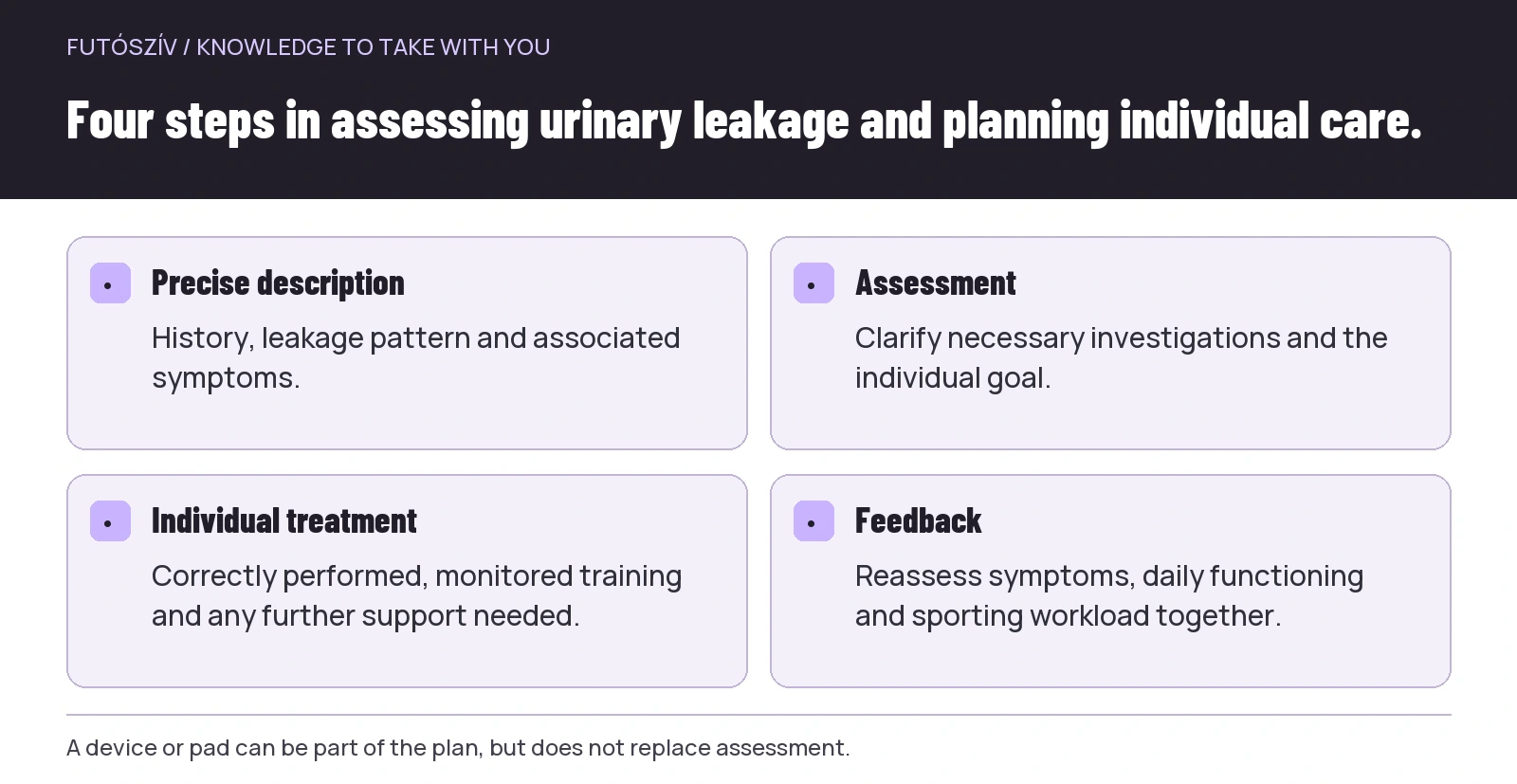
- Precise description
- History, leakage pattern and associated symptoms.
- Assessment
- Clarify necessary investigations and the individual goal.
- Individual treatment
- Correctly performed, monitored training and any further support needed.
- Feedback
- Reassess symptoms, daily functioning and sporting workload together.
Activity demands can be adjusted meaningfully too
There are more than two options when symptoms occur: continuing to run unchanged or stopping all movement. Depending on the individual situation, a shorter session, easier terrain, alternating walking and jogging or temporarily choosing another activity may be considered. Choose the appropriate direction based on assessment findings and symptoms.
Where possible, change one factor at a time so the response can be followed. If you shorten the run, change your fluids, start using a device and try a faster pace all at once, the result becomes difficult to interpret. Useful observation begins with a simpler situation.
Leakage is a signal to discuss the plan, not an assignment to prove your tolerance. Do not keep running until it definitely happens. Notice your condition afterwards too, and report any new symptoms in other daily tasks following the run.
Practical protection has a place in the plan
Suitable absorbent protection or a change of clothes may temporarily reduce anxiety while you address the cause and treatment. There is no need for shame. However, do not let the symptom’s impact disappear from the conversation simply because clothing conceals its consequences.
You can make a simple arrangement with a running partner: for now, you need a shorter loop that can be cut short. You do not owe everyone medical details. Asking for conditions that make shared movement more comfortable is enough. A partner’s support should not consist of calling the symptom common or insignificant.
If you are preparing for a race, toilets and opportunities to turn back are practical considerations, but the start date should not dictate the pace of treatment. Changing an entry or choosing a later goal is a genuine option. Sustainable running means more than completing one event that feels compulsory.
When should you seek prompt help rather than wait with routine training?
The NIDDK recommends prompt healthcare assessment if you cannot urinate or empty your bladder, see blood in the urine or have symptoms suggesting infection. Do not automatically attribute such changes to childbirth or running. Previously known incontinence does not explain every new symptom.
The NHS lists urinary-tract infection symptoms including burning when urinating, urgency, lower abdominal pain or back pain under the ribs, and fever. Seek urgent medical help with fever, chills, pain around the kidneys or a worsening condition. Do not try to deal with the symptom simply by missing one run and choosing a product at random.
Mention other problems accompanying leakage too: pain, persistent pressure, or difficulty controlling stool or wind may require separate attention. The fuller the picture your provider receives, the more useful the treatment plan can be.
What is the next concrete step?
Book an appropriate healthcare consultation and bring a brief description of the situation. Choose a personal goal: comfortable walking, less leakage during everyday movement or, later, a short run. Ask which assessment is needed, how results will be followed and whom you can contact if symptoms change.
Talking about urinary leakage does not have to dominate all your running plans. It can have a place in your life as a health issue that can be named and addressed. Accurate assessment, individual training and flexible activity demands together offer more support than hoping for dry trousers before every session.
Sources
- NICE NG123: Urinary incontinence and pelvic organ prolapse in women – management
- NIDDK: Diagnosis of Bladder Control Problems
- NIDDK: Treatments for Bladder Control Problems
- NIDDK: Symptoms and Causes of Bladder Control Problems
- Wang and colleagues: Pressure-Mediated Biofeedback With Pelvic Floor Muscle Training for Urinary Incontinence, randomized clinical trial, 2024
- NHS: Urinary tract infections
How Futószív articles are prepared: our editorial guidelines.