Movement’s purpose may change in the first weeks
After birth, getting up briefly, a comfortable walk around the home or a few individually recommended exercises can each be a movement task in its own right. Previous running happened under different circumstances. Healing, newborn care, sleep and a new daily rhythm together determine what fits now.
The 2025 Canadian postpartum movement guideline supports early light-intensity mobilisation and gradual progression adjusted to condition. Wound healing and symptoms matter when moving towards greater intensity. This does not make the first hospital-corridor walk the beginning of running preparation.
This guide concerns manageable organisation of the early period, not a precise running restart date. Birth mode, complications and personal condition may require individual advice. You need not complete another mother’s timeline to recover appropriately.
Discharge guidance should provide the first movement framework
Before reaching for an old training plan, review instructions for getting up, walking, lifting, wound care and follow-up. Ask for clarification if unclear. Take care and move can coexist in one situation, but you need to understand their practical meaning for you.
The NHS information on the early days also discusses postnatal care and gentle movement. Uncomplicated recovery and recovery involving procedures or illness may differ. Do not apply general advice instead of individual instructions.
Ask which movement is permitted now, what temporarily to avoid and which signs require earlier contact. Answers can form a simple daily plan. You need not decide the entire coming year’s sport on returning home.
Daily tasks can be demanding too
Feeding, changing nappies, getting up, stairs, bathing and carrying the baby all belong to the day. While adapting to these, more organised exercise may not be the most important new task. First examine whether everyday movement is comfortable with appropriate help.
Keep frequently used items within reach and reduce unnecessary carrying where possible. Request specific family help: preparing food, shopping, tasks for an older child or some household work. Support need not consist only of someone telling you to rest more.
If a movement consistently causes pain or uncertainty, tell postnatal care. Every daily task need not become a strengthening exercise. Appropriate technique advice and reducing demands support functioning rather than setting another achievement target.
 Enlarge diagram
Text version of the diagram
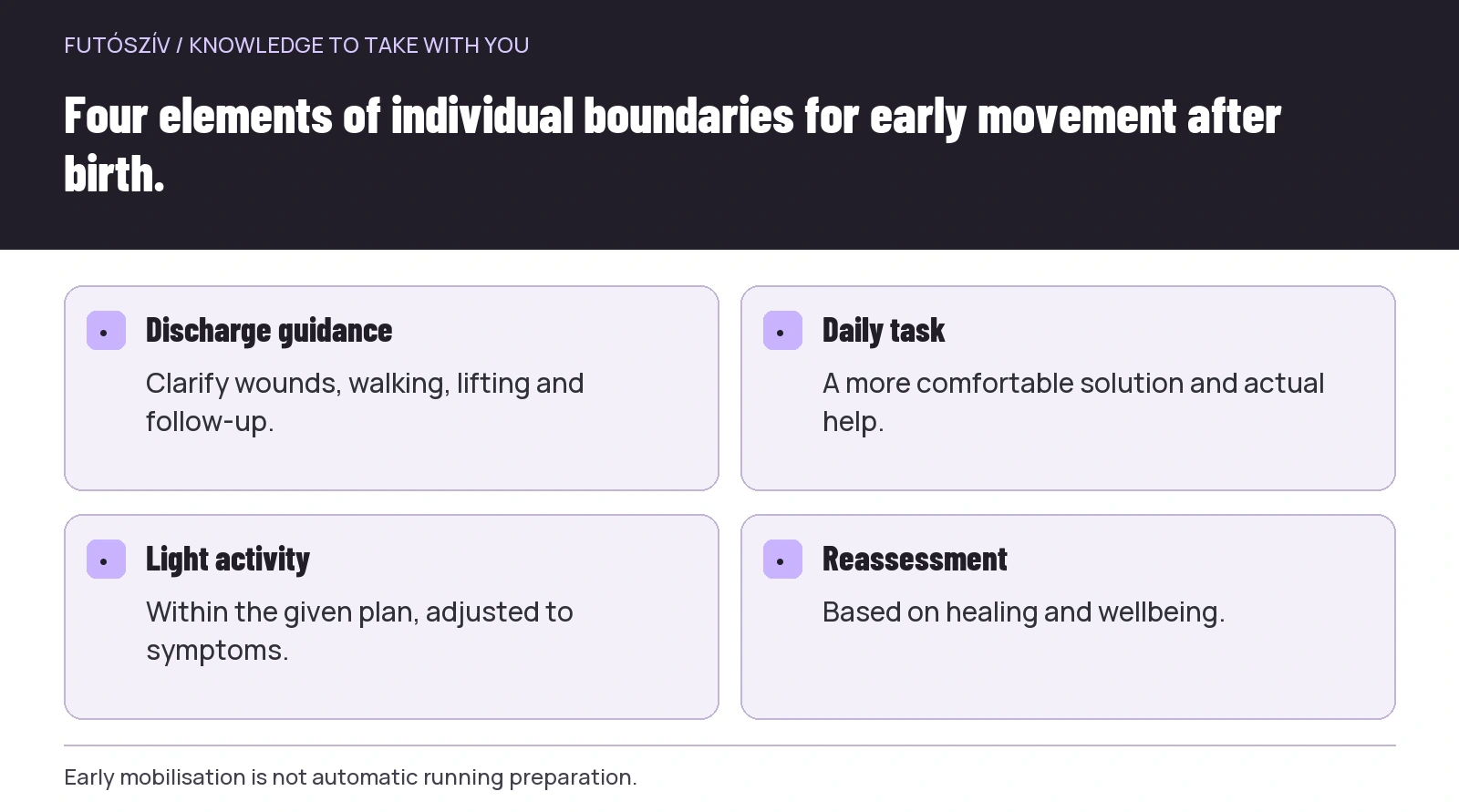
- Discharge guidance
- Clarify wounds, walking, lifting and follow-up.
- Daily task
- A more comfortable solution and actual help.
- Light activity
- Within the given plan, adjusted to symptoms.
- Reassessment
- Based on healing and wellbeing.
There are several steps between light activity and running
Early mobilisation may mean comfortable getting up and brief walking according to the plan. Later steps may include walking, individually appropriate exercises and eventually other movement. Running’s repeated greater loading means it does not automatically follow every symptom-free step.
The Canadian guideline emphasises gradual, symptom-based progression. Weekly recommended activity need not be achieved at any cost in the first days. Individual health barriers, healing and feasibility influence pace.
A comfortable short outing today need not automatically double tomorrow. Notice later wellbeing and symptoms too. Gradual progress allows repetition, slowing down or a day where everyday care and rest are the main tasks.
Bleeding, wounds and pain: why does change matter?
The NHS page on bodily changes after birth discusses postnatal bleeding and wound questions. Follow guidance for your birth to recognise expected patterns and changes to report. Do not compare every detail with others’ pictures or stories.
If activity increases bleeding or pain or creates wound symptoms, stop and seek advice. This does not necessarily establish the cause but provides important feedback. Repeating the longer walk or session is not an appropriate home investigation.
Fever, foul-smelling discharge, worsening wounds or substantial general illness require medical assessment. Do not automatically call symptoms part of post-birth fatigue. A scheduled follow-up is not a compulsory waiting deadline if important changes appear earlier.
Pelvic floor and abdominal wall: appropriate tasks matter more than many repetitions
The information accompanying the CSEP guideline highlights pelvic floor muscle training and appropriate technique. You need not collect as many exercises as possible early on. If unsure what to do or a task hurts, request appropriate professional feedback.
Birth circumstances, perineal or surgical wound condition and current symptoms may affect the plan. A general abdominal video does not account for all of this. Report urine loss, bowel or wind-control difficulty, pressure or pain; you need not first spend months trying to strengthen independently.
Abdominal-wall appearance is not a complete functional assessment. Movement, response to loading and health assessment may matter for later sport too. Do not tie your whole return’s success to a photograph or finger-measured gap.
Rest often requires organised help from others
With a newborn, uninterrupted sleep is not always simply a decision. Just sleep more offers little without opportunity. Discuss who undertakes which task and when you can actually gain relief instead.
A brief window suitable for movement need not be spent training. Food, washing, sleep or quiet sitting may help more today. Sport must not become another area of perceived shortfall at day’s end.
A training-plan creator needs real opportunities too. Do not begin with a week in which every feeding, sleep period and help arrangement is predictable on paper. A followable programme must tolerate reorganisation without constant catch-up pressure.
Food and fluids: regaining a previous body should not be the main task
Alongside recovery and baby care, regularly accessible food and drink provide practical support. Prepared meals, easy-to-eat ingredients and shopping help can matter greatly. Health condition, breastfeeding and other factors influence precise needs; ask for dietetic or medical advice on personal questions.
Do not automatically begin dieting alongside increasing sport in the early weeks. Appearance does not determine appropriate recovery. Returning goals can concern functioning and wellbeing rather than only weight or clothing size.
Report substantial difficulty eating, unusual weakness, persistent dizziness or other symptoms in care. Do not automatically explain them as life with every newborn. Distinguishing usual fatigue from a health symptom needing assessment may require individual consideration.
 Enlarge diagram
Text version of the diagram
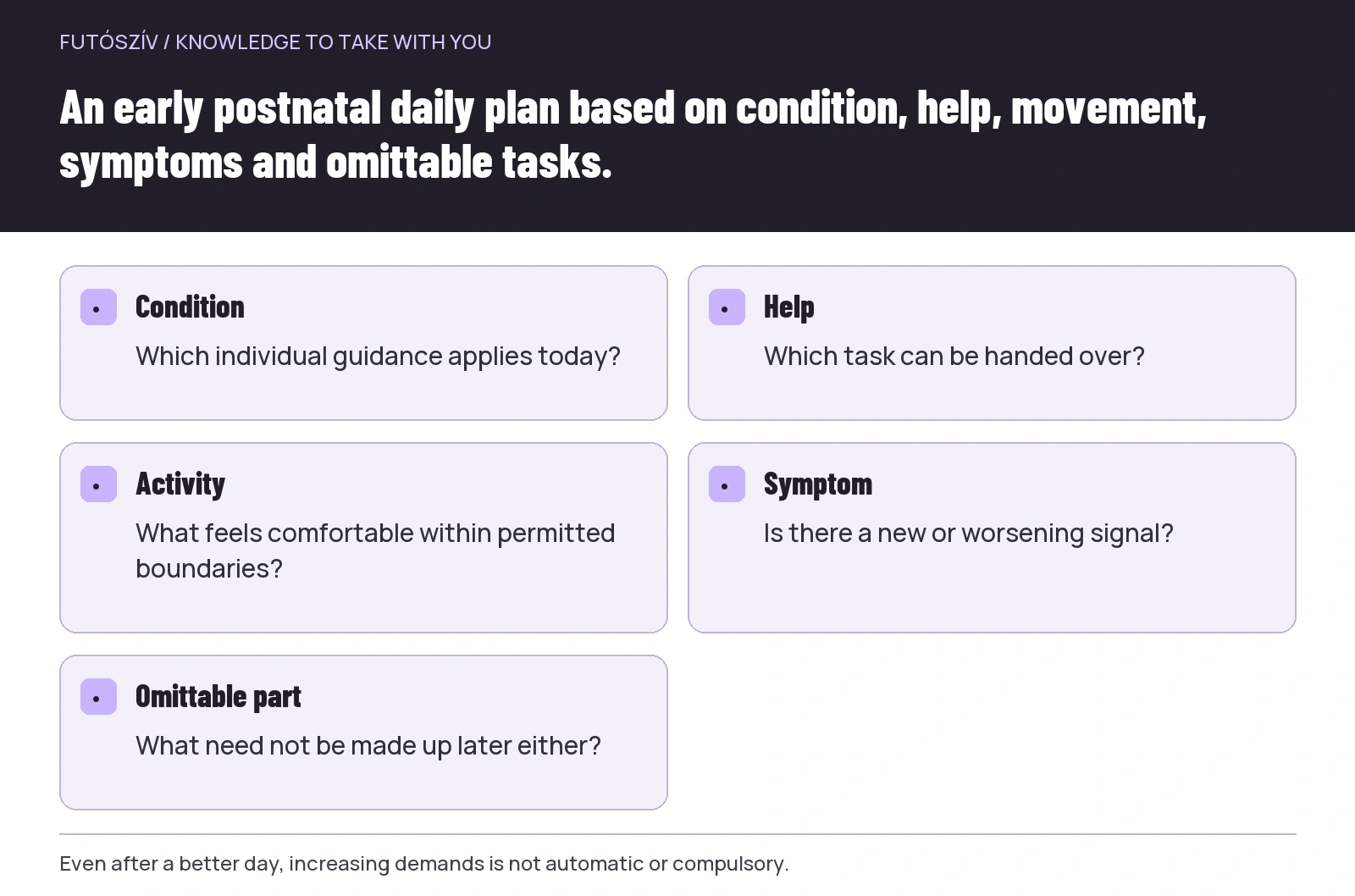
- Condition
- Which individual guidance applies today?
- Help
- Which task can be handed over?
- Activity
- What feels comfortable within permitted boundaries?
- Symptom
- Is there a new or worsening signal?
- Omittable part
- What need not be made up later either?
Enjoyment and ambivalence can both fit
You may miss running while not wanting to set off at all. Time with the baby may bring joy while lack of personal time feels difficult. These feelings do not invalidate one another. Every day need not be described with a single mood.
If anxiety, low mood or another emotional symptom persistently affects functioning, seek help through postnatal care or a mental healthcare professional. Running can support you but does not replace necessary care. You need not resolve it alone even if sport previously managed stress well.
Rapid returns on social media omit many important circumstances. Birth mode, support, pain and sleep may not appear in the image. Do not measure your pace against a brief video or conceal every symptom for a successful comeback story.
Urgent maternal warning signs can occur after birth too
The CDC HEAR HER campaign warns that serious pregnancy-related problems can occur after birth too. Chest pain, difficulty breathing, fainting, severe or worsening headache, visual changes, severe abdominal pain and heavy bleeding may require prompt care. Clarify the full list and personal actions within care too.
With one-sided leg swelling or pain, fever, severe illness or another concerning change, do not try treating yourself merely by missing the next session. Severe condition requires urgent help. Explain that you recently gave birth even if symptoms do not initially seem gynaecological.
If you seek help and still feel inadequately cared for, report symptom severity and the birth date again. People around you can support baby supervision, reaching care and explaining the history precisely. Maternal health cannot wait merely because daily tasks are numerous.
A brief daily plan that is not a comeback challenge
- What is my condition today, and which individual guidance applies?
- Which everyday task needs help or a more comfortable solution?
- Does permitted light movement feel good, or does rest matter more now?
- Has a new or worsening symptom appeared that needs reporting?
- What can be omitted without needing later catch-up?
Answers need not be identical daily. The first weeks are not a linear training programme. A better day may be followed by a harder night, additional tasks or a new health question, and the plan can adapt.
Follow-up should discuss your functioning too
At the next appointment, describe pain, bleeding, bladder and bowel-control symptoms, sleep and emotional difficulties if present. Ask more than the week when running may begin. Specific symptoms and goals support more useful planning of the next step.
First movement after birth is not proof of how quickly you regain former life. It belongs to adapting to a new health and family situation. Necessary care, rest and appropriate activity all have a place in a good plan, at your own pace.
Sources and further reading
- 2025 Canadian Guideline for Physical Activity, Sedentary Behaviour and Sleep throughout the First Year Postpartum
- CSEP: 2025 Postpartum Guideline and resources
- NHS: Your body after the birth
- NHS: Early days after birth
- CDC HEAR HER: Urgent Maternal Warning Signs and Symptoms
How Futószív articles are prepared: our editorial guidelines.