A date does not tell you what you are ready for now
Many people seek one postpartum week when running is allowed again. Time matters to healing but alone does not describe wound condition, pelvic-floor symptoms, movement capacity, sleep or actual daily opportunities. Two people giving birth on the same date may be in very different situations.
The 2024 international Delphi consensus on running readiness supports an individualised timeline. It combines experienced clinical and movement professionals’ opinions with available research. It is not an experiment establishing one certain restart week after every birth.
This guide helps identify conditions to clarify alongside the calendar. It grants no home start clearance and does not replace assessment of known injury, complications or symptoms. The aim is not the earliest possible run but a followable return open to reassessment.
First separate everyday movement from running
Comfortable walking is important progress but differs from running demands. Repeated impact and particular muscular work may create another task. If everyday movement remains painful or substantially limited, address its cause and appropriate support before a first running trial.
The POGP postnatal recovery information discusses separate steps from early movement to later sport. Every movement need not belong to one training category. Everyday functioning, targeted tasks and running loads can be planned separately.
Preparation need not look dramatic. More comfortable walking, learning appropriate physiotherapy or arranging accessible help can all belong. These are not unnecessary waiting before real sport but conditions of a programme working in your circumstances.
What might a professional assess before running?
The consensus highlights pelvic-floor function and symptoms, trunk and lower-limb capacity, balance and medical history among several areas. It does not provide proven uniform thresholds for every area. Completing one test or exercise therefore does not necessarily provide complete safety clearance.
At an individual appointment, describe caesarean birth, perineal injury, procedures, substantial blood loss or other complications. Symptom absence, wound healing and response to loading gain meaning alongside these. Do not conceal a symptom for fear of starting later.
Your intended return matters too. Brief enjoyable running, regular recreational sport and high-level competition preparation create different later needs. Someone identifying as a runner deserves running-specific support even with shorter distance or slower pace.
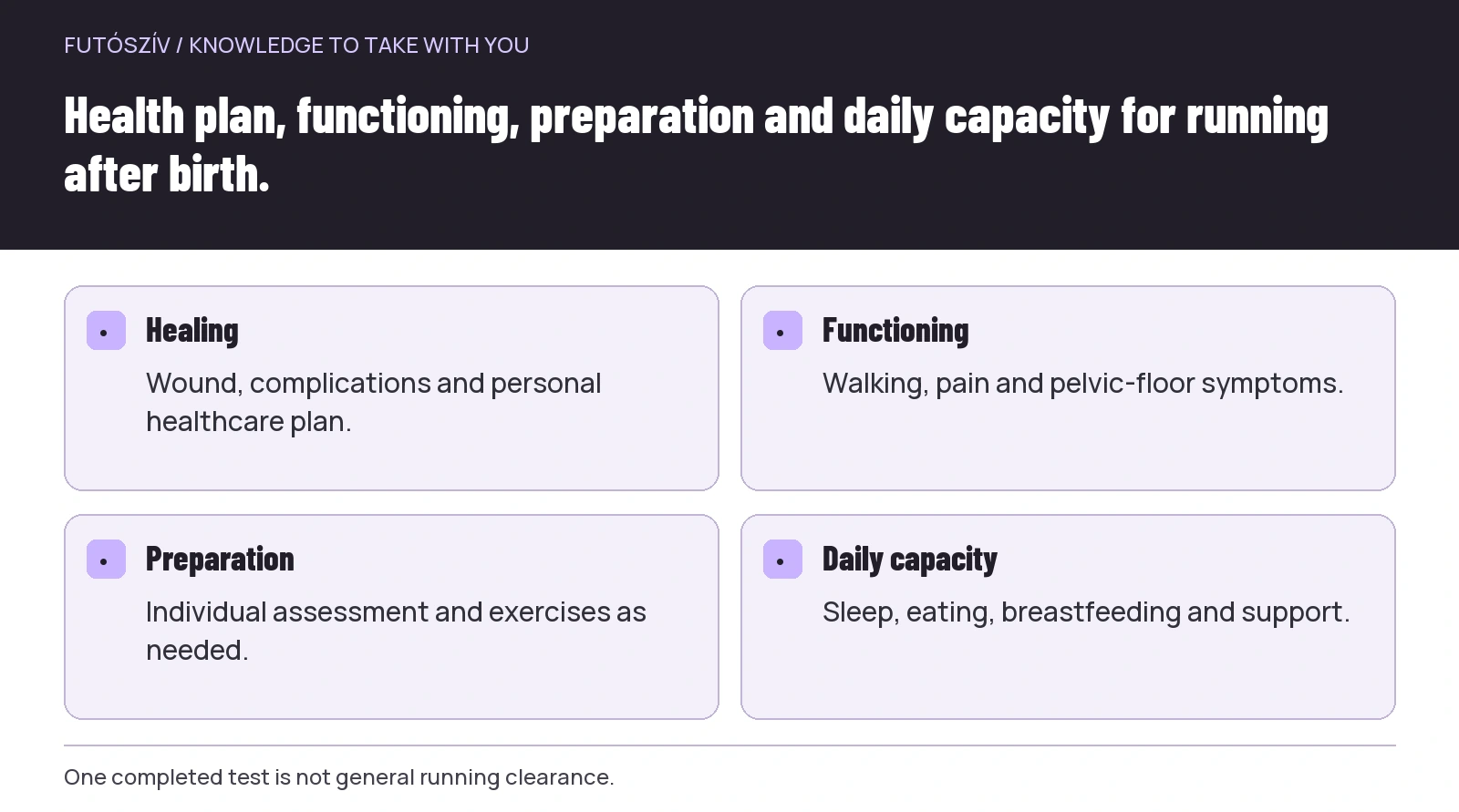 Enlarge diagram
Text version of the diagram
- Healing
- Wound, complications and personal healthcare plan.
- Functioning
- Walking, pain and pelvic-floor symptoms.
- Preparation
- Individual assessment and exercises as needed.
- Daily capacity
- Sleep, eating, breastfeeding and support.
Pelvic-floor signals: running through them is not compulsory
Seek appropriate assessment for bladder or bowel-control difficulty, vaginal heaviness or pressure, pain or other troublesome pelvic symptoms. A symptom occurring after many births does not mean nothing can be done. Its appearance during running is particularly useful information for a professional.
The NHS information on the body after pregnancy discusses pelvic floor and abdominal-wall questions too. Exercise technique and personal symptom assessment may matter more than completing a general repetition count quickly. Ask for feedback when uncertain.
An aid or pad concealing symptoms is not the same as running readiness. Practical assistance can have a place, but do not base loading decisions solely on symptoms remaining invisible externally. An appropriate plan accounts for functioning and wellbeing too.
Abdominal wall: gap width is not the whole story
Postnatal abdominal appearance receives much attention, but one distance or photograph cannot fully describe capacity. In the readiness consensus, inter-rectus distance did not reach agreement as a standalone milestone. This does not make the abdominal wall irrelevant, but shows why one measurement should not determine every sporting decision.
A professional may also assess movement, which tasks bring symptoms and needed support. An impressive exercise demonstration does not necessarily show complete functioning. Equally, an abdomen that is not flat does not prove running unsuitability.
Avoid promises that a short identical programme closes the gap and guarantees running clearance for everyone. Personal condition involves more factors. The aim is appropriate function and manageable loading, not restoring one body shape.
Pre-running exercise trials are not a home examination
Individual movement and load trials may form part of assessment, but tasks need matching to your situation. Do not begin painful jumping or repeated single-leg testing simply because an online checklist includes it. With known symptoms, seek advice first.
When a professional recommends a task, clarify its purpose and interpretation. What is observed? Which signals matter? Which variation suits current discomfort? The task supports choosing the appropriate next step, not proving yourself.
Home setting and available help matter too. If there is no space, time or safe opportunity for a recommended trial, request an alternative. Limited support access is not lack of sporting commitment.
When running can begin, make the first occasion observable
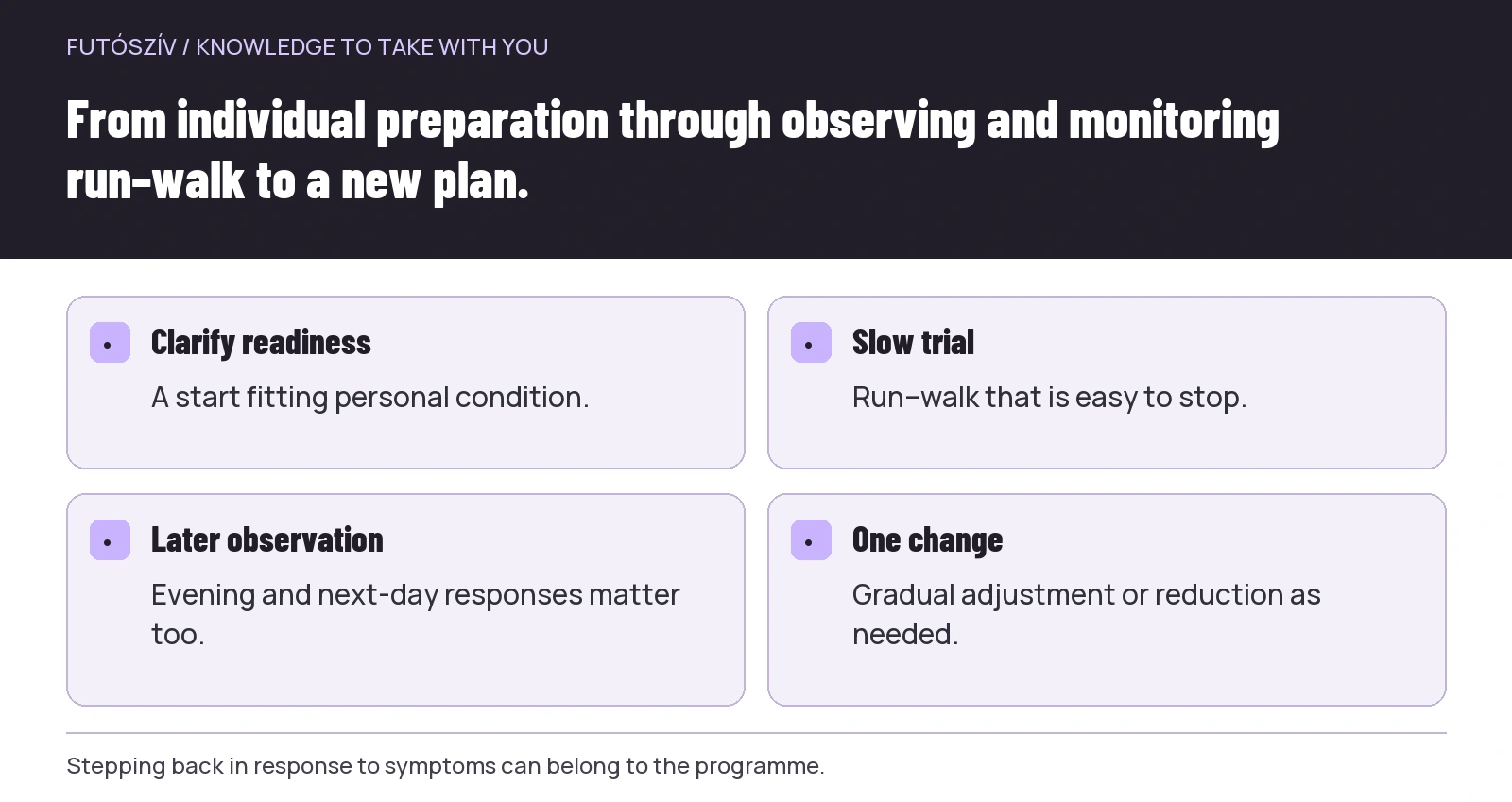
The 2024 consensus on return-to-running programme design supports beginning slowly and alternating running with walking after appropriate readiness is established. Exact proportions and quantities follow history and condition. The first occasion need not test the longest continuous distance still tolerable.
Choose an easily stopped route and allow feedback. The busiest group session or a paid race should not be your first trial. A nearby predictable setting makes responses easier to notice with less pressure to continue.
If pain or pelvic-floor symptoms arise, stop the running portion and reassess the plan with professional help if necessary. Completing a predetermined amount is not required for useful information. Stopping early can be appropriate.
 Enlarge diagram
Text version of the diagram
- Clarify readiness
- A start fitting personal condition.
- Slow trial
- Run–walk that is easy to stop.
- Later observation
- Evening and next-day responses matter too.
- One change
- Gradual adjustment or reduction as needed.
Assess more than feelings during the run
Evening or next-day symptoms, everyday movement and unusual fatigue provide important feedback too. If comfortable during an occasion but symptoms increase later, bring this back into planning. A few short precise diary sentences about movement and consequences suffice.
The programme consensus recommends accounting for sleep, mental health, nutrition and breastfeeding circumstances too. One muscle or load number does not determine progress. Capacity across the entire day belongs to what a sporting programme uses.
Temporarily reducing demands after worse nights or additional family tasks does not erase previous progress. Changes permitted beforehand reduce rushing. A running plan helps when it tolerates a changing routine.
Progression: few understandable changes at a time
The consensus recommends gradual overall loading and modifying one variable at a time. If distance, pace, terrain and frequency all rise together, later symptoms become harder to interpret. Clarify what changes now and what remains within established boundaries.
Increasing every week is unnecessary. Comfortably repeating a level can be meaningful progress. With a new symptom, illness or health change, reassess the planned increase rather than merely postponing it.
Strength work and other appropriate movement may belong to progression, but include their demands in the week too. A non-running day is not necessarily rest if heavy leg strengthening or another substantial activity occurs. Good decisions need the whole account.
Why do guides show different weeks?
A 2026 guide co-designed by several professions and postpartum runners proposes a staged return framework. Authors specifically state that feasibility and effectiveness need further study. Even a well-developed guide is not a complete unchanged solution for every user.
Proposed windows can differ because aims, participants and evidence types differ. Do not select the earliest number or apply the latest as compulsory waiting for every symptom-free person. Individual decisions need assessment of healing and functioning too.
If advice differs, ask which movement and conditions it specifically concerns. Gentle walking, general training and running often become mixed under sport. Clarification can resolve many apparent contradictions.
Five questions for preparing to run
- Is the personal healthcare plan clear, and does anything still need healing or investigation?
- Is everyday movement comfortable, and are pelvic or other symptoms present?
- Which preparatory movement and individual assessment are needed?
- Who helps account for symptoms, sleep, nutrition and routine, and how?
- What is the next small step, and which signals require reducing demands or seeking help?
Returning after birth may be slower, faster or more variable than expected. Real conditions alongside dates help make decisions more than hope or deadlines. The aim is sporting life where functioning and wellbeing matter alongside progress.
Bring a brief record of one week to the next medical or physiotherapy appointment if useful: which daily tasks felt good, when symptoms appeared and how much help left time to eat and rest. This provides an individual starting point for shared decisions.
Sources and further reading
- Christopher and colleagues: Return-to-running readiness after childbirth, international Delphi consensus, 2024
- Deering and colleagues: Designing a postpartum return-to-running training programme, international Delphi consensus, 2024
- An interdisciplinary, co-designed guide for return to running postpartum, mixed-methods study, 2026
- POGP: Fit for the Future, 2024
- NHS: Your post-pregnancy body
How Futószív articles are prepared: our editorial guidelines.