After childbirth, running can offer time to yourself, company and a familiar movement within a changed life. Even so, it does not feel good for everyone or resolve every emotional difficulty. If a previously enjoyable loop now feels empty, you have no energy to leave, or persistent anxiety accompanies your days, the conclusion is not that you run badly or lack discipline.
Find a place for movement while keeping a route to healthcare support open too. Needing support or treatment does not diminish your ability as a parent. This article helps with recognising symptoms and arranging the next step; it does not diagnose a condition or offer a treatment programme that can be replaced by running.
A difficult day is different from a persistent condition
The NIMH information distinguishes brief, milder mood changes after childbirth from more persistent or severe depression. Symptoms can include ongoing low mood, loss of enjoyment, anxiety, guilt and changes in sleep, energy and daily functioning. You do not have to experience every listed symptom before speaking to someone.
If symptoms are intense, worsening or interfering with daily life, do not wait for a time threshold to pass. You do not need to compare yourself with another parent before seeking help. Sometimes laughing, caring for the baby or going for a walk does not prove that your difficulty deserves no attention.
Describe the change simply: ‘I used to enjoy running, but now nothing gives me pleasure’, or ‘I cannot relax even when someone else is looking after the baby.’ A precise everyday sentence helps more than having to choose a diagnosis in advance.
Running data cannot establish a mental health condition
Someone can complete training while experiencing depressive symptoms; someone else may be unable to exercise because of physical recovery, limited support or fatigue. Kilometres are not a screening test. If training is the only area you still feel able to control, that does not remove the need to discuss your emotional situation either.
Look instead at the whole day. How do you experience caregiving, relationships, food, rest and things you previously enjoyed? What has become persistently difficult? You can seek support with these issues even if your running app shows improvement.
A sporting companion should not attempt a diagnosis from your pace. A more supportive question is how you are outside running and what specific help you need. ‘A good workout will sort you out’ can easily close the conversation you are trying to begin.
What does a clinical trial tell us about activity?
The PAM-PeRS trial evaluated a supported physical-activity intervention for people with postnatal depression that included face-to-face and telephone assistance. Participants were encouraged to be active and seek social support for activity. The research examined the programme within usual care, rather than advising people to abandon professional help.
Such findings do not establish that a specific running distance treats depression for everyone. Support and connection were part of the programme, and running was not the only activity studied. Place the possible role of movement realistically: it can contribute to care and quality of life, but is not a personal guarantee.
Feeling better after a session is a valuable experience. Not feeling better does not invalidate your symptoms or mean you need to train harder. Treatment plans can be adapted with a professional; you do not have to decide alone from a run’s outcome whether further help is needed.
 Enlarge diagram
Text version of the illustration
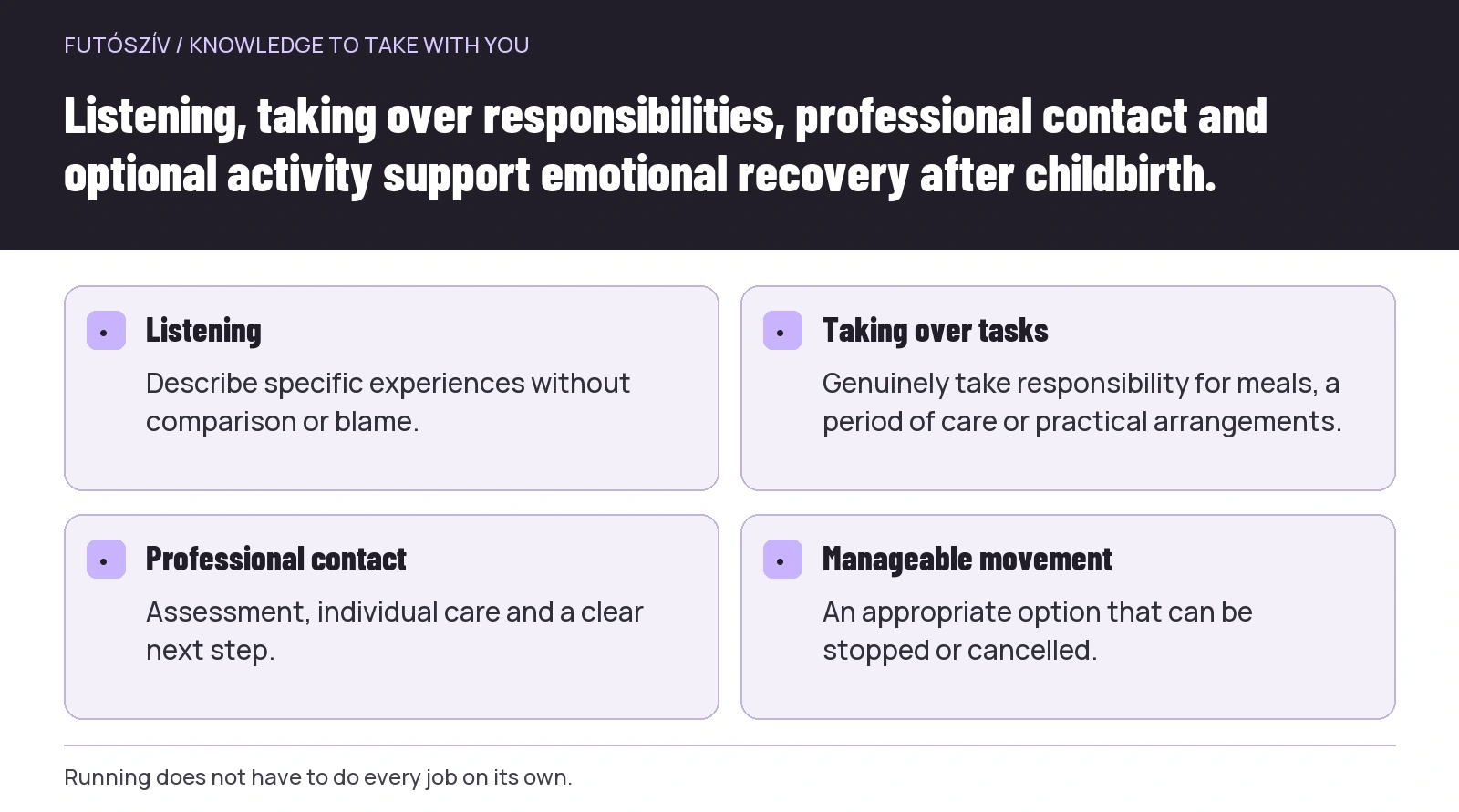
- Listening
- Describe specific experiences without comparison or blame.
- Taking over tasks
- Genuinely take responsibility for meals, a period of care or practical arrangements.
- Professional contact
- Assessment, individual care and a clear next step.
- Manageable movement
- An appropriate option that can be stopped or cancelled.
How can you start seeking help?
You can speak to your GP, gynaecologist, health visitor or a mental health professional. The NHS information on postnatal depression also emphasises making contact early. In Hungary, the first professional you reach can help clarify local care options; you do not need to know every service pathway beforehand.
If making a call is difficult, ask someone you trust to help arrange an appointment, accompany you or write down the main points with you. Explain when things changed, how you function day to day and any previous mental illness or treatment. Mention the time since birth and medications too.
At the appointment, it is fine to say you want more than general lifestyle advice. For example: ‘This is now affecting my days, and I would like to clarify what assessment and support I need.’ If the next step is unclear, ask who will contact you and when, and what to do if you get worse.
What can a supportive activity session include?
Movement may become more manageable when its purpose is not proving yourself. It can be a short familiar route, a walk with company or an easy run appropriate to your condition. Physical healing after childbirth and readiness to run still matter; hoping for emotional benefits does not override bodily symptoms.
You should not have to report publicly on the session, maintain a pace or appear cheerful. A companion can ask beforehand whether you want to talk or move quietly. A simple arrangement that can be cut short offers more freedom than a large commitment that is difficult to cancel.
If getting out is too difficult, support can first focus on booking an appointment or arranging a meal rather than putting on running shoes. Movement is not a condition for receiving help. On some days, the most important step is someone staying beside you and taking over a few tasks.
Family help should actually reduce the load
‘Let me know if you need anything’ is well-intentioned, but can be difficult to answer. Specific offers are more useful: bringing food, covering a period of care, accompanying you to an appointment or making a call. The purpose should not be to finally give you energy to train, but to reduce daily demands.
Running time and rest can both feature in shared arrangements. If someone helps only while you exercise, but not for sleep or a medical appointment, the support may be too narrow. Your needs are valid beyond productive activity.
A loved one can listen without immediately explaining the feeling away. Avoid comparisons and demands for gratitude. Loving the baby and experiencing emotional difficulty can coexist; one does not imply the absence of the other.
Discuss treatment in the context of your whole life
The NICE guideline on perinatal mental health emphasises care shaped around individual conditions and preferences. Psychological treatment, medication or other support may be considered after professional assessment. Breastfeeding, previous treatment and daily responsibilities are important parts of the decision.
Do not stop prescribed medication on your own because you have started running or because someone says sport makes it unnecessary. Discuss side effects, concerns and your sporting plans with your clinician. A precisely expressed question supports safer shared decisions.
Mental health treatment and running are not competing paths. They can be mutually supportive parts of a day, but you do not have to earn improvement through the amount of exercise you do. One better or worse run should not be the sole measure of treatment outcomes either.
 Enlarge diagram
Text version of the illustration
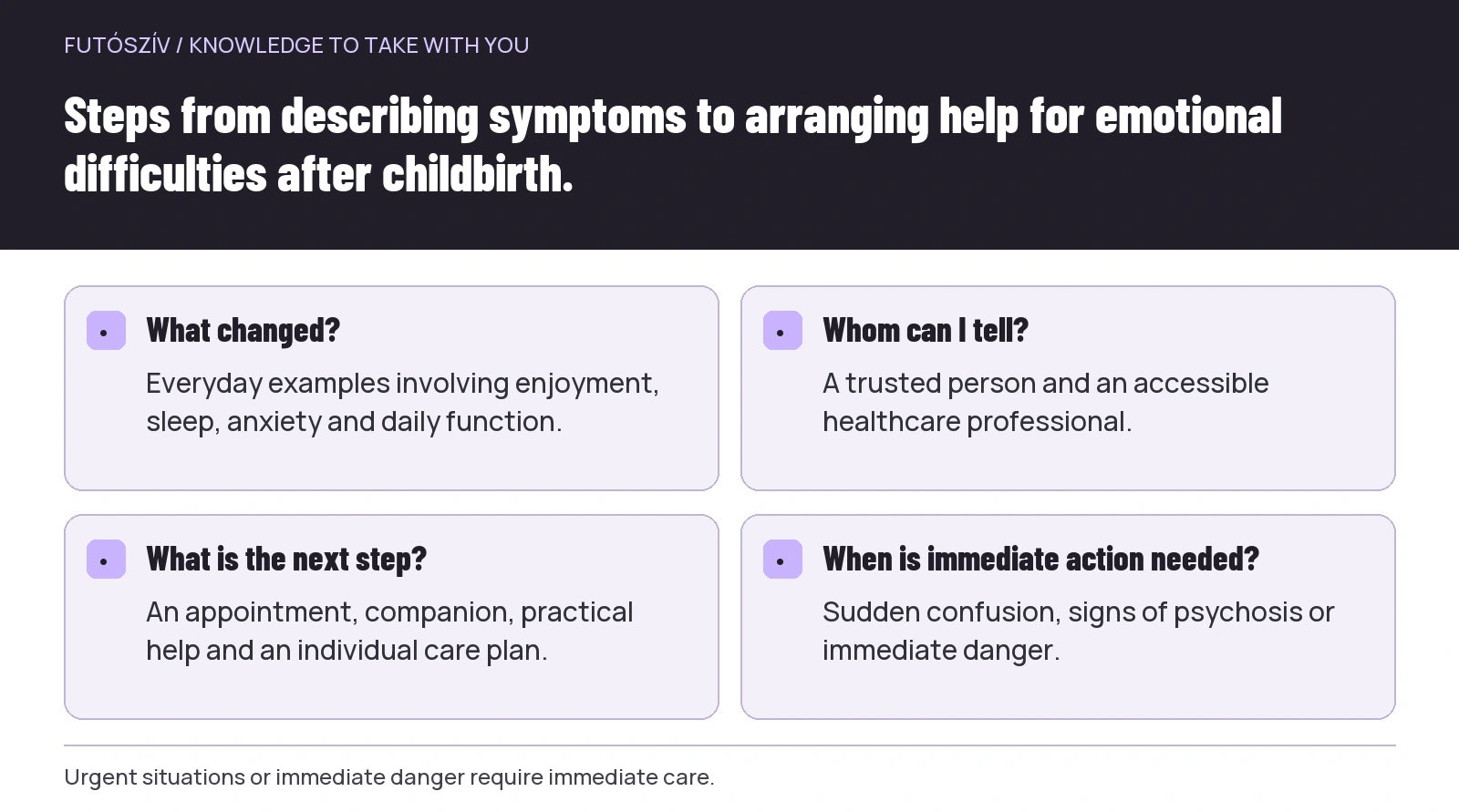
- What changed?
- Everyday examples involving enjoyment, sleep, anxiety and daily function.
- Whom can I tell?
- A trusted person and an accessible healthcare professional.
- What is the next step?
- An appointment, companion, practical help and an individual care plan.
- When is immediate action needed?
- Sudden confusion, signs of psychosis or immediate danger.
What about social media and your previous self-image?
Stories of quick returns after childbirth can create a sense that everyone should be getting steadily better. Support, treatment, financial circumstances and difficult days are rarely visible on screen. Your condition cannot be measured against someone else’s edited story.
If a platform regularly makes you feel worse, you can reduce its use or hide particular content. This does not resolve every emotional difficulty, but may remove an unnecessary daily burden. You can choose your running community too: look for one that values more than results and appearance.
You can also talk about a sense of loss around your former running self. There is no need to immediately create a joyful new identity. Your goals can change over time and running can find a place again without urgently reclaiming every previous result.
Memories of childbirth may require separate support
The difficulty may not be general low mood, but memories, fears or avoidance related to childbirth. Examinations, hospital settings or certain bodily sensations may be difficult. Do not try to fit symptoms into one label yourself; explain the specific experience to a professional.
The NICE guideline also discusses care for other mental health conditions around childbirth, including anxiety and trauma-related difficulties. Appropriate help requires discussing more than your enthusiasm for running. Physical and emotional recovery can be considered separately too.
Training does not need to become a forced exercise in confronting distress. If a movement or situation triggers intense distress, evaluate it as part of the treatment plan. A companion’s patience and predictable arrangements can be supportive, but do not replace skilled care.
When is immediate help needed?
The NHS treats postpartum psychosis as a medical emergency. Sudden confusion, beliefs detached from reality, hallucinations or an unusually elevated, rapidly changing state require immediate healthcare assessment. Do not explain this solely as sleep deprivation or wait to see whether a walk makes it pass.
If there is an immediate risk of someone harming themselves or another person, request emergency help by calling 112. A trusted adult should stay with them to help arrange care and ensure the baby’s safe care. In this situation, they should not go running alone or drive.
Tell a professional about frightening thoughts or severe anxiety even without immediate danger. You do not have to decide alone how serious each symptom is. Seeking help aims to understand the condition more accurately and arrange appropriate support.
A manageable next step
Choose one person you can tell today that things are difficult, and one professional contact through whom help can begin. Write down two or three changes in your days. If you want movement, keep the session appropriate to your condition, simple and cancellable; if you do not want it now, support is still deserved.
Running can be a source of enjoyment and connection with your body, but it does not have to perform the jobs of treatment, rest and community support alone. You can seek professional help for emotional difficulties after childbirth. The next good step is often taking that action with someone else.
Sources
- NIMH: Perinatal Depression
- NICE CG192: Antenatal and postnatal mental health – recommendations
- Daley and colleagues: PAM-PeRS pragmatic randomized controlled trial, 2015
- NHS: Postnatal depression
- NHS: Postpartum psychosis
How Futószív articles are prepared: our editorial guidelines.