Gradual progression means more than slowly adding kilometres
Gradual loading is common advice for symptoms around a tendon. On its own, this says too little about Monday’s run, Tuesday’s strength work and Wednesday’s walk to work. A usable plan must name the problem, permitted activity, monitoring and what happens if symptoms worsen. “Do it carefully” does not yet explain these.
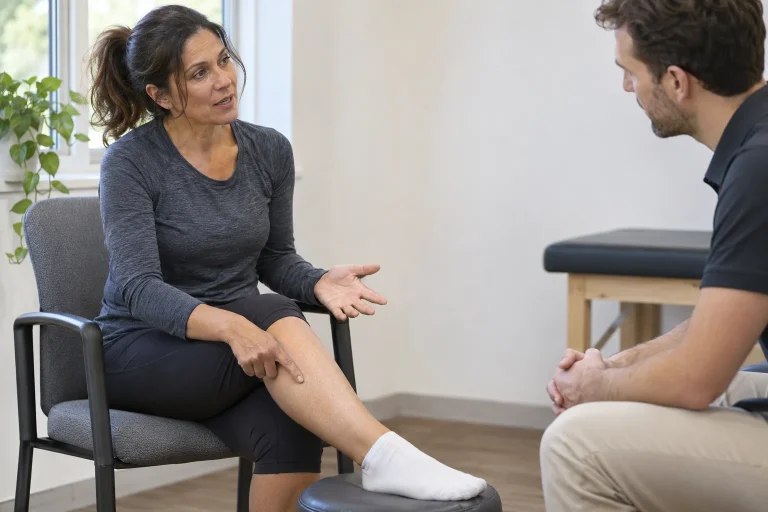
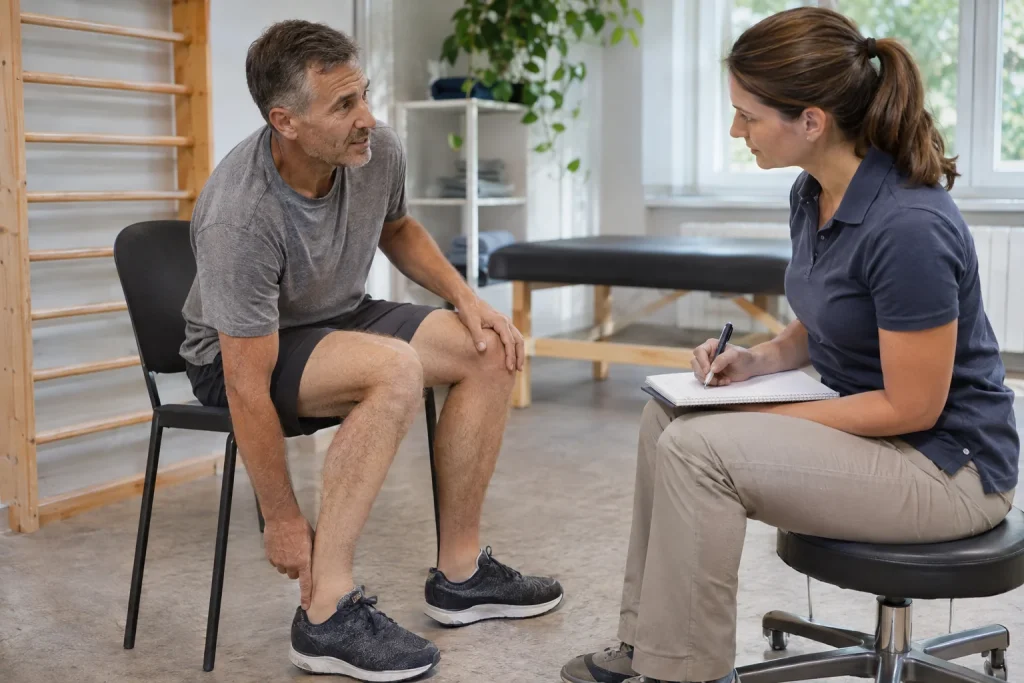
This article supports thinking about tendon loading, mainly through Achilles and patellar tendon examples. Not every heel, knee or thigh pain originates in a tendon, and the same exercise does not suit every tendinopathy. New, worsening symptoms or those affecting everyday movement need assessment first. A physiotherapist or care team develops the rehabilitation task individually.
For pain around the Achilles beginning with a sudden snap or feeling of being kicked, plus difficulty pushing off, do not begin exercises found for chronic tendon symptoms. The NHS Fife information on tendon rupture describes such symptoms too. Stop sport and seek prompt healthcare assessment; a sudden severe injury or illness may require urgent care.
First clarify which problem is being discussed
Midportion Achilles tendinopathy and a problem around its attachment to the heel bone are not identical in every respect. The patellar tendon is loaded in another anatomical situation, and other knee problems may underlie symptoms. If someone recommends exercise for “the same tendon pain”, ask whether the diagnosis really is the same.
The 2024 JOSPT guideline specifically addresses midportion Achilles tendinopathy. It recommends appropriately selected and dosed tendon-loading exercise as first-line treatment under defined conditions. Do not generalise this to independently starting the same heavy loading for every tendon pain.
At the appointment, request a simple explanation: what is considered the likely cause, what supports that and what remains uncertain? If further examination is needed, know the question it addresses. A diagnosis name helps when actions connect to it understandably rather than merely adding a new label beside pain.
Account for the entire day’s load
Tendons receive tasks besides running. Long walks, stairs, standing work, jump-based training and prescribed exercises may all belong to one day. Reducing only running kilometres while everything else rises may create a different overall change from what the calendar suggests. Review loading by activity.
Make a short list of fixed and adjustable elements. You may not be able to cancel commuting but can omit an extra stair session. Household tasks may offer organising possibilities too. Everything need not stop; develop a realistic plan in which important loading elements do not remain invisible.
The coach and physiotherapist should see the same week. If one adds strength work while the other changes running, ensure they know. Rehabilitation is not extra work to slip unnoticed alongside training. It has its own purpose and loading effect requiring room in the programme.
 Enlarge diagram
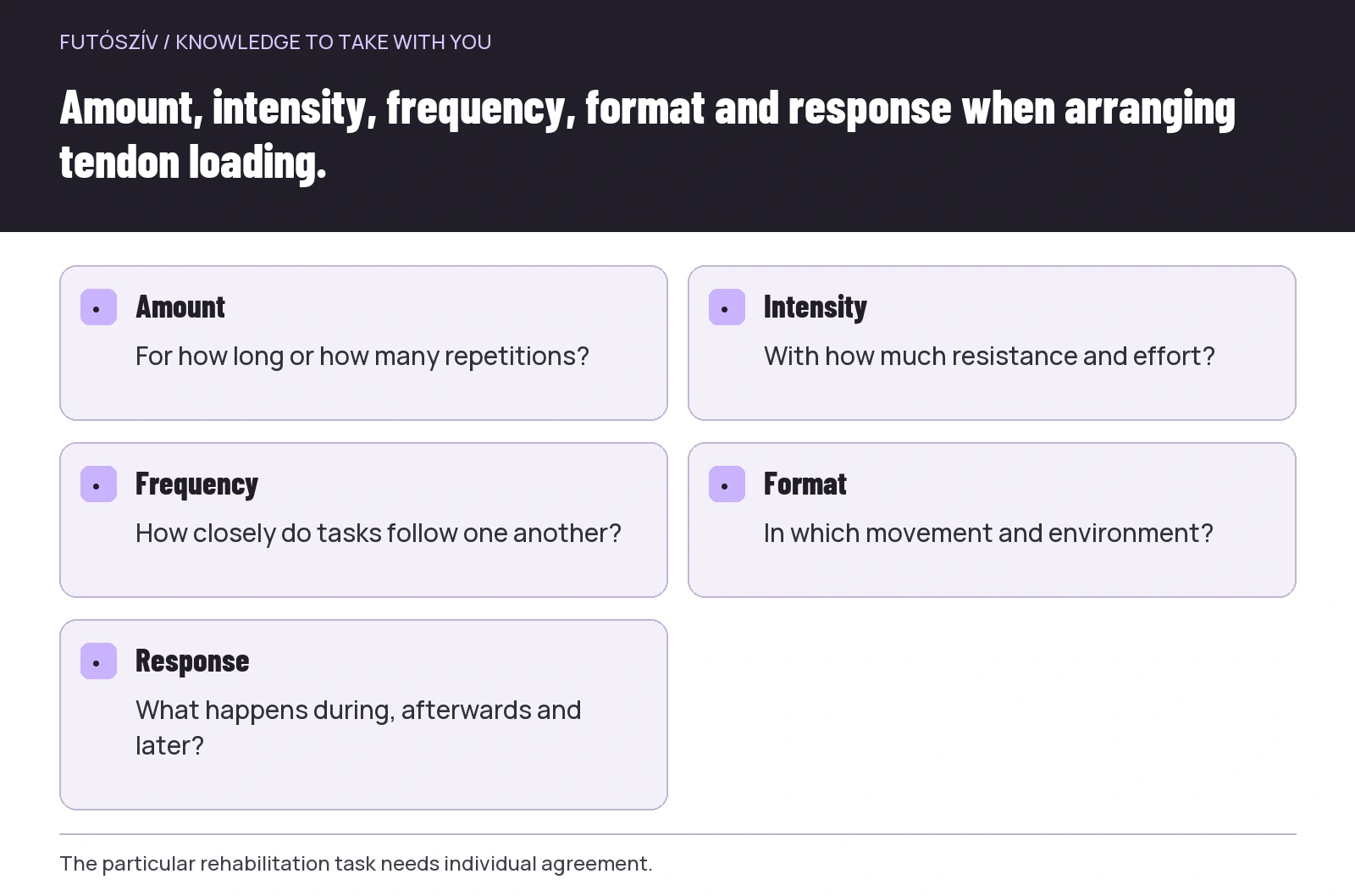
Text version of the diagram
- Amount
- For how long or how many repetitions?
- Intensity
- With how much resistance and effort?
- Frequency
- How closely do tasks follow one another?
- Format
- In which movement and environment?
- Response
- What happens during, afterwards and later?
Five variables of loading
Amount: for how long or how many repetitions do you perform the task? Intensity: how much effort or resistance accompanies it? The same total time can mean very different situations in easy walking, fast running or uphill. Kilometres alone therefore do not describe load.
Frequency: how closely do tasks follow one another? Format: which movement and environment are involved? Response: what do you experience during, afterwards and in later everyday tasks? Naming these prevents gradual progression remaining merely a feeling.
If making changes, describe exactly which element changed. A longer run, more accelerations, a new hill and a new strength exercise together are hard to interpret. Simplifying does not guarantee healing but makes the next response easier to discuss meaningfully with your clinician.
What does monitoring the response to exercises mean?
Agree with your clinician which observations they want: symptoms during the task, later sensations, morning stiffness or changes in a particular everyday function? Everyone need not use the same pain threshold. Do not automatically turn an online number into personal permission for further loading.
The Dutch Achilles guideline discusses patient education, load management and exercises together, with adjustments according to pain and condition. The lesson is that monitoring is more than scoring. Connect notes to a preagreed decision: when to retain the amount, when to adjust and when reassessment is needed.
Do not record only whether repetitions were completed. Execution, understood instructions and the following day matter too. If unsure whether you perform the task appropriately, request demonstration and feedback. “It is harder, but I did it” is not the desired information in every rehabilitation situation.
What does a study say, and what does it not?
A randomised study compared two exercise programmes in 76 athletes with mostly longstanding patellar tendinopathy. After 24 weeks, the progressive tendon-loading group showed greater improvement on a questionnaire combining pain, function and sports participation. Most participants were male and young adults, so findings do not automatically describe every runner.
In the study by Breda and colleagues , the between-group difference in return-to-sport rates was not statistically clear. This shows why a favourable primary result should not become a claim that everyone certainly returns in the same time. A programme’s usefulness and achieving a personal sporting goal are related but not identical measures.
You need not copy a whole research protocol for your knee pain. An appropriate diagnosis, feasible individual plan and monitoring are needed first. The study instead shows why discussing active, organised rehabilitation makes sense rather than searching for a quick miracle solution.
Rest and movement should both have roles in the plan
Modifying symptomatic activity does not necessarily mean stopping everything, nor leaving every usual sport unchanged. Clarify permitted forms with your clinician in your circumstances. Choices between complete rest and unrestricted running cannot be selected from a general motivational sentence.
If cross-training enters the plan, agree exactly which form and boundaries. “Not running” is not one type of load. A hard cycling climb out of the saddle, long walk and gentle water-based movement are very different tasks. Missed running time need not be replaced at all costs with another session of identical length.
Arrange practical conditions for rest too. Mention work involving much standing at the appointment; if exercises fit only late in the evening, that affects feasibility too. Even the best paper plan fails if unmanageable within real daily boundaries.
 Enlarge diagram
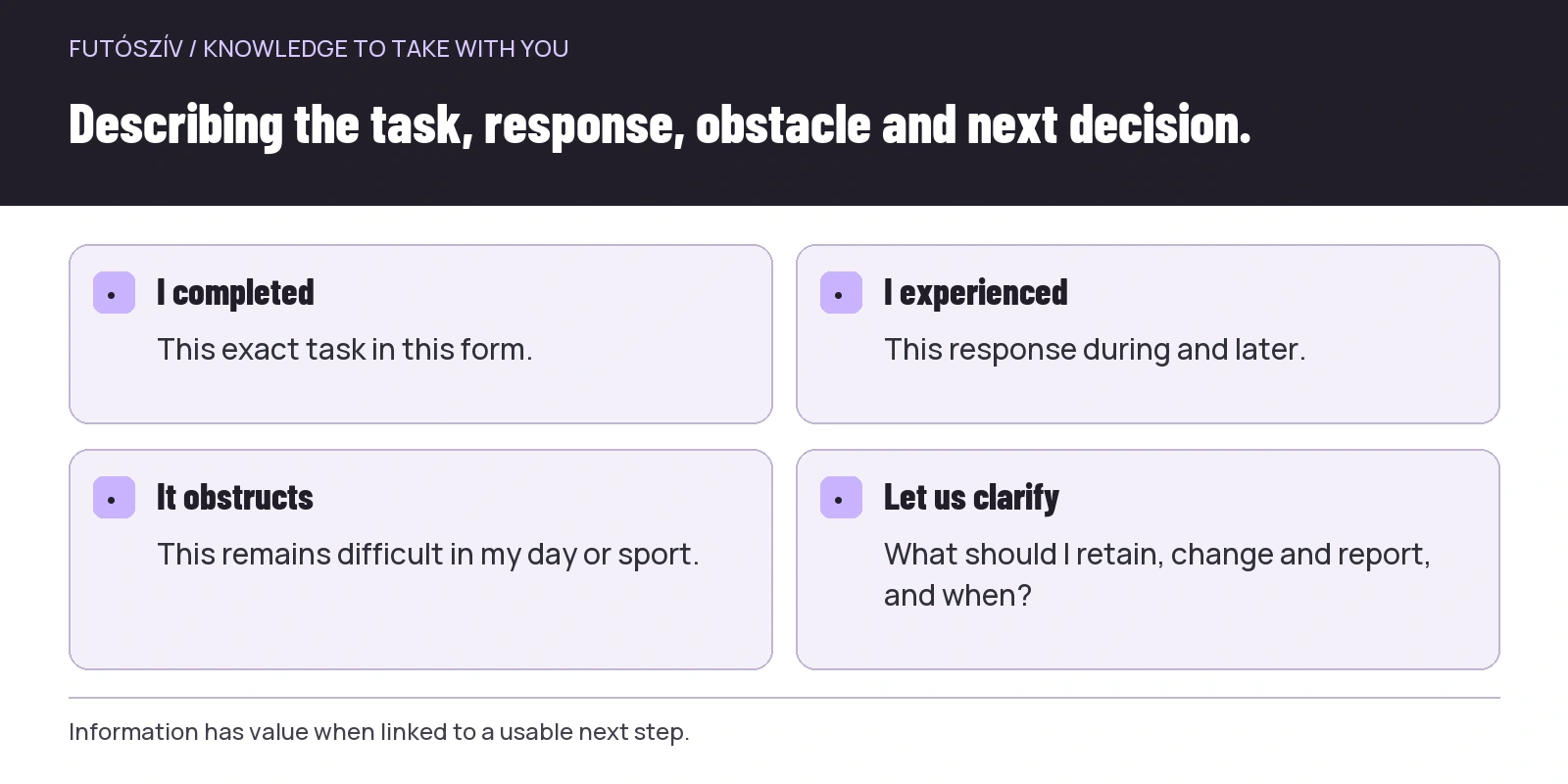
Text version of the diagram
- I completed
- This exact task in this form.
- I experienced
- This response during and later.
- It obstructs
- This remains difficult in my day or sport.
- Let us clarify
- What should I retain, change and report, and when?
Stretching and passive treatment should not obscure the main question
Temporarily pleasant stretching, massage or another treatment does not necessarily establish how the tendon can be loaded in running. Ask the element’s purpose and connection to the active plan. Brief symptom relief is not the same as regaining desired function.
The precise location of Achilles symptoms may matter in exercise choice too, so do not automatically begin heel drops over a step edge for every posterior heel pain. Select movement range and tasks individually. A video failing to discuss different conditions does not make your symptoms certainly the case shown.
Agree a few real goals for assessing treatment: for example, more comfortable everyday walking, appropriate completion of prescribed tasks or manageable introduction of later-permitted running sections. The aim is not necessarily reducing every moment of symptoms to zero after one session but organised improvement in personal condition.
Three everyday situations needing clarification of the plan
Better during training, harder the next day. Do not simply count this as warming up well. Record the whole response and discuss it with your clinician. Immediate sensations are only part of the story, so do not decide to increase the next amount solely at the end of the run.
The exercise goes well, but fast running does not yet. The two tasks may differ, so successful exercise completion is not automatic permission for full sporting load. Ask which steps connect rehabilitation with desired running. Transition between activities may require separate planning.
A new, sudden symptom appears. Previous tendinopathy does not automatically explain every new pain or strength loss. Stop the particular exertion and seek reassessment. This especially matters after a snapping sensation, substantial loss of function or severe injury; do not continue the old exercises unchanged.
Four sentences for the next consultation
First explain which task you performed and in which form. Then describe responses during and later. Third, name what obstructs everyday life or the sporting goal. Finally ask precisely what to retain, change and report in the next period, and when.
This brief structure helps prevent rehabilitation becoming repeated guesswork. If improvement does not follow the agreed pattern, review the plan; persistent symptoms do not prove you are not working hard enough. Diagnosis, loading or feasibility may need reconsideration.
Gradual progression becomes usable when connected to specific tasks, observations and decisions. Rebuilding running later should begin from this clarified framework too. The aim is a plan you understand, can carry out and can adjust with professional help according to your response.
Sources
- JOSPT: Midportion Achilles tendinopathy, clinical practice guideline revision 2024
- Dutch multidisciplinary guideline on Achilles tendinopathy, 2021
- Breda and colleagues: Progressive tendon-loading exercise therapy in patellar tendinopathy, randomized trial
- NHS Fife: Achilles tendon rupture
How Futószív articles are prepared: our editorial guidelines.