Vaginal heaviness, a downward pulling sensation or a noticed bulge can suddenly make running uncertain. Does every step worsen something? Is an exercise routine enough, or must sport now be avoided? With pelvic organ prolapse, symptoms, assessment findings and personal goals matter together. One photograph, stage or another person’s experience cannot give a complete answer.
Start with an accurate description and appropriate assessment. Sport can be adapted, and care may offer several options. This article supports decisions; it neither diagnoses nor promises to eliminate prolapse, and does not give universal clearance to run.
What does prolapse mean, and why assess it?
The RCOG information explains that pelvic organ prolapse involves a pelvic organ moving towards the vagina. Different areas and degrees can be involved, so precise identification matters. Not every vaginal symptom represents the same finding, and symptoms cannot establish at home which organ is affected.
Assessment should do more than state a stage. It should clarify symptoms, rule out other causes and support discussion of personal options. Ask for a simple explanation of findings, uncertainty and implications for everyday movement.
Even with a diagnosis, do not automatically treat new symptoms as part of it. Changed pain, bleeding or difficulty emptying the bladder or bowels may need separate assessment. An old label does not replace monitoring changes.
Map symptoms across daily situations
Describe what happens and when: prolonged standing, walking, running, lifting or the end of the day? Is there a vaginal bulge sensation, urine leakage, difficulty emptying the bladder or bowel symptoms? The NHS also discusses several symptoms; not everyone has the same list, and some people experience little difficulty from the finding.
Include what eases or aggravates symptoms. Does the sensation differ after a shorter day, another activity or rest? You do not need to provoke symptoms with a long workout. Everyday situations already experienced are a suitable discussion starting point.
Describe function through a specific task. ‘I feel heaviness after twenty minutes standing’ is more useful than saying everything is weak. Explain the impact too: which movements you avoid and how work or social sport is affected. Care goals need not be only anatomical.
Assessment stage and personal goals are different
The NICE guideline builds on considering symptoms, examination findings, preferences and treatment options together. Naming the prolapse matters, but decisions also need an understanding of the life and movement you want. Someone mainly troubled by everyday standing may need different support from someone returning to a specific sporting task.
Do not ask only whether the condition is bad. Ask which observations will be followed, which changes matter and what the first goal should be. This can reduce uncertainty about interpreting every sensation as deterioration.
Preferences also include which options you want to understand, what worries you and what fits your day. Every long-term decision need not be settled by the end of one conversation. Clarification and follow-up can be part of the plan.
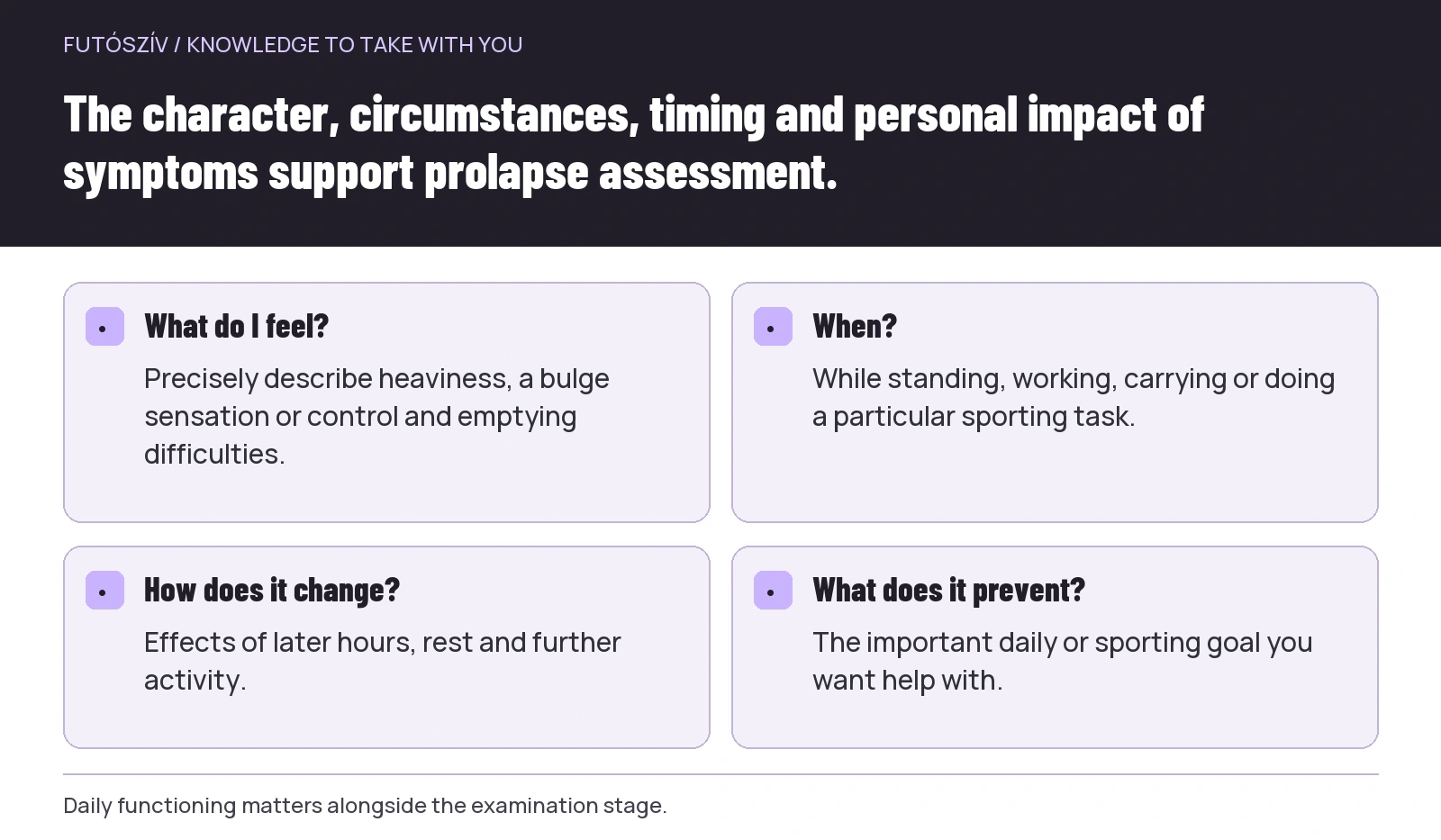 Enlarge diagram
Text version of the illustration
- What do I feel?
- Precisely describe heaviness, a bulge sensation or control and emptying difficulties.
- When?
- While standing, working, carrying or doing a particular sporting task.
- How does it change?
- Effects of later hours, rest and further activity.
- What does it prevent?
- The important daily or sporting goal you want help with.
What do we know about pelvic-floor training?
The POPPY randomised trial found better prolapse-symptom outcomes with personalised, individual pelvic-floor training. This supports symptom improvement, rather than guaranteeing every anatomical finding disappears or every running workload becomes symptom-free.
The NICE guideline recommends considering at least sixteen weeks of supervised training as a first option for symptomatic prolapse at certain early stages. This applies to a defined clinical situation; it does not mean everyone should follow the same home routine without assessment.
Understanding technique matters. Ask what to feel when contracting and relaxing, which position to practise in and how changes will be assessed. Report pain, uncertainty or inability to perform the task. More repetitions are not the automatic answer to every problem.
A pessary is an option, not a general running accessory
A support pessary is a device placed in the vagina that may provide support with prolapse. The RCOG discusses it among possible care options. Appropriate type, size, fit and follow-up require individual assessment; do not select one randomly as sports equipment.
The 2025 UK pessary guideline describes an organised professional framework for fitting and follow-up. If use during activity is your goal, state this specifically. Everyday comfort and fit during running are not necessarily identical situations.
Request clear instructions for handling, cleaning, checks and symptoms that mean contacting the provider. Self-management also needs learning if appropriate for you. Simply having the device does not remove the need to observe symptoms or activity demands.
Report new symptoms even when using a pessary
The Cambridge University Hospitals information recommends healthcare contact for unusual bleeding, heavy bleeding or excessive discharge. Follow the individual instructions for your device. Do not try to become accustomed to pain or uncomfortable fit through longer runs.
If you feel the device move or notice another change, describe the circumstances. Duration and activity type may matter at the next discussion. Do not resolve fit by independently modifying the device.
New or unexplained bleeding can have another cause, so do not automatically blame the pessary or running. Describe the complete symptom and history for appropriate assessment, even if the sporting session otherwise went well.
Place running within the whole day’s demands
An easy morning activity may feel different from the same task after prolonged standing, work or carrying. Include the rest of the day when describing loading. Shortening running is only one possible adjustment; organising home or workplace responsibilities can contribute too.
The RCOG also includes reviewing constipation, straining and other demanding circumstances in practical advice. Do not interpret these as personal failings. Recurring bowel or cough symptoms can receive appropriate help too.
Instead of permanent avoidance, request a specific adjustment: which task, in what amount and with which follow-up is manageable? The aim is not self-monitoring during every daily movement, but understandable actions in a few important situations.
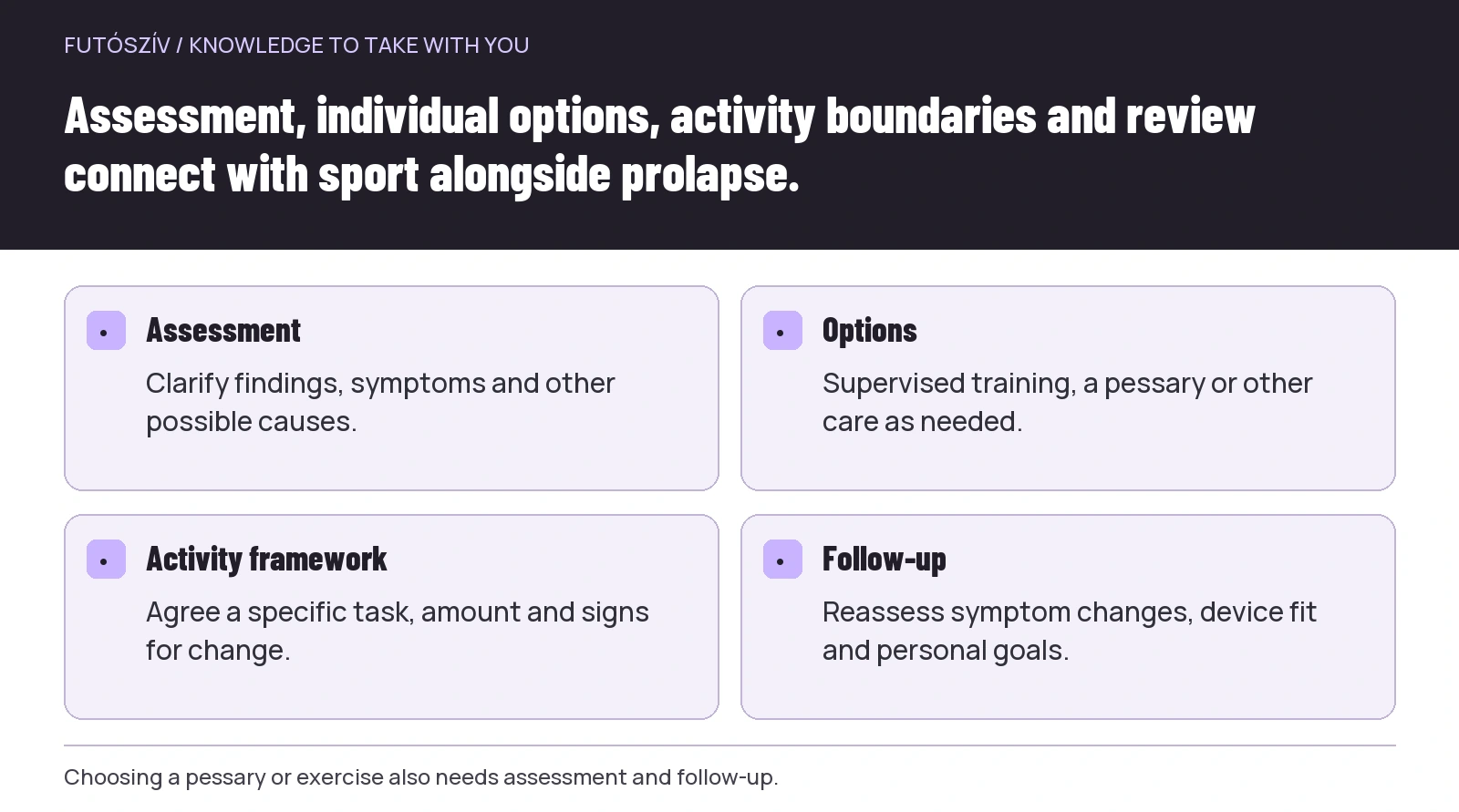 Enlarge diagram
Text version of the illustration
- Assessment
- Clarify findings, symptoms and other possible causes.
- Options
- Supervised training, a pessary or other care as needed.
- Activity framework
- Agree a specific task, amount and signs for change.
- Follow-up
- Reassess symptom changes, device fit and personal goals.
If running is considered, make conditions clear
A session agreed after individual assessment may be shorter, easier and possible to stop. Distance, pace, terrain and the whole day’s demands matter together. No universal kilometre limit suits everyone without knowledge of findings and symptoms.
Do not change several things at once. If trying a shorter run, keep circumstances simple and notice the later response too. A diary may only need workload, symptom timing and when you returned to your usual state. This supports evaluation with the professional.
If pressure, pain or another symptom appears, endurance should not be the goal. Stopping, walking or ending the session should be accepted options beforehand. A supportive running partner respects this rather than persuading you to complete the loop.
Before and after surgery involve separate questions
Surgery may be among the options when needed, but not every symptom or stage requires the same approach. Discuss expected benefits, risks, alternatives and personal goals. Running can be one consideration, but surgery is not simply a decision about sporting clearance.
After surgery, follow the instructions for the specific procedure. Do not automatically copy another person’s or another operation’s return timeline. Clarify what can be done now, recommended preparation and when running can be reassessed.
Establish whom to consult between surgical follow-up and sporting plans too. If advice conflicts, ask for clarification about the particular load. Clear responsibilities offer more safety than choosing the most permissive sentence.
Do not wait until the next workout with unusual changes
The NHS information on pelvic pain also discusses accompanying signs requiring urgent assessment. Inability to urinate, severe new pain, substantial bleeding, fever or severe illness need urgent healthcare evaluation. Trying another exercise is not the appropriate response. Alongside stopping running, arrange access to care.
Less urgent but recurring symptoms deserve review too. Do not wait until every daily task is affected. Discussing symptoms is appropriate even if the condition was previously called mild or others treat it as a natural age-related change.
The emotional burden of uncertainty matters too. Mention increasing movement avoidance because of fear. Seek a plan that combines appropriate care with manageable activity and personal choice.
Questions for a more specific plan
- Exactly which finding was identified, and what may explain my symptom?
- Which function and personal goal are we following alongside the examination stage?
- Which supervised training or other non-surgical options are appropriate?
- With a pessary, how do fitting, handling and review work?
- Which activities can I do now, and which signs mean changing them?
- Whom should I contact about new symptoms or reviewing the plan?
Pelvic organ prolapse and sport deserve individual assessment. Accurate symptom descriptions, understandable choices and a clear activity plan may help more than one general prohibition or promise. Your own goals and comfort belong in this conversation.
Sources
- RCOG: Pelvic organ prolapse
- NICE NG123: Urinary incontinence and pelvic organ prolapse in women – management
- Hagen and colleagues: POPPY multicentre randomised controlled trial, 2014
- United Kingdom Continence Society: UK Pessary Guideline 2025
- CUH: Self-management of a pessary for pelvic organ prolapse
- NHS: Pelvic organ prolapse
- NHS: Pelvic pain
How Futószív articles are prepared: our editorial guidelines.