
Running twice a day is not a compulsory stage of progress. It can be a way to distribute a larger workload built over a long period, or a practical response to an unusual schedule. In another situation, it merely adds two departures, two changes of clothes and less rest to an already crowded day.
It helps to distinguish splitting the original volume, adding a new run and putting two more intense sessions on one day. All three can be called a double day, yet they are very different decisions. The useful question is not whether professionals do it, but what specific problem it would solve in your own system.
Three different double days
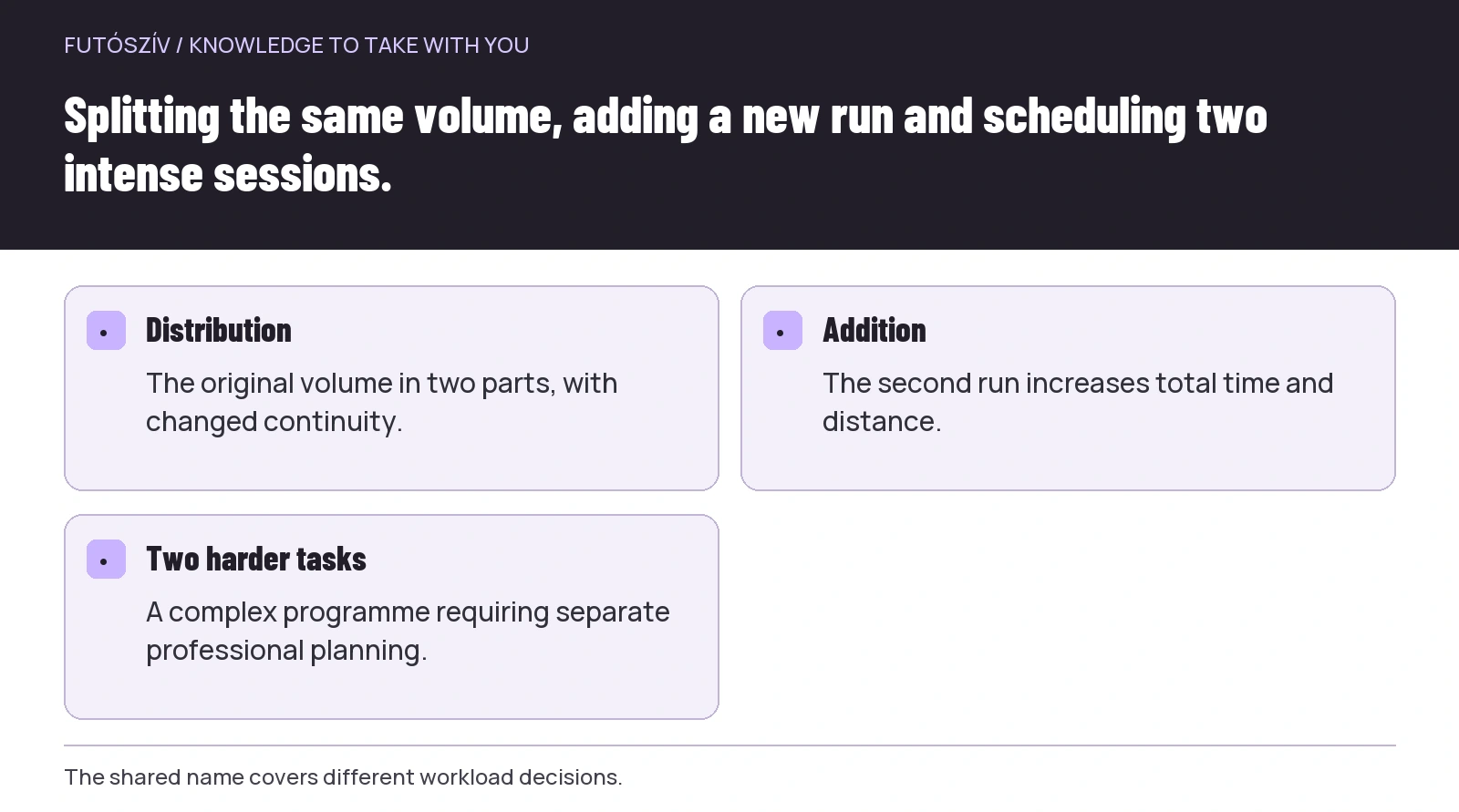
In the first case, you divide the running time you would otherwise complete into two parts. In principle, total volume does not increase, but the continuity of the effort and the rest between the parts change. That alone creates a different training structure.
In the second case, you keep the original run and add a shorter one. You then genuinely run for more time and distance. Calling it “just an easy second loop” does not erase the increase, and easy intensity does not make it cost-free.
The third case places two deliberately harder tasks on one day. This is a complex training-planning approach that should not be confused with an easy run to work and another home. A second intense workout is not the natural next step simply because two easy sessions once went well.
What problem would it solve?
Perhaps you want to distribute a larger volume you are already used to so that one session does not become too long. Perhaps short opportunities for movement arise at either end of your journey. These are specific organisational reasons, alongside which the total workload still needs planning.
A less useful reason is that every strong runner on social media seems to do doubles. The programme you see does not reveal years of background, sleep, working hours, professional support or earlier unsuccessful attempts. The day on display is not the whole system.
Write one sentence: a double day came up because… If the sentence ends without a problem to solve, another training structure may not be what you need now. Completing your existing programme consistently is a development opportunity in its own right.
The response may differ even with the same total time
In a crossover laboratory study fourteen male endurance athletes completed one longer and two shorter running sessions with the same total work-bout duration. Several hours of rest separated the two short sessions. Most participants were cross-country skiers, so the result should not be treated as a general response among recreational runners.
The research examined acute physiological and perceptual responses. It did not ask the same question as a training trial comparing results across a whole season. Lower strain on a particular measure that day does not automatically prove greater long-term development.
The lesson is that distributing the workload is a substantive variable. Two shorter runs are not equal to one longer run in every respect, even when the summary line in your log shows the same minutes.
 Enlarge diagram
Text version of the illustration
- Distribution
- The original volume in two parts, with changed continuity.
- Addition
- The second run increases total time and distance.
- Two harder tasks
- A complex programme requiring separate professional planning.
Why can metabolic experiments not simply be copied?
Training with lower muscle glycogen often comes up in arguments for twice-daily exercise. In an early human experiment the two legs of seven untrained men performed knee-extension work on different schedules. This was not a whole-body running programme.
In a later study involving trained cyclists and triathletes certain adaptation markers differed between the two training schedules, but improvement in the performance tested showed no clear advantage for the double schedule. Glycogen availability was also part of the research protocol.
These findings do not mean runners should organise a second session by skipping meals. A metabolic signal and usable sporting performance are not the same concept. Adequate energy availability is particularly unsuitable for jeopardising in an independent experiment.
Double threshold is a different category
Two easy runs do not make a double-threshold day, and a double-threshold day is not two races placed alongside one another. The term belongs to a planning concept in which intensity control and the structure of the complete programme are important.
It is easy to remember only the impressive repetitions from an online example. Without the background, workload monitoring and recovery conditions, imitation can produce a different task from the original system. The name does not protect you from choosing too fast a speed.
As a recreational runner, you do not need this approach to take your goal seriously. If considering it, individual professional planning and suitable support are needed. This article does not provide a double-intensity daily protocol to copy at home.
Count the full time required for two departures
Two shorter runs may represent the same movement time on paper as one longer run, but you prepare twice, change twice and perhaps travel to the route twice. Laundry, meals and winding down in the evening also take time. The entire process must fit into your calendar.
A simple organisational example: one sixty-minute run and two thirty-minute runs have the same movement time. If each outing also involves fifteen minutes of preparation and follow-up, the total time required that day is no longer identical. These are illustrative numbers, not training doses.
If the second run regularly delays bedtime or prevents a relaxed meal, the organisational benefit is questionable. Do not fund an increase in running time by quietly reducing recovery opportunities.
The interval between runs is part of the day too
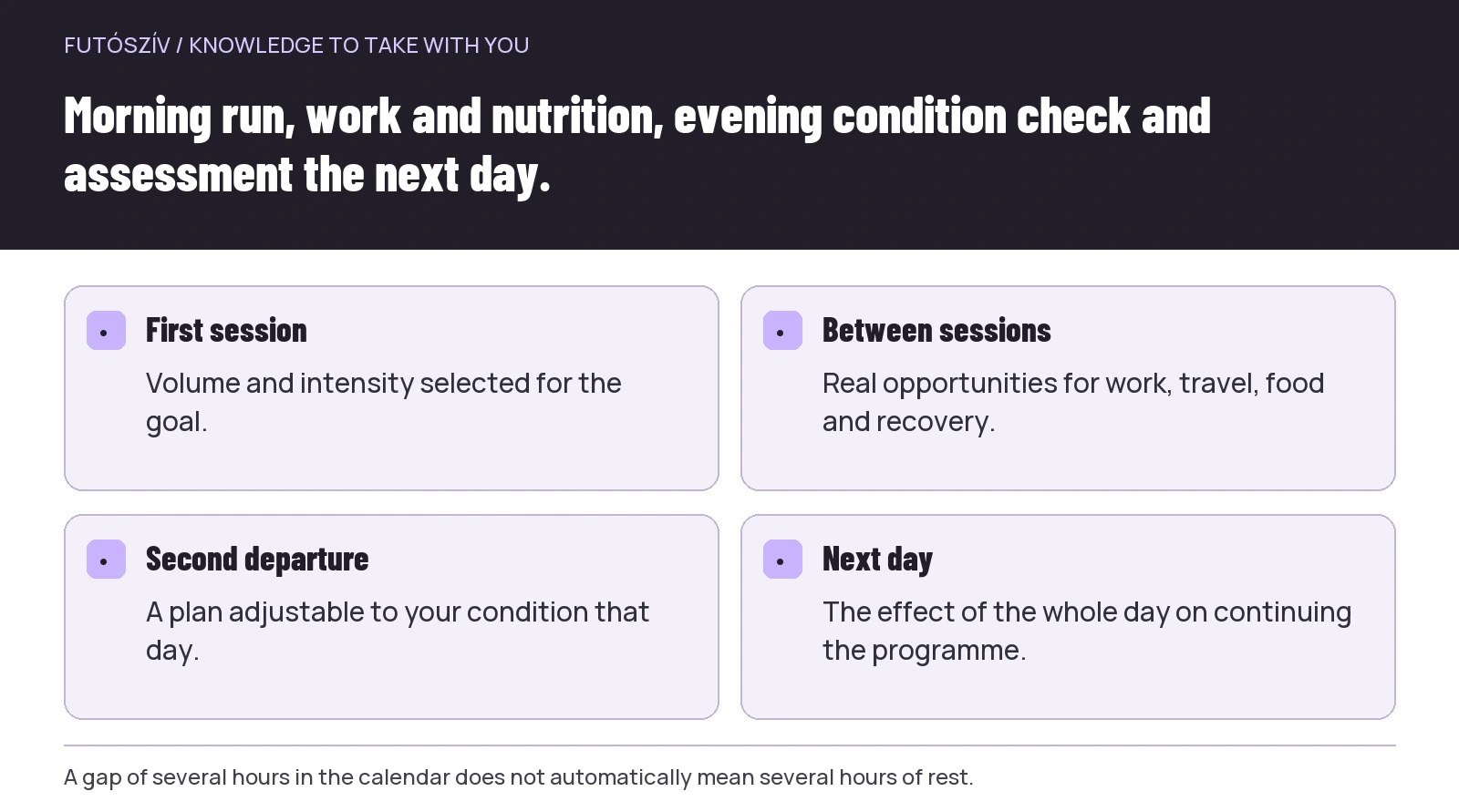
Between the two runs there may be office work, physical work, caring for children, travelling or resting. These do not produce the same starting condition for the second outing. A gap of several hours in the calendar is not automatically several hours of recovery.
Allow for adequate food and fluids, dry clothing and a realistic arrangement of tasks. You do not need to begin with special products; make the everyday basics workable first. Illness or particular nutritional needs may require individual advice.
Assessing your condition before the second run does not require a compulsory watch-based test. Briefly check for pain, unusual exhaustion, feeling unwell or a circumstance that makes the original plan unsuitable. A morning decision does not oblige you to complete the evening run at any cost.
Distribution or increase? Make the distinction in your log too
If redistributing weekly volume, keep the total visible. It is easy for the main run to remain unchanged while the second is added under a “just short” label. This is an increase in volume, not simply reorganisation.
Mark intensity too. If a second easy run turns into a faster group session, the original structure changes. Evaluate what you actually did rather than the workout name entered in the app.
It is useful to record the two sessions, the nature of the intervening day and how you felt the next day on separate lines. The whole story then does not disappear behind one daily distance total. This matters more for the next decision than two completed ticks in the calendar.
 Enlarge diagram
Text version of the illustration
- First session
- Volume and intensity selected for the goal.
- Between sessions
- Real opportunities for work, travel, food and recovery.
- Second departure
- A plan adjustable to your condition that day.
- Next day
- The effect of the whole day on continuing the programme.
When might one run be simpler?
If your current consistency is still uncertain, two departures may introduce another organisational difficulty. If the main session already leaves substantial after-effects, a second outing may not be the missing solution. If sleep is scarce, address that basic situation first.
The single run can be shorter and easy to fit in. You do not need to salvage the entire planned volume at any cost. A programme you can follow over time is often worth more than occasional exceptionally crowded days.
Another form of movement or an easy walk can also be enjoyable, but do not automatically regard it as the same running session. The choice may serve wellbeing, transport or relaxation. Not every activity has to carry the same training label.
How should you assess introducing it?
First check whether your recent programme has been consistent with acceptable after-effects. Then clarify the purpose of the new structure and which variable will change. If frequency, volume and intensity would all increase together, understanding the response will be difficult.
Do not trial it in the week before the season’s most important race. A new training structure needs observation time and room for adjustment. You do not need to treat the experiment as a permanent system after its first day.
Also assess how it fits the realities of family and work. A second run possible on paper may not be regularly manageable. A good plan works in your life, not only in spreadsheet cells.
Do not automatically explain performance decline as weakness
The joint ECSS–ACSM consensus statement on overtraining emphasises the balance between workload and recovery, and the complex assessment of persistent decline. One bad day cannot diagnose overtraining syndrome, but recurring problems should not be dismissed either.
Unusual exhaustion, sustained performance decline, altered wellbeing or recurring pain call for assessing the programme and health background together. The answer is not automatically another run, and cannot be chosen on one device score alone.
If you have sharp or increasing pain, a limp or feel unwell, do not use the second run as a checking test. Medical help may be needed depending on symptom severity. Shortening the day’s plan can be an appropriate adjustment.
Leaving out the double can also be a good decision
If two sessions clearly solve an organisational or training-planning problem and the whole system remains manageable, they may have a place. If no benefit is apparent, running once a day is not a lower level of sport. The number of clothing changes in a day does not measure how seriously you run.
At the end of the decision, be able to name four things: the goal, whether total volume changed, what happened between sessions and how the next day went. These provide a basis for choosing an individually appropriate next step.
Sources
- Comparison of acute physiological responses between one long and two short sessions of moderate-intensity training in endurance athletes.
- Skeletal muscle adaptation: training twice every second day vs. training once daily.
- Skeletal muscle adaptation and performance responses to once a day versus twice every second day endurance training regimens.
- ECSS–ACSM joint consensus statement on overtraining syndrome.
How Futószív articles are prepared: our editorial guidelines.