
A run goes worse than expected and you immediately seek an explanation: the long run was too much, the plan is wrong or fitness has disappeared. After an exceptionally good day, you may instead feel every target pace can rise immediately. A training diary can help prevent one session from becoming the whole story.
That requires more than collecting plenty of data. You need a good question, comparable sessions and consistent interpretation. The diary’s purpose is not judging you after every run, but making the next decision more precise.
Begin with an answerable question
“Am I improving?” is too broad. A more precise question might ask whether a familiar easy route has recently required different effort, or whether the next key workout regularly becomes difficult after a longer run. Suitable sessions can be selected to address these.
Link the question to your goal. If establishing consistency, completed sessions and scheduling may matter more than the fastest kilometre. If practising race pace, section pacing and recovery intervals belong in evaluation too.
Write the question before scrolling through graphs. Otherwise it is easy to invent a new story afterwards for whichever number stands out. Good analysis searches deliberately and accepts that an answer may remain uncertain.
Separate the plan from what happened
Record the intended task and actual execution. A shortened main set, longer recovery or route change matters. If only the original plan remains visible, later comparisons do not concern reality.
Briefly add why you changed it: lack of time, transport, weather, well-being or symptoms. Not every departure means unsuccessful training. Adapting to the situation may have been appropriate execution.
A missing session should not automatically mean zero discipline either. Illness, family responsibilities or necessary rest call for different decisions from a poorly chosen time slot. A precise reason can support useful changes later.
Check the data first
Are you measuring the same concept every time? Elapsed and moving time may differ, and automatic pauses can conceal stops. These also shape average pace on a road run full of crossings.
Check units, accidental duplicates and apparently faulty sections. One unusually fast kilometre alongside a jump on the map may not represent a performance peak. Mark the error rather than creating a training-theory explanation from it.
Leave missing data missing if it cannot be reliably recovered. Invented effort or sleep values produce an apparently tidy table while weakening interpretation. Honest uncertainty beats precise-looking guesswork.
Compare similar tasks
An easy run, interval workout and race serve different goals. Arranging their average paces in one line does not provide a performance trend. Group by task first, then examine change over time.
Identical labels can conceal differences too. An “easy” session may vary in length, terrain and preceding load; for intervals, recovery belongs to the workload. Make any changed element visible in the comparison.
You need not make every condition perfectly identical. Everyday running is not a laboratory. The aim is recognising important differences rather than attributing every variation solely to fitness.
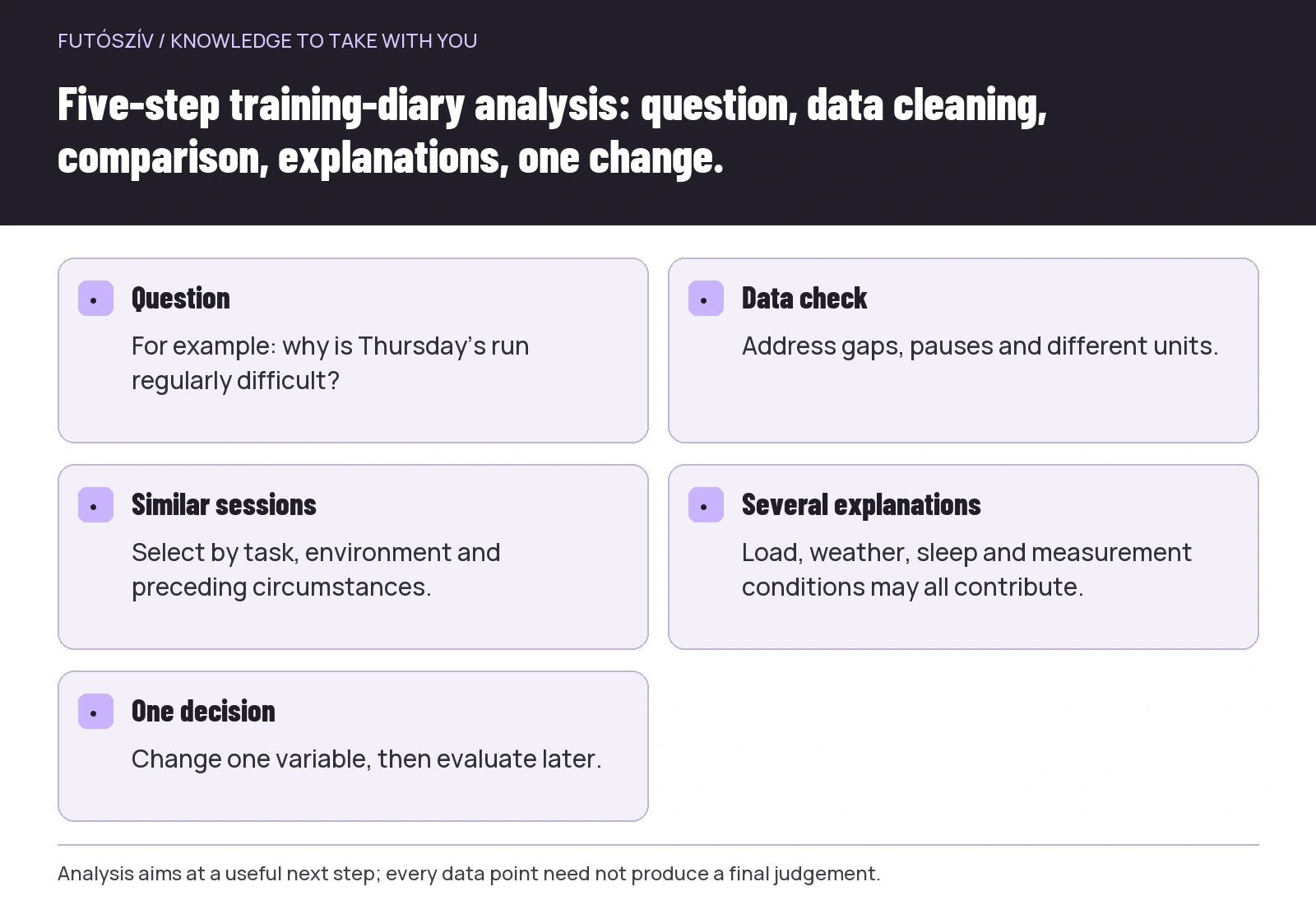 Enlarge diagram
Text version of the illustration
- Question
- For example: why is Thursday’s run regularly difficult?
- Data check
- Address gaps, pauses and different units.
- Similar sessions
- Select by task, environment and preceding circumstances.
- Several explanations
- Load, weather, sleep and measurement conditions may all contribute.
- One decision
- Change one variable, then evaluate later.
Even a repeatable test is not a perfect copy
A five-kilometre time trial on a non-motorised treadmill involving seventeen male runners showed good repeatability, but variation remained between measurements. The study concerns its own testing environment; its findings cannot create a universal error margin for every outdoor run.
The lesson is that a small difference alone does not always represent real, lasting change. Measurement conditions, daily state and execution can contribute. A measurement regarded as reliable and completely noise-free data are different things.
Seek several appropriately comparable experiences. You need not run a maximal test every week. Completed familiar, manageable sessions and how they feel can provide information when recorded consistently.
Do not treat the environment as a minor footnote
Wind, temperature, terrain and stops can affect pace and effort. A large study analysing results from several marathons also examined environmental factors’ relationship with performance. This is group-level race data, not a personal time correction for every workout.
A few relevant words may suffice in your diary: strong headwind, slippery route, many stops or unusual heat. You need not retrospectively calculate the environmental cost to decimal places. The note already helps avoid a faulty comparison.
For substantial elevation, examine duration and effort alongside pace. Simply adding flat and trail kilometres does not describe every task. The cause of change is often visible on the map before you seek a complex measure.
Effort is not less valuable because it is subjective
Consistently recording sensations can add information distance misses. The same loop may feel easy one day and unusually hard another. That difference matters even if pace stays similar.
Load estimation based on whole-session effort has also been examined in research. This does not turn a subjective value into a direct biological instrument. Its value lies in consistent personal feedback, not ranking everyone’s numbers.
Use a predefined scale and similar recording routine. If one rating concerns only the last fast section and another the whole day, the numbers represent different concepts. A brief written comment can clarify.
Look at sequence alongside totals
Weekly running time or kilometres are useful summaries but do not reveal adjacent tasks. Two weeks with similar totals may differ in whether manageable days separated hard workouts or everything clustered at the weekend.
If one key workout repeatedly goes poorly, inspect preceding days. A long run, new strength work, travel or little sleep can all belong to the story. Do not analyse only the session that felt difficult.
Recognising a pattern does not automatically prove its cause. Two things changing together may relate, but other factors can underlie them. A considered, traceable adjustment may be the next step, not an immediate final verdict.
Look for extremes behind the average too
A calm-looking monthly average can conceal a sudden large weekend or prolonged complete break. Examine individual days and weeks too. An average helps when you understand its distribution.
The fastest data point can receive excessive attention. If you always regard the best day as your true ability, every other run looks like decline. Typical repeatable performance and an exceptional result are different information.
The same applies to the worst day. After a difficult run, review what preceded and followed it. If a problem persists or includes symptoms, do not dismiss it merely as statistical variation; appropriate help may be needed.
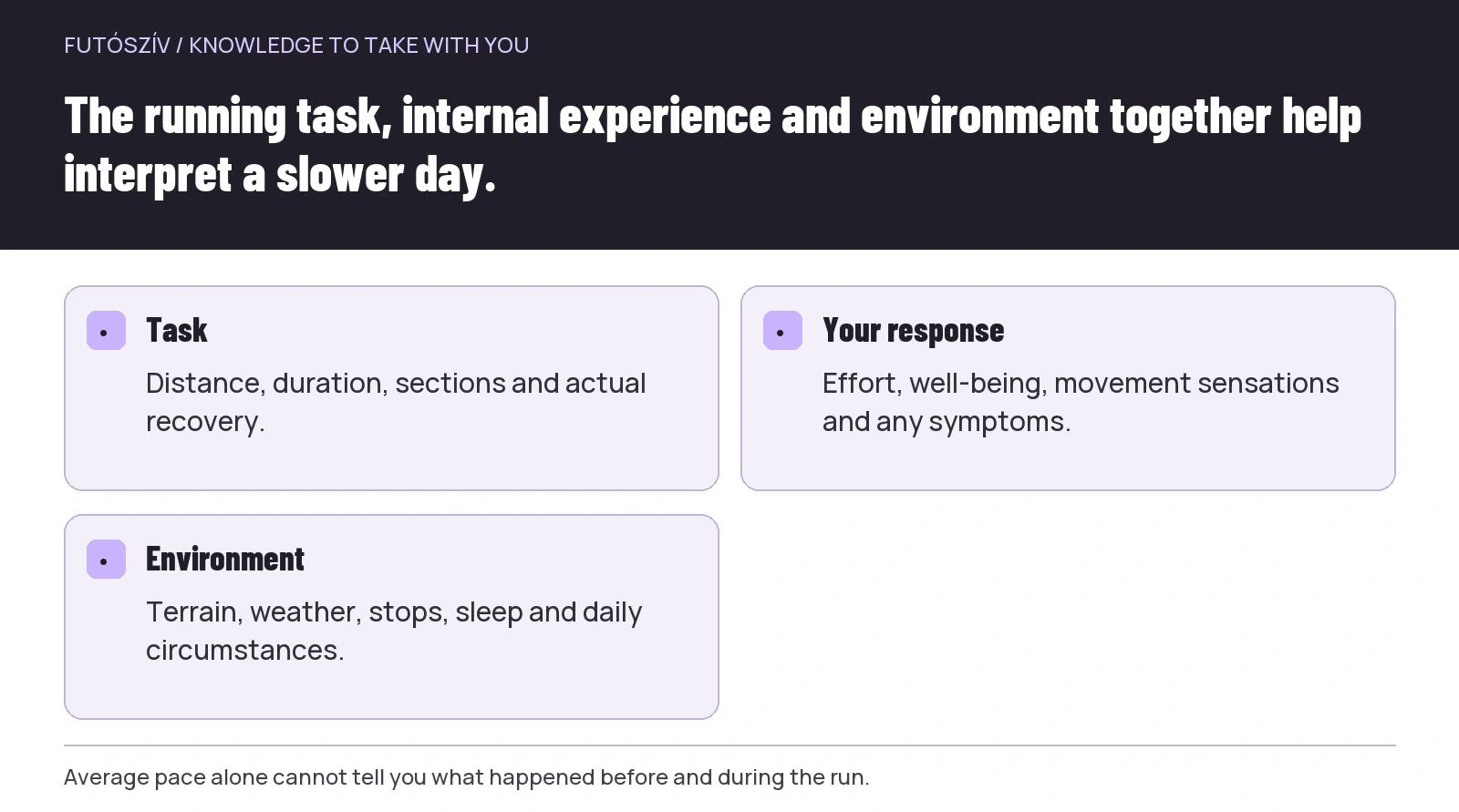 Enlarge diagram
Text version of the illustration
- Task
- Distance, duration, sections and actual recovery.
- Your response
- Effort, well-being, movement sensations and any symptoms.
- Environment
- Terrain, weather, stops, sleep and daily circumstances.
An example: Thursdays are regularly difficult
A runner notices that Thursday’s easy run has felt unusually hard for weeks. They first check whether the tasks are genuinely similar. They discover new strength training on Wednesdays and a regularly later bedtime that evening.
This does not yet prove how much each factor causes. It creates a concrete next question: if strength-session size or placement changes and more sleep opportunity remains, will Thursdays become more manageable? Fit the adjustment into the whole plan.
At the next review, they consider more than average pace. They record well-being, effort and whether the weekly system worked. The change aims at a more manageable programme, not a prettier spreadsheet cell.
Another example: a faster loop with greater effort
A runner is pleased to go faster on a familiar loop, but the note says it also felt substantially harder. This need not automatically be labelled improvement or failure. It was simply a task performed with different effort.
If the goal was easy running, a faster time does not necessarily mean better fulfilment. Maintaining the easy character may be the next lesson. If it was a deliberate test, record its background and conditions precisely instead.
Interpreting the diary therefore always returns to the original question. A number is not good or bad by itself. It describes a relationship between task, effort and environment.
Choose one decision at the end
Do not change pace, volume, terrain, shoes and training day simultaneously merely because you found several possible explanations. After multiple changes, identifying what helped is difficult. Choose one important, realistic next step.
Write when and from which experience you will evaluate it too. You need not turn life into a rigid experiment, but keep the decision traceable. If illness or another major change intervenes, account for the new situation separately.
If information is insufficient, the decision can be further consistent observation. This is not inaction. Collecting a few appropriate observations is better than rewriting the programme after one bad run.
Do not let the diary become another stress source
If every run traps you in prolonged analysis or display colours determine your mood all day, simplify. A few important data points and a short note may suffice. The tool should support running rather than create another compulsory performance.
Seek appropriate help for persistent anxiety, compulsive checking or difficulties disrupting daily life. A training diary is not a diagnostic platform, and every question need not be solved through independent data analysis.
A good diary is reviewable, honest and detailed enough for decisions. Its value is not showing a record every day, but helping recognise your own patterns and adapt the next task to reality.
Sources
- The Reliability of Running Performance in a 5 km Time Trial on a Non-motorized Treadmill – repeatability in a particular testing environment.
- Impact of environmental parameters on marathon running performance – observational analysis of a large race database.
- A new approach to monitoring exercise training – whole-session perceived effort’s role in estimating training load.
How Futószív articles are prepared: our editorial guidelines.