
Your plan says “easy run” on Tuesday and “recovery jog” on Thursday. Their paces are almost identical, yet their purposes may differ. The distinction is not a secret heart-rate boundary, but why the activity is in the week, the condition you start from and what you hope it will do. Clarifying this reduces the chance of every slow day quietly becoming another substantial session.
Names vary between coaches and programmes. Here, an easy run means planned endurance work at a comfortable intensity. A recovery outing means short, low-load activity primarily adapted to a more fatigued state. These are working definitions, not clinical categories applying to everyone.
The same speed does not mean the same load
Imagine two forty-minute runs on the same park path. You arrive rested for one; the other follows a hard race, poor night and long working day. Distance may be similar, but internal exercise load and total daily demands can differ. External performance is only half the story.
The sports-physiology overview of load monitoring distinguishes external work from the internal response. In practice, record perceived difficulty alongside kilometres, pace and time. Calling a run easy in a spreadsheet does not make it easy.
Look beyond fast days in the running week. A long slow loop, hilly easy session or new surface can also provide substantial work. Understand overall load through the whole outing and your response, rather than one data field.
An easy run can have its own training purpose
Easy running can accumulate endurance work, maintain regular activity or build the foundation for a longer programme. You need not append fast sections to give every such day meaning. Easier and harder stimuli both have roles in a training week.
The study involving runners by Esteve-Lanao and colleagues compared the performance effects of different intensity distributions. Such research supports the importance of distribution without providing one compulsory weekly ratio for every recreational runner. Participants, programme and measurement method limit generalisation.
An easy day is therefore more than “empty space between hard sessions”. It can have a defined task. Still set boundaries: planned duration, acceptable hills and whether spontaneous acceleration at the end is allowed. Without clarity, company or route can readily change the purpose.
A recovery run need not be compulsory
The recovery label creates an odd obligation for many runners. They feel they must run fatigue out of their legs to recover. This conclusion goes too far. Short, comfortable movement can be pleasant, but running is not necessarily what you need that day. Walking or rest may suit better.
Treat such a day as a choice. If everyday walking is difficult, legs hurt or you generally feel unwell, do not set out because of the programme’s label. If easy movement feels good, keep it genuinely comfortable and easy to shorten. Completing the original distance at any cost is unnecessary.
After a recovery outing, ask whether it made the day more manageable or added fatigue. “I ticked that off too” differs from the session genuinely serving the week. Make that distinction visible in your diary.
 Enlarge diagram
Text version of the illustration
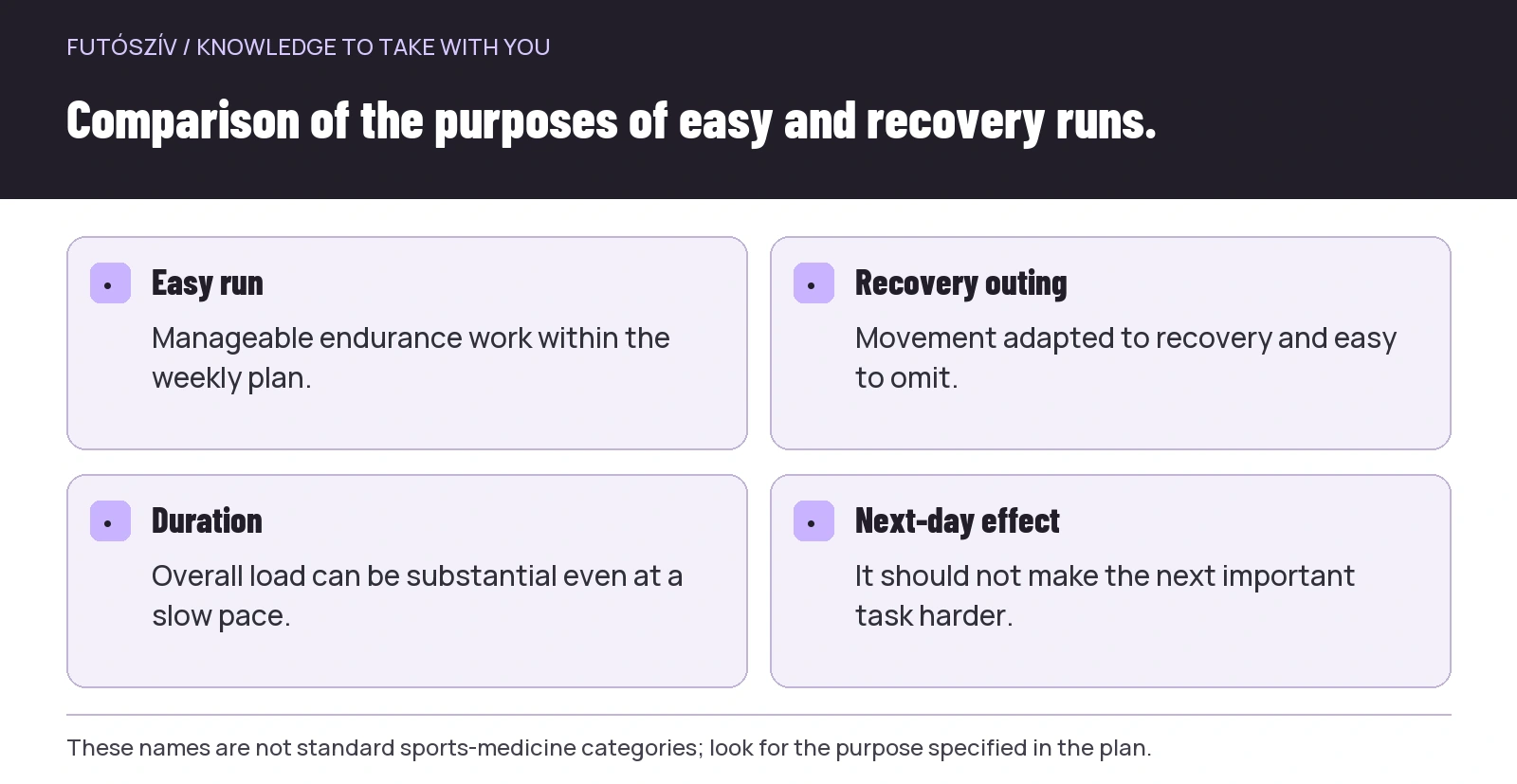
- Easy run
- Manageable endurance work within the weekly plan.
- Recovery outing
- Movement adapted to recovery and easy to omit.
- Duration
- Overall load can be substantial even at a slow pace.
- Next-day effect
- It should not make the next important task harder.
Conversational pace differs between people
Comfortable running leaves attention for surroundings without speech becoming continual gasping. This is a useful observation, but not an equally precise instrument for everyone in every situation. Respiratory disease, medication or individual health circumstances may make other feedback important too.
Do not copy easy intensity from a partner’s kilometre time. Even in company, slowing, shortening or separate groups may be needed. Someone chatting effortlessly beside you does not establish that your relative effort is the same.
With a coach, ask what easy means in your programme: heart rate, perceived effort, route or a combination? “Not fast” may be insufficient, especially if you tend to chase yesterday’s pace every outing.
Slow running can still be long and tiring
Load has duration as well as intensity. Two comfortable hours differ from twenty easy minutes. Fatigue after a long loop does not disprove lower intensity during it; total work simply differs.
Route matters too. Hills, technical ground, heat and repeated stopping and restarting change the outing. For a recovery day, consider organisational and environmental difficulty as well as reducing pace. A short, familiar loop is often easier to regulate.
Near the finish, adding a detour is tempting because you are already out. Decide beforehand if the day’s purpose is low load. Sport can allow spontaneity without every easy outing lengthening for the same reason.
Four situations, four separate assessments
The day after hard intervals. If easy movement is comfortable and there are no symptoms, a short outing may fit. If movement loses coordination from the opening minutes or pain worsens, do not treat it as compulsory loosening-up. Assessing the situation matters more than the label.
The day after a long race. Fatigue can change for several days after finishing. You need not prove you are back by running the next morning. Travel, access to food and fluids, sleep and comfortable everyday movement deserve attention too.
Poor sleep in an otherwise easy week. A planned easy run can be shortened. Missing minutes need not be added tomorrow. Adaptation often means retaining the weekly purpose while changing individual days.
A rested day before an important session. Easy movement may belong to the routine, but unusually good legs are not a reason to speed up. Feeling good is not always an invitation to another test. Keep the next day’s task in view.
Consider measurement methods when planning weekly distribution
Much is said about ideal ratios of easy and hard minutes. Ratios also depend on whether time, distance or a session’s principal purpose is counted. Intervals with warm-up and rests can contain many easy minutes while remaining a hard day overall.
The work by Seiler and Kjerland also examined quantifying intensity distribution in elite athletes. Do not extract one percentage and fit every runner’s week to it. Method and sporting background are part of the number.
For recreational runners, initially distinguishing main hard days, planned easy work and optional loosening-up may suffice. This clarifies the week. If all three continually merge, define the original purposes more precisely.
 Enlarge diagram
Text version of the illustration
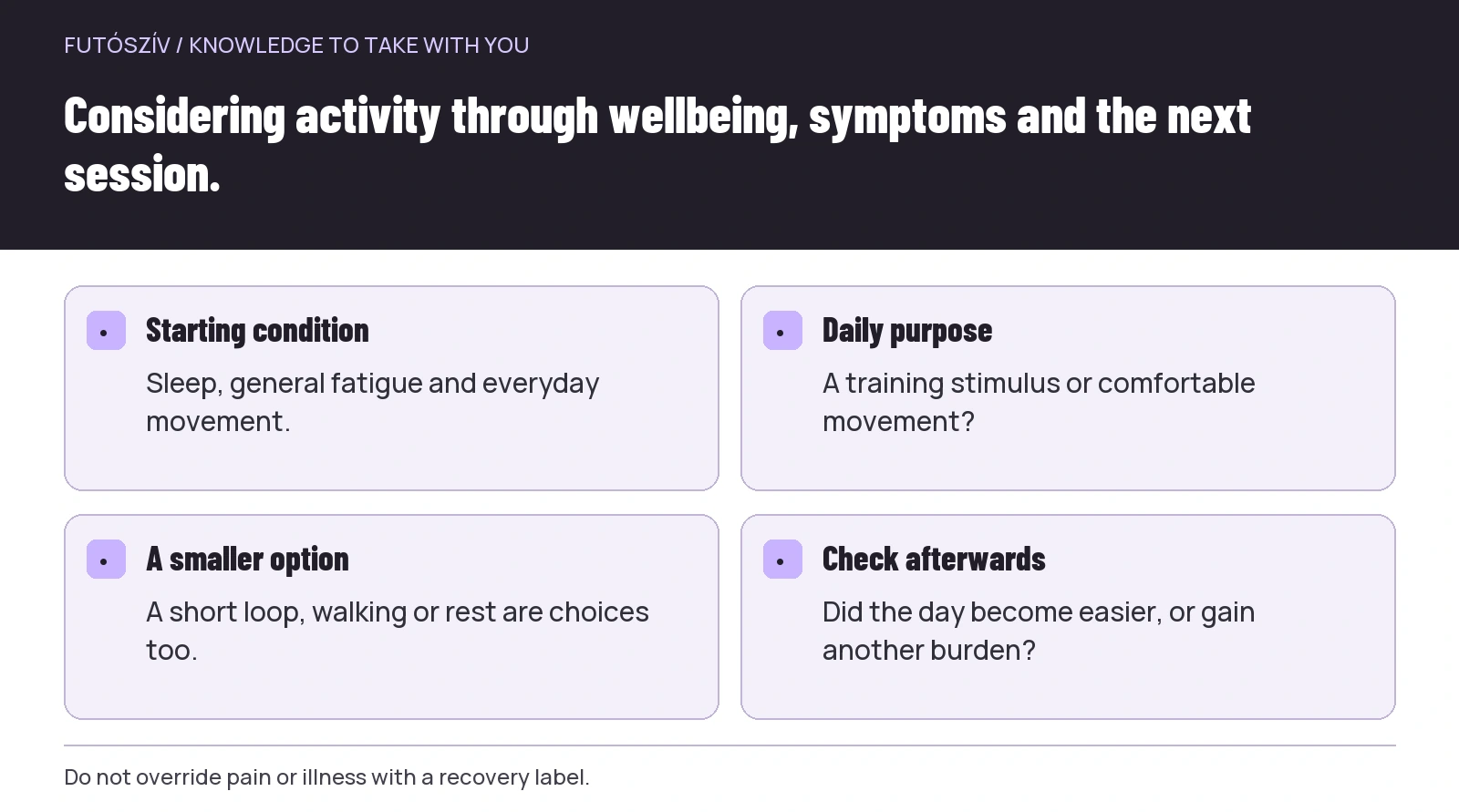
- Starting condition
- Sleep, general fatigue and everyday movement.
- Daily purpose
- A training stimulus or comfortable movement?
- A smaller option
- A short loop, walking or rest are choices too.
- Check afterwards
- Did the day become easier, or gain another burden?
What to record besides pace
Write the day’s purpose before leaving, then how it worked. For example: “intended as short loosening-up, but company made it moderately hard throughout”. This is useful information, not a confession of failure. Organise a similar outing differently next time.
A sentence about the following day helps too. Assessing the recovery label involves more than immediate enjoyment. If it regularly makes an important run harder, it may be too long, fast, poorly timed or simply unnecessary.
Do not turn the diary into another performance contest. Running every day earns no good score if weeks become less manageable. Data should help decide the next step.
How to discuss it with your coach
Ask specifically: is this developmental work or optional loosening-up? What is the shorter version? Which symptoms or conditions override it? If joining a group, what boundaries should it retain? Answers create a clearer day than a colour code.
Tell your coach about life beyond the course too. Travel, night work or caring demands create a different background from a rested day off. Life circumstances need not all be quantified to have a place in planning.
Without a coach, write the same answers yourself. The goal is not rigid checking, but giving “easy” a real, achievable meaning in your week.
When rest is the more accurate answer
With worsening pain, symptoms changing your gait, feeling ill or unusual malaise, even easy running is not automatically appropriate. Seek professional help where needed. This article is not individual injury-management advice or clearance to exercise with symptoms.
A planned rest day can be a deliberate training decision. If omitting a recovery run lets you complete the week’s important tasks in a manageable condition, omission has a purpose too. Running life includes more than recorded kilometres.
A simple trial for next week
Choose an easy day and one intended for recovery, placing a one-sentence purpose before each. At week’s end, check whether their roles actually differed. If not, decide whether both labels are needed or the plan is divided only in appearance.
A usable system explains what you do and why. Easy running can be valuable work, recovery movement a pleasant option and rest the best daily choice. Let your condition, circumstances and whole week’s purpose guide the decision together.
Sources
The runner study, intensity-distribution research and load-monitoring overview cited in this article provide the scientific framework. Names and scenarios are editorial interpretations, not standard diagnostic categories. Seek appropriate professional advice for individual illness, injury or persistent fatigue. Sources checked: 18 November 2026.
How Futószív articles are prepared: our editorial guidelines.