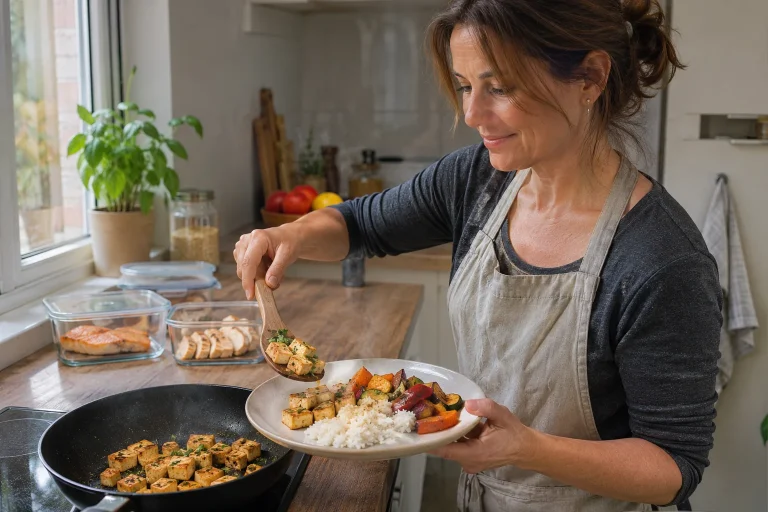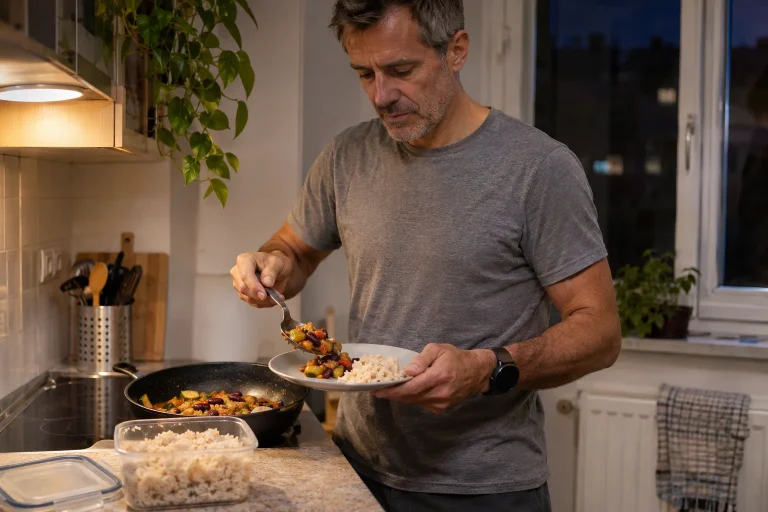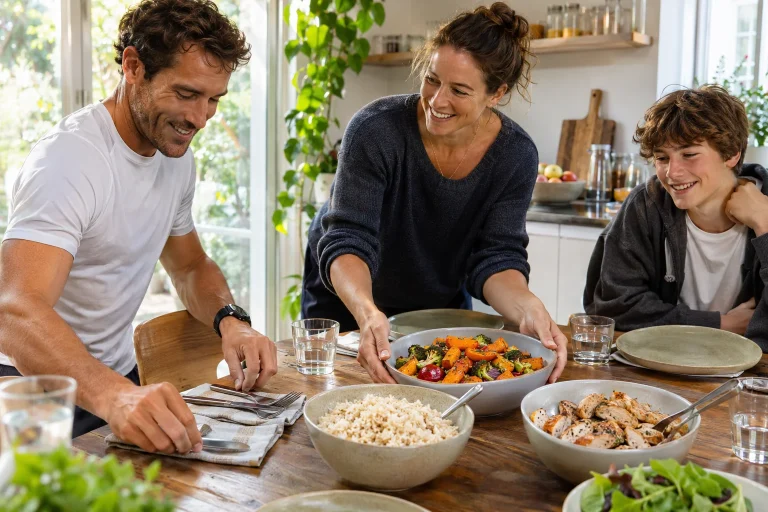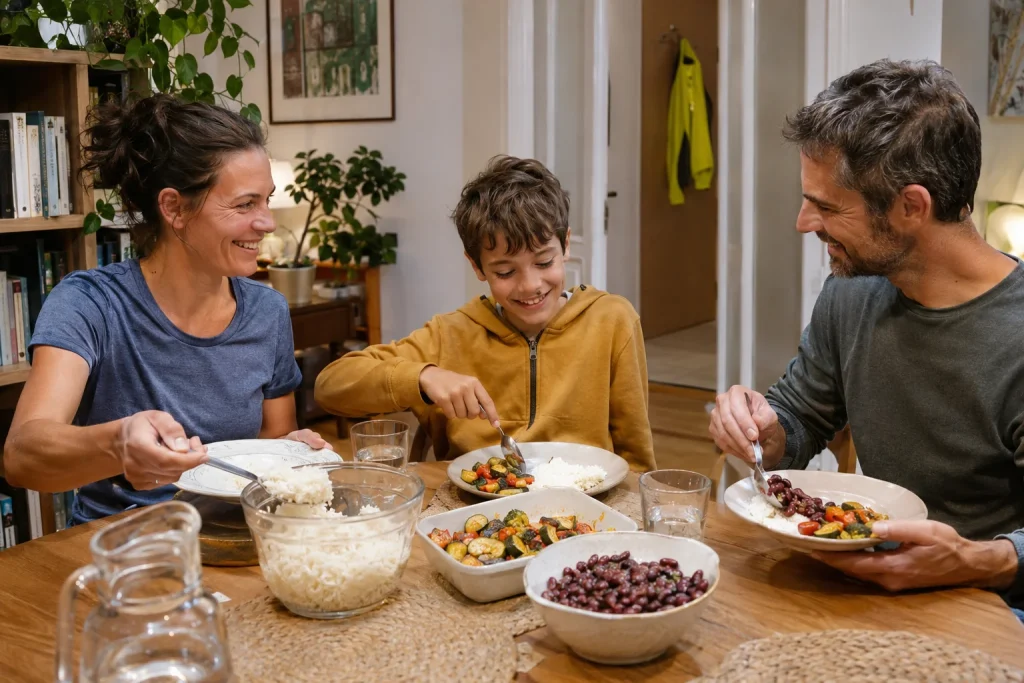
At family dinner, not everyone arrives home at the same time, wants the same food or wishes to eat the same amount. Running training can make this especially visible: someone is still travelling at the shared meal time, another is already hungry and nobody wants to prepare several completely separate dinners. Food served from shared basics in differing combinations can help with organisation. This article presents an everyday kitchen method without personalised portions or diets prescribed for children. Individual needs relating to age, health, allergy and sporting demands must be respected separately.
A shared meal need not mean identical plates
The same suitable basics can produce several combinations while preserving shared cooking. Participants’ appetites, preferences and needs may differ; running alone does not determine everyone’s portion. The NSWIS sports nutrition meal ideas also note that food proportions and quantities relate to individual circumstances. This article draws on the importance of personal adaptation, not copying elite-athlete portions to the family table. Appetite and needs do not become identical because food was cooked in one pot.
The aim is not to put every family member on a runner’s diet. A personal plan for an athlete and organising shared dinner are different tasks. For children, pregnancy, illness or a special diet, the relevant appropriate professional guidance matters. The kitchen system helps suitable elements be available rather than prescribing how much each person must eat. Keeping this distinction clear also makes conversation easier: we prepare a shared base while retaining individual needs and choices.
Agree timing first
Write down who can eat when and where there is real uncertainty. Everyone need not wait for a late-finishing session, and the runner need not leave all eating until one late time either. The NSWIS information on training conflicting with meals discusses organising the whole day in this situation. The specific solution depends on individual needs and comfort. The practical family question is what should be available at a particular time and how it will reach the table in appropriate condition for someone arriving later.
Identify a simple alternative if training or work runs late. For example, some family members eat at the planned time, while the portion to be eaten later goes into storage according to safe handling appropriate to the food. Arrange reheating and serving for the later meal too. The default backup should not be an entire pot left on the table for hours. Shared cooking retains its advantage only when the food-safety task between different eating times is planned as well.
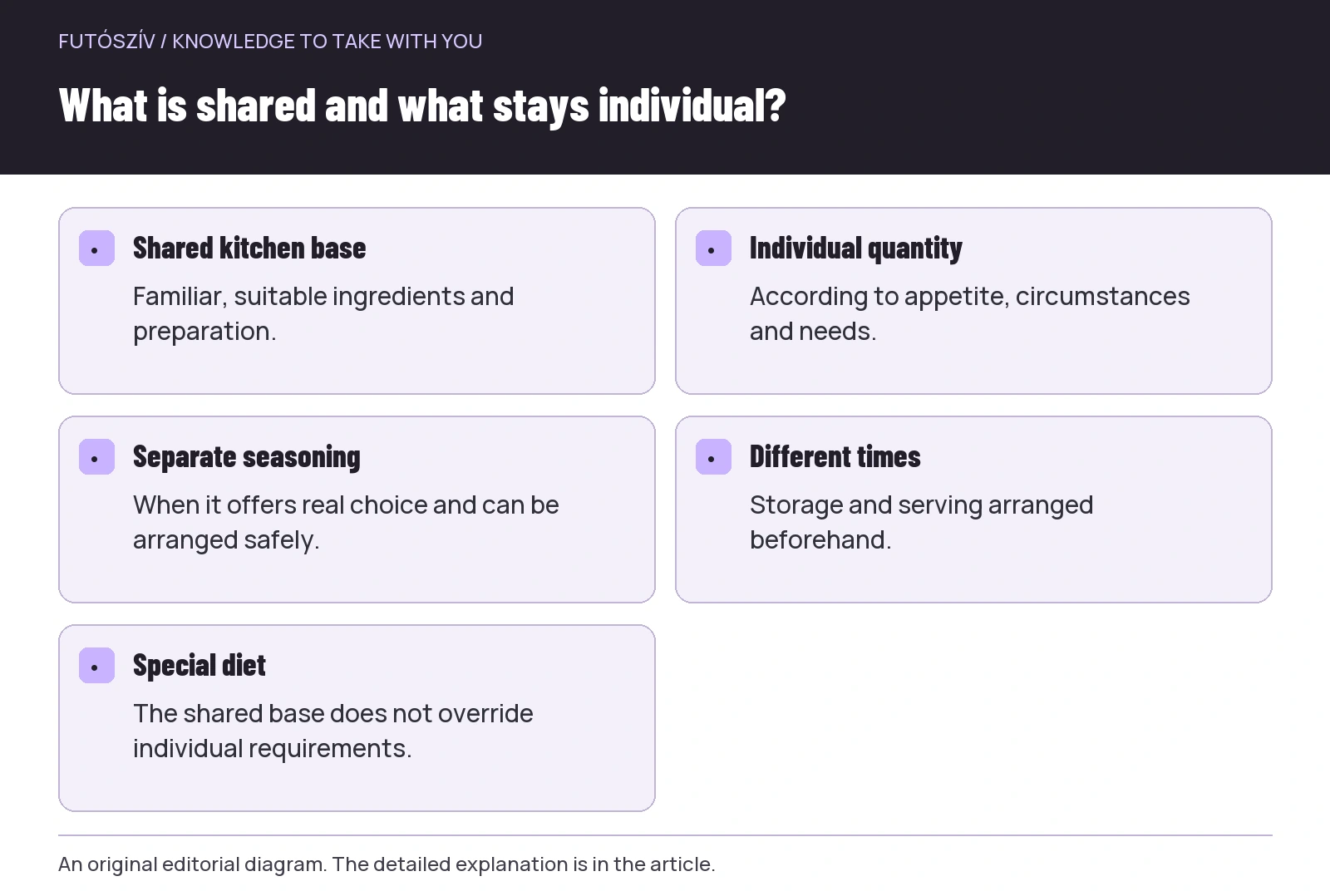 Enlarge diagram
Text version of the diagram
- Shared kitchen base
- Familiar, suitable ingredients and preparation.
- Individual quantity
- According to appetite, circumstances and needs.
- Separate seasoning
- When it offers real choice and can be arranged safely.
- Different times
- Storage and serving arranged beforehand.
- Special diet
- The shared base does not override individual requirements.
Choose a basic meal that genuinely allows different servings
A useful starting point might be pasta made to your own recipe with sauce and accompaniments offered separately, a bowl meal with several suitable toppings or a bread-based dinner with appropriate choices. Fit specific elements to the household’s diet and tastes. Not every dinner needs breaking into components; sometimes a one-pot dish enjoyed by everyone is simpler. A modular approach helps where separate serving offers real choice, not where it unnecessarily increases washing-up and the number of storage containers.
Think through the food elements by role: what is the base, which suitable protein source accompanies it, how vegetables or another necessary addition appear and what provides flavour. The adult OKOSTÁNYÉR guide can help review general food choices in Hungary. This adult framework is not precise portion guidance applicable to every family member and sporting situation. In kitchen organisation, it supports a dinner plan involving more than one ingredient, alongside adjustments needed for individual requirements.
Example: a pasta dinner served in separate components
The base can be pasta fitting the household diet, prepared according to its package, accompanied by a sauce the family enjoys and prepares appropriately. Suitable vegetables and a protein source fitting the diet can be offered too. Adapt particular portions and proportions to participants’ needs. Separate serving means plates need not be identical while most cooking remains shared. If a family member needs a different ingredient, arrange its safe preparation and separation separately; a separate bowl alone is not sufficient in every case.
During preparation, consider which element is made fresh, what can appropriately be prepared beforehand and how to handle the portion eaten later. You do not need to leave the whole supply on the table at once if people eat at different times. Appropriate storage and reheating should fit the specific food. The example has no prescribed gram amount or athlete nutrient target: it shows the logic of cooperation and serving. A personal diet cannot be automatically derived from the family pot, but shared kitchen basics can support its implementation.
Example: a hot bowl assembled individually
Another option is separately offering a familiar side-dish base, appropriately prepared vegetables and several toppings suitable for those involved. Participants choose according to individual needs, and seasonings can vary separately too. Many options are unnecessary: a few working elements may suffice. If everyone receives a different complete meal, the advantage of a shared base may be lost. In a simple system, overlapping tasks remain shared and differences appear where actually needed. Your own appetite need not be measured against other people’s plates.
Food choice is not a competition at the table. The runner is not obliged to take more, and others do not automatically receive less because they did not train. Quantity requirements are complex and individual; if a precise sports nutrition plan exists, its implementation can be coordinated with the shared kitchen. Family conversation should focus on practical questions: what needs to be plentiful, what people enjoy and which element should be separate. Shared dinner then remains a supportive setting rather than a place to justify or compare eating.
| Kitchen decision | A simple possible approach | What remains individual? |
|---|---|---|
| Basic meal | A dish enjoyed together that can be served in several ways. | Dietary suitability and necessary quantity. |
| Seasoning | Some elements can be offered separately. | Taste and known restrictions. |
| Late arrival | An appropriately stored portion and familiar serving procedure. | Coordination with the day’s other meals. |
| Sporting demands | Accessible, suitable elements. | The personal sports nutrition goal and timing. |
| Leftovers | Date, contents and a safe onward path. | Who will actually eat them and when. |
Make the food’s path clear for someone arriving later
Someone arriving after running should know which food is where and what still needs doing. A short label or discussion can help: contents, storage time and necessary further preparation. There should be no guessing whether a container left on the counter is fresh, awaiting refrigeration or set aside for another purpose. The Nébih menu-planning guide makes handling and storage of prepared food conditional on specific requirements. The kitchen plan must follow these rather than arranging only quantities and flavours.
When reheating, do not repeatedly heat the entire shared dish for each arrival. Follow the appropriate portioning, storage and reheating procedure for the specific food. The Nébih educational material The Journey of Food also discusses thawing and repeated reheating. Labelled, organised portions can help avoid unnecessary temperature changes. If the food’s history is uncertain, do not leave the person arriving late to invent the decision; establish a safe solution beforehand.
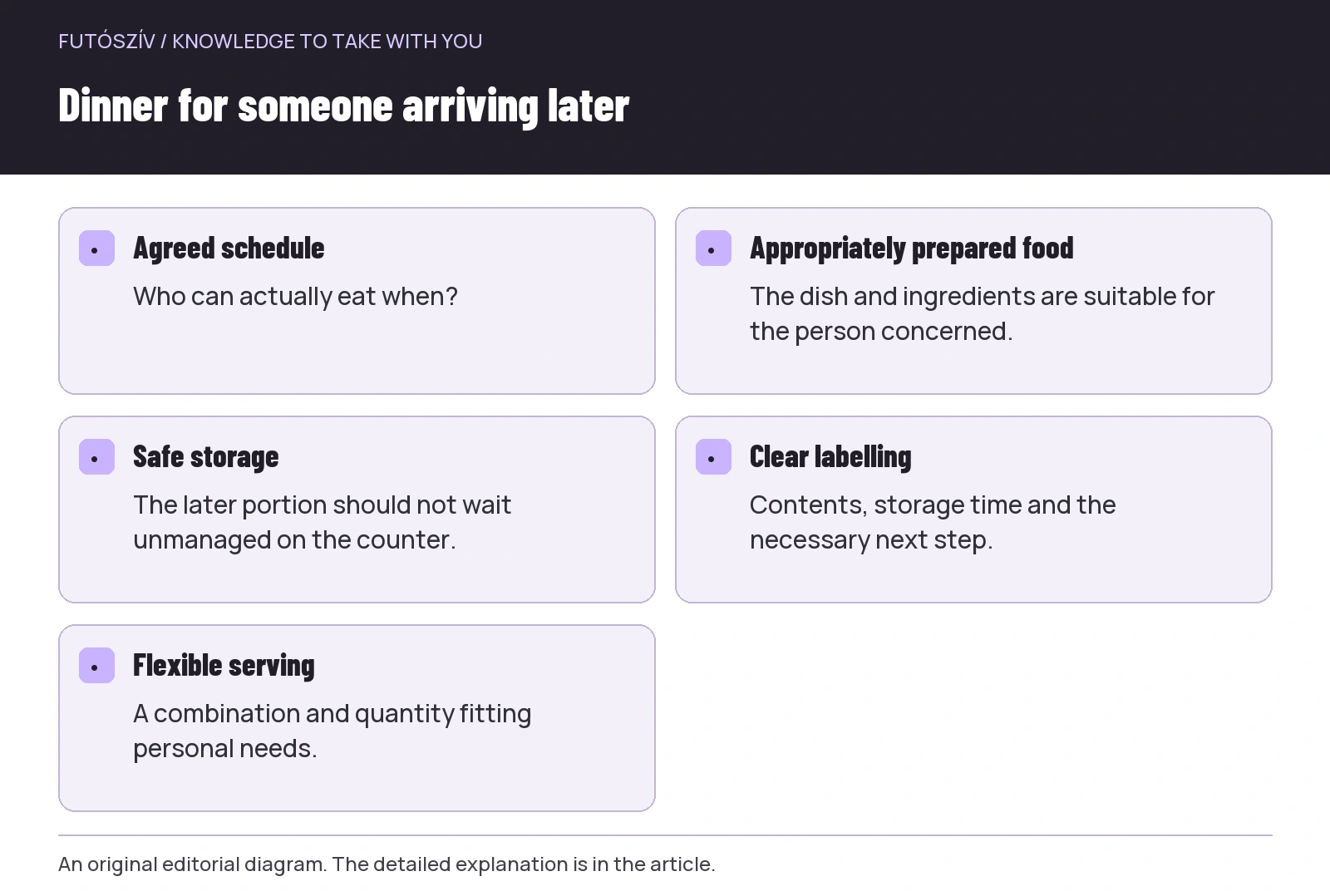 Enlarge diagram
Text version of the diagram
- Agreed schedule
- Who can actually eat when?
- Appropriately prepared food
- The dish and ingredients are suitable for the person concerned.
- Safe storage
- The later portion should not wait unmanaged on the counter.
- Clear labelling
- Contents, storage time and the necessary next step.
- Flexible serving
- A combination and quantity fitting personal needs.
Do not leave every last step to the most tired person
Sharing tasks belongs to the common system too. Discuss who prepares, who handles appropriate storage and what remains for each person on arrival. This need not be identical every day. The aim is to prevent making meals happen alongside running, work and family tasks from depending on one person’s improvisation. If late dinner requires only a few clear steps, it is easier to arrange than if the entire ingredient search and cooking begin then. The plan should fit work that can be undertaken together.
A brief preparation list may suffice: what is cooked together, what will be offered separately, which portion needs appropriate storage and the simple backup if the day changes. Every plate need not be designed beforehand. If the menu is more complicated than the time committed, simplify dishes rather than food-safety steps. Shared dinner remains a sustainable everyday habit when kitchen work and later tidying also fit. A few genuinely suitable elements are often clearer than too many separate options.
With allergies and special diets, check the shared base
Consider known dietary restrictions from the beginning of shopping and recipe choice. Removing an ingredient afterwards from a shared sauce is not necessarily an appropriate solution. Follow professional guidance given to the person concerned, product ingredient and allergen information, and necessary separation rules. Modular serving is an organisational option, not automatic allergen removal. This article does not provide an individual allergy-management recipe. Arrange the conditions of safe shared cooking precisely for the relevant needs rather than relying merely on separate plates.
Discuss differing needs factually without personal judgements. Someone unable to eat an element is not creating a kitchen competition or merely being fussy. Selecting an appropriate alternative may require time and information; give it room in the shared plan. Equally, the runner’s sports nutrition goal is not a general rule for the family. A working shared base can support differing needs but does not remove them. A clear ingredient list and agreed division of tasks help everyone involved know what went into the food.
What should happen to actual leftovers?
Before cooking, consider who is expected to eat and which portion will be saved for later. Handle leftovers appropriately to their nature and storage conditions, labelled and traceable. Avoid anonymous containers whose preparation time nobody remembers the next day. Two separate lunch plans should not count on the same leftovers, and nobody should have to eat food in uncertain condition to prevent waste. Better prevention comes through realistic cooking quantities and safe storage, not later guesswork.
After the first few shared meals, discuss what worked. Which separately served element offered real flexibility, what was made in excess and how much work remained for the later meal? Improve one point at the next dinner. The aim is not a perfect system every evening but a shared meal that works with different routines and needs. One basic meal can then produce several suitable combinations, retaining both the advantage of shared cooking and individual choice.
Sources and further reading
- NSWIS: 38 balanced meal ideas for athletes
- NSWIS: What should I do if I train during meal times?
- MDOSZ: OKOSTÁNYÉR for adults
- Nébih: Menu planning without leftovers
- Nébih: The journey of food
How Futószív articles are prepared: our editorial guidelines.