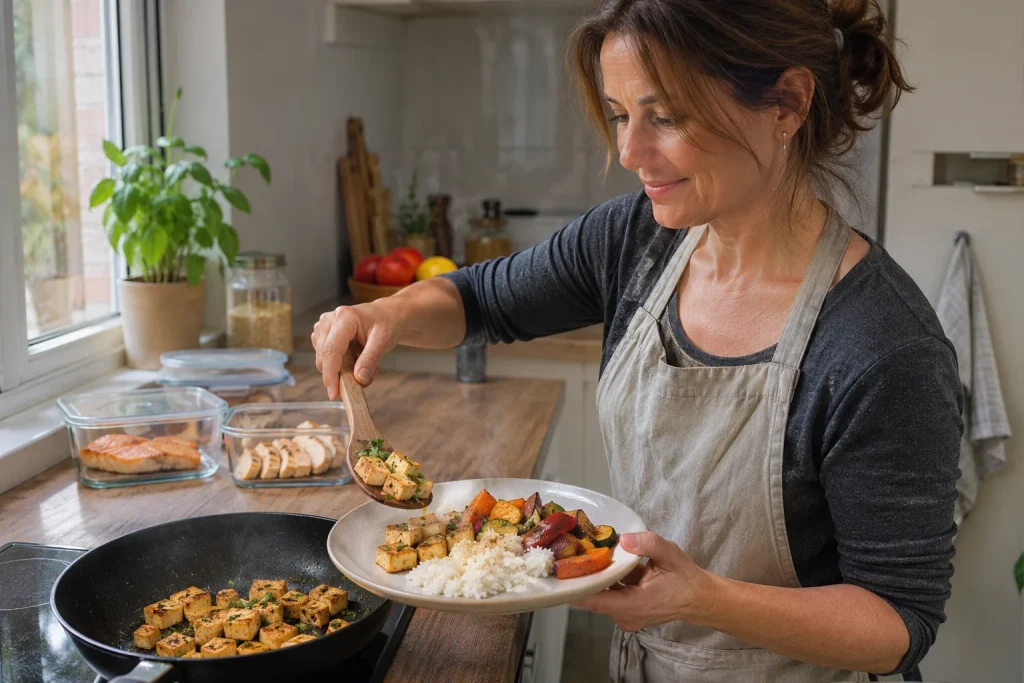
The same side dish can start several dinners. An appropriately prepared base can accompany fish, tofu or chicken if that version fits your diet. This helps avoid learning an entirely new workflow for every main ingredient. Interchangeability has limits, however: the three ingredients do not share identical composition, do not necessarily suit equal portions and need different preparation or cooking times.
This guide supports food preparation and organisation for adult recreational runners. It is not a personal dietary plan and establishes no nutritionally equivalent exchange ratios. With an allergy, illness or prescribed diet, ingredients, accompaniment and preparation must all be appropriate. These menu formats illustrate thinking, not performance promises from our own testing. Adapt quantities and the entire meal’s composition to your needs.
What exactly does a shared side dish mean?
A shared side does not mean a large batch kept for days under uncertain conditions. Here we begin with a base planned and appropriately prepared for one meal, to accompany different main components. It might be potato, pasta or another side fitting your diet, with its ingredient-specific preparation and handling rules. Taste, other ingredients and available equipment matter in selecting it.
A more neutrally prepared base can adapt to different seasoning. Some prominent flavours can belong to the topping or separately offered sauce. Different dinners then become combinations with their own flavour rather than forced versions of one dish. A simple base is not a flavourless meal. It means flavour can be shaped deliberately later without every ingredient meeting in the same pan.
Keep the shared base separate from raw toppings initially. A cooked side exposed to raw meat or fish juices cannot simply be served as a clean ready element. Give the prepared base and ingredients awaiting cooking separate places in your kitchen map. This is not needless complexity: knowing each food’s state makes the system reliable.
Choose for the whole dish
Do not select among three main elements from one highlighted nutritional value. Specific composition, quantity, preparation and other foods matter too. Plain versus marinated or sauced products create different kitchen situations. Fish species, meat preparation and tofu texture matter as well. For precise substitutions matching personal nutrient needs, plan with a dietitian rather than deriving equivalence from raw weights side by side.
For weekly options, consider availability, preparation knowledge and what you enjoy. All three versions need not be used in one week or meal. Thinking from a shared side provides several working possibilities. Explore a wholly new main component when equipment and sequence can be reviewed calmly.
| Main element | First kitchen question | What not to assume automatically |
|---|---|---|
| Fish. | Which specific product, in what condition and with which preparation instructions? | Fish fillet and ready canned fish do not share the same operations. |
| Tofu. | What texture, composition and intended use does the product have? | That every tofu cuts identically and serves the same purpose. |
| Chicken. | Is the product raw, appropriately thawed or ready to eat? | That the raw ingredient needs only brief surface browning. |
| Shared side. | When will it be ready, and how will it remain appropriate until serving? | That it can wait indefinitely for entirely differing topping times. |
 Enlarge diagram
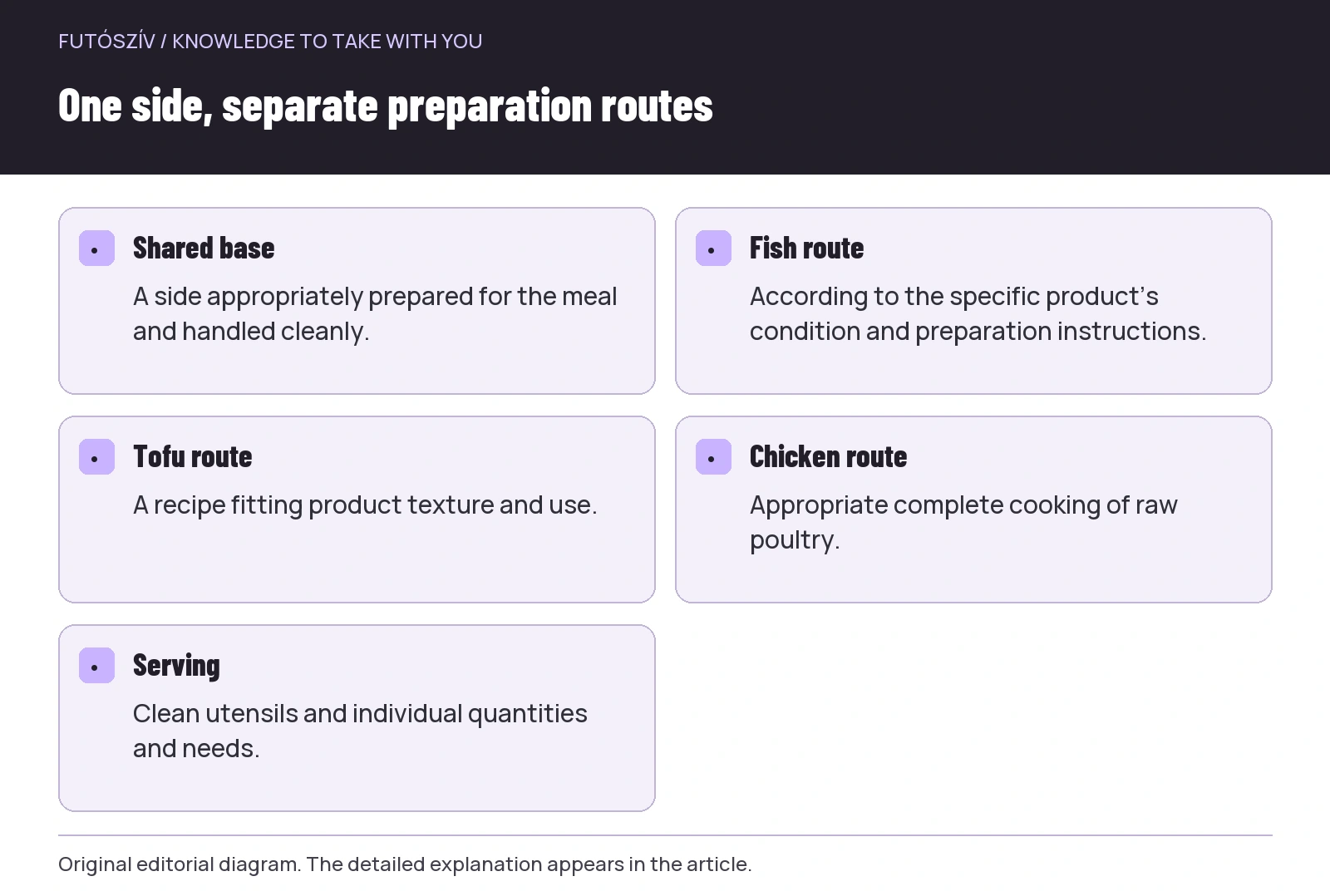
Text version of the diagram
- Shared base
- A side appropriately prepared for the meal and handled cleanly.
- Fish route
- According to the specific product’s condition and preparation instructions.
- Tofu route
- A recipe fitting product texture and use.
- Chicken route
- Appropriate complete cooking of raw poultry.
- Serving
- Clean utensils and individual quantities and needs.
Fish version: product condition and clean separation
The NHS guide to fish and shellfish emphasises avoiding contact between raw fish or its juices and cooked or directly consumed food. Raw preparation needs separate plates and utensils. Follow refrigeration and thawing requirements too. Cooking does not make fish suitable for a person allergic to it.
For a freshly cooked fillet, prepare the side and accompaniments first. Have suitable recipe equipment and work surfaces available. Use a separate clean plate for cooked food and do not touch the cooked side with utensils contaminated by raw fish. Adapt the full sequence to the specific product. This menu format gives no universal fish cooking time and cannot apply unchanged to every size or product type.
For ready-to-eat canned fish, labels, packaging condition and handling after opening have different emphasis. There is no need to imagine adding raw-fillet operations, but the opened product cannot wait indefinitely on the table either. Pair it with the side in an appropriate usable form. Account for bones and any cutting according to the food and person eating it.
Tofu version: the recipe starts with texture
First identify the tofu version purchased. Softer and firmer products may fit differently into a dish planned with solid pieces. Read seasoned products’ ingredients and use instructions separately. Plant origin does not automatically make every pack ready to eat or identically preparable. Build your recipe on that product’s instructions.
The NHS stir-fry recipe also suggests a firm-tofu variation on its original turkey dish. This illustrates how the same vegetable-and-side format can use different main elements. It is a family meal idea, not a general personally equivalent nutritional exchange. Consider the new ingredient’s preparation and whole-meal suitability separately.
For a topping in pieces, choose a product and recipe allowing it. Cutting, managing moisture and necessary pan space can all affect the result. Do not force a soft, crumbling base into pieces imitating chicken. Another serving form may be enjoyable: an appropriately prepared sauced or spoonable element offers a different experience with the same side.
Chicken version: plan for thorough cooking
The Food Standards Agency cooking guidance emphasises thoroughly cooking poultry. A clean food thermometer can support appropriate checks, together with time needed at the particular temperature. Clean it after use to avoid transferring contamination. External browning in a pan alone does not replace checking complete appropriate cooking.
For chicken, clearly separating clean and raw stages particularly helps. Prepare vegetables, side and serving tools; give raw-meat handling its own work surface and proper subsequent cleaning. Check composition and use for marinated or processed products too. The word chicken does not identify whether the package holds a raw ingredient or directly usable prepared food.
Do not copy cooking time from another version. Piece size, product condition and equipment all matter. Simplification can mean a known recipe, prepared ingredients and clear sequence, not shortening thorough cooking. If the full operation cannot fit available time, choose another safely achievable dinner. The shared-side idea permits that change too.
Three menu formats with the same thinking
The first serves the side separately with a separately cooked main component and vegetables. Contents are visible and individual portions easier to adapt. Flavour can focus in the topping or separate sauce. The second pairs the cooked side with an appropriately prepared sauced main. Texture and sauce quantity then belong to the meal, so compare more than solid ingredient pieces with another version.
The third is a warm bowl assembled at serving. Ready elements are prepared separately and meet on the plate. This may help households needing different versions with some shared bases. Preparation must still ensure appropriate conditions for everyone. With allergies, later omitting an ingredient from a shared bowl is insufficient; other dietary needs also require knowing sauces and seasonings used.
 Enlarge diagram
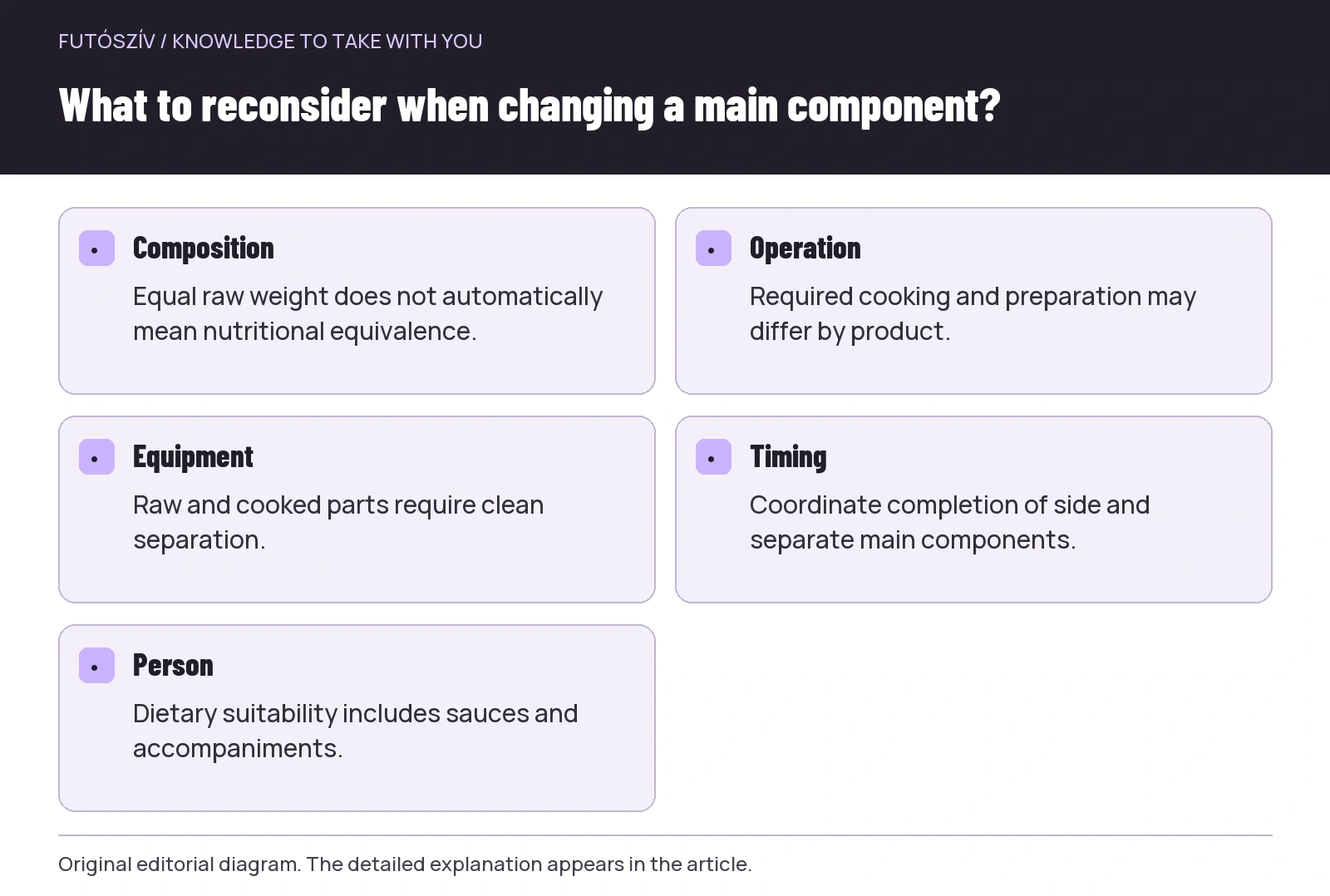
Text version of the diagram
- Composition
- Equal raw weight does not automatically mean nutritional equivalence.
- Operation
- Required cooking and preparation may differ by product.
- Equipment
- Raw and cooked parts require clean separation.
- Timing
- Coordinate completion of side and separate main components.
- Person
- Dietary suitability includes sauces and accompaniments.
Shape flavour in separate layers
Choose a flavour direction for the main component and adapt the shared side. Seasonings, suitable vegetables and separately served dressing need not all be highly prominent. A simpler side allows the main element’s character to emerge. Observe your experience when trying flavours and note combinations to make again. This is a kitchen choice, not a health classification.
Handle sauce ingredients as carefully as the main ingredient. An apparently plant-based version may contain something unsuitable for you, and one shared sauce may change the whole meal’s dietary suitability. With several diners, simple known composition and separate additions may be clearer. Variety comes from deliberately shaped favourite combinations, not unlimited ingredient numbers.
Time the meal around the slowest necessary operation
List main operations for your version and see what can safely happen in parallel. Coordinate side completion, thorough cooking of the main and serving. Do not automatically treat a recipe’s total minutes as your kitchen’s timing. Heating equipment, chopping and cleaning take time too. Knowing the actual sequence helps more than an excessively tight dinner window.
If several main components are prepared for one table, allow each its required cooking. Different operations may need more equipment or different starting times. Everything need not be compressed into one vessel. The shared-side method simplifies planning without promising every different need can be solved in one movement. Undertake as many versions as you can prepare under orderly appropriate conditions.
What makes this a repeatable everyday system?
Make three brief recipe notes for the same favourite side if all three main ingredients suit your diet. Each should include specific product condition, required preparation, appropriate cooking method and selected accompaniment. Do not merely write replace chicken with tofu. Make operations legible and retain whole-meal individual suitability. The sheets can later support shopping and timing too.
The method helps when it leads to enjoyable achievable meals. If a version takes too much work, seek another format or simpler flavouring. For personal nutrient ratios, request dietetic help. Several dinners can grow around one side while differences between main elements, appropriate handling and your eating needs remain visible.
Sources and further reading
- NHS: Fish and shellfish
- NHS: Turkey stir-fry, vegetarian variation
- Food Standards Agency: Cooking your food
How Futószív articles are prepared: our editorial guidelines.