Openness can mean several clearly described routes into participation
A running club wants to welcome new people while offering suitable sessions for experienced members too. The apparently simplest solution is to invite everyone to the same loop, labelled for all levels. Yet real differences remain on site: experience, goals, route knowledge and desired professional support vary. Openness therefore creates tasks in the programme structure too.
Every club need not meet every need at the same time. What matters is that existing formats are understandable, newcomers can find an appropriate next step and experienced participants receive more than an unstated compromise. Community unity and differing session content can be planned together.
Name needs first instead of ranking members
Beginner and experienced are overly broad labels. A returning runner may be new to social running, while a longstanding club member is now exploring another distance. In programme planning, therefore ask which tasks and support participants need.
Someone seeking their first regular sessions may head towards a different format from someone wanting professionally supported work towards a race. Someone else may choose a simple social loop alongside both. Club membership does not mean one permanent participation role from which you cannot later move.
When gathering needs, separate services actually deliverable from a wish list. A group social session, guided introduction and individual coaching may require different support. The club should describe precisely what it can actually organise and support appropriately.
Use overseas examples to understand the structure
The official RunTogether introduction presents several group formats for beginners, continuing participants and those seeking a greater challenge. This is the English system’s own programme and conditions, not a ready-made classification transferable to every Hungarian club. For your organising, it prompts the question of how to describe different entry points clearly.
The England Athletics 2026 report on Coastal Striders also presents differing running backgrounds and participation needs within one community. The example is not a general impact study or a guaranteed club-building recipe. It allows questions about your own community’s formats from a concrete operating example.
Do not automatically copy overseas names or participant numbers. Look first at your own location, leadership support and participant needs. A good classification makes real sessions understandable rather than using new labels to obscure an identical, unchanged programme.
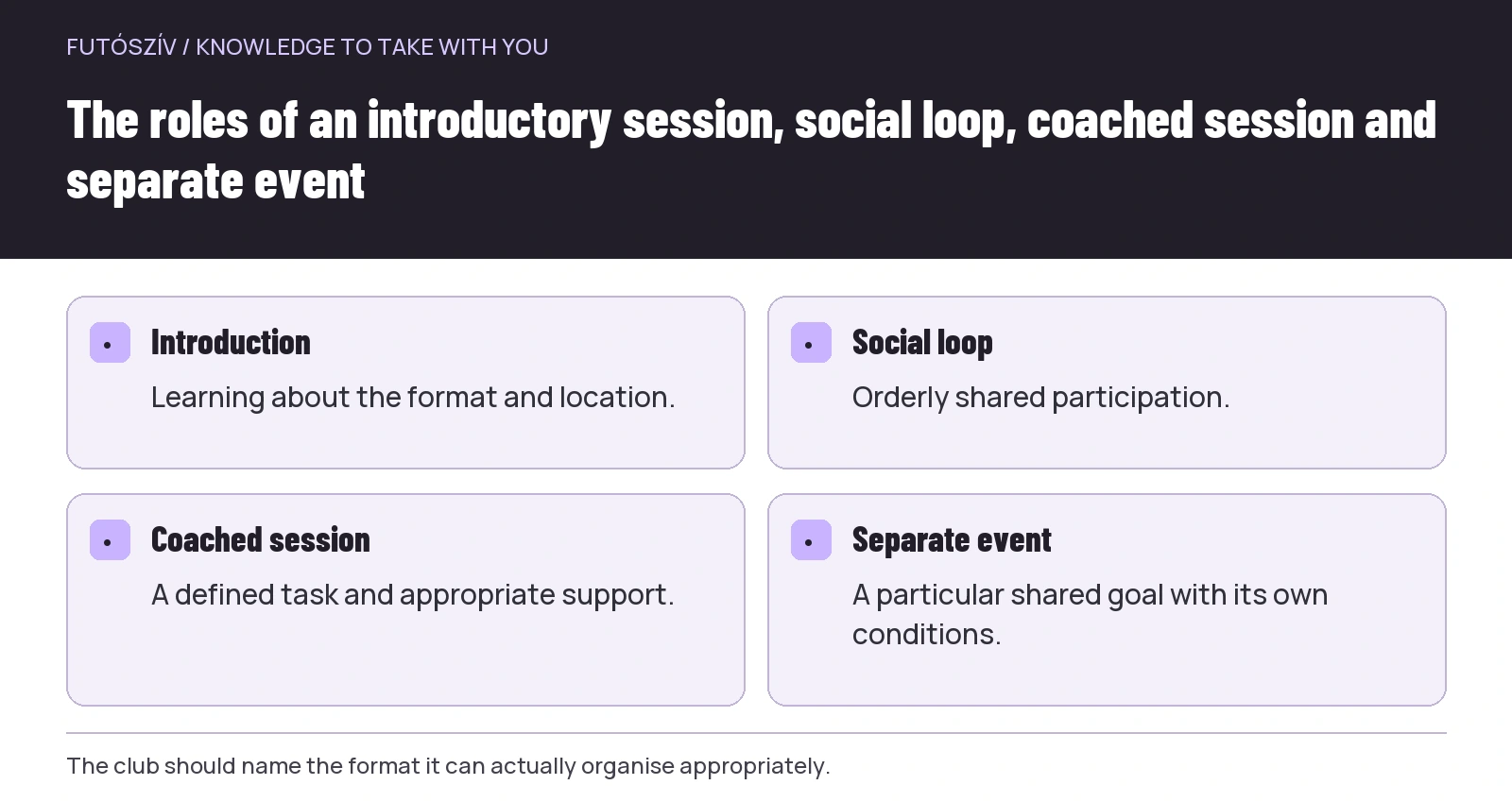 Enlarge diagram
Text version of the diagram
- Introduction
- Learning about the format and location.
- Social loop
- Orderly shared participation.
- Coached session
- A defined task and appropriate support.
- Separate event
- A particular shared goal with its own conditions.
Make a simple programme map
You can present club sessions in a table enabling newcomers to understand differences. Include purpose, route character, background needed, support and how to ask questions. People should not have to infer everything from pace-group letters alone.
| Programme role | What might participants seek in it? | What needs describing precisely? |
|---|---|---|
| Introductory session | Getting to know the format and location | Entry conditions and actual support |
| Social loop | Orderly shared participation | Staying-together and finishing arrangements |
| A defined coached session | A specific task and appropriate leadership | Service content and background needed |
| Separate event | A particular shared goal | Registration, preparation and organising conditions |
The table is an original planning framework. Every club need not operate all four formats. The overview can also reveal missing capacity, creating a question for later development.
Make the next step understandable from the first session
New participants should receive more than a trial experience: they should know where to ask about continuing. Which description should they read, whom should they consult and how can they choose another session? This can help prevent them landing by chance in the most visually striking group or the one containing most acquaintances.
Continuing need not automatically mean harder or longer. It may mean repeating the same format, choosing another time or seeking more suitable support. Develop the personal training plan with the appropriate person; the club’s entry route should make that discussion accessible.
Someone still observing the possibilities should not immediately have to adopt a complete membership identity. Make conditions for trials and lasting participation clear. Specifying fees, registration and the actual service is as much part of openness as a friendly welcome.
Moving between groups should not be a reward or demotion
Choosing another group can mean matching the task. A target race, routine or personal situation changed, so another session is now suitable. Let this be discussed without calling every switch progress or failure.
Communication between group leaders matters too. If someone joins a new format, necessary information should reach the appropriate person in the appropriate way, consistently with the organisation’s own procedures. Participants should not have to work out from scratch every time who can answer them.
Update changes in programme descriptions too. A previously social loop may develop into another type of session, but new content needs a new, precise description. Moving between formats does not work among old names and unstated changes.
Experienced members should not automatically become volunteer helpers
An experienced runner can contribute a great deal if they accept an appropriate task. But faster pace or longstanding membership alone does not confer a leadership role. People have a right to attend their own programme, and the club must actually arrange necessary organising support.
If offering a helper role, make its content, time commitment and conditions clear. Training or organisational requirements for readiness are separate questions. Enthusiasm or personal results alone must not be declared sufficient for the task.
Whether or not accepting a role, experienced members should receive understandable information about sessions suitable for them too. Openness does not mean every training need must be met in the same shared loop. A clear relationship can be established between separate programmes and shared club life.
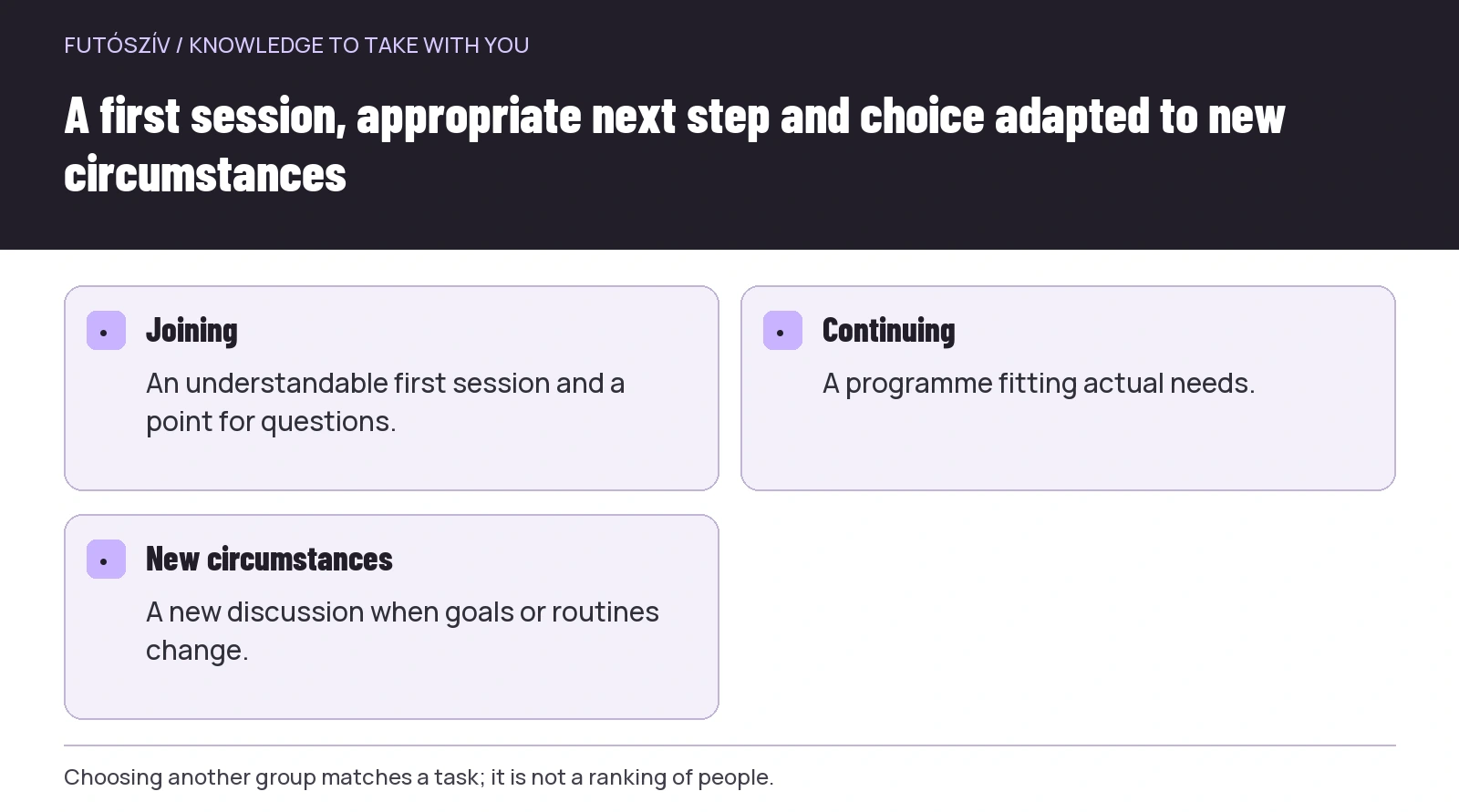 Enlarge diagram
Text version of the diagram
- Joining
- An understandable first session and a point for questions.
- Continuing
- A programme fitting actual needs.
- New circumstances
- A new discussion when goals or routines change.
Shared identity should involve more than results lists
The club’s story can include races, personal milestones, route experiences and background work. If public communication shows only the strongest results, new people may struggle to see where they can connect. Show the diversity of actual sessions too.
Do not describe a shorter programme or learning process apologetically. Name its own role precisely. Community participation can be an independently chosen format, not merely a waiting room for a longer distance later.
Handle participants’ choices separately when making pictures and reports. Everyone need not appear publicly to show more aspects of club activity. An accurate programme description or original educational diagram can also provide a useful picture of the offering.
An edited example of two separate sessions and shared closure
A club attracts both newcomers and longstanding runners during the same period. Organisers initially plan a single loop advertised for every level. Discussion of needs reveals, however, that one group wants to learn the format while the other seeks a specific coached session.
After reviewing actual capacity, the club develops two appropriately organised sessions with separate descriptions and leadership arrangements. An optional, clearly organised closing part provides shared social connection. Participants in one session are not presented as an incidental group attached to the other programme.
The example is an original editorial construction, not a prescribed club model. Another community may solve the task at different times or with a simpler offering. The point is to connect actual needs, real support and clear descriptions.
A beginner-friendly format should remain visible beyond a few weeks
Many communities periodically advertise an entry programme. After it ends, however, participants need to understand how to continue. If the next available format suddenly sets completely different expectations, the transition remains a separate organising task.
Every club need not constantly start a new group. Naming the precise period, registration and transition can help, however. Interested people should know when to ask and what is currently available. Waiting or starting later can also be communicated clearly.
Think about returning members too. After a longer break or changed goal, their previous group is not necessarily the first choice. Part of an open club is allowing discussion of changed personal circumstances rather than automatically assigning people back to an old label.
State capacity limits
The number of appropriate leaders, locations and available background tasks may be finite. Match programme expansion to these. Public demand alone does not create the necessary conditions. If planning a new format, think through its actual operation first.
If you cannot meet a need now, say so precisely. Participants can then seek another suitable opportunity or a later session. An unclear, overly broad promise can create more disappointment than honestly stated boundaries.
Assess organising support work too. Programme descriptions, welcoming newcomers and checking venues are real tasks. A club’s openness cannot be built indefinitely only on a few people’s invisible, unlimited commitments.
Use feedback to examine how the offering fits
Ask participants whether they understood the session’s purpose, found a suitable next step and experienced practice matching the description. These help identify where a programme or transition is missing. Attendance figures alone do not answer every question.
Do not automatically treat experienced and new members’ views as mutually exclusive needs. Different formats may be required, while shared information and club life support both. Start from specific organising conditions rather than a general beginner-versus-advanced debate.
An open running club can therefore have several understandable routes into participation. The first session, transitions and an experienced member’s own programme can all be named. Clear arrangements and mutual respect can give the community unity while participants’ differing tasks find an appropriate place too.
How Futószív articles are prepared: our editorial guidelines.