
Feedback is useful when it also supports the next step
After a group run, one person says it was good and another says this does not work. Important experiences may lie behind both sentences, but neither yet tells the organiser what to retain or change. Feedback in a running community does not require specialist language. A specific situation, personal observation and understandable request can already provide a good foundation.
This article concerns everyday organising and cooperation feedback in an adult running community. Personal coaching, health questions and handling a serious complaint may require separate frameworks. Different topics should connect with the appropriate person and channel rather than being combined into one shared review round.
First say what you want to discuss
Feedback may concern the accuracy of an invitation, the meeting place, following the route, group arrangements or finishing procedures. These are organising questions. If you want advice on your own training task, however, discuss it separately with the appropriate leader or coach.
Unsolicited technical or health assessments of another runner’s movement are not the same as observations about the shared programme. Do not assume participation in the group automatically entitles you to provide such advice. Ask whether they want to discuss it at all and whether you are the appropriate person.
The UK Coaching professional communication guide also emphasises understanding participants’ needs and feedback preferences in coaching feedback. The source writes for a coaching setting, not a ready-made procedure for general club disagreements. In your own community conversation, the useful principle is to clarify the topic and appropriate format first.
Brief feedback can have three parts
Name the situation, describe your own experience, then say what you would like clarified or changed. This is an original editorial framework, not a compulsory communication method. It helps the other person understand what to respond to.
| Part | Edited example | Why does it help? |
|---|---|---|
| Situation | At the second junction on today’s loop | You are discussing a specific point |
| Experience | I did not hear which branch came next | You name your own perception |
| Request or question | Could we clearly indicate the way ahead here next time? | A discussable next step emerges |
In the example, you are not claiming nobody paid attention to the group. You connect your own observation to an organising request. This lets the other person discuss the specific arrangements and, where necessary, add information you did not see.
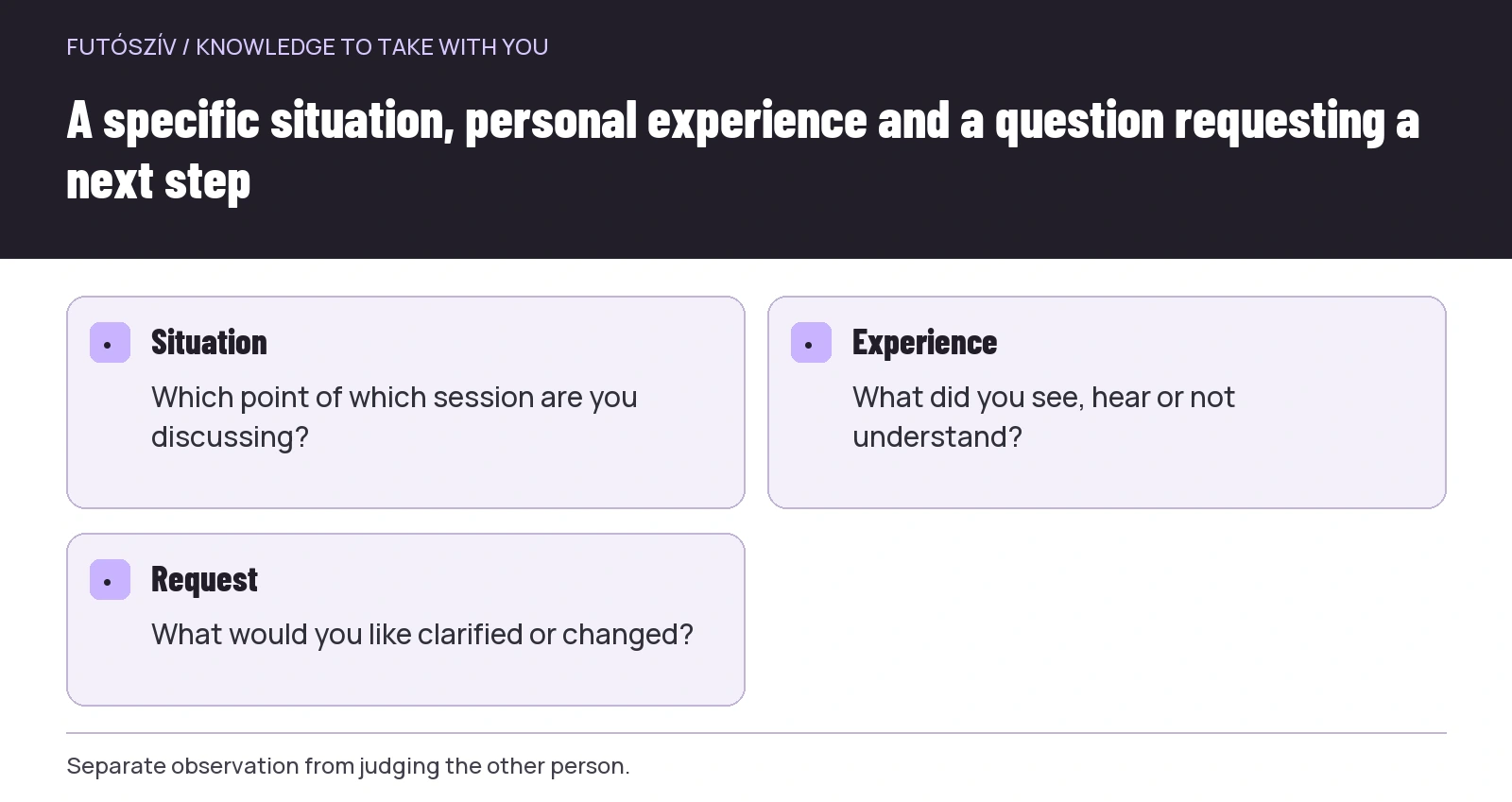 Enlarge diagram
Text version of the diagram
- Situation
- Which point of which session are you discussing?
- Experience
- What did you see, hear or not understand?
- Request
- What would you like clarified or changed?
Turn a general label into an observation
The sentence “the group fell apart” can mean several things. Did you lose the others at a bend, move at different paces or not know where everyone was at the finish? Naming the detail makes the next change more precise too.
The same applies to positive feedback. Alongside “very good organisation”, explain which element helped. The map link was accurate, a recognisable person welcomed newcomers or there was an understandable briefing before splitting into groups. These tell the organiser what is worth preserving.
Feedback is not honest merely because it contains strong adjectives. Precise observation often says more. If you are unsure about something, mark it as a question: I do not know whether this was announced beforehand because I saw this version. Making uncertainty visible is part of a factual conversation.
Timing and the audience matter too
A brief practical question may be clarified at the end of the programme. For a more complex or personal topic, requesting a separate conversation may be more appropriate. The aim is to let both people pay attention without having to discuss necessary details before a large group in a hurry.
The organiser is not obliged to give a complete immediate answer to every question on site either. However, it should be clear when and through which channel they will return to it. “We will discuss it” is useful when linked to a real next step. An answer that disappears for an uncertain period is not a feedback system.
A shared platform may suit general programme improvements, but not every personal matter belongs there. Choose the appropriate channel according to the topic and the community’s own procedures. A serious or urgent problem must not be deferred to a later satisfaction survey.
Ask specific questions when requesting feedback
“How was it?” is open-ended, but many people do not know which details interest you. A few well-defined topics may help: whether the meeting was findable, the programme format understandable and any point on the route remained uncertain. The question should relate to the organising purpose.
Do not ask only for confirmation. “Everything was fine, wasn’t it?” can easily suggest the desired answer is already known. Be genuinely curious about missing information and arrangements that could improve too. Participants should know their answers may affect the next session.
The England Athletics collection on well-run clubs also treats listening to members and continually improving club operation as part of organising. This resource was prepared for its own English club system. The community principle can simply be turned into a question: how does members’ specific experience reach the next organising decision?
Give quieter participants a usable channel too
Not everyone wants to speak in a shared circle. A brief later message, appropriately handled questionnaire or personal conversation may offer another setting. The chosen form should fit how the community actually works and its data-handling procedures.
If using a questionnaire, request only data whose purpose you understand. Do not automatically promise anonymity if the technical or organising solution does not provide it. Respondents should know who can access information and how it will be used.
Alongside freely expressed feedback, a few concrete questions can help. Requiring an answer to every question is not necessarily needed, however. The aim is to gather understandable experiences, not make every participant complete an administrative task at the end of the run.
As a recipient, understand the observation first
If you receive criticism, the first task is to clarify what it concerns. Ask about the place, time or version of the programme seen. This is not an evidential obstacle course for the other person but joint organisation of information. The question’s tone and purpose should be understandable.
Do not immediately prepare an explanation for every detail before the other person finishes. You may know more about the background, but the participant’s experience still reveals what reached them. Sending an announcement beforehand and its actual comprehensibility are two separate questions to examine.
If you find an error, name the correction precisely. If a change cannot be undertaken, explain the actual boundaries. Listening to feedback does not mean automatically accepting every suggestion. A response people can follow, however, shows the topic had a meaningful place in the decision.
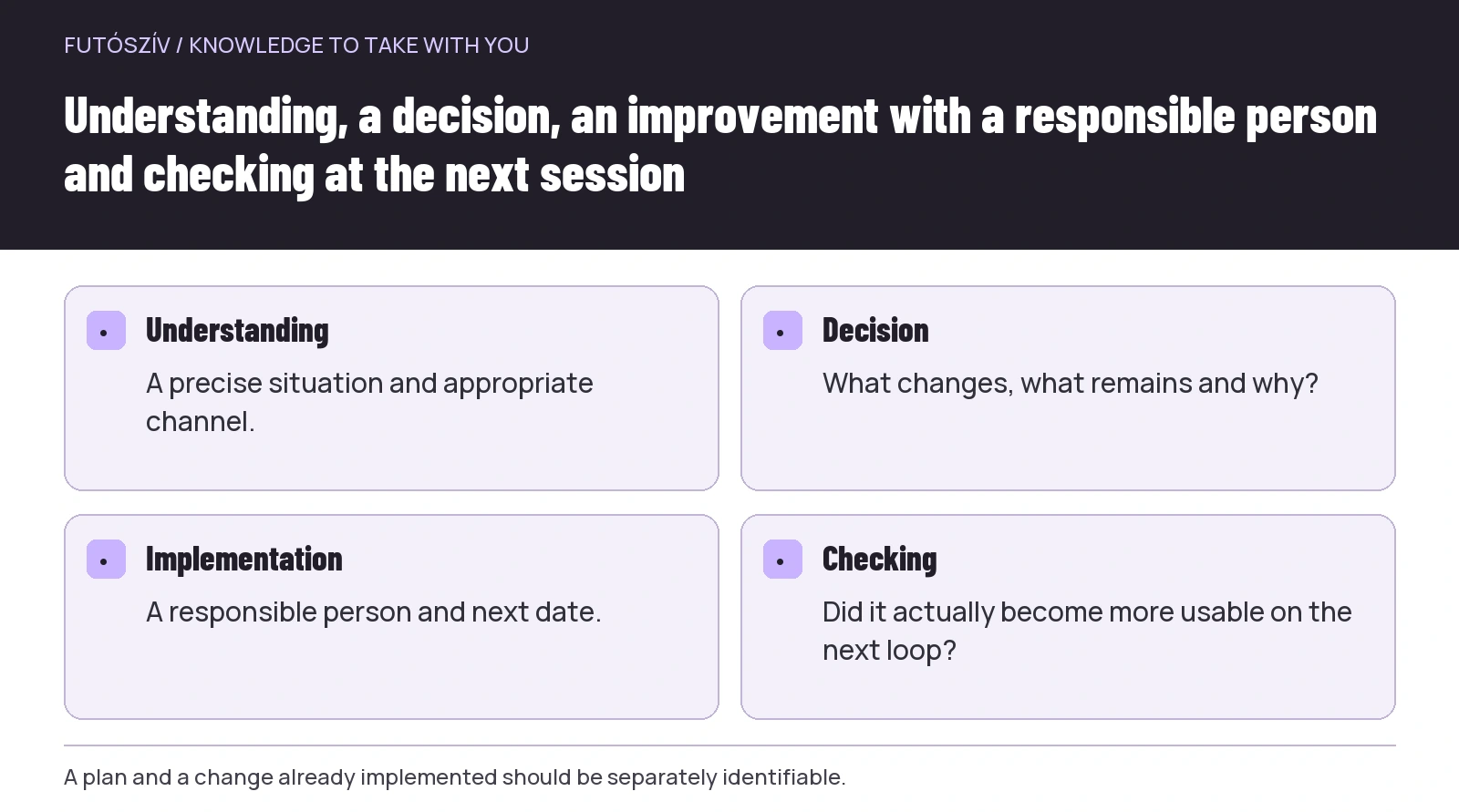 Enlarge diagram
Text version of the diagram
- Understanding
- A precise situation and appropriate channel.
- Decision
- What changes, what remains and why?
- Implementation
- A responsible person and next date.
- Checking
- Did it actually become more usable on the next loop?
An edited example of misunderstanding an invitation
After a run, a participant says the programme differed from expectations. The organiser initially feels everything was in the description. Conversation reveals, however, that the participant saw an older shared image still showing a different meeting place and programme format.
In their joint review, they distinguish the original description from the old image circulating further. The next step is to name the primary information location and mark changes clearly. They need not decide whether someone is generally inattentive or a poor organiser. They correct the specific communication error.
The example is an original editorial construction. It shows that differences in information or process often underlie feedback. A precise question can produce a change helping other participants later, instead of personal judgements.
Do not hide professional advice inside general feedback
A comment about a running companion’s shoes, body shape or movement can easily become unsolicited advice. A professional question should connect with the appropriate person and framework. Reviewing a community programme does not automatically authorise personal diagnosis.
Even when someone asks about your experience, identify what is personal experience and where you lack appropriate knowledge. You can discuss successful equipment use as a personal example, but do not claim the same item suits every runner. Keep the boundary between source and conclusion visible.
The organiser should similarly separate logistical programme improvements from professional training changes. Clarifying a meeting place is a different level of decision from rewriting a participant’s training load. The appropriate channel helps prevent feedback becoming an accidental change to a personal programme.
Do not consign a serious matter to a general satisfaction section
If the topic involves harassment, unfair treatment, endangerment or another serious problem, use the community’s appropriate reporting procedure. The organisation should make this understandably accessible. This article does not provide a complete complaints or legal procedure.
Everyday programme improvement and handling a serious matter may be different tasks. The recipient should not promise confidentiality, an investigation or an outcome they cannot provide in their role. Directing the matter to the appropriate responsible person and giving factual information matter more than a quick reassuring sentence.
In an urgent dangerous situation, seeking necessary help takes priority over the club’s internal feedback procedure. A community questionnaire or the next members’ meeting does not replace dealing with the immediate situation. It is therefore useful to clarify the different channels independently of the programme.
Give the response an owner and a next date
You can make a brief task list from incoming suggestions. What is the specific question, who will examine it and when will they report back? Every idea need not become a lengthy project. Fixing a missing map link is simpler; developing a new group format may require more discussion.
Communicate to participants what has actually been decided. If you are still exploring the possibility, say so. A plan and a completed change should not merge into a single success report. Being able to follow the process can also support trust in feedback.
Do not forget what should be retained. If several people say the arrival welcome worked well, organise it for the next session too. Feedback is not only finding faults but recognising working practices.
Check the change on the next loop
If you clarified the meeting place, see whether a newcomer can find it. If route explanations changed, ask whether they were clearer. Actual use shows the value of a change, not merely having written new text.
Undertake only as many improvements at once as you can follow through. Many ideas without owners easily become a recurring cycle of complaints. A smaller, concretely implemented change produces understandable experience for the next shared session.
Feedback in a running community thus consists of a situation, observation and appropriate next step. Participants know where and what they can ask about, while organisers see which arrangements to retain or clarify. The conversation serves to improve the shared programme instead of becoming a series of personal judgements.
How Futószív articles are prepared: our editorial guidelines.