A large range of movement does not tell the whole story
Some people easily extend their knees backwards or reach the floor farther than others without experiencing symptoms. For others, repeated injury, pain or uncertainty makes movement difficult. Observing hypermobility and assessing a symptomatic condition are separate questions. A flexible joint does not automatically imply disease, and symptoms should not be dismissed as mere flexibility.
The Ehlers-Danlos Society information on HSD distinguishes asymptomatic joint hypermobility from symptomatic spectrum conditions. Diagnosing HSD requires individual assessment and consideration of other possible causes. A social-media video or a score obtained independently does not produce a complete diagnosis.
As a runner, the first question is therefore not whether every hypermobile person may run. You need to understand your own symptoms, stability, diagnosis and goal. This article offers discussion and organisational points for that purpose; it does not diagnose or prescribe an individual load.
When is professional assessment worthwhile?
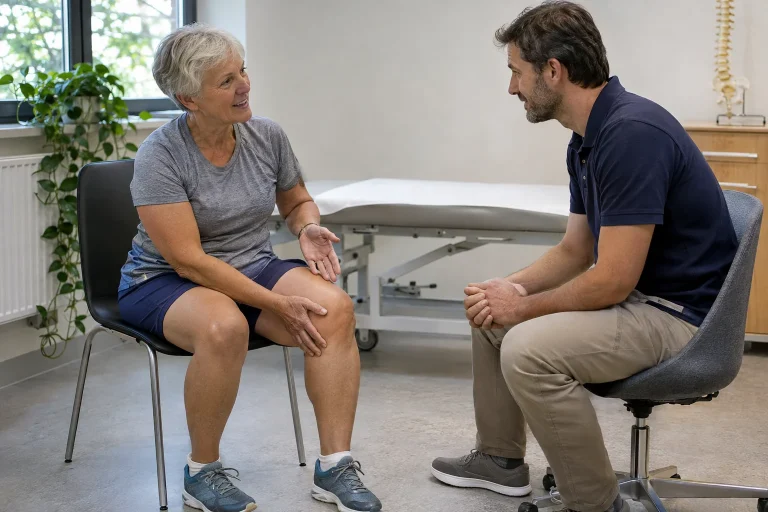
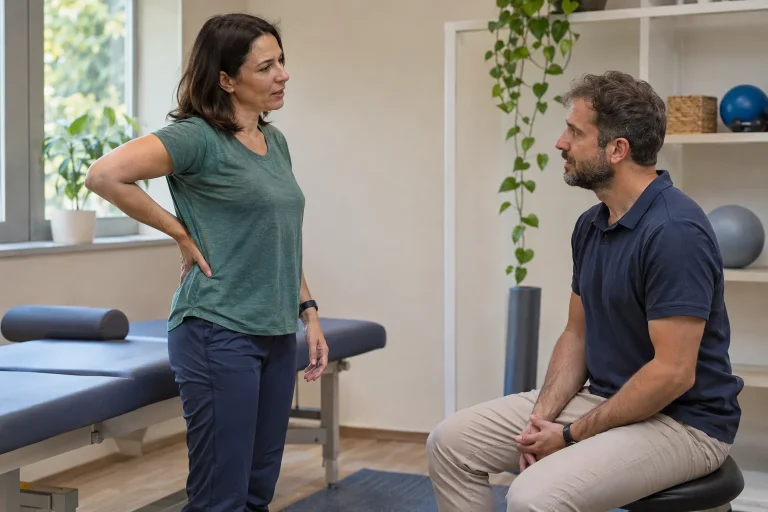
Seek healthcare help for recurring pain, giving way, dislocation, unusual susceptibility to injury or symptoms limiting daily activities. Also report if several joints are affected, similar difficulties occurred previously or a connective-tissue disorder is known in the family. You do not have to select the precise condition beforehand.
The NHS hypermobility information explains assessment of symptoms and joint problems, alongside the role of appropriate physiotherapy. A range-of-movement score may come up during the appointment, but the whole history involves more. Function, previous events and any associated condition matter too.
With a sudden injury, substantial deformity, severe pain or new changes in sensation or movement, do not wait on the basis of an earlier hypermobility explanation. Prompt assessment appropriate to the injury is needed. Even with a known condition, a new problem requiring separate care can occur.
A symptom-free runner and a runner with unstable joints ask different questions
If all you know is that you are flexible, do not infer your sporting options from someone else’s hEDS or HSD story. These individual conditions can differ, and load capacity varies even within a diagnosis. Appropriate advice does not treat every joint and life situation as one group.
The Ehlers-Danlos Society’s physical therapy guide recommends avoiding high-impact activities, including running and jumping, with unstable joints, and emphasises individual professional guidance. This is an important limit: running is not the automatic next step in every symptomatic condition. Discuss your own options with a suitably knowledgeable clinician.
If running is currently inappropriate, that does not remove your access to movement and community. Another form, a shorter programme or later reassessment may be options in the individual plan. Suitability for running need not become a general value judgement about your body or motivation.
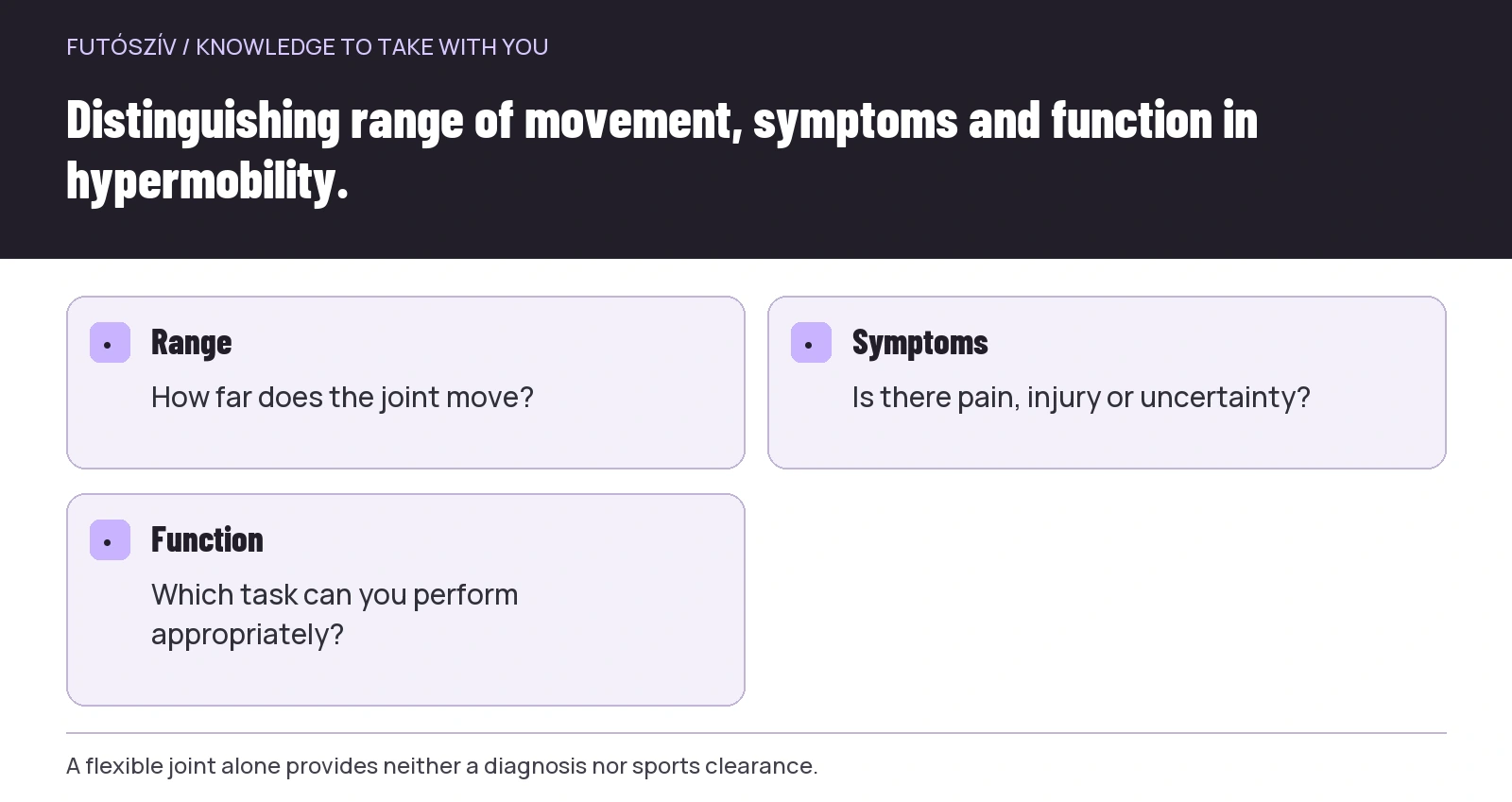 Enlarge diagram
Text version of the diagram
- Range
- How far does the joint move?
- Symptoms
- Is there pain, injury or uncertainty?
- Function
- Which task can you perform appropriately?
Stability: which task would you like to manage better?
The word stability can easily become a vague expectation. Translate it into a specific activity: more secure stair use, steady walking, a movement needed for work or a sports task permitted later? Identifying the goal helps choose what to assess and develop. The missing link is not the same for everyone.
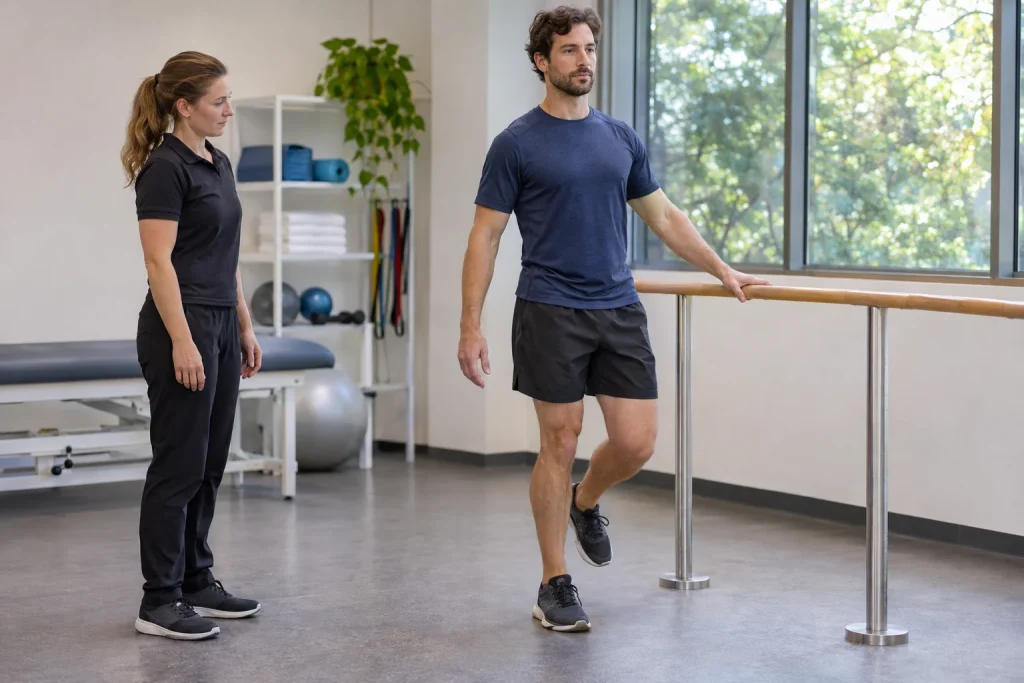
A physiotherapist can also give individual tasks addressing strength, movement control and body-position sense. The Society’s guide discusses appropriately selected exercises supporting movement control and joints. The specific technique and load depend on symptoms; a general strengthening video should not be your only guidance.
Alongside the goal, ask the professional to explain which response to observe. An apparently comfortable movement and later daily function can be separate pieces of information. Clarify if you do not understand what you should feel or notice. A task does not need to look impressive to have an appropriate purpose.
For home exercises, show which chair, wall, handhold or other equipment you can actually use. If the setting is unsuitable, ask for a different version. An exercise manageable in the clinic becomes daily help only when it is also clear and workable in your own surroundings.
The greatest range of movement is not a compulsory goal
Stretching classes and social-media challenges often reward greater and greater range. With hypermobility, however, it is not self-evident that you need still more flexibility. In your own plan, a controlled range and an appropriate task may matter more than reaching an end position.
Do not demonstrate your joint’s end position over and over as proof. A professional should guide tests needed for assessment, while your daily programme should have its own purpose. If a movement is uncomfortable or uncertain, you do not have to force it because others call it easy.
Discuss stretching individually too. You may have muscles that feel tight or other restrictions, but that does not mean every joint needs moving through a larger range. Instead of general statements to “never stretch” or “stretch everything”, ask for instructions tied to your own needs.
What does a strengthening study say, and what does it not answer?
A randomised trial compared higher-load and lower-load strengthening in adults with HSD and symptomatic hypermobile shoulders. The study on shoulder function explored how a targeted programme could be applied to a defined problem. Importantly, it was not a running study and did not test lower-limb load capacity.
It is therefore incorrect to conclude either that all hypermobile people can exercise only against minimal resistance or that high loads suit everyone. The trial involved individual tasks and follow-up. A higher load mentioned in a research title is not an independent training instruction for home use.
For your own plan, ask which ability strengthening targets, how resistance is selected and what follow-up is needed. Professional help is there precisely to translate possibilities and limits into your condition. You do not have to decide between research protocols alone.
Plan the whole day, rather than just twenty minutes of training
Daily load includes work, travel, standing, housework and prescribed exercises. If a programme is theoretically short but reaching it involves a long, crowded journey, the real framework is very different. Access and energy demands deserve discussion just as much as an exercise’s name.
The Hypermobility Syndromes Association exercise guide emphasises individual choice and caution. A practical plan should allow modification when your condition differs that day. Flexibility does not mean having no system, but having one usable in real circumstances.
Write down which tasks are fixed and where help can be requested. If getting to treatment or exercise is demanding too, say so; another time, location or arrangement may be needed. Do not automatically interpret an unmanageable plan as a lack of motivation. Understand the practical obstacle first.
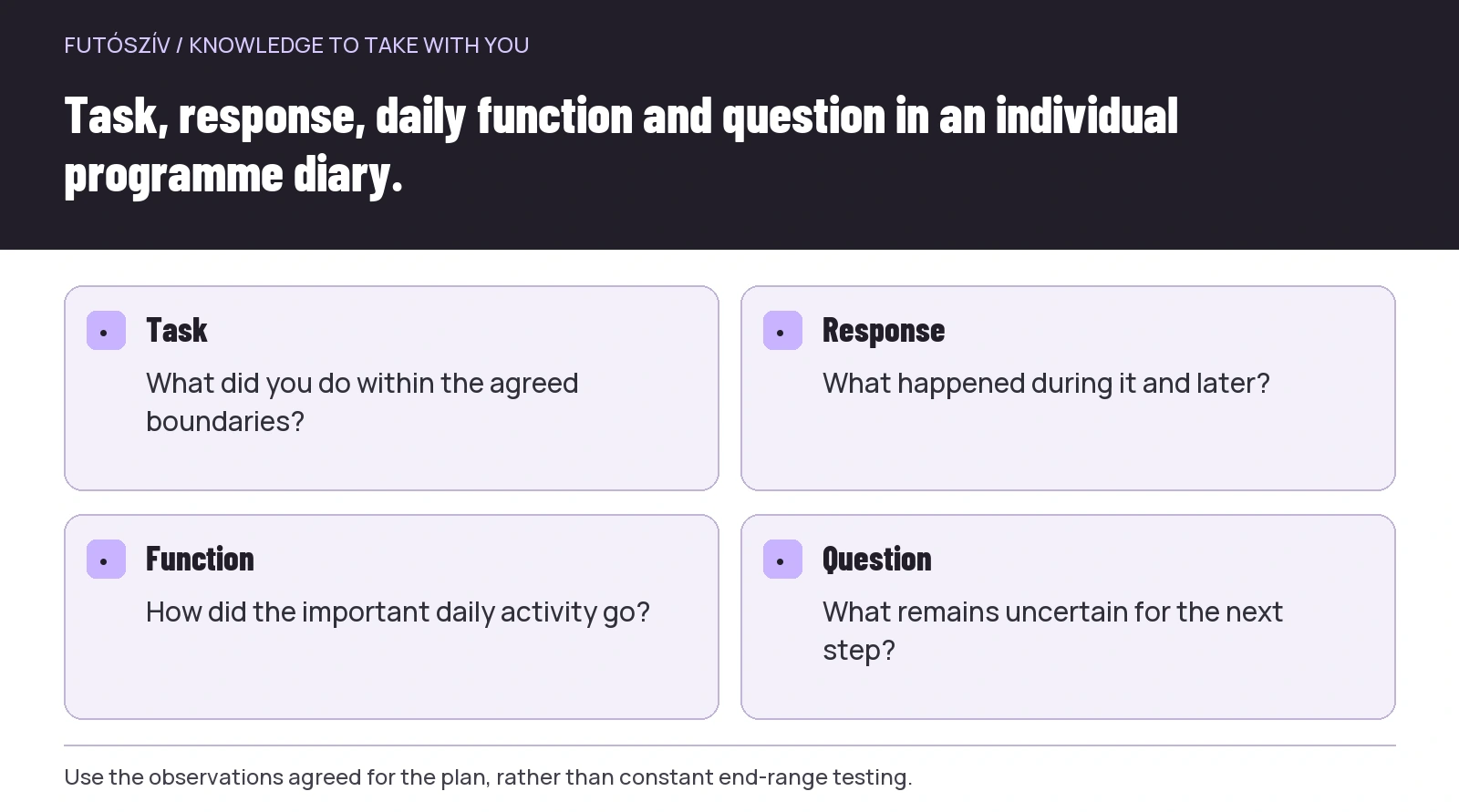 Enlarge diagram
Text version of the diagram
- Task
- What did you do within the agreed boundaries?
- Response
- What happened during it and later?
- Function
- How did the important daily activity go?
- Question
- What remains uncertain for the next step?
If running is an option, agree on the environment too
Decide about running only on the basis of your own condition and professional advice, particularly with instability or recurring injury. If it has a place in your individual plan, do not describe short, flat jogging and a dark, rocky descent with the same word. Different environments impose different demands.
An appropriate first location may offer good visibility, options to shorten the route and an easy exit. Do not independently change duration, terrain and frequency simultaneously. For monitoring, know which symptoms or uncertainty require stopping and what should happen afterwards. This is an organisational framework, rather than general clearance to run.
Footwear, any support or assistive device also needs individual consideration. A product should not become a reason to reintroduce load previously judged inappropriate. Ask what the device supports, how its fit can be checked and when it needs review. The device and movement programme belong together.
Communication with the coach and community matters too
Sharing a diagnosis or symptom does not mean giving up independent decision-making. Explain the movement boundaries necessary for the shared outing and specify the help you want. You do not need to disclose every health detail for a modification to be accepted.
As a coach, do not automatically treat great flexibility as either an advantage or a flaw. Ask about history, the individual care plan and the athlete’s goal. “This is easy for you because you are flexible” may overlook control and symptoms. A striking end position does not select the appropriate task.
Social connections can continue when someone currently does a different activity or skips an outing. Volunteering all day should not become a compulsory role in place of running. Inclusion means being able to discuss the mode and load of participation freely, without shame.
Four points can help track an individual programme
Record the task first: what did you do within the agreed framework? Then the response: what happened during it and later? Third, function: how did a daily activity important to you go? Finally, the question: what remains uncertain for the next step? A short diary may help more than constantly testing every joint.
If a new injury, worsening instability or another concerning symptom appears, seek assessment according to your own plan. An earlier diagnosis does not remove the need to discuss a new symptom. The aim is not to attribute every difficulty to hypermobility, but to give the particular situation appropriate attention.
Movement with hypermobility deserves a nuanced discussion: there are symptom-free people and conditions requiring substantial support. A good plan respects that difference. Movement chosen on the basis of your own function, goal and condition is worth more than a statement that prohibits or urges everyone equally.
Sources
- The Ehlers-Danlos Society: What is HSD?
- The Ehlers-Danlos Society: Physical therapy
- NHS: Joint hypermobility syndrome
- The HMSA: Exercise
- High-load versus low-load strengthening for hypermobile shoulders: randomized trial
How Futószív articles are prepared: our editorial guidelines.