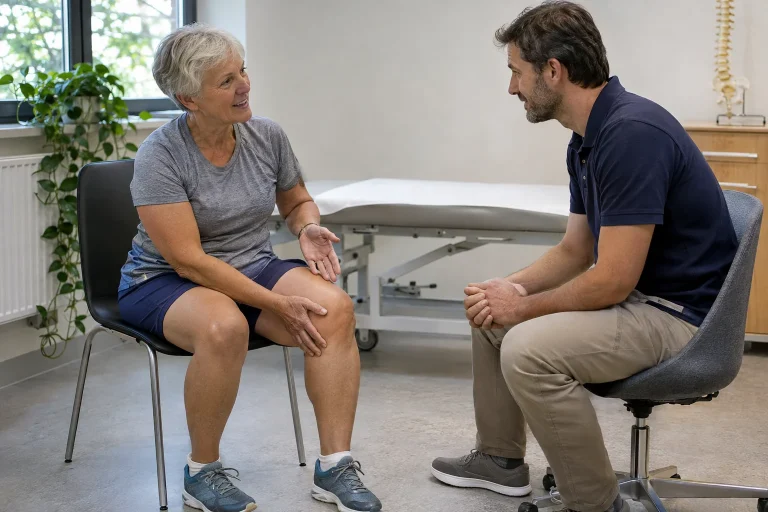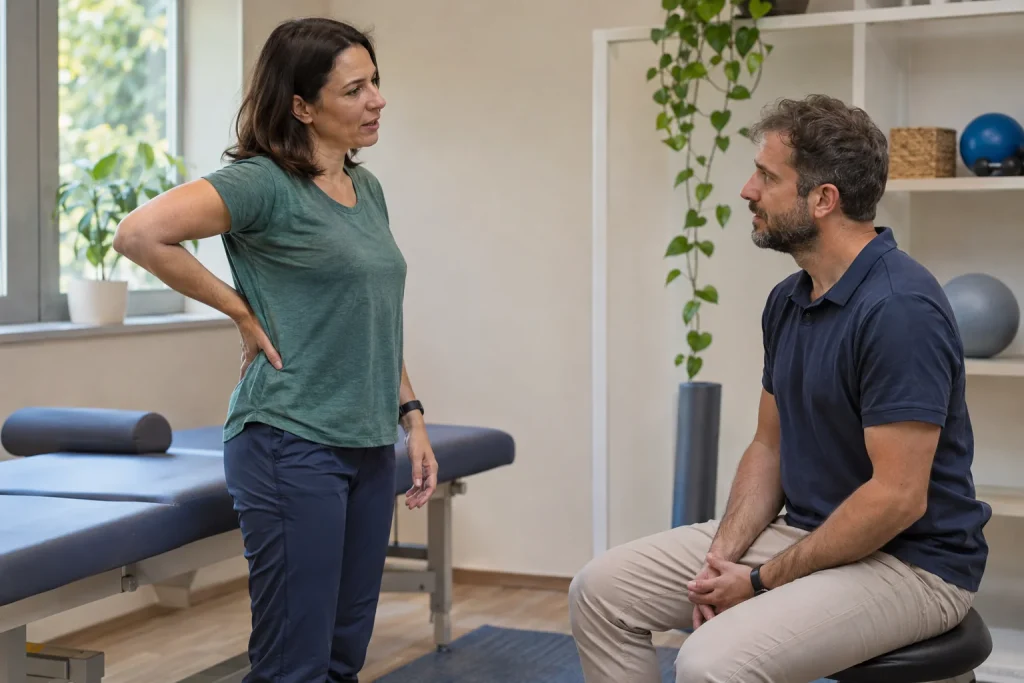
Low back pain does not come with one single running rule
On mentioning low back pain, many runners encounter two extremes of advice: never run again, or solve everything through movement. Neither statement knows your own history. Recent severe symptoms, a condition with neurological symptoms and longstanding, appropriately assessed non-specific low back pain are different situations. Clarifying this comes before making a decision.
The WHO’s 2023 guideline recommends an individualised, coordinated approach to caring for chronic primary low back pain, in which education and an exercise programme may have a role. The WHO document addresses a defined condition and care setting. It does not prescribe the same training for everyone with a painful back or replace investigation of a new symptom.
This article helps you ask about your own movement options and identify what to observe within an agreed programme. It does not provide a diagnosis, medicine dose or personal clearance to run. A useful goal is an understandable, workable plan in place of either prohibition or compulsion.
Which symptoms are urgent rather than training-planning questions?
New bladder or bowel dysfunction, loss of sensation around the perineum, or pain, weakness or numbness affecting both legs alongside low back pain may require emergency care. The NHS information on back and low back pain lists these as signs requiring immediate help. Symptoms after a serious accident or chest pain can also be urgent situations.
In Hungary, you can call 112 for a life-threatening or serious emergency condition. Do not wait until the next day’s run to find out whether movement improves it. Rapidly worsening pain, fever or feeling generally unwell may also warrant prompt medical advice. Old low back pain does not automatically explain every new symptom.
If you already have an individual treatment plan, consider the new symptom in relation to it too, but do not ignore the change. Instructions you received may not cover every later condition. The first task here is appropriate care, rather than assembling a symptom score or training graph.
What does “non-specific” mean?
The term non-specific low back pain does not mean symptoms are imagined or insignificant. It refers to a clinical situation without a clearly identified specific cause determining separate treatment. Assessing this is a healthcare task. You cannot assign yourself to this category with certainty from an online symptom description.
At the appointment, ask which condition is considered likely, which important causes were considered and what remains uncertain. Mention radiating pain, altered sensation or a change in strength separately. “My lower back hurts” can be too broad a statement for defining your individual activity boundaries.
Describe the everyday effects of pain too: what is most difficult among sitting, sleeping, working, walking and leisure? Care is about more than addressing a word in a report. An activity important to you and quality of life are appropriate goals as well, even if running remains a more distant plan for now.
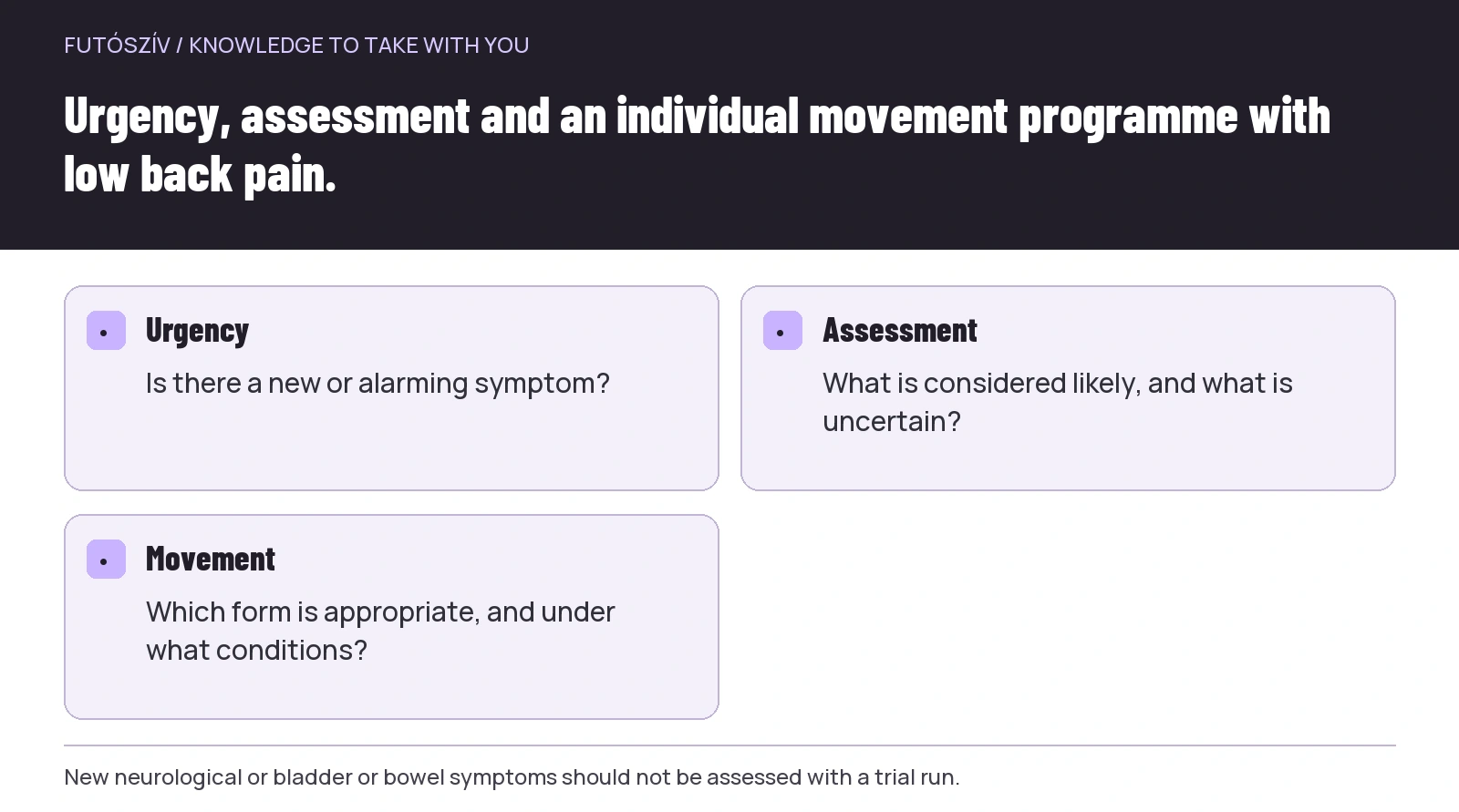 Enlarge diagram
Text version of the diagram
- Urgency
- Is there a new or alarming symptom?
- Assessment
- What is considered likely, and what is uncertain?
- Movement
- Which form is appropriate, and under what conditions?
What can we learn from a running clinical trial?
The ASTEROID randomised trial included 40 adults aged 18–45 with chronic non-specific low back pain. It compared a supported, individualised run–walk programme with a waitlist control over 12 weeks. The programme group had more favourable pain and function outcomes. The 2025 publication therefore challenges the general claim that running must always be avoided with this condition.
The study was small and short, with selected participants in a defined age range. Nine non-serious adverse events probably related to the study were also reported. The finding must therefore not be translated into a claim that any running is certainly safe or curative for every case of low back pain. Nor was the comparison made with every other active treatment.
Selection excluded, among others, people with previous spinal surgery, certain specific spinal conditions and pregnancy. The findings therefore cannot be transferred automatically to those situations.
The practical message is that, after appropriate assessment, discussing running as an individual option can make sense. You do not need to copy the research programme immediately. Your symptoms, history, goals and available support should determine which movement fits your situation now.
Do you need imaging before moving again?
The NICE low back pain guideline does not recommend routine imaging in every case in non-specialist care, and in specialist care links consideration to whether the result is likely to change management. This does not mean imaging is never needed. A suspected serious or specific cause may require a different assessment.
Ask which question the examination aims to answer. If an image is unnecessary, ask for an understandable explanation of the decision and next step. If you have an earlier report, its wording needs interpreting alongside current symptoms and examination. You do not have to infer a complete sports ban from one word in a report.
Do not be left without movement instructions while waiting for imaging, or if there is none. What can you do, what should wait and which change means contacting the service sooner? A useful answer explains not only which test will happen, but also how to organise your day in the meantime.
The movement programme should be chosen and feasible
NICE also considers individual needs, capabilities and preferences when selecting forms of activity. Not everyone enjoys running, and not everyone has the same time or financial resources. If running matters to you, say so; if another activity is more manageable now, that is a valid starting point too.
Do not write the programme for an imaginary empty day. You commute, look after children, do household tasks and may manage another illness too. You do not need to regard every demand as dangerous, but these affect the plan’s feasibility. Individualisation applies to daily organisation as well.
When deciding, ask which goal the chosen movement serves and on what basis it can be modified. “Any movement is good” is too general when you have specific symptoms. “Nothing is allowed” likewise needs clarification if you do not know what it covers or for how long. A clear framework makes cooperation easier.
If running is appropriate, describe load in more than kilometres
For an agreed restart, duration, pace, terrain and the possibility of stopping are all part of the plan. A familiar route that can be shortened can help with organisation. You do not need to compare yourself with your previous best form on the first occasion. The goal is experience meaningful in your current situation.
Alternating walking and running can be part of some programmes, but there is no compulsory ratio suitable for every case of low back pain. Know from your own plan which symptoms or changes mean stopping and whom to speak to afterwards. Modifying load is not solely a question of willpower.
Do not increase duration, accelerations and difficult terrain all at once because one session felt better. It is worth knowing the response during and after it before the next step. Repeatable, manageable movement can provide more information than a single big run undertaken to prove something.
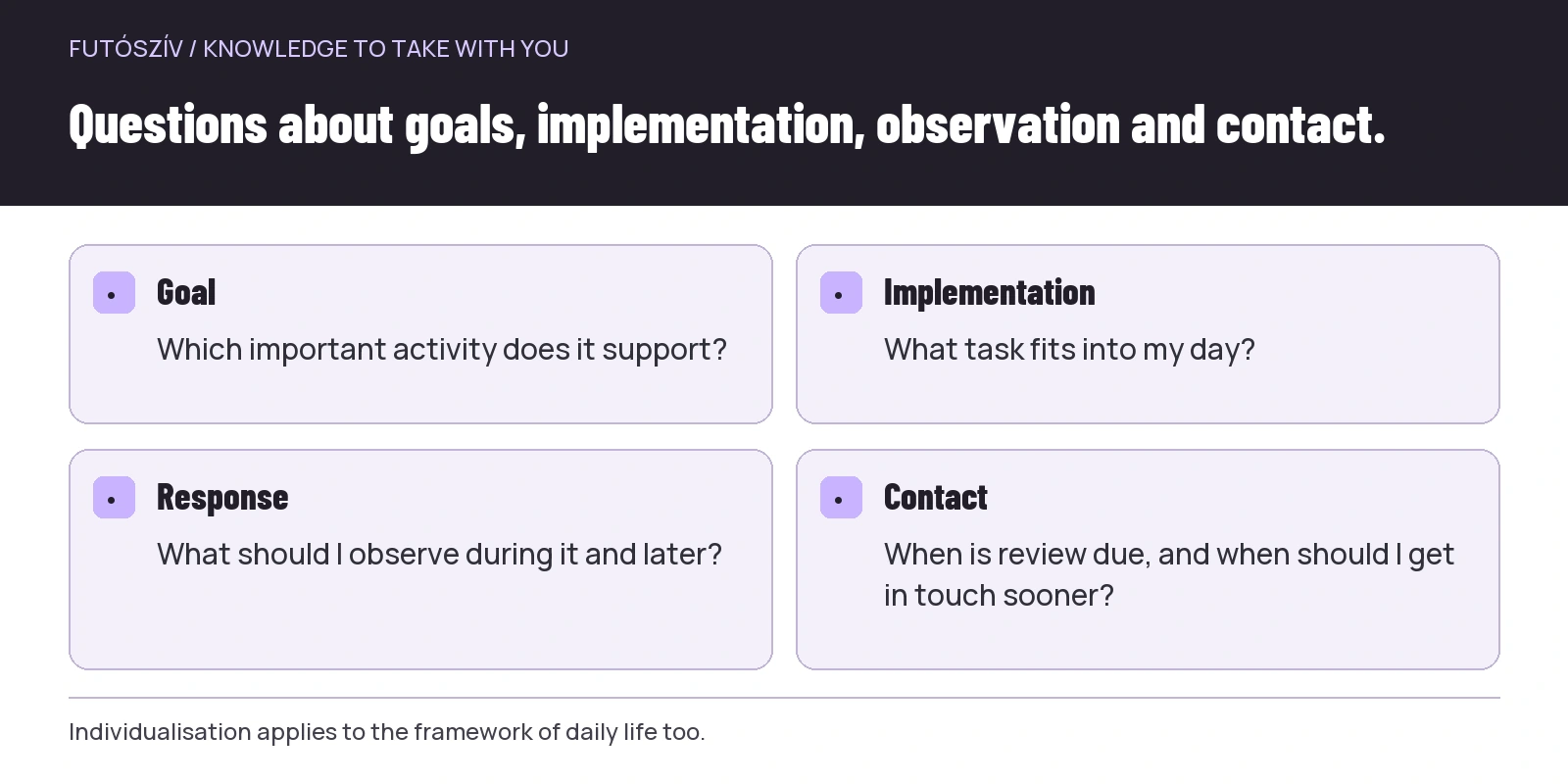 Enlarge diagram
Text version of the diagram
- Goal
- Which important activity does it support?
- Implementation
- What task fits into my day?
- Response
- What should I observe during it and later?
- Contact
- When is review due, and when should I get in touch sooner?
Core muscles, posture and the supposedly perfect movement
Much low-back-pain advice identifies one missing muscle or bad posture. Some abilities or movement tasks can indeed be assessed individually, but a photograph does not provide a complete explanation. Do not turn your body into an object of constant fault-finding. The aim is useful ability and activity, rather than an ideal pose held rigidly at every moment.
If you receive a strengthening or movement task, ask what it aims to achieve. It should be demonstrated, appropriately dosed and fitted into the daily plan. You do not need to start every possible core exercise at once, and forcibly provoking pain is not proof of good work.
Psychological support or pain-management education does not mean symptoms are unreal either. The WHO’s multicomponent care approach can respond to different needs simultaneously. Physical function, uncertainty, sleep and daily functioning can all belong in the discussion without personal blame.
Do not let the diary become another burden
A few brief points are enough: what did you do, how did it feel during it, what changed later and how did an important everyday task go? You do not have to score every movement. Notes are useful when they help the next consultation, rather than organising your attention around symptoms all day.
Record better days too, and mark changes in the plan. If you slept more, worked less and moved differently at the same time, do not attribute every improvement definitely to one exercise. A diary reveals relationships rather than producing clinical proof at home.
If function worsens or a new symptom appears, report it according to your individual plan rather than waiting with another diary entry alone. Observation and care belong together. Monitoring aims to let experience change the next decision, rather than merely accumulate data.
The next good step can be small and precise
At the end of the consultation, describe in your own words what you agreed: which activity comes next, its purpose and when to provide feedback. This can quickly reveal whether you understood an instruction differently. You can also ask for a written summary or demonstration if that helps you carry it out.
Give your coach the activity framework. You do not need to bring every health detail before the group, but the limits necessary for planning load should be known. A running community is supportive when it accepts modified sessions and does not measure recovery against your old pace.
A good answer about running with low back pain may be individual and conditional. Evidence can leave room for activity while new or urgent symptoms still deserve serious attention. It is therefore worth discussing movement suited to your own situation with a precise question, a real goal and a manageable plan.
Sources
- NHS: Back pain
- WHO: Guideline for non-surgical management of chronic primary low back pain, 2023
- NICE NG59: Low back pain and sciatica, recommendations
- ASTEROID randomized trial: Running in adults with non-specific chronic low back pain
How Futószív articles are prepared: our editorial guidelines.