
A recurring loop can provide a simple meeting framework
A short, familiar running loop offers an organising advantage: participants need not learn a new route and meeting place every time. That does not automatically create a community. Alongside a recurring time, an understandable welcome, genuinely accepted organising tasks and freedom in how to connect are needed too.
The goal may be a small, dependable session that new people can occasionally join. There is no need to build a large club or national movement immediately. A community organised around a short loop makes sense when programme size, location and organisers’ capacity remain in harmony.
Name the purpose of the recurring session first
Why choose this particular loop and format? The main purpose may be getting acquainted, an easily planned social session or a regular meeting for local runners. A shared statement helps determine the route, group format and finish that fit.
If the programme’s purpose is unclear, different expectations can accumulate over time. One person expects coaching, another company and another shared race preparation. These may be separate organising commitments. The recurring loop’s first description should explain the actual format and where to ask about suitability.
The official parkrun resources page names several forms of participation in its simple, recurring event system, from running and volunteering to social presence. This is its own organisational model, not a complete club procedure to copy freely. For your planning, it can prompt the question of which simple, consistent participation format you want to meet around.
The short loop should be a complete programme in its own right
Do not present it as an incidental detail before serious running. Someone arriving for it commits to its framework. Choose distance and character according to participants, location and necessary experience, not a universal kilometre figure.
Give finishing a precise place and procedure. If a separate conversation or café visit follows, make its optional nature and possible cost understandable. Belonging to the community should not be proved by remaining for every additional activity.
A separate agreed option may be offered for those wanting to extend the run, but the new task needs its own arrangements. Short-loop participants should not quietly become waiting extras in a longer session. The advertised programme should remain recognisable.
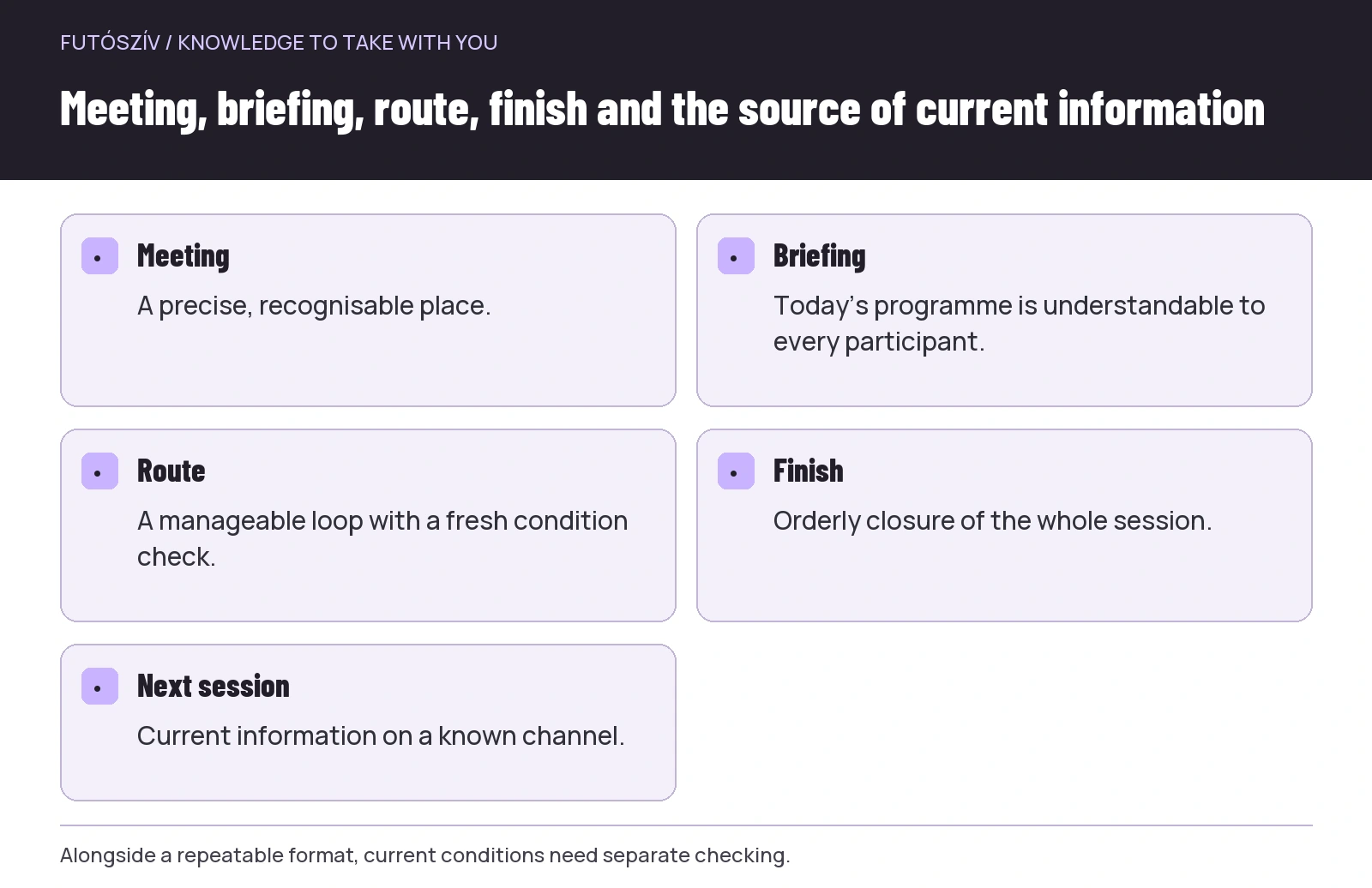 Enlarge diagram
Text version of the diagram
- Meeting
- A precise, recognisable place.
- Briefing
- Today’s programme is understandable to every participant.
- Route
- A manageable loop with a fresh condition check.
- Finish
- Orderly closure of the whole session.
- Next session
- Current information on a known channel.
Five constant elements can support understanding
| Constant element | What can it offer participants? | What actually needs organising? |
|---|---|---|
| Recognisable meeting point | Less searching on site | A precise point and current access |
| Brief programme explanation | Everyone understands today’s format | Accounting for changes and newcomers |
| Familiar route | A clearer shared task | Ongoing condition and access checks |
| Orderly finish | A whole session people can plan | Actual closing and communication arrangements |
| Source for the next date | Knowing where to check again | An updated information channel that is actually monitored |
Consistency does not mean the event can be held identically under every condition. It concerns the repeatability of the operating structure. Current circumstances must be considered separately for every session.
Every week is someone new’s first session
Regulars gradually take the turning point, group arrangements and finish for granted. A newcomer still needs the basics. The recurring format should therefore not close into an internal system of habits understood only by established members.
Have a recognisable person or role welcoming newcomers and directing them to the appropriate leader. How much to introduce themselves should remain optional. You need not ask every arrival for a public sporting biography before giving them the next-step information.
The England Athletics collection on inclusive clubs also connects the experience of being welcomed and able to participate with community arrangements. For your own short loop, examine whether newcomers actually find the session and understand how it works, rather than only whether the introduction page uses a friendly adjective.
Do not leave organising invisibly to one person
A regular meeting can easily become a constant expectation. If all information, location checks and welcoming exist only in one member’s head, their absence may make the entire session uncertain. Name actual tasks and agree them with appropriately prepared people.
Accepting tasks should be voluntary and clear. Who updates the invitation, checks the venue, leads the programme and handles questions? Roles also require necessary knowledge and organisational support. Regular attendance alone does not automatically make someone a suitable leader.
Clarify cover arrangements too. If conditions cannot be met, the programme can be cancelled or changed in the agreed way. Reliability does not mean holding it at all costs, but providing accurate information about current status.
Regularity also needs change management
The park may host another event, access may change or weather may require a new decision. The condition of a previously successful loop is not a permanent promise. Give each session an appropriate check and an actual responsible person.
The parkrun cancellation information asks participants to check the current website and social channel for its own events. Even recurring programmes may face last-minute changes. In your own community, therefore name where the currently valid announcement can be found.
If choosing another route, make the new version complete. Meeting, approach, programme format and finish may change together. Familiarity with the old loop cannot automatically be transferred to a new location, particularly for newcomers.
Leave room for personal connection
A repeated shared loop can provide occasions to meet, but friendship is not an organiser’s performance indicator. Everyone need not be required to converse or join a shared platform. A quieter presence may also be participation suited to the programme.
An optional brief conversation or simple shared thank-you at the finish can create closure. The format should not become a larger task than the session itself. Participants should be able to leave in a hurry without their commitment to the community being questioned.
Sharing results should remain a separate choice too. A regular short loop does not require a public list of weekly kilometres or target races. Someone wishing to discuss these topics can find an appropriate social setting while the shared programme’s purpose remains clear.
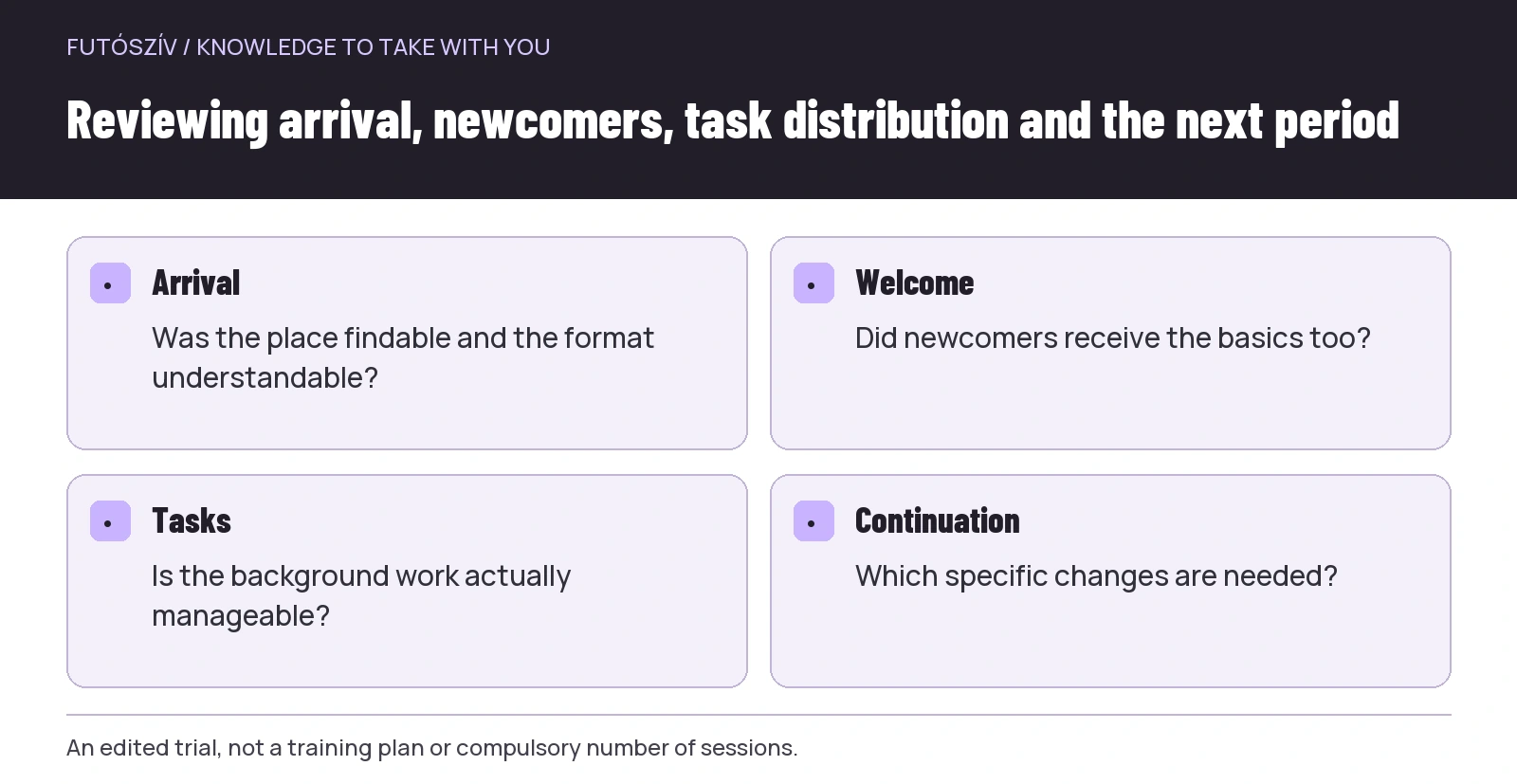 Enlarge diagram
Text version of the diagram
- Arrival
- Was the place findable and the format understandable?
- Welcome
- Did newcomers receive the basics too?
- Tasks
- Is the background work actually manageable?
- Continuation
- Which specific changes are needed?
An edited four-session trial
A small community plans four recurring sessions on an already checked loop. The number four is an original organising example, not a professional requirement or training plan. After the first session, they examine whether the meeting was findable and the programme understandable.
After the second, they ask about welcoming newcomers; at the third, they examine the distribution of organising tasks; and at the end of the fourth, they collect changes needed for the next period. They do not invent a new spectacle for every session; they refine the usability of the existing format.
They decide on continuation according to actual capacity and participant experience. The same format may remain, they may offer fewer sessions or seek another venue. The trial’s value is not the fastest possible growth in numbers but learning how arrangements can be understandable.
Growth needs a suitable venue and support too
More participants may mean more welcoming, route-following and communication tasks. A loop that works with a small gathering may not function identically with a larger group. Review conditions for using the location, other visitors’ movements and appropriate organising capacity.
Do not automatically increase the accepted participant count based on responses to a social post. Actually leading the session and doing background work are separate questions. If more prepared people, a different format or appropriate consultation are needed, arrange those first.
A limit on numbers can be communicated understandably. New applicants should know how to participate next time and where to ask questions. Openness and actual capacity need handling together: an overly broad promise may later create a situation difficult for both new and established participants to follow.
Keep communication simple and updatable
A recurring session can have a permanent introduction page and separate current announcements. The first explains the programme format; the second contains the next date and changes. Link the two clearly so participants do not set off based on an old post.
Dates on old pictures and invitations should remain identifiable. If someone reshares them, it should still be clear which session they concerned. If advertising publicly, information for the next programme should preferably not be available only deep inside a hard-to-access private conversation.
Handle photography and data sharing separately. The community’s story can be preserved while participants’ choices remain clear. Access to information about the next meeting should not depend exclusively on appearing publicly.
Shared tasks should not become a new ranking
One person occasionally helps with welcoming, another attends less often and another can manage only the running part. Community contributions may differ. Tasks necessary for the programme must be organised, but need not become a hierarchy of human worth.
Explain roles precisely and allow questions. Anyone accepting a new task should receive its information and appropriate support. Background work takes real time, so regular helpers’ capacity needs considering too.
If everything falls to too few people, that is an organising question. The programme can be simplified or its frequency matched to actual commitments. Community sustainability is not proved by a few people making the session happen beyond their own limits every week.
What should you assess before the next period?
Examine how understandable the programme is, welcoming newcomers, location use and task distribution. Participant numbers alone do not fully answer any of these questions. A smaller, orderly session may be more manageable than a rapidly growing meeting with uncertain arrangements.
Choose one or two specific improvements from feedback. A more precise meeting point, clearer finish or better-shared information task are directly usable changes. There is no need to invent a new name and appearance for every period.
The community value of a short, repeated running loop can lie in recurring, understandable meetings. Regularity is accompanied by a considerate welcome, appropriate organisational support and a participation format allowing choice. This can create a session participants can find, understand and choose again according to their own opportunities.
How Futószív articles are prepared: our editorial guidelines.