
Runners often postpone strength work until there is time left over. Then the week ends, and easy runs, the long run and work have left no room. Strength training becomes a useful part of a routine when you plan for it and consider its demands together with running. You do not need an elaborate exercise collection to start; a clear purpose and a repeatable structure matter far more.
This guide provides general information. Pain, injury, recovery after surgery or a chronic condition may require individual assessment and appropriate professional guidance. These descriptions do not replace learning exercises individually and do not promise freedom from injury.
First, clarify why you want to build strength
Someone just getting acquainted with weights needs a different plan from someone who has lifted for years but is preparing for a running race. The goal might be general muscular strength, everyday physical capacity, supporting running or professionally guided rehabilitation. These can overlap, but they do not mean the same thing.
Write one sentence describing your intention for the next few weeks. For example: I want to learn the basic movements and fit two short sessions into my week. This is more manageable than trying to fix every running weakness at once. Learning technique and working under heavy loads do not need to be compressed into the first session.
The NHS general strength-training guidance recommends activity working the major muscle groups on at least two days a week, building up gradually. This is a health framework, not an identical programme for every runner. Your training history and recovery help determine how to put it into practice.
What does research involving runners show?
Put simply, running economy describes how much energy or oxygen running at a particular speed requires. Some strength programmes may improve it. In the study by Støren and colleagues , well-trained distance runners improved their running economy after eight weeks of maximal-strength training. However, the study involved particular participants and a specific programme.
A randomised study of middle-aged recreational runners found that resistance and jump-based training could improve economy, while five-kilometre times did not necessarily improve. The 2025 Zanini study also examined economy during prolonged running in well-trained male runners. Its findings cannot automatically be transferred to beginners or every age group.
The practical lesson is that strength work can have a place alongside running, but a research headline is not a personal promise. It does not mean you should use the same heavy weight, number of jumps or weekly schedule. Programme quality, a suitable starting level and coordinating the overall load matter.
Think in movement patterns before individual exercises
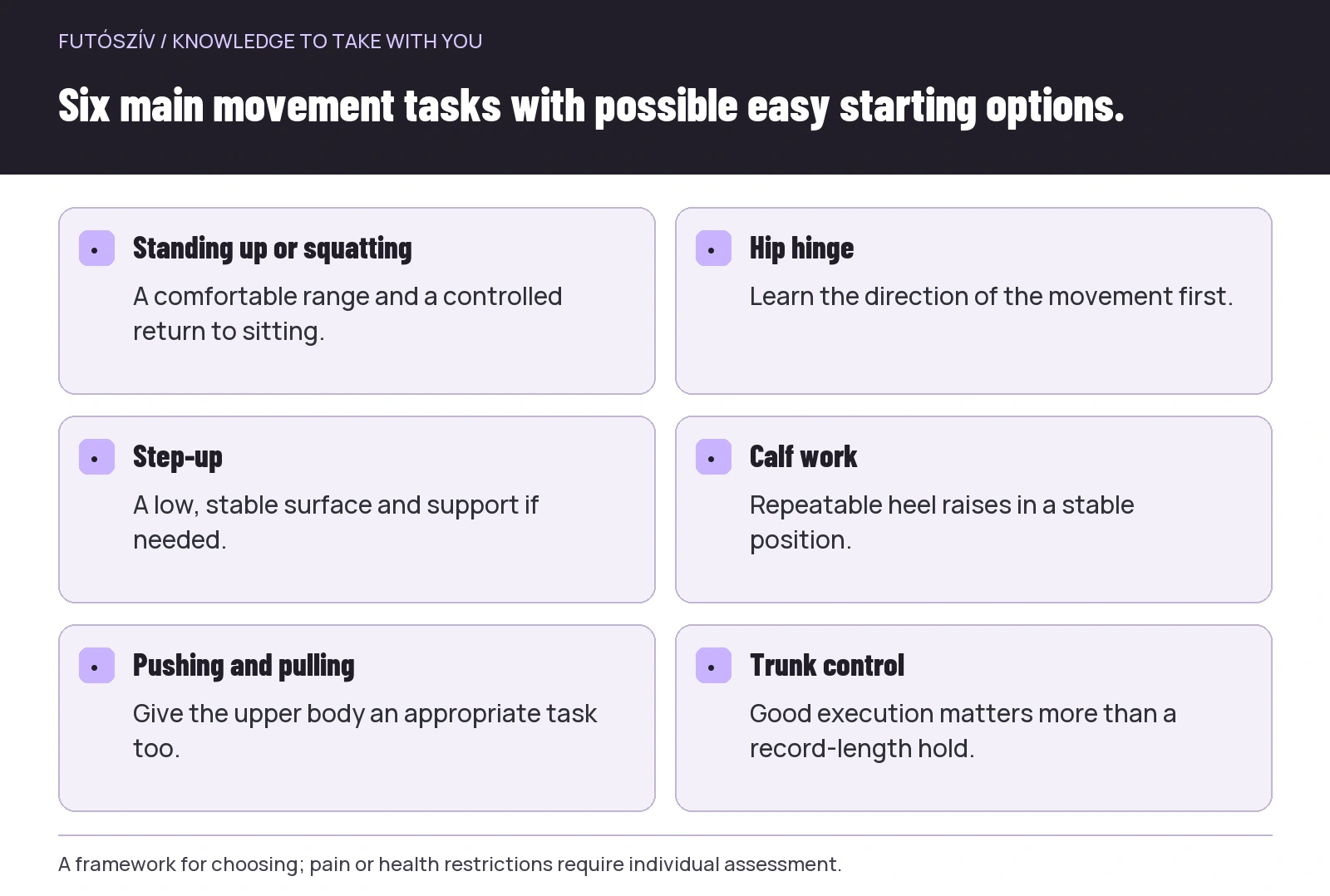
Exercise collections can easily become endless lists. A clearer approach is to look for a few main tasks: movements requiring knee and hip extension, a hip hinge, stepping up or a split stance, calf work, upper-body pushing and pulling, and trunk control. Many simple or more demanding exercises can serve these purposes.
A movement pattern is not an anatomical fault-finding tool. You do not need to turn every small difference seen in a mirror into a problem. Aim for execution that you understand, control and can repeat with an appropriate load. If you are uncertain, a good professional can replace much guesswork in a few individual sessions.
Because running involves supporting yourself on one leg, choosing only single-leg exercises can be tempting. Yet two-leg and supported variations can be useful for learning and loading. An exercise does not become “running-specific” because you perform it on a conspicuously unstable surface.
 Enlarge diagram
Text version of the illustration
- Standing up or squatting
- A comfortable range and a controlled return to sitting.
- Hip hinge
- Learn the direction of the movement first.
- Step-up
- A low, stable surface and support if needed.
- Calf work
- Repeatable heel raises in a stable position.
- Pushing and pulling
- Give the upper body an appropriate task too.
- Trunk control
- Good execution matters more than a record-length hold.
Six simple tasks to use as a starting point
The following list is a selection framework, not a compulsory session for everyone. After learning an easier variation, you can decide how to make it harder. Stop and seek help for sharp or worsening pain. Completing the movement at any cost is not the goal.
| Movement task | A possible starting option | What to observe |
|---|---|---|
| Standing up or squatting | Standing up from a stable chair | Comfortable range of movement and controlled return to sitting |
| Hip hinge | Learning a hip hinge without equipment | Do you understand the direction of movement? |
| Step-up | A low, stable step beside a handhold | Predictable support |
| Calf work | Two-leg heel raises at a stable support | Slow, repeatable movement |
| Upper body | Wall push-ups and an easy pulling exercise you have learned | Comfortable shoulder position and continuous breathing |
| Trunk control | A simple stabilisation exercise you have learned | Do not make holding for as long as possible the only goal |
The NHS home-strengthening page includes, for example, standing up from a chair, mini-squats and heel raises. Stable equipment without wheels and gradual progression are essential practical considerations. Illustrated demonstrations can aid understanding, but do not force yourself to copy a movement that is painful or uncertain.
Repetitions, sets and rest: three separate decisions
A repetition is one complete movement. A set is several repetitions performed in succession. Rest gives you the opportunity to approach the next set with proper attention too. There is no need to be embarrassed about resting, and strength work does not automatically need to become a breathless circuit.
The American Heart Association general guidance mentions sets of eight to twelve repetitions as one useful framework, as well as a qualified professional to teach technique. A beginner’s session devoted to learning movements may be easier still; the number alone does not define the load.
Two people can do very different work with the same number of repetitions. Resistance, range of movement, tempo and how much you have left in reserve all matter. At the start, seek well-controlled execution rather than testing maximum strength in the first week. Have a clear, agreed method for increasing the load.
How to make it harder while understanding the change
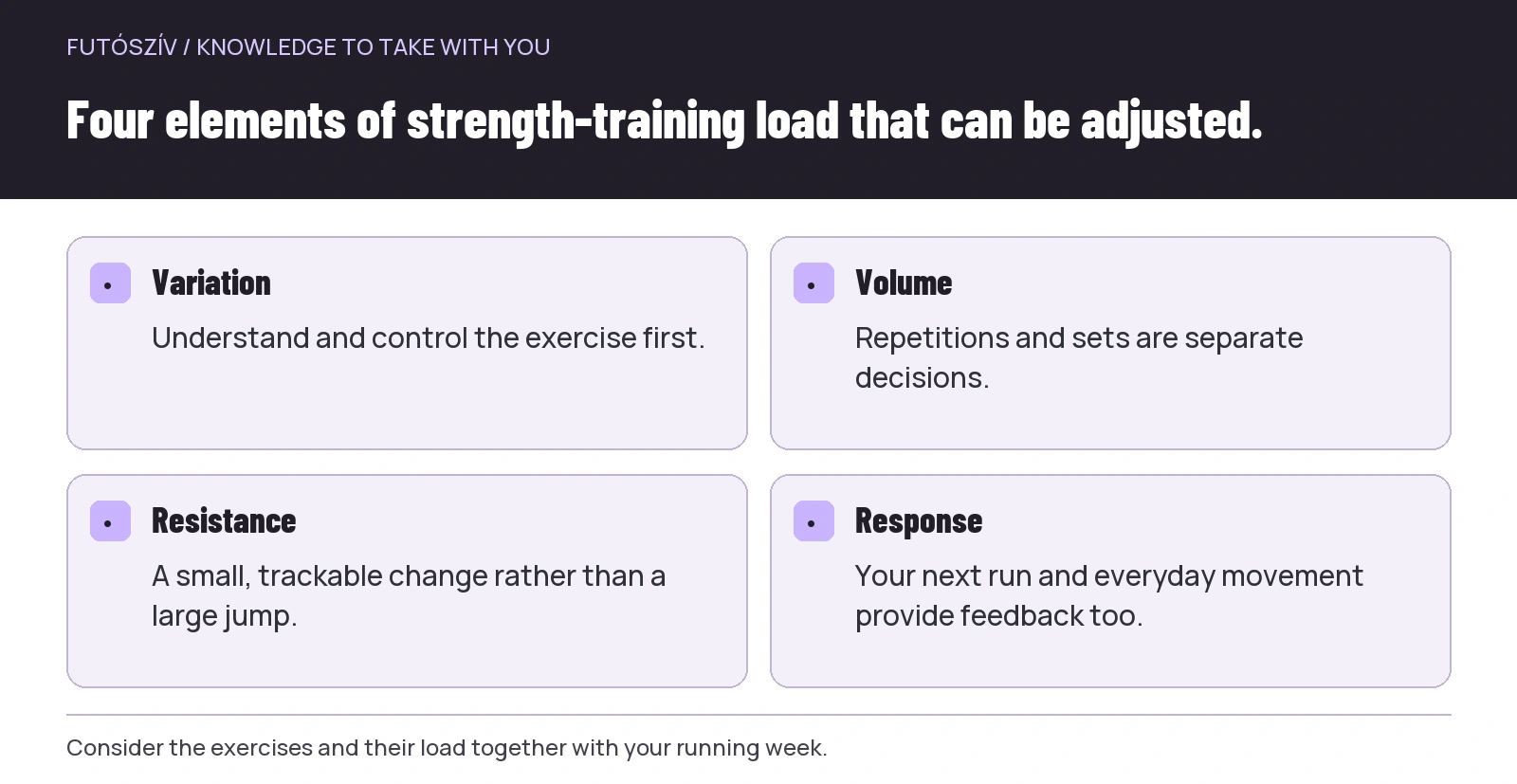
You can change the number of repetitions, sets, resistance or the exercise itself. Increasing everything at once makes your response difficult to observe. In a simple diary, note the chosen variation, load and sets. Alongside “it went well”, briefly describe how much you felt you had left in reserve.
Once a task is easy and consistent, a small change can be the next step. Its size is individual. A heavier weight is not better at any cost if you no longer understand or control the movement. Equally, if you want to develop, you need not work with the same easy variation forever.
How your next run feels after a new exercise is feedback too. Note if stairs or an easy loop became unusually difficult. The diary helps coordinate the two activities, rather than looking for faults in every muscle sensation. Persistent, severe or localised pain is worth discussing with a professional.
Fit the weekly schedule to your whole life
There is no single perfect strength-training day for every runner. What works alongside three easy runs differs from what works during intensive race preparation. If strength work is new to you, do not place the most unfamiliar load immediately before your most important running session. First learn how you respond.
A simple illustrative week could have an easy run on Monday, short strength work on Tuesday, rest or walking on Wednesday, running on Thursday, another easy strength session on Friday and your usual running at the weekend. This is a planning example to adapt to your own load. If your running week is already at its limit, do more than simply add another task.
Running and strength work can fall on the same day, but the order and time between sessions depend on your goal. If you work with a coach, explain which task matters most in that period. Understanding the logic of your own week is more useful than a rule that “everyone always does it this way”.
 Enlarge diagram
Text version of the illustration
- Variation
- Understand and control the exercise first.
- Volume
- Repetitions and sets are separate decisions.
- Resistance
- A small, trackable change rather than a large jump.
- Response
- Your next run and everyday movement provide feedback too.
At home or in a gym?
At home, the advantage is the low organisational barrier: no travelling, and a short block is easier to begin. Available resistance and a safe space are the limitations. Check that chairs, steps and attachments are stable; do not trust household furniture with loads it is not designed to bear.
A gym offers more equipment and professional help, but you also need to learn to adjust machines. A machine is not automatically better or worse than free weights. Look for a solution suited to your goal, experience and access. Equipment should remain a tool rather than a matter of identity.
If only a few short weekly sessions fit, choose a programme that does not require searching for a new video every time. Consistent use of a few familiar exercises allows more observation than continual variety. You can then connect progress to the work you actually do.
What should you not expect from strength training?
It does not establish that injury can never happen or automatically correct every aspect of running technique. A supposedly weak muscle or a movement seen in a mirror cannot establish the cause of every symptom. Distinguish rehabilitation from general conditioning.
Muscle soreness is not a compulsory sign of quality either. A good session can be less dramatic and leave everyday movement entirely manageable the following day. If stairs are difficult for days after every session, reconsider the load and timing. You are looking for a cooperative role for strength work within your running programme.
Appropriate food and rest remain part of the whole picture. You do not need to begin with a special “runner-strength” product. First check whether you eat regularly, allow time for recovery and can manage the total weekly load within your actual daily schedule.
Learning can be the task for the next four weeks
Choose a few basic tasks, ask for help with execution and set two manageable appointments. After the first sessions, observe your response during and after movement. If all is well, build further in small steps. Establishing the weekly routine is a valuable result in itself.
At the month’s end, start with three questions: did you attend regularly, do you understand the exercises more confidently and did the work remain compatible with running? These answers offer a better foundation for the next programme than how impressive or exhausting the session looked.
Sources and checking
This article cites the NHS and American Heart Association information linked above and three studies involving runners. Research findings are interpreted alongside their limitations concerning participants and programmes. The table and weekly schedule are our own editorial examples, not rehabilitation or individual training plans. Sources checked: 18 November 2026.
How Futószív articles are prepared: our editorial guidelines.