
A stride is a short, progressively built-up brisk running section. Its aim is to let you experience movement faster than easy running for a few seconds while remaining composed, then leave enough time to breathe comfortably again. The peak speed your watch draws is not what matters, and you do not have to win a race at the far end of the park.
The term is used in several ways. Some people call every short acceleration a stride; in athletics, measuring high speed reached after a run-up can have a separate meaning too. This article concerns endurance runners’ controlled increases in speed. Maximum sprinting, longer intense intervals and a complete pre-race warm-up are different tasks.
First define why it belongs in the session
Distinguish three different intentions. At the end of an easy day, the aim may be movement variety; before a faster session, practising the transition; before a race, part of an already tested warm-up routine. The same section fits into a different total load in each setting. Shortness alone does not automatically make it restorative.
If you add it only because every serious runner does it, the task still lacks a reason. Establishing regular easy running, available time and how you respond to loading may be more important grounds for a decision. Strides are not a compulsory entrance requirement for running and do not replace consistent endurance work.
A useful aim might be: I want to practise accelerating without scrambling. That can be observed. “It improves my running technique” is too broad: what would demonstrate improvement, and in which situation? Do not give one short exercise the power to solve every running problem.
Give the acceleration a beginning, middle and end
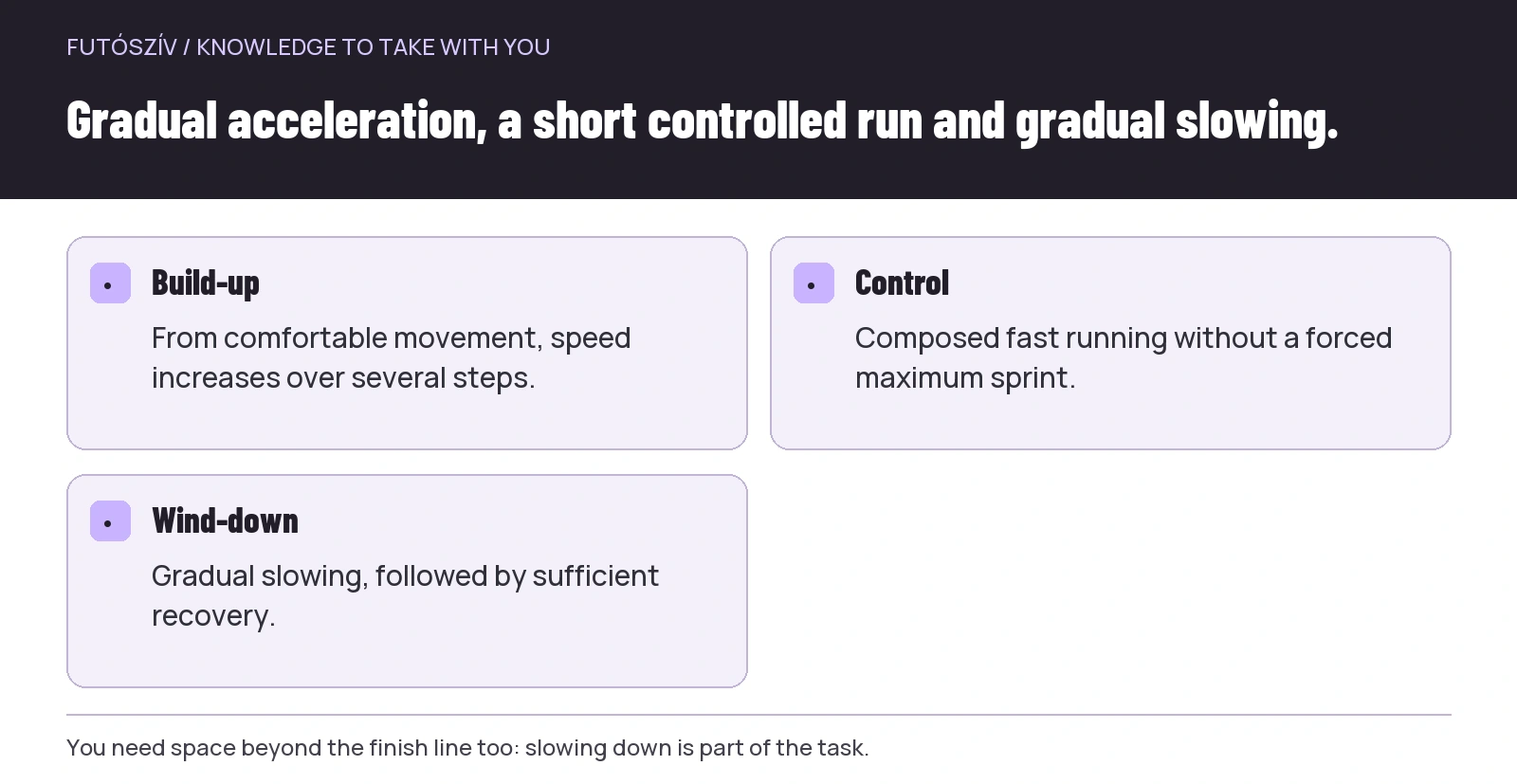
Start from comfortable movement, then build speed over several steps. Keep the middle controlled: you still have a choice over speed, without straining with raised shoulders and a tense face. Finally, slow gradually. A marked finish line should not mean slamming on the brakes.
These three parts distinguish the task from starting flat out from standing. A standing start is a separate skill and load. If halfway through the acceleration you are already waiting to stop, the speed may have been too high, the section too long or the task unsuitable for that day.
Good execution is not necessarily spectacular. Rhythm changes noticeably, but you do not need to direct every step individually. One simple focus, such as calm shoulders or gradual acceleration, may help more than five technical instructions at once. Movement should not become a continuous self-monitoring exam.
Treat duration as an example, not an exam requirement
Training descriptions often include brisk sections of around ten to twenty seconds. This is an example for orientation, not a proven optimal dose for every runner. Leave room for acceleration, a short composed section and slowing down; do not let breathlessness determine when you stop at the end.
Treat repetition counts with similar care. After a few good-quality attempts, finishing may be sensible even if an online plan specifies more. Section length, speed, the preceding run, recovery and terrain together make up the load. Four very hard accelerations differ from four restrained increases in speed.
Percentage-based speed instructions are not always usable either. Without knowing maximum speed, ninety per cent is more an impression than a precise measurement. For a recreational runner, controlled, repeatable movement is often a clearer boundary than a percentage with no reliable reference.
 Enlarge diagram
Text version of the diagram
- Build-up
- From comfortable movement, speed increases over several steps.
- Control
- Composed fast running without a forced maximum sprint.
- Wind-down
- Gradual slowing, followed by sufficient recovery.
Recovery is not wasted time
Before the next attempt, restore comfortable breathing and allow yourself to run attentively again. Depending on the situation, this may involve walking or easy movement. You do not need to jog in recovery simply to avoid a slow section on the workout graph.
Deliberately shortening recovery changes the task. Fatigue can accumulate between fast sections, bringing the exercise closer to intense intervals. That may be a deliberate coaching decision for another aim, but should not happen accidentally in something originally intended as a light technical addition.
Notice the next start. If the same speed requires more strain each time, you are not proving a lack of perseverance. The information may suggest longer recovery, lower speed or ending the session. The value of strides is not measured by the suffering accumulated at the end.
What do we know about fast sections in a warm-up?
Research protocols are much more precise than general advice: they examine a set number, duration and intensity of sections in specified participants. A crossover study involving eleven trained runners compared different intense warm-ups. This does not prove that every recreational runner should choose the same acceleration sequence.
Race type matters too. In research examining 800-metre performance , investigators looked at adding a hard section alongside usual strides. A result for middle-distance runners’ short, intense race cannot simply be transferred to preparation for a first half marathon or an easy evening run.
The evidence is therefore primarily useful for asking questions: in whom, before which task and against which comparison did a routine work? Strides can be a practical training tool, but there is no reason to promise a general performance guarantee or standalone injury-prevention protection.
Why not copy weighted-vest experiments?
An interesting study can sometimes immediately become equipment advice. A small study tested a weighted-vest warm-up , while later, in a 5,000-metre trial with collegiate cross-country runners , strides with added weight did not improve performance compared with the unweighted version.
This is not a simple yes-or-no answer about weighted vests. Protocols, loading and performance tests differed. The practical conclusion is that one striking headline is not enough to introduce new equipment, particularly when you are only learning ordinary accelerations.
You do not need extra weight, a steep descent or resistance equipment to practise controlled speed changes in your own running. Understand the task in a simple setting first. Progression is justified only with a clear purpose and appropriate background.
Choose somewhere with room to slow down too
A suitable route is not merely long enough for the fast part. Leave space beforehand to prepare and afterwards to slow safely. Avoid blind bends, driveways, crowded pedestrian areas and unexpected obstacles. A watch alert does not give priority over others.
The surface should be predictable. Wet grass, loose gravel, icy pavement or a root barely visible after dark create different requirements from a straight track with good visibility. Uneven ground is not automatically better technical training: when learning a new acceleration, reducing uncertainty may be useful.
If no suitable section is available that day, omit the exercise. You do not need to fit it between parked cars or before a pedestrian crossing. Following the programme matters less than genuinely having a safe place for the task.
 Enlarge diagram
Text version of the diagram
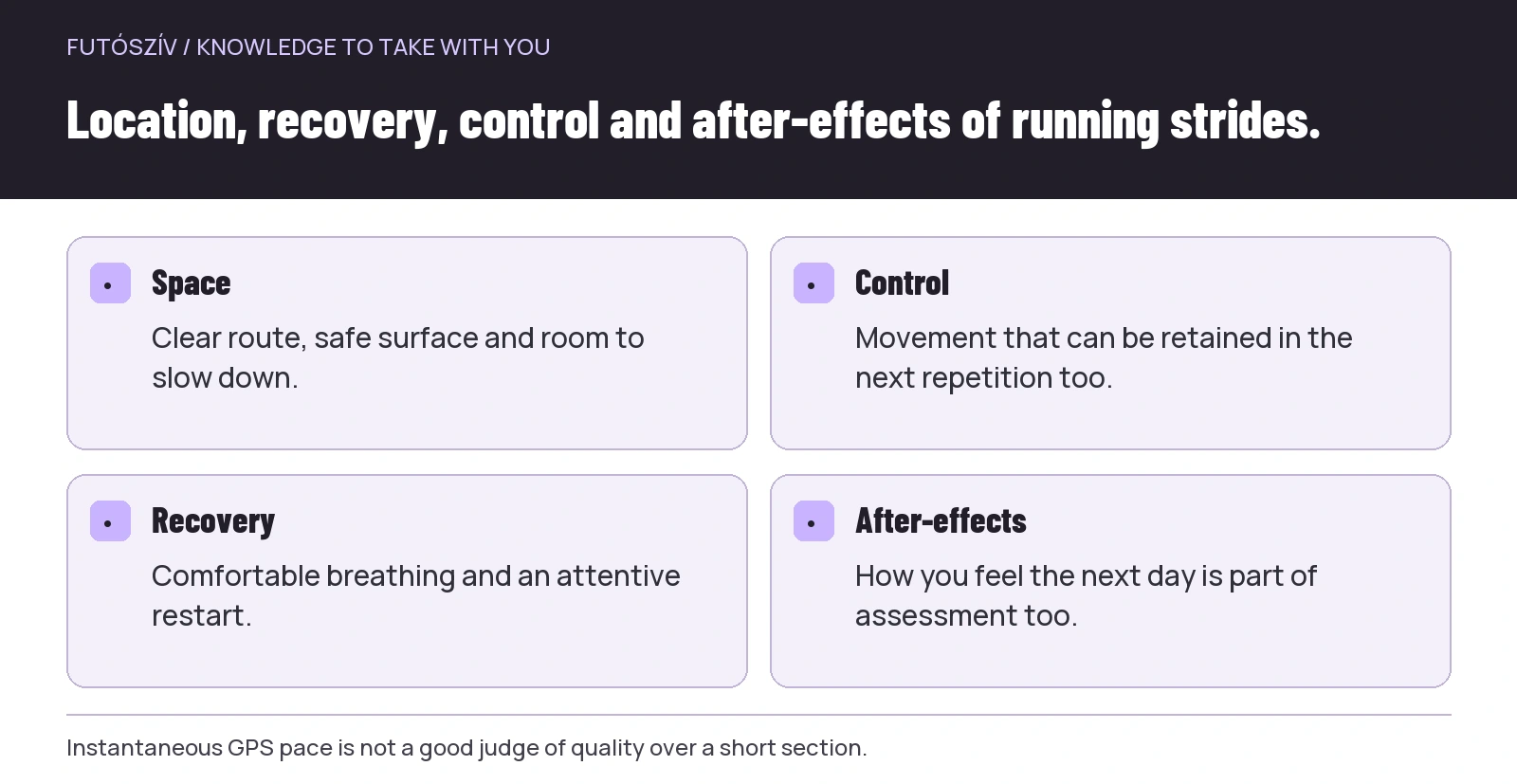
- Space
- Clear route, safe surface and room to slow down.
- Control
- Movement that can be retained in the next repetition too.
- Recovery
- Comfortable breathing and an attentive restart.
- After-effects
- How you feel the next day is part of assessment too.
A watch can easily distract over a short section
Instantaneous GPS pace may lag or fluctuate during a short acceleration. By the time the target appears, you may already be slowing down. Accelerating again in response means device delay starts directing the session. Strides are not a suitable place to chase precise kilometre pace every second.
An approximate time cue or two well-chosen points may be enough. The same route and similar conditions can help compare sections, but this does not require a record table. Movement control and the quality of the next repetition should provide the first feedback.
Heart rate can also follow rapid changes with a delay. A seemingly low value at the end of a short stride does not prove your legs received no substantial load. Do not reduce differences between breathing, muscular work and speed to a single display number.
Where do they fit in the week?
After an easy run, the overall day remains easy only if the addition is short, controlled and well tolerated. A new fast task at the end of a long, tiring run may have a different cost. When considering weekly loading, include hills, strength work and other intense movement too.
Before a faster session, strides can provide a transition. Consider the whole warm-up then: initial easy movement, any drills, accelerations and waiting before the main part. An established routine may be worth more than a special element added at the last moment.
The day before a race should not aim to test a new habit. If you have no experience with accelerations, you do not need to adopt them on the evening before the start because others do. Race week aims to preserve usable preparedness, rather than seek a new training stimulus.
When should you change or stop?
Stop the task for sharp or increasing pain, or pain altering movement. Do not test a pulling sensation with an even faster repetition. Recurring symptoms may require individual assessment of loading and health; a general article does not clear you to return after injury.
Unusual illness, chest symptoms, feeling faint or disproportionate breathlessness are not technical challenges either. Do not continue accelerating; severe or persistent symptoms may require urgent help. With health-related restrictions, discuss the possibility of more intense running with your treating professional.
With little sleep, a difficult workday or unusual muscle fatigue, easing back can itself be a sound training decision. Not all fatigue signals danger, but neither must every circumstance become an obstacle to overcome. Omitting a few accelerations does not make the running week worthless.
How to evaluate afterwards
Three brief notes may be enough in your log: the aim, how controlled acceleration remained and how you felt later and the next day. Do not record only the fastest moment. If the following run feels unusually hard, reconsider total loading too.
Progress does not necessarily mean increasing speed. It can mean smoother transitions, calmer execution, choosing a better location or recognising earlier when to finish. These experiences help you use the task in the right place.
Strides are a useful addition when they have a clear, small purpose. Leave enough space for acceleration and slowing, enough recovery to repeat, and enough freedom to omit them. A short burst of speed need not leave a long debt for the following days.
Sources and limits of interpretation
The cited primary studies examined different warm-ups and performance tasks in small samples. They do not establish a universal stride prescription. The location, observation and logging suggestions in this article are practical editorial examples, not a personalised training plan or a medical fitness assessment.
How Futószív articles are prepared: our editorial guidelines.