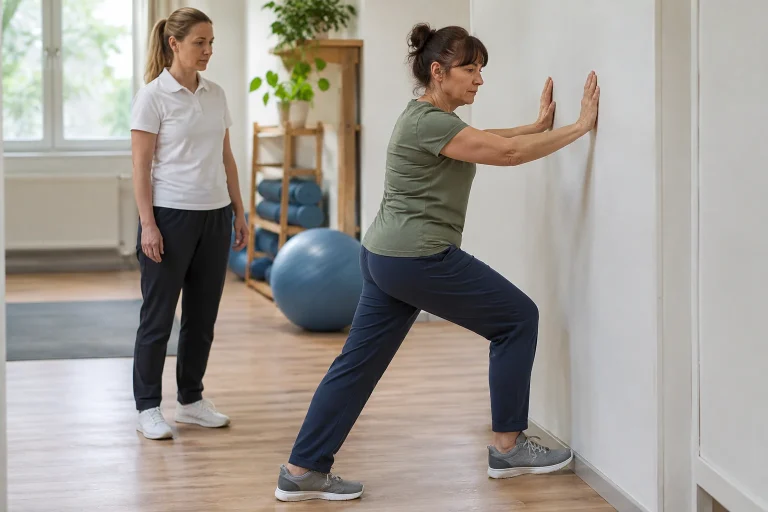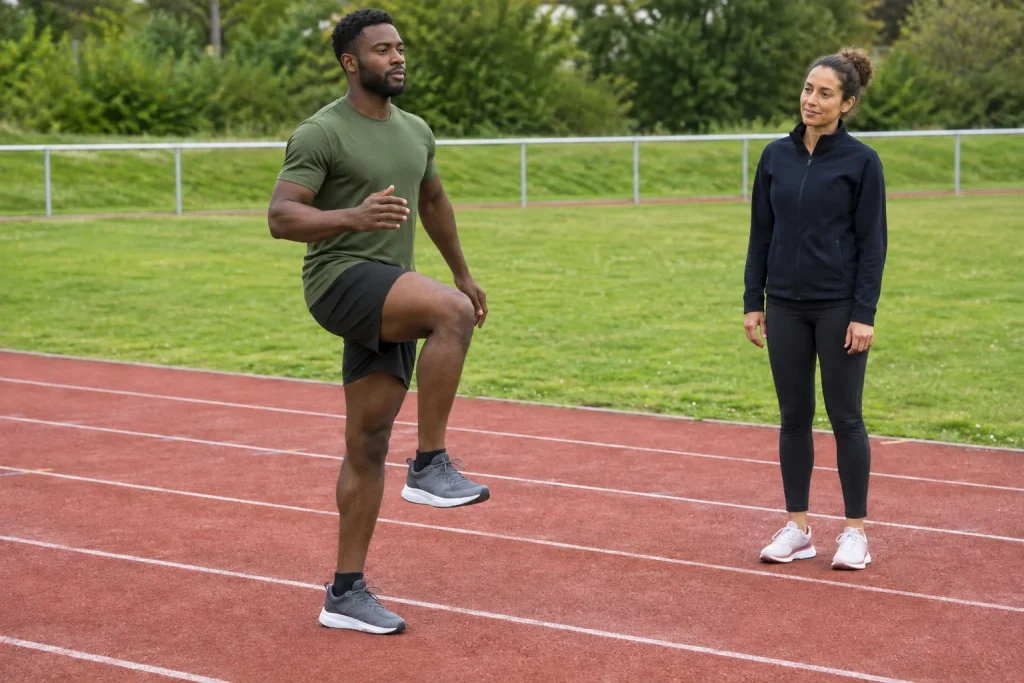
At the edge of the park, one person moves with high knees, another takes tiny steps and a third bounds. From outside, running drills may look like a compulsory sequence of complicated movements. In reality, they are useful when you understand each task’s purpose and its difficulty suits your background. You do not become a runner by completing every known exercise, but by giving your chosen movement a meaningful place in preparation.
Technique practice can mean learning coordination, preparing as part of a warm-up or a separate loading task. Do not blur these together. A demanding bounding block, for example, is not the same as a few calm walking drills before an easy run.
State the aim first
“Better running technique” is too broad an aim to follow from a single exercise. More precise aims might be feeling a rhythm, coordinating arms and legs or learning a new task. The aim determines what you attend to and when you stop.
An exercise can be useful because it simplifies one movement detail. It does not need to look exactly like continuous running. Equally, an exaggerated practice movement does not need to be transferred unchanged into every running step.
The World Athletics guide for beginners prioritises learning simpler tasks well over setting difficulty too high. This is a useful organising principle for technique practice too: first make it understandable and controlled, then add complexity.
What does research on technique training demonstrate?
A pilot study with beginners analysed a programme combining education, practice and video feedback. This was a complex intervention, so the separate effect of a single exercise cannot automatically be isolated from its outcome.
Another experiment examining technique instruction found changes in some movement characteristics, but no improvement in running economy. Movement that looks prettier or different therefore does not necessarily mean lower energy cost.
The research calls for modest wording. Technique learning may have purpose and value, but a drill list should not be sold as a package guaranteeing greater speed or freedom from injury. Individual response and the particular task remain important.
Good drill practice does not exhaust you unnecessarily
If practice is part of a warm-up, remember that a running task may follow. Becoming completely fatigued by the end of the sequence does not necessarily serve that purpose. Match quantity and difficulty to the whole session.
If you are learning coordination separately, leave time for questions and another attempt. A rushed sequence without recovery can easily become an endurance task. Performing the movement faster does not mean you necessarily learn it better.
Observe fatigue and movement control separately. If the task falls apart, simplify, shorten or finish. You do not have to complete the original repetition count in every circumstance.
Location: leave room to move and stop
Choose an even surface with clear visibility where you will not unexpectedly cross other people’s paths. Give the exercise a clear beginning and end. It should not lead straight into a road, steps or crowded cycle lane.
Grass is not automatically a better surface. It may be uneven, slippery or full of hidden holes. Tarmac, synthetic track and other surfaces can feel different; choose the location for the task and your own background.
In a group, leave enough distance. Keep the walking return route clear too. Demonstrate a new exercise while stationary so that people do not have to guess direction and rhythm while moving.
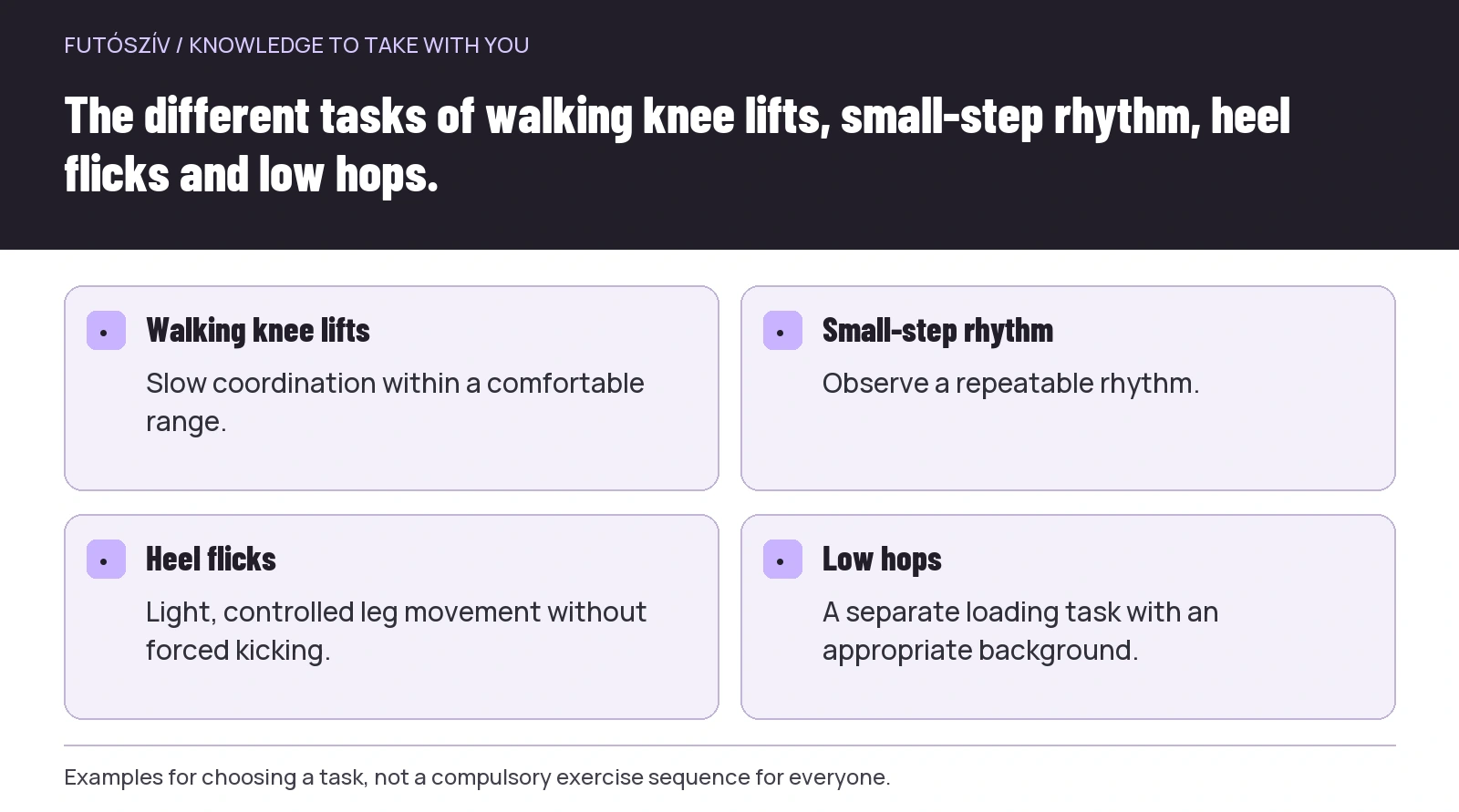 Enlarge diagram
Text version of the diagram
- Walking knee lifts
- Slow coordination within a comfortable range.
- Small-step rhythm
- Observe a repeatable rhythm.
- Heel flicks
- Light, controlled leg movement without forced kicking.
- Low hops
- A separate loading task with an appropriate background.
Walking knee lifts: slow coordination
The walking version gives more time to observe coordination between arms and legs. Lift the knee only within a comfortable range and keep support controlled. Getting it higher at all costs or compensating by leaning backwards is not the aim.
Start from simple walking and change only as much as you understand. If balance is difficult, support or another easier version may be appropriate. Individual possibilities matter more than a uniform group appearance.
The task does not imply lifting the knee high in every step of an easy run. A drill can exaggerate a detail for learning. Continuous running involves different speed and timing.
Small-step rhythm: do not aim for frantic movement
Short, light steps can make rhythm observable. Keep body position and effort manageable. There is no need to produce the greatest possible number of contacts or chase a universal beat.
If the task makes your shoulders, jaw or hands tense too, simplify. Technique attention is not necessarily better when you monitor many body parts together. One clear cue is often enough.
After the rhythm exercise, observe your natural running without forcibly maintaining exaggerated tiny steps. The aim is experience, not a new movement imposed on an entire session.
Heel flicks: controlled movement without forced kicking
Heel flicks can emphasise light backward bending of the leg. Do not regard kicking your buttocks hard as success. Keep the movement comfortable, without hurried changes in body position.
Versions of the exercise may differ, so ask precisely which task is intended in a group. A stationary and a travelling version do not necessarily require the same attention. The name alone is not enough instruction.
If it provokes symptoms around the knee or thigh, do not force it. The movement is not suitable for everyone in every condition. Individual modification or professional assessment may be needed.
Hopping and bounding: a separate loading category
Hopping and jumping tasks can create different loads from walking coordination. Background, surface and dose matter. Large jumps do not need to appear in every beginner drill session merely because they look impressive.
If such an exercise is in the programme, learn an easier version and how to stop. Increasing height or distance should not come before control. It also needs to fit the total weekly running and strength load.
Pain and the following day’s response are separate information. Substantial muscle soreness does not prove technique learning went well. The purpose of an appropriate task is not the strongest possible after-effect.
After demonstration, retain a single clear cue
Many piled-up instructions can make execution harder. Choose one easily understood aim and attend to it first. Once the movement is familiar, another detail can follow later.
A running experiment examining attentional focus showed that the wording of an instruction can also influence energy cost. The finding does not mean you must never focus on a body part, but avoiding constant, excessively detailed self-monitoring is worthwhile.
As a coach, ask what the athlete understood from the cue. The same sentence may elicit entirely different movements in two people. Feedback is part of learning, not an inconvenient interruption.
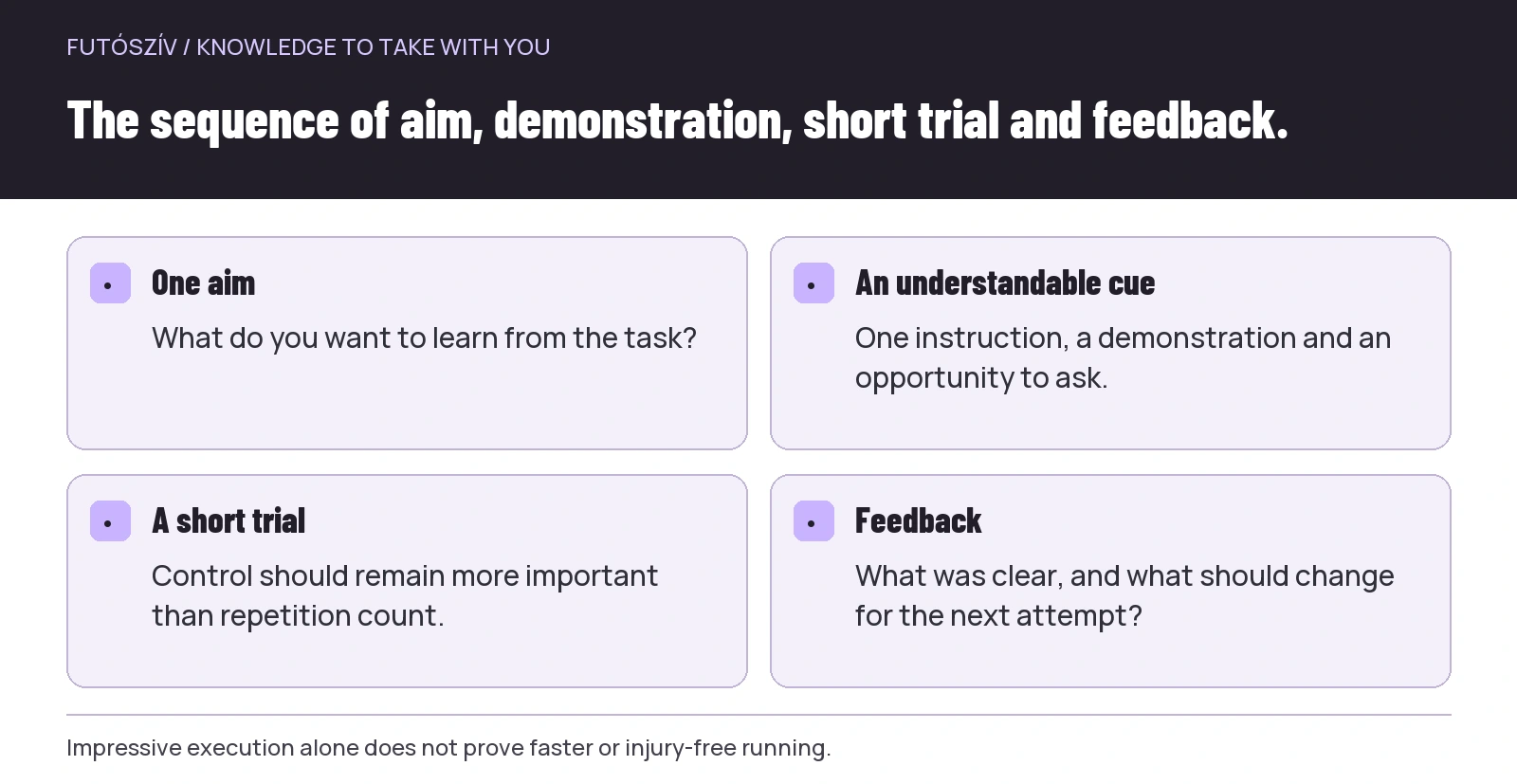 Enlarge diagram
Text version of the diagram
- One aim
- What do you want to learn from the task?
- An understandable cue
- One instruction, a demonstration and an opportunity to ask.
- A short trial
- Control should remain more important than repetition count.
- Feedback
- What was clear, and what should change for the next attempt?
Transfer to running is a separate question
Becoming more skilful at a drill does not necessarily change your movement in the same way at every running speed. Continuous running requires different timing and loading. The relationship between the learned detail and the whole task needs observation.
Research examining a running-drill test battery analysed associations between exercise performance and short sprint outcomes. An association is not the same as proving that training the particular exercise alone makes everyone faster at sprinting or distance running.
Choose feedback for the real aim. When learning coordination, clearer and more controlled execution can be an outcome. If you have a performance question, evaluating it takes more than a prettier practice video.
Do not seek a new drill every time
Variety may be pleasant, but learning also requires repetition and comparable situations. A few familiar tasks can reveal change more clearly than a completely new sequence every week.
Briefly note what each exercise serves. If you can no longer state its purpose, simplification may be needed. A long list is not a mark of professional quality in itself.
Progression can mean greater coordination complexity, another rhythm or more independence, rather than only more repetitions and bigger jumps. The chosen step should fit the learning aim.
Make room for different versions in a group
Training history, range of movement and support needs can differ within the same group. The same task may be achievable in an easier or different form. Looking exactly like everyone else should not be a condition of participation.
Show the sequence, direction of travel and stop signal beforehand. Alongside spoken instruction, a visual demonstration or written prompt may help. Ask what communication works for participants.
Give help and physical contact only by agreement. The athlete’s own comfort and consent are fundamental in technique learning too. The aim is movement understood independently and manageable for them.
What should you note after the session?
You do not need to score every movement. The exercise name, aim and a brief note may be enough: was it understandable, which version worked, and did symptoms occur? The next session can build from that.
If filming, agree on sharing beforehand. Footage made for personal learning is not automatically public content. Tracking technical development does not require featuring other people.
At the end of good drill practice, you do not necessarily have more exercise names to list. Instead, it becomes clearer what each task is for, how to modify it and when to ask for help. This is more usable knowledge than a perfectly copied movement sequence.
An easier version is not a lower rank of participation. It is good when it makes the task understandable and provides an appropriate starting point for the next attempt.
Sources and verification
This article cites World Athletics guidance, experiments examining technique instruction, attentional-focus research and a running-drill test study. Exercise examples are not universal training sequences, and research associations are not performance guarantees. Pain and individual limitations require appropriate professional help. Sources checked: 18 November 2026.
How Futószív articles are prepared: our editorial guidelines.