
In many runners’ plans, a rest day is an empty square. In reality, it too involves decisions: what you leave out, how you use the time, how well you can sleep and what you expect from the next session. If heavy strength work, a long hike and late work sit behind the empty running log, the day became easier in name only.
The aim is not a perfect recovery ritual. A rest day primarily offers an opportunity not to add planned sporting load to a week already containing enough tasks. It can be useful without special equipment, subscriptions or a watch measuring “recharge”.
Workload and rest form a programme together
A training plan concerns more than completing as much work as possible. The joint position statement of European and American sports-science organisations highlights excessive load combined with inadequate recovery as a problem. This does not mean a tired morning is already overtraining syndrome; identifying that is a complex clinical question.
A rest day built in beforehand can organise weekly structure. It shows where there is no further sporting task and leaves space between important sessions. How many such days somebody needs depends on history, total workload and life circumstances. One universal weekly number is less useful than a clear adjustable plan.
Do not therefore enter rest as a reward earned only through flawless training. It can belong in the plan from the outset. Illness, symptoms or exceptional circumstances can also override a sporting task already scheduled.
What does a rest day mean to you?
Clarify the word with your coach and yourself. Does it mean no running, no targeted exercise or a day allowing very easy movement? If one person understands complete rest and another a long ride, misunderstanding is already present.
Everyday movement need not disappear, naturally. You commute, shop, accompany children and use stairs. These cannot be stopped for everyone, nor is that the aim. The question is whether you add another deliberate demanding task and how unusual the whole day’s demands are.
A short planning sentence may be more precise than a blank: “No targeted training today; I will finish the day earlier.” Or: “A comfortable walk I can shorten if it feels good.” This provides direction without making rest another performance requirement.
Replacement sport is not automatically rest
A day without running can still be demanding. An intense cycling class, heavy leg-strength session or long mountain hike is a separate task. If reducing total load was the original aim, evaluate these accordingly rather than by sport name.
The term active recovery can particularly easily conceal the purpose. Some movement may fit if genuinely comfortable, enjoyable and easy to shorten. If there is distance to complete, a record to chase or exhaustion at the end, simply calling it training is more accurate.
The decision is not moral. You may enjoy choosing a shared hike one week and modify another run accordingly. The problem is logging a large workload as rest, then expecting the next hard run unchanged.
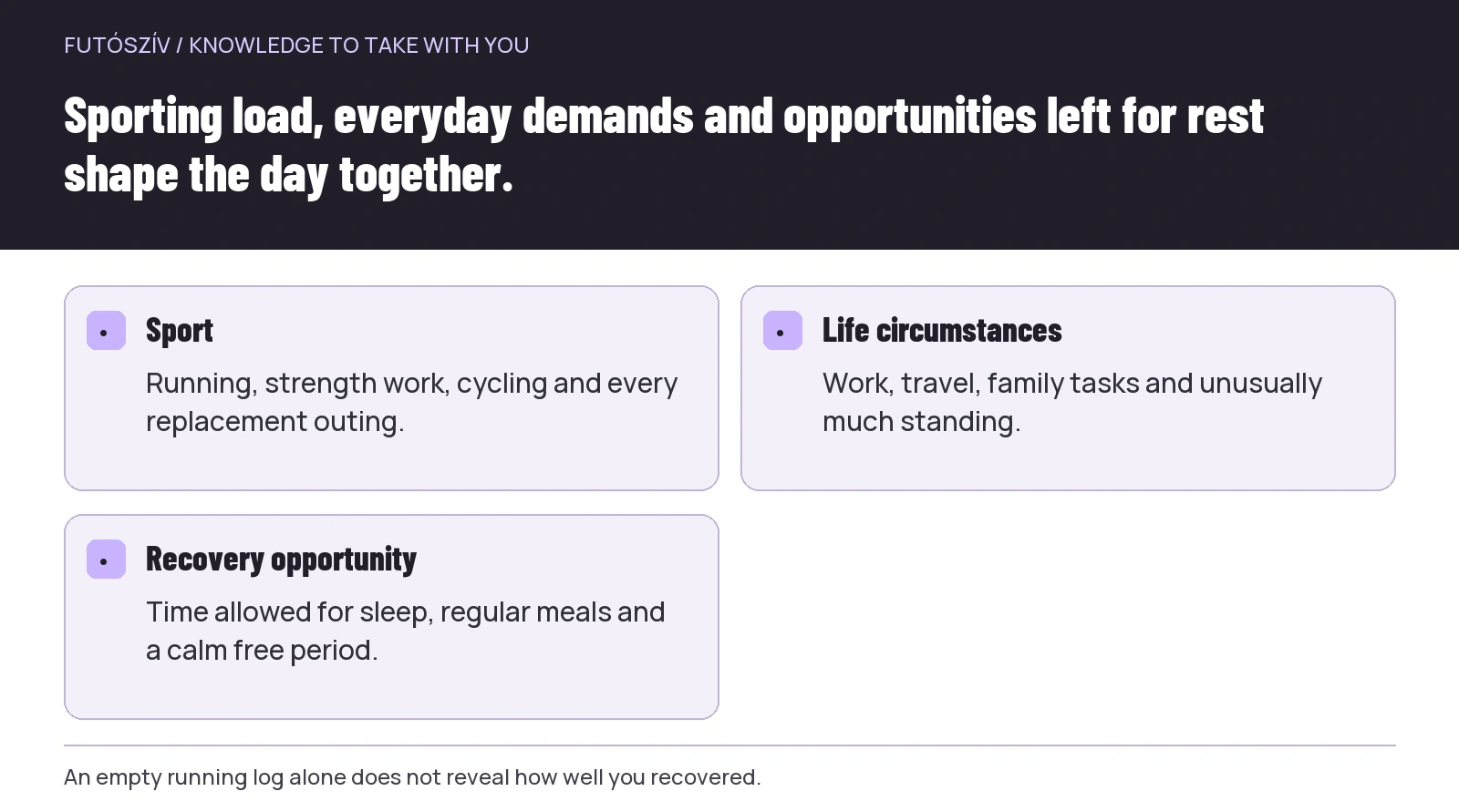 Enlarge diagram
Text version of the illustration
- Sport
- Running, strength work, cycling and every replacement outing.
- Life circumstances
- Work, travel, family tasks and unusually much standing.
- Recovery opportunity
- Time allowed for sleep, regular meals and a calm free period.
Where should it fit in the week?
Start with genuinely demanding days: a long run, intense workout, new strength task or race. Add difficult periods at work and home. This makes it clearer where sporting load may need reducing and where a calmer day is actually possible.
The next calendar day after exercise is not everyone’s single best resting place. Omitting running on a busy weekday may help logistics considerably; shared weekend family time may make another person’s programme sustainable. Consistency matters, but a rigid weekday name is not more important than the actual structure.
The IOC consensus on sporting load and illness risk also recommends planning adequate recovery opportunities, especially after intense periods, competition and travel. Training minutes alone do not define the task; environment and life circumstances contribute.
Treat watch feedback as data, not clearance
You can have pain or feel unwell despite a favourable readiness score. An unusual value may reflect measurement conditions, different sleep or another factor. The display alone is neither a diagnosis nor a complete assessment of exercise tolerance.
In a study with recreational runners, individualised training used several sources: overnight heart-rate variability, perceived recovery and running measures. The programme examined adaptation based on several signals, not unquestioning obedience to one consumer-watch score.
If measuring something, collect personal history under similar conditions and assess it alongside wellbeing. Without a device, brief notes on sleep, unusual fatigue, mood and familiar movement sensations can also help. Every morning need not become a laboratory test.
Do not demand peak form the next day
A rest day offers reduced workload, but does not guarantee every measure improves within twenty-four hours. Poor sleep, extensive travel or emerging illness may mean the following day also needs adjustment. Calendar rest does not automatically erase the preceding period.
Reassess before the next session. If all is well, follow the plan. With unusual fatigue, easing off or further rest can be reasonable too. Do not run hard because you feel yesterday means good performance is now “owed”.
Less rushing through the week, time to eat or a calmer arrival at the next session are achievements in reviewing rest too. These may not immediately appear on a pace graph, but matter for sustainability.
You need not fill every minute freed up
The hour gained by omitting a run can quickly fill with new tasks. Responsibilities sometimes make that inevitable, but if every rest day means moving house, deep cleaning or working late, the label says little. Replanning the whole week may help more than more precise training arithmetic.
Choose one or two simple opportunities: preparing for an earlier bedtime, a relaxed meal, shared time or a free evening period. They need no performance result. Rest is not successful only if you can prove perfect relaxation by its end.
You can take a break from checking training data too if it creates unease. Avoiding all running content is unnecessary, but you need not compare your rest day with other people’s daily kilometres. Somebody else’s shared workout is not a missing task in your plan.
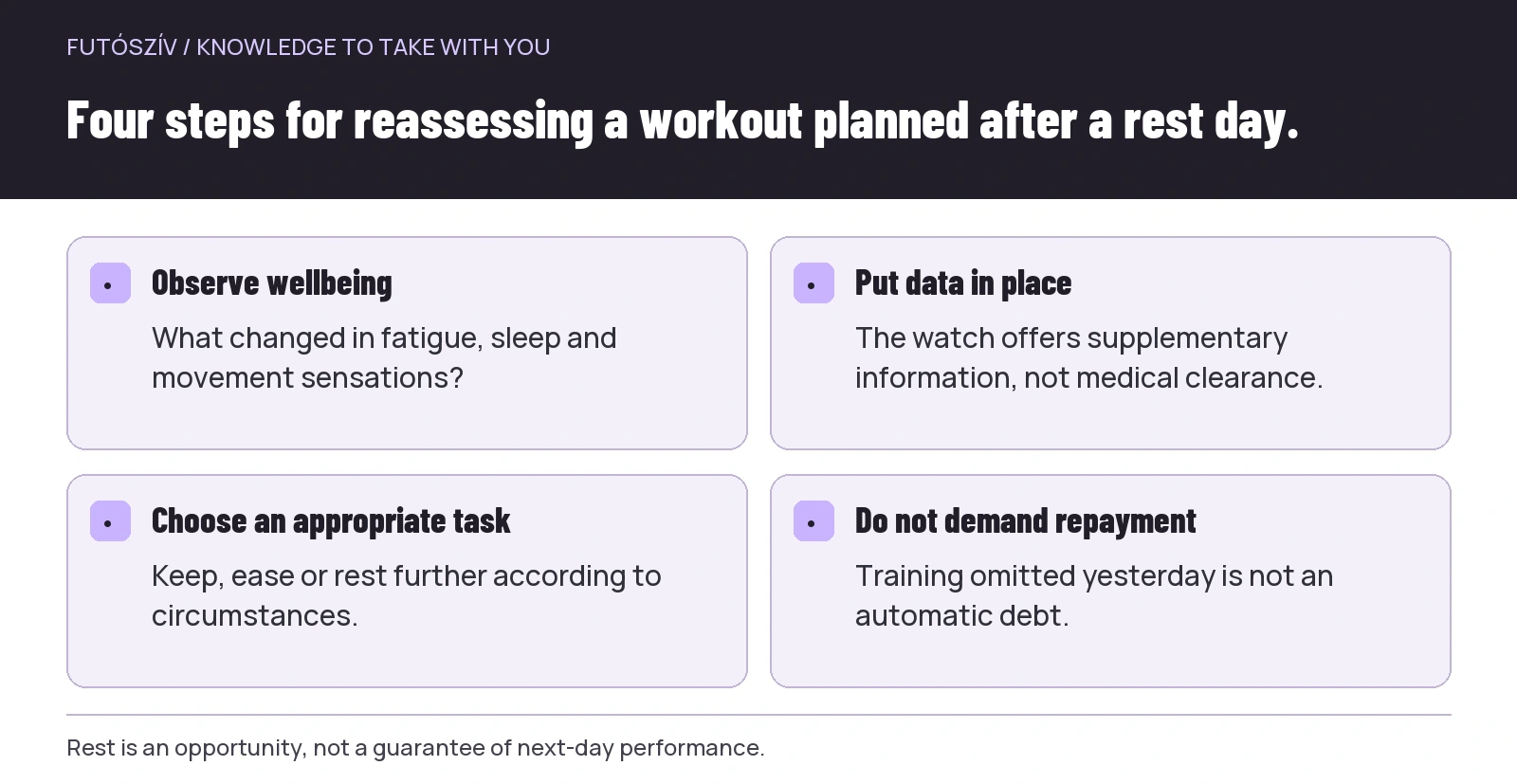 Enlarge diagram
Text version of the illustration
- Observe wellbeing
- What changed in fatigue, sleep and movement sensations?
- Put data in place
- The watch offers supplementary information, not medical clearance.
- Choose an appropriate task
- Keep, ease or rest further according to circumstances.
- Do not demand repayment
- Training omitted yesterday is not an automatic debt.
If stopping is difficult
A common thought is that one missed day loses momentum or that only fatigue proves sufficient commitment. Tell a coach or trusted running companion about these thoughts. Clarifying the plan’s purpose often helps more than another reassuring performance test.
If not exercising repeatedly causes strong anxiety, sport overrides relationships and responsibilities or rest becomes impossible, seek appropriate mental-health support. An article cannot diagnose this. The 2026 IOC consensus also emphasises environment and seeking help in supporting elite athletes’ mental health.
Do not treat food as a reward for distance run either. If persistent uncertainty or pressure to compensate develops in the relationship between exercise and eating, seek knowledgeable help. A rest day should not create another system of self-restricting rules.
Three common everyday situations
Before a busy working day: if travel and arriving home late are already foreseeable, a rest day may reduce rushing. You need not force a dawn run then treat sleep loss as an inevitable part of the day. Weekly order can fit life circumstances.
After an unusually hard session: look beyond whether an easy run was originally listed tomorrow. Assess your current state and omit the sporting task if needed. Yesterday’s completion does not oblige another completion.
When time unexpectedly opens up: good weather and an empty afternoon can tempt. If rest was the goal, first decide whether the week’s plan changes. After a spontaneous long run, do not automatically leave all subsequent loads in their original places.
What happens to the missed session?
If a rest day replaces a planned run, no automatic debt arises. Making it up by piling work onto tomorrow can remove precisely the reduction needed. First examine which task matters for the week’s aim and which can be omitted.
A short message to a coach can be factual: what was missed, why you chose that and how you feel now. This is more useful than “sorry, I ruined the week”. The revised plan can start from reality.
The same works independently: rearrange the next few days rather than one day alone. Do not put several demanding outings together solely to tick every line of the original weekly list.
When one rest day is no longer enough of an answer
Persistent performance decline, unusual fatigue, recurring illness or lasting symptoms should not be managed indefinitely through more single-day rests and guessing. Alongside reviewing workload, an appropriate medical assessment may be warranted. Several causes can produce similar symptoms.
A rest day does not replace care for concerning illness either. Seek help appropriate to the situation for sudden severe symptoms. “I am resting today anyway” is not an answer to every health question.
In a workable system, rest can be planned and extended when needed. You need not reach injury or prove sufficient exhaustion every time. Sometimes having no further training task is part of consistent preparation too.
Sources used
- ECSS–ACSM joint position statement on overtraining syndrome – a professional framework, not a home diagnostic test.
- Individualized Endurance Training Based on Recovery and Training Status in Recreational Runners – a training study using several data sources.
- IOC: sporting load and illness risk – considerations for planning recovery.
- IOC mental-health consensus, 2026 – professional recommendations for an elite-athlete setting.
How Futószív articles are prepared: our editorial guidelines.