A worse week does not yet tell you the cause
Your familiar pace suddenly feels harder, even easy running no longer refreshes you, and before every new session you hope your drive will finally return. Overtraining can seem a quick explanation. The word, however, can conceal several situations: temporary training fatigue, insufficient recovery, illness, persistent maladaptation or a complex mixture.
The joint ECSS and ACSM consensus distinguishes functional overreaching followed by performance improvement after recovery, non-functional overreaching and overtraining syndrome. The latter two are particularly difficult to separate: the course over time and exclusion of other causes matter. One heart-rate value or a few bad days cannot classify everyone.
In practice, first decide which changes and help are appropriate rather than which label goes in the training diary. Symptoms needing investigation do not become harmless because “I must just have overtrained”. Equally, one difficult preparation day should not prompt predicting a syndrome lasting months.
Imagine the same training week in three life situations
The first runner begins rested, eats regularly and has time to relax after harder days. The second receives exactly the same programme but wakes with a young child at night, faces deadlines at work and misses lunch on several days. The third returns after an infection and immediately tries to reproduce previous paces.
Mileage is identical; the situation is not. The professional consensus on recovery and performance discusses other life demands in relation to recovery alongside training and competition. This does not mean every stress acts identically, but that the programme needs fitting to the real person.
Following the plan may work for the first runner; temporary load changes and restructuring the day may matter for the second; assessment of return after illness comes first for the third. None benefits from using others’ weekly totals to prove they “should be able to cope”. Describing circumstances is information, rather than an excuse.
First separate change from interpretation
“I am completely worn out” is understandable but difficult to use for a shared decision. More precise might be: three recent easy runs were unusually demanding; post-session fatigue extends into my working day; I stopped my usual distance several times. These are observations for which explanations can then be sought.
Consider the environment when assessing performance too. Heat, strong wind, hills or another surface can make the old pace a different load. Watch GPS errors, another course or a session incomparable to earlier ones can distort comparison as well. You need not disregard numbers, but first know what you are comparing.
Choose a few signals meaningful to you: subjective difficulty of easy movement, daytime function, sleep and unusual symptoms. Do not add a new biomarker daily. The diary aims to support a shared decision, rather than become another task that reduces rest further.
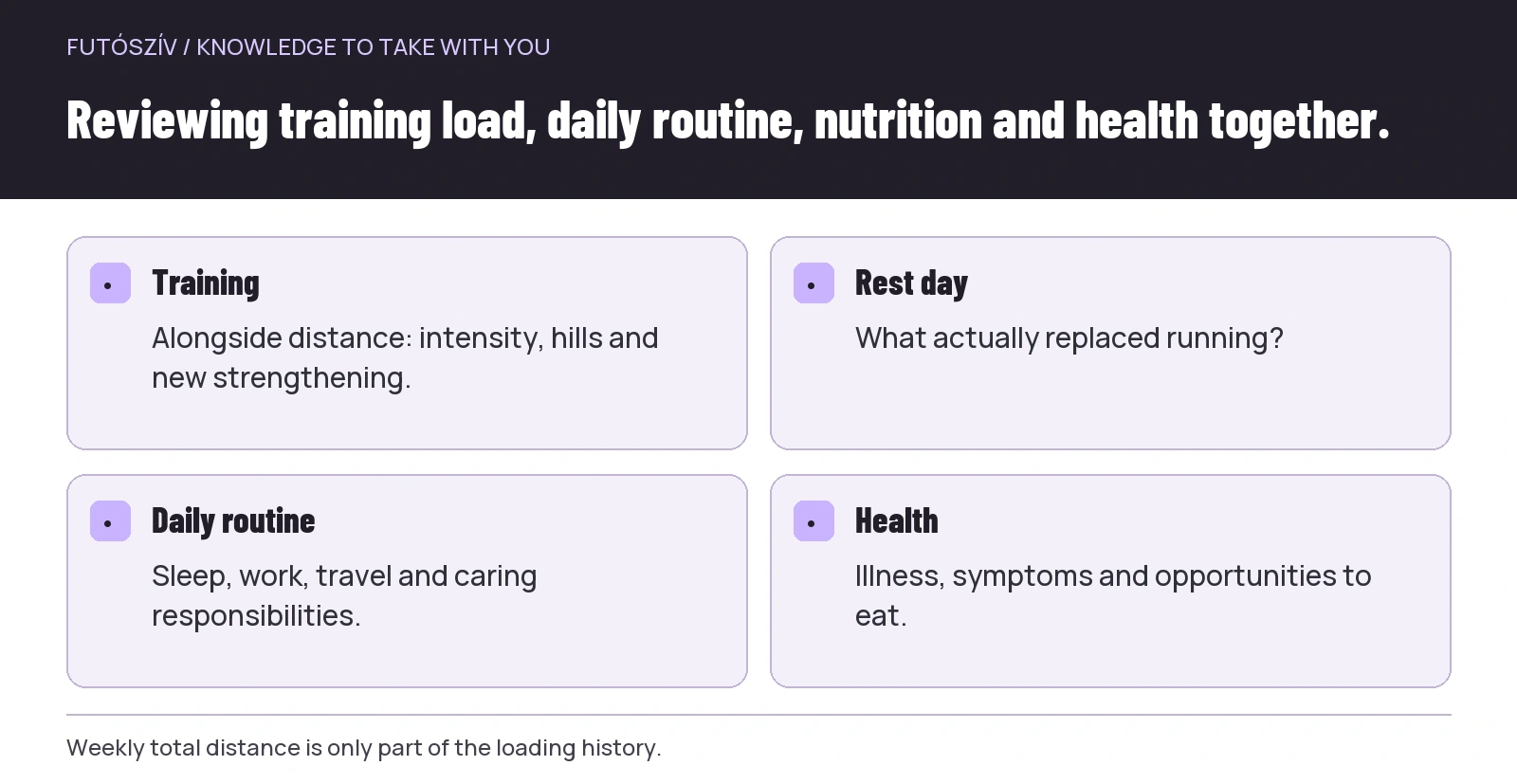 Enlarge diagram
Text version of the diagram
- Training
- Alongside distance: intensity, hills and new strengthening.
- Rest day
- What actually replaced running?
- Daily routine
- Sleep, work, travel and caring responsibilities.
- Health
- Illness, symptoms and opportunities to eat.
There is no single home test for overtraining
According to the ECSS/ACSM document, among hormonal, performance, psychological and biochemical indicators examined, there is no generally accepted marker solving diagnosis alone. Be wary of a service or online table promising definite overtraining or definite readiness from one number.
Heart-rate variability, morning pulse or a watch’s recovery estimate can be useful observations when you know your usual pattern and measurement limits. A different result does not identify whether infection, measurement error, alcohol, poor sleep or another factor is responsible. A “green” display does not override feeling unwell either.
The Australian Institute of Sport position statement on training load supports monitoring individual response and assessing different information together. A recreational runner need not copy every tool of its elite-sport framework. The more important principle is giving the runner’s experience and health weight alongside load figures.
When is medical help needed beyond a training diary?
The NHS information on tiredness recommends medical assessment if unexplained fatigue persists, affects daily life or occurs with other symptoms. Help is appropriate before you become unable to complete even one session. Symptom significance does not depend on weekly mileage.
Mention weight changes, mood changes, strong palpitations, breathlessness disproportionate to activity or suspected breathing disturbances during sleep alongside fatigue. This list is not a diagnostic test. It matters because possible causes include health conditions beyond sports load.
Chest pain, fainting, severe difficulty breathing, confusion or another sudden severe illness requires urgent help. Do not prescribe yourself a recovery day or try another run to check the situation. Appropriate care takes priority over the sporting programme.
The background map: what should you review with a coach?
First examine load changes. Not just total distance: did new intervals, more hills, harder surfaces, new strengthening or more frequent races enter the programme? A short but unusually intense week may load you differently from a longer easy period. Other sports and physical work can be part of the history too.
Second, review what actually happened on rest days. If running was replaced with heavy leg strengthening, hours of hiking and long travel, “rest” on the calendar does not describe the whole situation. You need not call every movement a dangerous load; establish clearly whether genuine recovery opportunities existed.
Third, consider routine and health. The AIS material on mental fatigue draws attention to relationships between mental activity and recovery too. Exams, caring responsibilities or a difficult work period may allow different training. The solution is not necessarily buying another recovery device; less organised sports load may simply be needed.
How can easing back become an actual decision?
“I will run more easily” is often too vague. Agree which session to skip, what to remove from the week and when to review your condition. Even without a coach, it may help to specify that you will not make up missed hard sessions now and will seek professional help according to symptoms.
Not all fatigue can be addressed with the same amount of rest. Illness, injury, persistent impairment or symptoms worsening with a delay after exertion do not suit a general “two days off, then back” recipe. The individual cause and clinical situation determine what is needed.
Arrange basic practical conditions too: when can you sleep, where will proper food be available and which optional activity can be reduced? If work or family leaves little flexibility, do not view that as a personal failure. Adapt training load to what is genuinely feasible now.
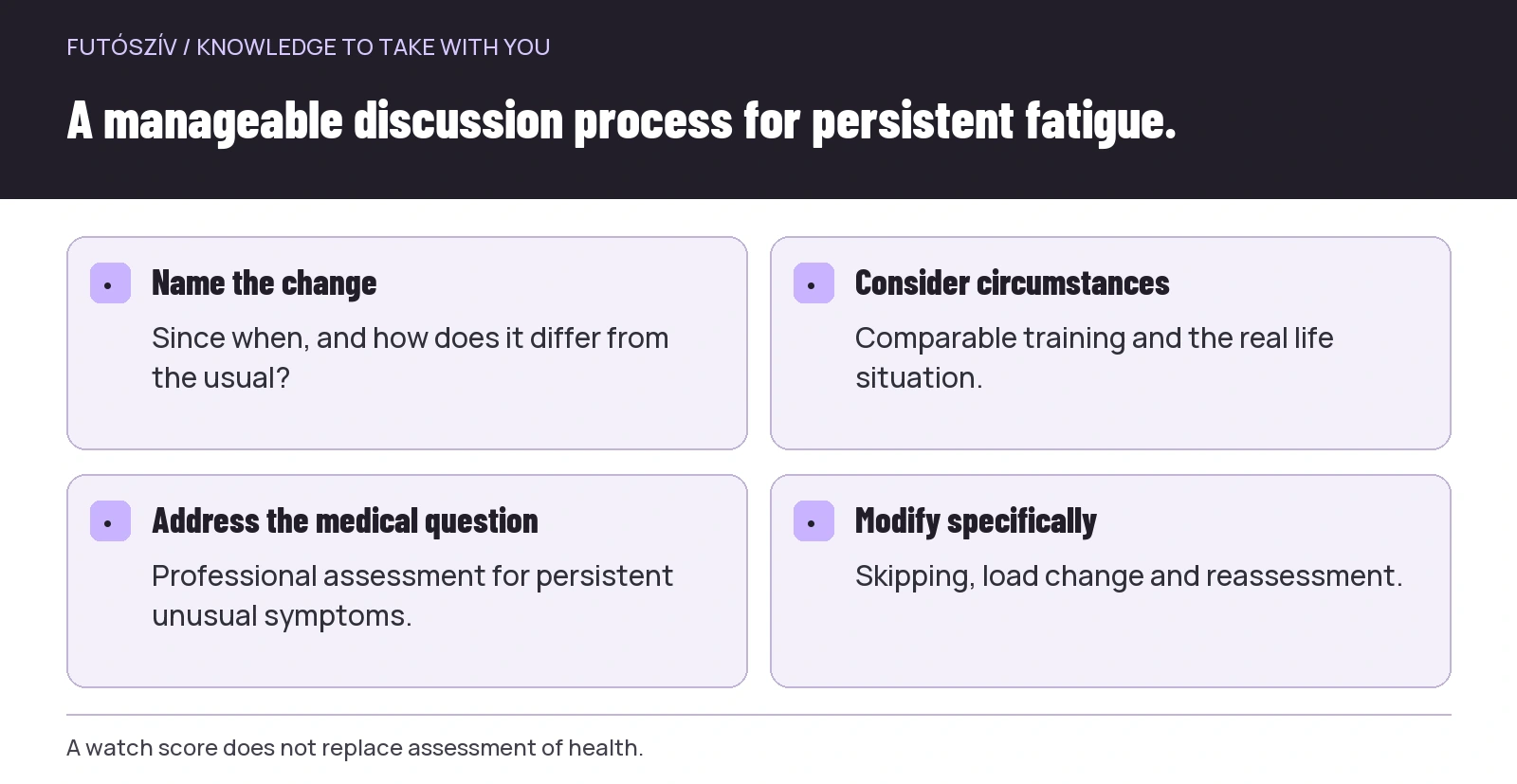 Enlarge diagram
Text version of the diagram
- Name the change
- Since when, and how does it differ from the usual?
- Consider circumstances
- Comparable training and the real life situation.
- Address the medical question
- Professional assessment for persistent unusual symptoms.
- Modify specifically
- Skipping, load change and reassessment.
Why is cramming missed sessions in later unhelpful?
A running plan is not a collection of overdue bills. A missed interval session does not become useful by squeezing it between two other hard workouts. If you eased back because you were not responding appropriately to previous load, concentrating it may recreate the very problem you wanted to leave.
The AIS reloading guide emphasises adapting return after load reduction to history and current capability. There is no formula working precisely for every situation. Other movement during time without running does not necessarily maintain the same sport-specific load capacity.
Build the next programme from the current condition instead. The race goal, distance or timing may need changing. This is a specific planning task rather than loss of commitment. Long-term consistency allows a period whose main outcome is re-establishing capacity for load.
An outline for a useful discussion
- What changed? Mention more than pace: how are everyday function, sleep and the state after training?
- How long has it lasted? Identify onset, preceding illness or a significant preparation change.
- What could explain it? Discuss load, environment, eating and life circumstances together.
- Is a doctor needed? A coach’s opinion alone should not replace assessment of persistent or unusual symptoms.
- What is the next step? Make a specific modification with reassessment clarified beforehand.
This discussion does not require months of flawless data. A few clear observations already help more than an uncertain label. If consulting several professionals, bring the same short timeline and product list so they do not work from different fragments of the story.
Recovery is not an exam to perform perfectly
It is easy to build a compulsion to recover alongside a compulsion to train: precise scores, devices, measurements and evening checklists follow one another. If they cause anxiety, simplify. Rest need not become another competitive discipline, and a bad night does not make the entire preparation worthless.
Overtraining syndrome is a serious professional question, but everyday running decisions do not always need a final label on the first day. Recognising that the previous plan is not working now, addressing necessary medical questions and planning from real load capacity can be enough. Your body’s response is not a rating of your willpower.
During reassessment, ask more than whether the old pace has returned. It also matters whether the working day is easier, eating is more manageable and unusual symptoms have resolved. If these do not improve, reconsider the original explanation and plan too.
Sources and further reading
- ECSS/ACSM: Prevention, diagnosis, and treatment of the overtraining syndrome, 2013
- Recovery and Performance in Sport: Consensus Statement, 2018
- AIS: Training load in relation to loading and unloading phases of training
- NHS: Tiredness and fatigue
- AIS: Mental Activity, Fatigue, and Recovery
How Futószív articles are prepared: our editorial guidelines.